Search
Showing 10 of 7355 results
-
Brazil and New Zealand united on sustainability – check out the Kōrerorero: Voice of the Oceans
Science, sustainability, and innovation were the focus of a special edition of Kōrerorero, which presented the Voice of the Oceans initiative. The online event, held in late August, showed the importance of education for building a more sustainable planet and highlighted the potential of cooperation between Brazil and Aotearoa New Zealand on issues related to the future of the planet.
Kōrerorero was produced by Education New Zealand Manapou ki te Ao (ENZ) in Brazil and featured an introduction by Bruna de Natale, ENZ’s market development manager in Brazil. It was the first time that the event was broadcast in Portuguese, with simultaneous translation into English.
New Zealand Ambassador to Brazil, His Excellency Mr Richard Prendergast formally welcomed attendees to the event.
“The ocean and its resources are under pressure due to human activities, such as overfishing and pollution,” said Richard. “New Zealand’s approach to promoting a healthy ocean and ensuring good management of its resources involves education, to reinforce decision-making based on traditional knowledge and support development,” he added.
The kōrerorero featured the CEO of Voice of the Oceans, David Schurmann, who is an alumni from Aotearoa New Zealand – he has a degree in Cinema from Auckland University of Technology and, in addition to his work at Voice of the Oceans, is a filmmaker. His film “Little Secret”, from 2017, was chosen as the Brazilian representative in the competition for one of the places in the best foreign film category at the Academy Awards. He is part of the Schurmann Family, which since 1984 has carried out maritime expeditions around the world to promote sustainability.
Currently, the sailboat Kat, from Voice of the Oceans, is sailing around the world to raise awareness about the importance of combating pollution caused by plastic in the oceans. In November the boat will arrive in Auckland, at the end of its journey around the globe. The boat was named Kat after Kat Schurmann, David's kiwi sister.
“Voice of the Oceans was created because we are eyewitnesses of what has been happening in the oceans, which is plastic pollution,”, warned David Schurmann during the Kōrerorero. “Over the last twenty years, as we've travelled around the world, we've noticed an increase in plastic waste in the seas,” he added.
David also explained the role Aotearoa New Zealand played in creating Voice of the Oceans: “Part of it all has a direct connection to New Zealand – I lived and studied there for six years, where I trained as a filmmaker in the 90s. It was during this period that I realised that the New Zealand population already had a very strong ecological awareness, and that was the seed that helped me create Voice of the Oceans”, said David.
In 2016, upon returning from a trip around the world, David and his family decided it was time to give the oceans a voice, to unite humanity around environmental protection. The objective of the initiative, according to him, is to unite people and countries in favor of practical solutions for the preservation of the seas.
Alexander Turra, professor at the Oceanographic Institute of the University of São Paulo, classified as the best in Latin America in the latest edition of the QS World Rankings, also participated as a panelist in Kōrerorero. “We need to put the sea in people's heads, hearts and souls, so that they realize that we are intrinsically connected to it,”, said Alexander. “The ocean is the foundation of what happens on the planet, so preserving the Earth starts there.”
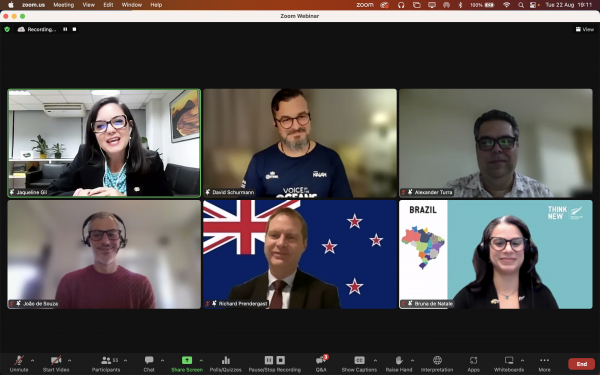
Kōrerorero also had the contribution of New Zealand based Brazilian researcher João Souza, leader of the Moana Project, which seeks to understand the impact of climate change and extreme events on the main food sources linked to the ocean, in Aotearoa New Zealand. According to João, the project works through partnerships with the fishing industry and communities living in coastal regions, making use of their traditional knowledge.
“We have sensors on fishing nets, so every time fishermen throw that net into the sea, our sensors pick up signals. Thus, we are able to generate information about the ocean, even predicting the occurrence of extreme events. The knowledge acquired is shared with everyone involved”, explained João.
The debate was mediated by Jaqueline Gil, director of international marketing and sustainability at Embratur – Brazilian Tourist Board. There were 185 registrants before the event, which was accompanied live by 69 people, who received a certificate of participation. The Kōrerorero recording is available in Portuguese and English on the ENZ online platform.
-
Water safety tips for students
Here are some tips you can share with students about water safety:
- Always check the weather forecast before you go out. Conditions can change fast.
- Never swim or surf by yourself or after drinking alcohol.
- Watch out for strong rips and currents at surf beaches – look out for gaps between the waves and discoloured water near the shore. If you are caught in a rip do not try and swim against it, raise your hand and call for help.
- If you’re swimming at a beach, look for an area with lifeguards and only swim in that area. This area is marked by yellow and red flags.
- Only swim at a depth that is safe for you. If you're just learning to swim or you're not a confident swimmer, stay where the water is shallow and your feet can touch the bottom.
- Don’t swim in your clothes or shoes as they can weigh you down and can be dangerous.
- Check very carefully before jumping or diving into a lake or river, especially if you’re not sure what’s below the surface.
- Always wear a lifejacket when boating or fishing (and make sure the people you’re with are wearing them too).
For more in-depth information, visit this link: https://www.newzealandnow.govt.nz/resources/stay-water-safe.
Resources specific to Auckland can be found here: https://www.dpanz.org.nz/.
And check out NauMai NZ for useful information and advice.
-
Europe market update for secondary schools
As the sector rebuilds capability and welcomes international students back to New Zealand, this session will provide valuable information to secondary school staff wanting to refresh their knowledge or learn more about working with education agents and recruiting school students in Europe.
We are hosting one 1.5-hour Zoom session on Thursday 16 March from 3.30-5.00pm NZT.
The session will introduce schools to ENZ’s Europe team, provide an update on the market, and have guest speakers on hand to share their experiences of working in Europe.
In previous years, many students from Germany, France and Italy have travelled to New Zealand on student exchanges, seeking new experiences at New Zealand high schools. These countries are a priority focus for ENZ staff based in Europe.
In 2019, 1855 German students, 406 Italian students, and 370 French students spent time studying in New Zealand high schools. At least 66% of German international students were enrolled in schools in 2020, making this the largest subsector for Germany students.
Register for the session here.
Visit IntelliLab here to learn more about the Europe market.
- Sharing our stories resized
- PMSLA 2016 17 Round 2
- Auckland mural 02
- NZIEC day1 657
-
Why country preference matters for international student experience
The 2025 International Student Experience Survey has recently closed. Many thanks to all providers who encouraged participation from their current or recent students.
As we grow our timeseries we aim to look below the topline findings for additional nuggets of information. For example, in our analysis of the 2024 International Student Experience Survey we looked at how a first-choice preference of study destination may impact eventual student experience.
Summary of findings
- 78% of international students currently or recently studying with a New Zealand provider reported that New Zealand was their number one choice of study destination.
- Of the 22% of respondents for whom New Zealand was not their first choice, Australia was most preferred (32%), followed by the USA (17%), Canada (15%), and the UK (14%).
- The most common reasons people gave for selecting a country other than New Zealand as their first choice of study destination was that their preferred country has ‘a good standard of living/is a developed country’ (26%), good institutions/education providers (24%), ‘a high quality of education’ (23%), and ‘good employment opportunities’ (23%).
- Country preference matters for student experience: Overall, experience scores were higher for those who reported that New Zealand was their first-choice destination for international education (median score 8 out of 10) compared to those for whom New Zealand was not their first choice (median score 7 out of 10). This effect persisted controlling for age, gender, subsector, and home country.
ENZ’s Director of Insights, Marie Clark, says that her team will be looking to focus on more of these sorts of insights for the coming year.
“With global policy changes impacting student decision making around country preference, it is important to understand how this might flow on to influence student experience and, even more importantly, actions providers can take to improve the experience of students for whom New Zealand may not have been the first choice for a study destination,” Marie says.
Recommendations for education providers to ensure a positive student experience
Irrespective of whether New Zealand is a prospective or current international student’s preferred study destination, education providers can take the following actions before and during the student application phase and after enrolment to ensure a positive overall student experience.
Prospective decision-making phase
1. Clearly articulate the benefits of studying in New Zealand, followed by benefits offered by specific locations and education providers to ensure that students have a broad idea of the New Zealand way of life.
2. Identify the key drivers of choice for your target students and if those drivers focus around country, course or provider choice.
3. Ensure that those supporting student decision-making are equipped with the same knowledge as well as how New Zealand compares to the alternative destinations that the prospective student may be considering.
Application and enrolment phase
4. Invest in pre-arrival communications, take the time to reinforce the choice of destination with both the international students and their influencers.
5. Ensure pre-arrival communications address common challenges or challenges regularly highlighted by international students of a similar demographic.
6. Consider how international students can begin to build their networks and local connections to ensure a smooth transition.
During study
7. Identify if there are a group of students at your institution, who may have been actively considering an alternative destination.
8. Look at which aspects of student experience have the most impact on overall experience and invest your resources there. For example, enhancements to living experience scores are likely to have the most impact on overall student experience.
-
Schools Sector webinar: ENZ business plan and kōrero mai
Education New Zealand Manapou ki te Ao (ENZ) is hosting a webinar on Wednesday 18 October to present and discuss our Business Plan for the 2023/2024 Financial Year, and to hear what's on your mind as we look towards 2024.
This webinar will be hosted by ENZ Schools Lead, Mary Camp, with guest Sharon-May McCrostie, ENZ’s Director, Sector Engagement.
Date: 18 October 2023
Time: 2.30pm NZT
Register in advance here: https://enz.zoom.us/webinar/register/WN_apLHhg2pSp2kJ2KRTryZGA
After registering, you will receive a confirmation email containing information about joining the webinar.
If you have any questions, please contact Mary - mary.camp@enz.govt.nz
-
Growing New Zealand’s education connections in the Middle East
ENZ participated in the re-opening ceremony and stressed the importance of education connections between New Zealand and Saudi Arabia to a 300-strong audience.
A rousing performance of ENZ’s waiata – Manapou ki te Ao – by Ngāti Koraha, a kapa haka group based in Dubai, supported the embassy’s re-opening ceremony.
The event took place in the same week that University of Otago alumna, Rayyanah Barnawi, made the news as she is set to be Saudi Arabia’s first woman astronaut in space when she travels to the International Space Station later this year.
The visit was a useful opportunity to engage on education with Saudi Arabian government officials and to discuss G2G opportunities with NZ Inc agencies in the wider Middle East region.
ENZ’s Senior Advisor for the Middle East, Bronwyn Shanks, said the visit has been valuable in the way it has helped ENZ to lay the groundwork for an education delegation to the Middle East, including Oman, the United Arab Emirates, and Saudi Arabia in May.
“We understand the significance of the Middle East region for our education sector, particularly Te Pūkenga, universities, English language schools and edtech companies.
“We’re building knowledge and connections on the ground that can help open doors for New Zealand education providers looking to grow their links in the region and look forward to supporting them with a high-level education delegation visit.”
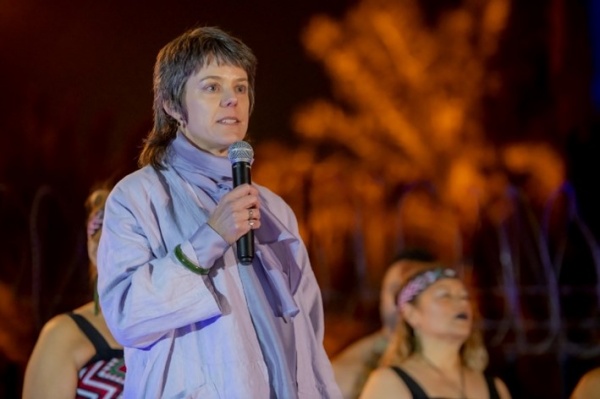
ENZ’s Bronwyn Shanks speaking at the New Zealand Embassy re-opening event, with Ngāti Koraha kapa haka group in support
Alongside the embassy’s re-opening event in Riyadh, ENZ and representatives from the University of Waikato and the University of Auckland met with Saudi government connections, including the National Institute for Educational Professional Development (NIEPD), Technical and Vocational Training Corporation (TVTC), Ministry of Culture, and Ministry of Tourism.
The discussions’ focus was on how New Zealand education providers could support Saudi Arabia’s efforts towards upskilling their young people under Vision 2030.
“It was great to meet some of those young alumni hosted by the University of Waikato and hear about the positive impact their New Zealand education experience continues to have now they are back in Saudi Arabia,” Shanks said.
ENZ and the University of Waikato also visited the University of Wollongong in Dubai, one of a network of study centres under university consortium NCUK, with which ENZ and all eight New Zealand universities have a partnership agreement to provide in-country foundation programmes.
Education providers interested in knowing more about education engagement in the region can contact ENZ’s Senior Advisor for the Middle East, Bronwyn Shanks, on bronwyn.shanks@enz.govt.nz.