Search
Showing 10 of 7337 results
-
Former international student represents Aotearoa in Ecuador
With his career as an agronomist under way, Juan Pablo came to New Zealand on an MFAT-administered scholarship in 1988, wanting to build on his agricultural qualifications. After taking English courses at Victoria University Wellington Te Herenga Waka, he completed a two-year Diploma in Rural Studies at Massey University Te Kunengaki Pūrehuroa.
His time in New Zealand had such a profound impact on his life that he returned home determined to establish lasting bonds between the two countries. And there is no doubt that his appointment reflects just how much he has achieved.
Juan Pablo says he had dreamed of coming to New Zealand long before he got here. He had read ‘Grass to Milk’, Campbell McMeekan’s 1960s account of New Zealand’s dairying management practices which was well-known among dairy farmers in Ecuador. “I read the book and decided this is the place I want to go.”
Learning from the best
Very few students travelled to New Zealand from Ecuador at that time, most went to the United States for further education, he says. “Many people asked me why I was going to New Zealand, and people still ask me about it today. I tell them I went because I wanted to learn from the best.”
Juan Pablo says he was inspired by his lecturers, especially the late Professor Colin Holmes, a respected researcher, mentor, and advocate of the dairy industry.
“I came from an education system where the teacher held all the knowledge, where it was always black or white. In New Zealand it was totally different because learning was inquiry-based. Critical thinking was the method of developing knowledge.”
He says his experience was transformative on both a personal and professional level.
“The things I saw and learned, the New Zealand way of doing things, and the care and respect people had for each other had a powerful effect on me.”
Over the decades since Juan Pablo’s education experience in Aotearoa, he has built a highly-regarded career in Ecuador, founding and leading primary industry companies, accepting numerous board appointments, representing Ecuador in international free trade agreement negotiations, and being recognised with multiple honours for his contribution to the livestock and dairy sector.
Enduring ties to New Zealand
But he never forgot his ties to New Zealand, working tirelessly to strengthen the bilateral relationship and boost both business and education opportunities. He initially established a company to import agricultural products from New Zealand. When he later secured the role of General Manager of the Cattlemen’s Association, he passed on all his business contacts, and the organisation has been importing electric fencing components and seeds from New Zealand companies ever since.
“In 1988, we brought some cattle in from New Zealand for a breeding programme. Now many farms in Ecuador, including the ones I oversee, have cattle from New Zealand stock. And in the 1990s I helped to establish an education programme with Massey, which saw lecturers come to Ecuador to take short courses in dairy management.”
“When it comes to dairy farming, almost everything I know I learned in New Zealand - pasture management, milk production systems, electric fencing, animal welfare – and farmers have applied these practices successfully in Ecuador,” Juan Pablo says.
“New Zealand is top of mind for every farmer here. When you talk about New Zealand here, everybody knows about its reputation in agriculture. Going to New Zealand is on the wishlist for many people.”
Honoured to represent Aotearoa
Juan Pablo says he was deeply honoured to be asked to be New Zealand’s Honorary Consul in Ecuador, a role which is all about connections and creating opportunities which benefit both countries.
“I am very proud, and I’m happy because I now have the chance to advocate for Aotearoa,” he says. “The better the relationship with New Zealand, the better it is for Ecuador too. We must focus on what we have in common and make the most of it.”
He firmly believes international education is at the heart of relationship-building and collaboration between countries, even more than tourism and business. “You learn the values of a nation through education. Time spent studying in New Zealand will make you a better person.”
“International students will become New Zealand’s ambassadors to the world.”
-
Around the world in five
Canada
The government of Canada has announced a CAN$1.7 billion scheme to attract international research talent, including scholarships for international doctoral students, as well as funding to recruit established and early career researchers.
The United Kingdom
Franchise providers have been told to “clean up or close down” as the UK government moves to bring the fast-growing sector under mandatory regulation and crack down on “rogue operators” exploiting students and public funds.
America
Just 4% of international students recently surveyed said they felt “very or extremely” safe in the US, as shifting visa rules and hostile immigration policies contribute to a climate of fear on American campuses.
India
The number of Indian students pursuing higher studies abroad has declined for the first time in three years, according to data from Ministry of External Affairs (MEA) released to the Indian parliament.
Global
Times Higher Education’s new report, Towards 2035: Projecting the Future of Global Higher Education, predicts that university-level enrolments will continue to grow through 2035 from their present number (264 million globally), but that those enrolments will be shaped and driven by much different forces than in the past.
-
NZ-China education relationship strengthened
Chief Executive Grant McPherson says the Joint Working Group is a valuable mechanism for maintaining the long-standing education relationship between the countries, which dates back nearly 20 years.
“Joint initiatives including the innovative Tripartite Partnership, bring together our governments, as well as our researchers, educators and students and leverages New Zealand’s research strengths.”
The Secretary for Education, Iona Holsted, co-chaired the Joint Working Group meeting and led the New Zealand Delegation, with ENZ Chief Executive Grant McPherson and NZQA Chief Executive Dr Grant Klinkum. The Chinese delegation was led by the Vice-Minister of Education, Tian Xuejun.
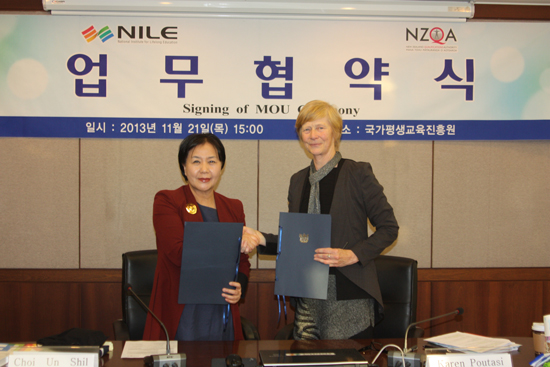
A key outcome of the meeting was the signing of a Strategic Cooperation Arrangement by the New Zealand Qualification Authority’s (NZQA) Chief Executive, Dr Grant Klinkum, and Director General of the Chinese Service Center for Scholarly Exchange (CSCSE), Mr Jiacai Cheng.
Dr Klinkum commented that: “This refreshed agreement reflects the value both organisations place on mutual cooperation regarding the exchange of information and qualification recognition arrangements.”
“As part of our future work together, the two agencies have agreed to establish a working group to better understand the opportunities and challenges related to recognising online qualifications.”Universities New Zealand representative Rebecca Needham said the Joint Working Group meeting was a timely reminder of the breadth of initiatives that continue to strengthen New Zealand's education links with China during a time of limited international mobility.
“The meeting was a valuable opportunity to undertake some deeper thinking about areas of longer-term cooperation, while continuing to celebrate the Chinese Scholarship Council students who are able to continue their study in New Zealand following the recent PhD border exceptions,” Needham said.
Chair of the International Working Group for Te Pūkenga, Tony Gray, said he was pleased to see the “genuine enthusiasm” at the Joint Working Group meeting to further develop tertiary education partnerships.
“There are many potential opportunities to collaborate with China as it implements its 2019 National Implementation Plan for Vocational Education Reform. There is real interest [from China] in understanding New Zealand's key vocational education and applied higher education practices and pedagogy,” Gray said.
“The Joint Working Group between China and New Zealand highlights the strength of our strategic education partnership and provides further impetus for key projects that are mutually beneficial,” ENZ Director – Greater China, Miranda Herbert, says. “It is pleasing to see that we’re both heading in the same direction with our internationalisation goals.”
-
University of Canterbury leads a delegation to India
Accompanying Dr Carr were his UC colleagues Dr Stuart Wise, Deputy Head of School of Education, and Dr Gail Gillon, Pro Vice Chancellor.
The delegation met with a range of Indian institutions in New Delhi and Mumbai to discuss study abroad, collaborations, research linkages and exchange opportunities. They addressed students and faculty on topics such as doing business in India, an overview on early literacy and learning, and New Zealand skill shortages for teachers in the fields of science, mathematics and ICT. The sessions helped generate awareness for specialist courses offered by University of Canterbury.

Dr Rod Carr, Vice-Chancellor of the University of Canterbury
Jugnu Roy, ENZ’s Country Manager for India, said UC’s efforts to appeal to talented Indian students is already paying off.
“UC is the first New Zealand university to have an in-market presence in India, which has contributed significantly to the growth in its student numbers.
“Building on this, the recent delegation reflects UC’s strong and continued commitment to the Indian market.”
ENZ coordinated some high-level meetings and media engagement opportunities for Dr Carr during his time in India.
The New Zealand High Commissioner to India, Designate H.E. Joanna Kempkers, an alumna of University of Canterbury, hosted a networking dinner in New Delhi, which was attended by a number of Indian education stakeholders.

Dr. Rod Carr addressing Masters of Education students at IP University in Delhi.

H.E. Joanna Kempkers (centre) and partner Dr Tim Markwell (also UC alumnus) with University of Canterbury representatives, ENZ representatives and a few guests.
-
Crowdsource your NZIEC 2017 experience
Alongside the usual presentations, workshops and panel discussions, we’re introducing crowdsource cafés.
Crowdsource cafés are designed to harness the collective intelligence of the group. Rather than listening to ‘a sage on the stage’, these interactive sessions will see you working with others to brainstorm and problem solve.
“Crowdsource cafés are a neat way to explore the breadth and depth of experience and insights from professionals across our industry,” says Sam Mackay, ENZ Strategic Projects Manager.
“You’ll connect with other delegates, share challenges, learn what others are doing, and come away with new ideas and inspiration you can implement.”
There’s a crowdsource café for school delegates to share international marketing tips, and another for all delegates to explore emerging trends and developments.
“To make the most of these sessions, come prepared to share your insights, tips and best practice with fellow participants,” says Sam.
"We’ll also be announcing three new session formats in the lead-up to August. Stay tuned!"
-
PM announces widened Game On English in Japan
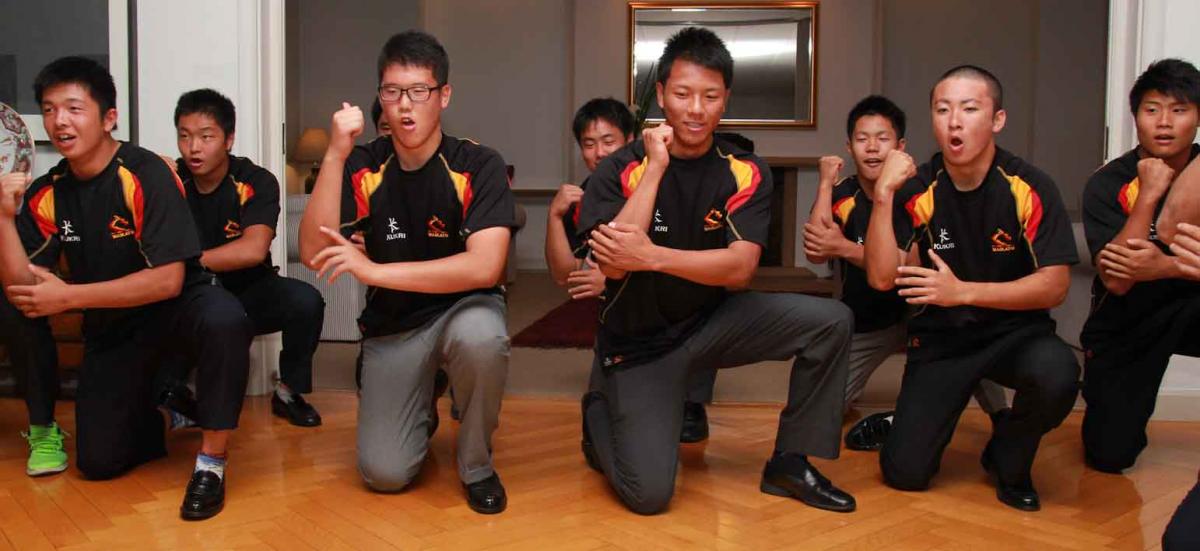
Launched by Prime Ministers Abe and Key in July 2014 and piloted with two groups from Japan last year, the programme has now expanded beyond rugby to include rowing and golf.
Surrounded by past-participants and hopeful future participants of the programme, PM Key noted the importance of building both English language and sporting skills for Japan’s youth in the lead up to the 2019 Rugby World Cup and the 2020 Olympics. Tokyo will be a host city for the RWC and will also host the Olympics and Paralympics.
Ran Aoki, who participated in last year’s pilot programme, and Shunsuke Hoshitani, a hopeful for this year’s programme, greeted Prime Minister Key in English and welcomed him to Japan. They thanked Governor Masuzoe for the opportunity and said that they both aim to represent Japan at the 2019 RWC and 2020 Olympics.
Education New Zealand’s Senior Market Development Manager, Fiona Haiko, commented “At the moment there is a real appetite in Japan for fresh ideas and programmes that not only develop English language skills, but also develop a broader skill set, whether it be in sporting or other areas. Initial feedback and interest in the programme is encouraging.”
Below: PM Key and Tokyo Governor Masuzoe with (L) Shunsuke Hoshitani and (R) Ran Aoki. Back row: Representatives of the Kanto Super League (KSL) teams who participated in the pilot last year and will participate again this year.

-
Next webinar for the schools’ sector – 20 March 2024
Join Mary Camp on Wednesday March 20th 11:00 – 12:15 for discussion on the theme:
Growing Positive Public Perceptions of International Education.
Session highlights:
-
Marie Clark, ENZ Director Insights, will present recent research on New Zealanders’ perceptions of international education
-
Sai Raje, ENZ Senior Advisor Communications, will show us a toolkit for communicating the benefits of international education in your communities
-
We’d love to hear your tips of what you’ve seen work well in harnessing community support for your international programmes.
Next webinars (topics TBC):
-
Wednesday 17 April
-
Wednesday 15 May
-
Wednesday 19 June.
Register in advance for these webinars: https://enz.zoom.us/meeting/register/tZ0od-Cprj0iHdYcue0gGAXPY04bC7cMjPps
You can register once and attend any or all sessions. After registering, you will receive a confirmation email containing information about joining the meeting.
Please note these sessions are for NZ schools only – agents should check out https://agentlab.enz.govt.nz/
-
-
Six million students look to NZ's teachers in digital campaign
On 8 October, ENZ launched Future Proof 2.0, the second iteration of its successful “Future Proof” marketing campaign from earlier this year, which raised awareness of New Zealand’s #1 ranking in the Economist Intelligence Unit’s Worldwide Educating for the Future Index.
Philippa Brown, ENZ’s International Digital Content Manager, said the new campaign aims to personalise the ranking by showcasing the teachers and academics who make New Zealand’s education system world leading.
“Brand research has shown that teacher quality is an important factor in decision making – so the campaign’s central message is: Our teachers lead the world in preparing students for the future.
“By creating campaign videos, profiles and photos of our teachers and the ways they work to encourage and challenge their students, we hope to attract more international students seeking that same learning environment.”
The campaign will run over eight weeks across 14 of ENZ’s strategic markets, and has already reached over six million students and attracted close to 4,000 to sign up to our database.
“These prospective students receive a series of emails that further tell New Zealand’s education story and encourage them to register for My StudyNZ, where they can find study programmes aligned to their interests, and connect directly with New Zealand institutions and agents.
“Future Proof 2.0 offers a fantastic opportunity for New Zealand providers to increase the impact of their own marketing by aligning their activities with the campaign. For example, they can highlight their region’s or institution’s teachers while the campaign is running.”
Providers can access free Future Proof 2.0 assets in The Brand Lab, including videos, imagery and other content.
Click here for more detailed information on the campaign approach, key messages and how you can make the most of this campaign.
-
GP practice for international students
Caring Clinic is focused on meeting the needs of international students and migrants from Asia, providing services in Cantonese and Mandarin as well as English, and offers innovative services including Skype consultations after hours and e-prescriptions.
The new clinic has been welcomed by the Auckland Agency Group (AAG), a cross-agency collaboration of central and local government agencies formed to lead communication with international student groups, ethnic communities and providers in Auckland.
Hayley Shields, ENZ’s Director of Student Experience and Chair of AAG, said the new clinic reflects the shift to make support services more attuned to students’ cultural needs.
“More than 60 per cent of international student enrolments are in Auckland, and it’s important for students to be able to access culturally appropriate healthcare services.
“This is one of the key objectives in the New Zealand International Student Wellbeing Strategy.”
Dr Jessie Liu and Dr Ruoh Sim, the two principal doctors at Caring Clinic, came to New Zealand as teenagers and both studied medicine at Otago University.
-
ENZ seeks Expressions of Interest to grow the Thai schools’ sector
In 2023, enrolments from Thailand were the fifth largest for New Zealand’s schools with most enrolments coming from students living in Bangkok. Education New Zealand Manapou ki te Ao (ENZ) is now looking to grow this market by collaborating with New Zealand schools and regional Thai education agents to build partnerships with schools in cities outside the capital city (referred to as ‘second tier’ cities).
The initiative, called the Thailand Second Tier City Promotion is planned to run in 2025-2026. ENZ is currently seeking feedback from New Zealand schools to measure interest in participating in the promotion and is running a survey until Tuesday 30 October 2024 for interested schools.
Collaborative school clusters are invited to participate in the initiative which will form sister school partnerships with regional Thai schools. Each cluster should consist of at least three schools.
Through these partnerships, a wide range of study options for Thai students and schools will be available. This may include short-term 4-week school immersion programmes, 1 to 2 terms or full year study programmes, teacher trainings, virtual interaction, online curriculum-based collaborative projects etc.
ENZ’s Acting General Manager - International, Mr Ben Burrowes, said that over the years New Zealand has built a very strong reputation as a high-quality education destination particularly amongst students from Bangkok. He says that this helped the market rebound significantly post-Covid.
“With the international education market in Bangkok now highly saturated, ENZ sees this promotion as a good opportunity to help schools reach an untapped market in regions across Thailand.
“Through working with high performing regional education agencies and in collaboration with New Zealand schools, our initiative aims to support the development of sister school partnerships in each province,” said Ben.
“This is a strategic move to raise the profile of New Zealand’s school sector and grow interests from a new pool of prospective students and their parents,” added Ben.
If your school is interested in exploring this opportunity, please fill out this survey by Tuesday 30 October to help us match your interest with our upcoming initiative. Additional information can be found in this document. If you have any questions, you can email these through to NZ’s Market Manager – Philippines & Thailand, Chortip Pramoolpol Chortip.Pramoolpol@enz.govt.nz.