Search
Showing 10 of 7355 results
- Senior Market Development Manager Korea Dec 2016
-
Changes to visa services get underway
“Online processing is a feature of the recently announced new Immigration New Zealand operating model,” said Celia.
In early 2018, the change programme will move into full gear. First will be the closure of Hong Kong and the removal of visa processing functions in Dubai. Comprehensive transition plans are being prepared for each of the offices that are closing and for the transfer of work to receiving offices.
Under the new model, visa processing offices will specialise in particular visa types, thereby increasing the depth of knowledge Immigration Officers will have on the visa type being processed in their office. For the education sector, work in future will be shared between three offices: Mumbai, Palmerston North and Beijing (for Chinese students).
In the event that a student needs to be interviewed as part of the application process, this will usually be carried out by the relevant processing office. This process may also utilise the new risk and verification network.
INZ is confident that the new model will not lead to a drop in customer service standards. The new model recognises the importance of maintaining market knowledge and will see the implementation of a risk and verification network with a physical presence in Manila, Bangkok, Dubai, Pretoria, Washington DC and London.
There are many countries in the world where INZ has never had an office yet visa applications, including online visa applications, have been successfully dealt with.
As the new model is introduced over the next two years, INZ will be keen to receive feedback on how the implementation is going from the providers’ perspective. Formal checks on the progress of implementation will take place every six months and if further changes are required these will be explored.
- Study with NZ 2 Landscape v2
- paul Irwin 3
-
Hundreds of Brazilian high school students arrive at New Zealand schools
Over January and February, 200 students from Paraná and 100 from São Paulo arrived in New Zealand on a Brazilian state-funded scholarship that will have them spending a semester and term in New Zealand schools while staying with host families.
Chosen for their academic performance, attendance, and completion of an English course, these top students get a chance to immerse themselves in New Zealand's education system and culture.
New Zealand is considered a strategic partner by Paraná state and São Paulo. This programme highlights the success of increased educational cooperation between Brazil and New Zealand. In addition to improving English proficiency, the initiative also aims to develop intercultural skills.
Paraná's programme, launched in 2019, has sent 1,240 students to various countries, with more than 600 going to New Zealand.
Coordinator of the São Paulo programme, Simone Telles, said New Zealand was chosen for this programme due to our innovative education system, use of technology, the freedom given to students and the welcoming nature of New Zealanders.

Simone Telles and ENZ’s Market Development Manager, Bruna de Natale: Education partnership between São Paulo and New Zealand.
In São Paulo, ENZ Market Development Manager, Bruna de Natale, attended one of the departure days for the group traveling to New Zealand. Bruna spoke to Luciangela Fonseca, mother of one of the selected students, Juan Fonseca. Luciangela said she felt “pride mixed with fear and emotion” and that the family felt privileged to get this opportunity.
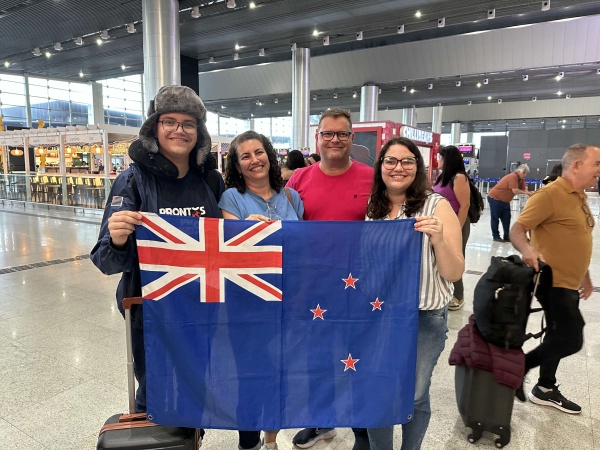
Juan Fonseca, his parents, and sister. Emotions at the departure for Auckland.
All programme costs are funded by Brazilian states, including transportation, education, food, accommodation, and leisure activities.

Paraná students departing in São Paulo.
- NZIEC day1 306
-
Insights from Europe's biggest international education conference
EAIE is the main annual international education conference in Europe, and September’s event in Helsinki was the largest to date, attracting 6,200 higher education professionals from 95 countries.
ENZ Senior Advisor – Special Projects, Bronwyn Shanks, sees unique opportunities in the Europe market. “New Zealand education offers a contrast to the traditional, theoretically-based learning we often see in European systems,’’ she says. “New Zealand’s natural environment is already a big drawcard, and our practical, hands-on approach also attracts European students to New Zealand’s ITPs and PTEs.’’
European students willing to pay for education like to see a clearly defined return on their investment, she says. This means gaining skills for the future of work, learning to think critically, collaboratively and globally.
In areas of Europe where youth employment is high — it’s over 20 percent in France and above 30 percent in Italy and Spain — the focus is also work preparedness and employability.
ENZ’s focus markets in Europe are Germany, France, the UK and Scandinavia, as well as Italy at secondary school level only. Each market has its own nuances, but all have strong bilateral ties and research links with New Zealand, so it makes sense for ENZ to work with other New Zealand government agencies and institutions to build on those relationships.
Outside the UK, European students are used to a free public university system, which makes this a price-sensitive market. On the other hand, there are policies in place to encourage international student mobility and provide funding, for example through Germany’s Academic Exchange Service (DAAD), generous government funding programmes in Scandinavia, and EU programmes such as Erasmus+.
“To realise the opportunities Europe offers – especially if we’re being realistic about the resources we have – we need to focus on enhancing international engagement. This means partnering with education agents and building both institution-to-institution links and government-to-government relationships to expand our reach.”
- Around the world in 22
- NZEducationEvent 258 v2
-
Letter from the CE: We look forward to a busy 2018
The Government is determined to take careful, well-informed steps that will underpin the long-term sustainability of the international education sector and the highly valuable contribution it makes to New Zealand.
It is important to note that existing settings apply. As in this statement on Immigration New Zealand’s website, there have been no changes to immigration rules to date, and INZ continues to process student visas and post-study work visas as usual. Under changes introduced over the last 18 months, there is already a big correction underway in international education, with a focus on quality at all levels.
Education New Zealand looks forward to another busy year in 2018, working with students, providers and fellow government agencies on a strong future for international education in New Zealand.
In the meantime, enjoy the holiday season.
Grant McPherson
Chief Executive, Education New Zealand