
Search
Showing 10 of 7355 results
-
How to register for ENZ events
1. Go to https://enz.govt.nz/events and select the event you want to attend.
2. Click on the ‘Event info’ button.

3. Log in if you already have an ENZ Events account, or request a new account by clicking on the link provided. Once you have created a new ENZ Events account, you will need to return to https://enz.govt.nz/events, select the event you want to attend and sign in.

4. When you have signed in, you will be taken to an Overview page. Please scroll down the page to the ‘Click here to register’ link which will take you to the registration page.

5. Complete the registration form, making sure you tick the events you want to attend. If you don’t tick an event, you will not be registered.

6. Once you have submitted your registration form, you will receive an acknowledgement email. Read the email and check the events you registered for are showing correctly. If they are not listed, then you have not registered correctly and need to contact the events team at events@enz.govt.nz.

-
Individual applications for PM’s Scholarships for Asia and Latin America now open
“Following on from the successful group applications, the Prime Minister’s Scholarships for Asia and Latin America are now open to individual applications, and this is the only opportunity for individuals to apply in 2022,” Grant McPherson, Chief Executive, Education New Zealand Manapou ki te Ao said.
These scholarships enable talented New Zealanders who are passionate about supporting local and global communities to add an international dimension to their learning and develop their global citizenship competencies and networks.
“We welcome diverse applicants from all stages and walks of life - you don't need to be a current student, and you don’t need top grades. We are looking for applicants who can display qualities like cultural awareness, initiative, and confidence. Previous scholarship recipients have come from a wide range of backgrounds and have studied in a range of fields, including environmental science, languages, law, the arts, and business.”
More than 2,400 Kiwis have benefited from the programme since 2013, contributing to New Zealand’s ability to engage with key partners in Asia and Latin America.
The Prime Minister's Scholarship is open to New Zealand citizens or permanent residents who are at least 18 years old at the time of application and have been a resident in New Zealand for at least 12 of the previous 24 months.
Scholarship funding can be used to cover, for example, tuition fees to undertake a course in Asia or Latin America, flights to and from Asia and Latin America, living and accommodation costs, travel and medical insurance and visa fees.
More information is available on the Education New Zealand Manapou ki te Ao scholarship website here. Applications close on 31 August 2022.
-
Creative rangatahi showcased at the New Zealand Youth Film Festival
Seventeen-year-old Jaeyun Han, an international student at Newlands College, Wellington, bagged the award for Best International Student Film. Han, from Korea, won the award for his film ‘Him’ - a dark tale of jealousy, obsession, and unrequited love.
Education New Zealand Manapou ki te Ao (ENZ) sponsored the Best International Student Film category of the awards, with ENZ General Manager Sector Services Sahinde Pala presenting the winner’s award.
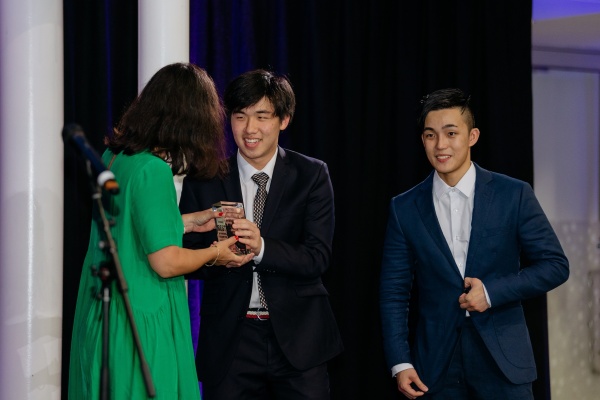
Sahinde Pala presenting the award to Jaeyun Han with festival founder Ryan Chow looking on
“We warmly congratulate Jaeyun.
“ENZ is pleased to support the International Student Film award and the film festival for the wonderful platform they offer young people to share their stories and collaborate. The festival is a great way to showcase what New Zealand offers as a film and creative study destination, and ultimately helps grow connections between international students and New Zealanders,” Sahinde said.
“I was blown away by the talent of all the students involved, they will have bright careers if they choose to enter the film industry. Jaeyun’s storyline, coupled with sophisticated editing and camerawork, made for a gripping and unforgettable film.”
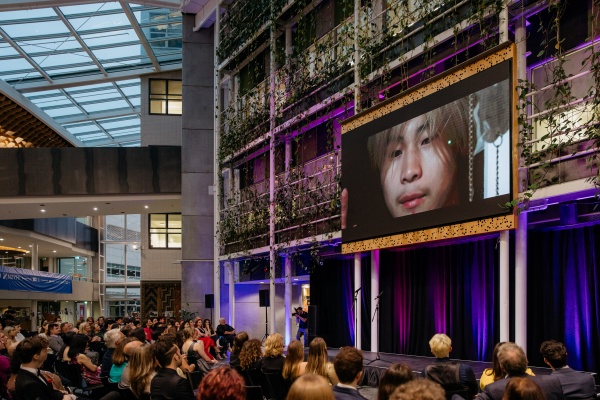
The winning Best International Student Film ‘Him’ being shown at the award ceremony
Jaeyun was one of three final nominees, all of whom were invited to an industry experience day exploring TVNZ, Department of Post and AUT last week, ahead of the awards.
The competition was judged by leaders in the industry. Marvel Studios Director of Technology Katie Hinsen, Weta Digital Visual Effects Associate Producer Jeremy Hollis, and Professor Welby Ings from AUT made the final decisions.
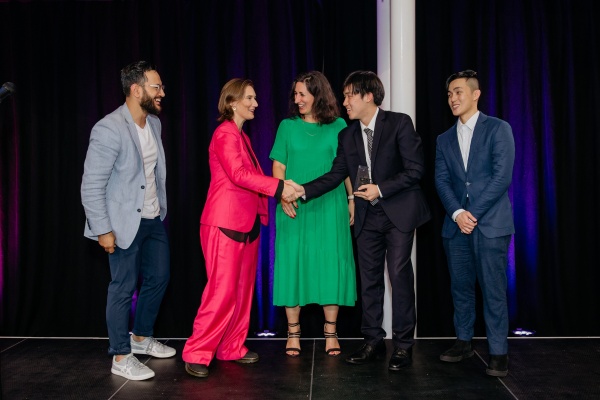
Judges Jeremy Hollis and Katie Hinsen congratulating Jaeyun Han alongside Sahinde Pala and Ryan Chow
“A teacher at school encouraged me to enter the festival and I didn’t think I had a chance of winning. This is such a surprise and an honour,” Jaeyun said.
He received a $500 cash prize and mentorship session with New Zealand cinematographer Phillip A.T Smith, who has worked on notable films such as ‘Mad Max Fury Road’, ‘Dune’ and ‘District 9’.
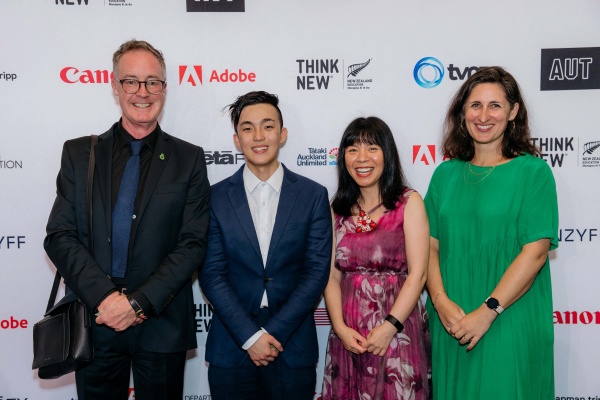
From left to right: ENZ Student Experience Manager Ross Crosson, festival founder Ryan Chow, Senior Advisor Student Experience Faymie Li and Sahinde Pala
NZYFF is founded by Ryan Chow, an international student from Canada studying towards a Bachelor of Business and a Bachelor of Communications Studies at Auckland University of Technology (AUT).
Ryan is passionate about providing an opportunity for youth to have their work celebrated and connecting them with industry professionals to kick-start their careers, which is how NZYFF came to be founded.
Jaeyun’s film is available to view here, and the other nominated films are available to view on the NZYFF website here.
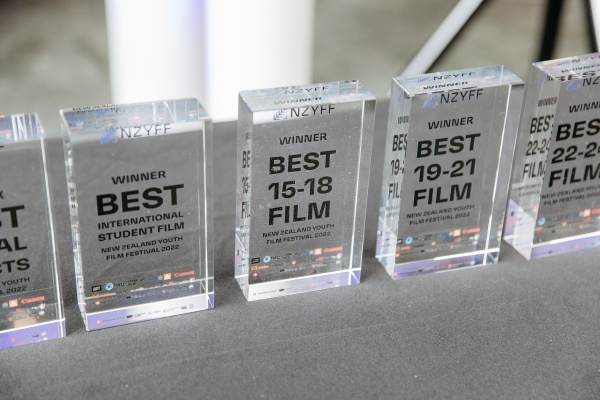
Trophies presented to the category winners
-
October update from Immigration New Zealand
Update on student visa processing*
Since the borders reopened on 1 August 2022, we have received 7,710 student visa applications from international students outside New Zealand. We have decided 4,885 of these applications with over half of these decisions being made in less than 4 weeks and 95% being made within 7 weeks.
*Figures current as at 17 October 2022.
Submit your student visa application for early 2023 study now
Thank you to everyone who has followed our guidance around waiting to submit applications for a student visa for 2023 study. We now encourage students who are intending to begin their studies in New Zealand in early 2023 (up to the end of March) to submit their applications. If you have all your documents ready (including your offer of place and up to date financial evidence) then apply now to give enough time for your application to be processed before your intended travel date. Follow the checklists on the INZ website Student visa information | Immigration New Zealand for guidance on what to provide with your application.
Sending your passport to INZ
We have changed the rules for when you need to send us your passport. Now, if you are applying for a student visa you only need to send us a high-quality scan of your passport, you will not usually need to send your actual passport to be scanned at a Visa Application Centre (VAC) or an Immigration New Zealand office. This is a temporary measure to help with visa processing. Please note applicants may still receive an automated letter asking for a passport to be submitted. This is not required. We are updating the letter to address this issue.
More information: Sending your passport | Immigration New Zealand
Post-study work visa eligibility
Changes have been made to the Post-Study Work Visa eligibility requirements and visa conditions, to reflect the government decisions announced on 11 May 2022. For more information check the INZ website: New Post Study Work Visa requirements announced | Immigration New Zealand
-
Code Camp gives Japanese students a taste of a NZ education
ENZ delivered a one-day Code Camp on 11 July to 14 high school students at Waseda Jitsugyo School, using the Code Avengers platform to deliver coding lessons in English to the students and help them build a New Zealand-themed website.
Code Avengers is a global EdTech company based in NZ that provides interactive, gamified online courses that teach a broad range of digital skills including computer coding, digital literacy, and design.
The Code Camp was delivered in a hybrid format with two instructors onsite at the school and one instructor joining online. The day received positive feedback from students who not only enjoyed learning how to code using English, but also experienced New Zealand’s inquiry-based style of learning in a fun, collaborative environment.
ENZ’s Director of Education – Japan, Misa Kitaoka, says there is plenty of potential for EdTech services in Japan.
“While there is a general perception of Japan being technologically advanced, there is a lot of catching up to do when it comes to technology . As the Japanese government accelerates the promotion of digital education during the pandemic, Code Avengers meets the immediate demands of Japanese educators to teach Digital Technology and English language.
“What makes Code Avengers unique is its user-friendliness, accessibility and affordability.”
Coming up in September, ENZ is teaming up with Young Enterprise (YES), the North Asia Centre of Asia-Pacific Excellence (North Asia CAPE) and MEXT Tobitate (Japan’s Ministry of Education, Culture, Sports, Science and Technology) to deliver a 3-day Biz Venture Programme.
Twenty high school students from Japan and New Zealand will meet online for three days to develop business solutions to address social issues in Japan, including child poverty, gender equality and well-being, and exploring the themes of UN SDGs (Sustainable Development Goals).
Like Code Avengers, YES has been supporting secondary schools across NZ to promote youth entrepreneurship registering more than 1,000 enterprises, some of which have a strong SDGs focus on their business solutions.
Head of YES, Elizabeth Pittman says, “We are thrilled to offer our first ever entrepreneurship programme for New Zealand and Japanese students.
“With New Zealand’s geographic isolation and relatively small population, many Kiwi businesses need to think globally from the start. The BizVenture programme will allow our students to understand the Japanese business context and increase their global competency. New Zealand youth have such a strong interest in sustainability and improving social outcomes within their communities and abroad, and this challenge allows them to explore that interest in a business context.”
ENZ looks forward to continuing to exploring new modes of delivery and showcasing NZ education to key partners in Japan.
-
From the Acting Chief Executive: Building global connections
Tēnā koutou katoa
Earlier this week the Prime Minister of the Socialist Republic of Viet Nam, His Excellency Phạm Minh Chính, made an official visit to New Zealand accompanied by a large delegation. Joining him was their Minister of Education and Training, Nguyen Kim Son. The visit was a timely opportunity to highlight our education cooperation with Viet Nam and to identify areas in which we can grow.
Viet Nam is a multi-sectored market for New Zealand’s international education sector and the fifth largest source country for international students.
I was delighted to witness first-hand the signing of an Education Engagement Arrangement (EEA) between New Zealand and Viet Nam, signed by our Minister for Tertiary Education and Skills, Hon Penny Simmonds, and Viet Nam’s Minister of Education and Training. This arrangement demonstrates to prospective students and their families that New Zealand is a partner of choice for the Vietnamese Government in the field of education, which aligns with the New Zealand Government’s priority to build a more resilient and sustainable sector. You can read more about the EEA and the signing event in this issue of E-News here.
Keeping with the theme of building global connections, last week I was pleased to meet with Ambassador Eduardo Saboia, the Secretary for Asia and Pacific at Brazil’s Ministry of Foreign Affairs (Itamaraty). Brazil is our largest partner in Latin America and prior to the COVID-19 pandemic, New Zealand welcomed over 3,000 Brazilian students. We know that Brazilian students are valued additions to New Zealand classrooms, and that Brazil has been a popular destination for the Prime Minister’s Scholarships for Latin America.
Last week we also received formal confirmation that Hon Penny Simmonds, Minister for Tertiary Education and Skills, will be the Minister responsible for international education and Education New Zealand Manapou ki te Ao.
Minister Simmonds is the Member of Parliament for Invercargill, elected in 2020. Prior to her election, Penny was Chief Executive of the Southern Institute of Technology (SIT) from 1997 to 2020.
The coalition Government has made clear its objective to double the value of exports in 10 years and we now await the Minister’s Letter of Expectations which will set out her detailed expectations for our work.
In closing, positive news to share is that international students are returning to New Zealand. The total number of international student visa holders, in and outside New Zealand is now 45,753 – that is a 171 percent increase since our borders reopened in August 2022 (16,853). The total number of visa holders in March 2024 is 68 percent of those in March 2020 (67,331), when the borders closed. It is heartwarming to see the beaming and excited faces of the new intake of international students joining their schools, universities, Polytech's, English language institutes, and other private training establishments in the gallery of student welcomes that has been compiled here.
After the challenges of recent years, it is a reason to celebrate.
Ngā mihi,
Linda Sissons
Acting Chief Executive
-
From the Acting CE: Open for business – international education and the vocational reforms
I am therefore very pleased that Education New Zealand has the opportunity to contribute and support the work of the establishment unit for the New Zealand Institute of Skills and Technology (NZIST) and the reforms.
The NZIST will bring together the existing 16 ITPs to create a unified, sustainable public network of vocational education.
As we all know, New Zealand enjoys a strong reputation for work-ready education and industry training.
The reforms should build on New Zealand’s reputation as a high-quality choice for international students. They should also help develop a strong national identity for the vocational sector, representing a significant opportunity for providers to attract overseas students.
They should also help ensure a regional spread of students across New Zealand, with a lot of benefits for the regions – including skills, diversity and revenue.
I’m also very pleased to see that the reforms recognise the importance of international education. One of the seven IST work streams focuses entirely on it.
The International Education Working Group is chaired by Michelle Jordan from Venture Taranaki. Members are drawn from across nine institutes of technology/polytechnics and one skills organisation.
We are working closely with the group to support their work. And we’ll continue to work with them through the journey to share our experience and expertise.
The NZIST has a huge challenge ahead. And the changes to the country’s vocational education system will take time to embed.
While there is much happening at the provider level, the message for the sector and international students is that it’s business as usual. ITPs are open for business. And ENZ is continuing to market them. Students can continue to enrol at ITPs for 2020 as usual, including for multi-year programmes. Existing programmes, qualifications and credentials will continue to be recognised internationally.
The changes will take time, but they are an investment in the future of New Zealand’s vocational education and international education sectors.
-
Growing offshore interest in NZ through onshore ‘Famils’
‘Famil’, short for ‘Familiarisation’, are visits organised to literally familiarise invited groups of people with a product, or in our case, New Zealand as an international education destination. The intended purpose is that those who attend famils will become valuable advocates for a New Zealand education and therefore drive preference for New Zealand in market.
During Covid-19 these visits were stopped due to border closures. Now that borders have been fully open for some time and our international education sector is recovering, this summer provided the perfect opportunity to show off New Zealand, including our regions and unique culture, and the wide range of educational and experiential offerings to representatives from various international markets.
The summer of showcasing New Zealand started in November with two media famil groups from India and Viet Nam. This was followed by three groups of education agents from Brazil, Germany and South Korea visiting in March and most recently, a famil co-hosted by ENZ and Air NZ bringing Japanese school teachers to regions in the North Island. ENZ subsidises these programmes with other costs covered by participants, regional economic development agencies, and education providers.
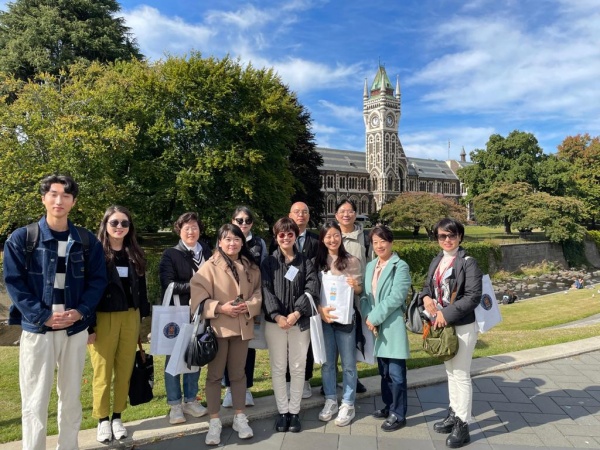
The University of Otago provided a campus tour with a Korean student and didn't miss the opportunity for a classic picture with its famous Clock Tower.
ENZ’s General Manager International, Lisa Futschek said that careful planning goes into facilitating these visits to ensure the famil groups are exposed to a range of subsectors that are relevant to the visiting country while also leveraging the visits to benefit as many providers as possible.
“While we’d love to showcase every New Zealand provider, this is obviously not possible. Much consideration is given to the source market and to the subsectors that we know are popular with that country.
“This ensures we are targeted in our approach and our visitors go back to their countries equipped with the most relevant information that helps build that pipeline of future students," said Lisa.
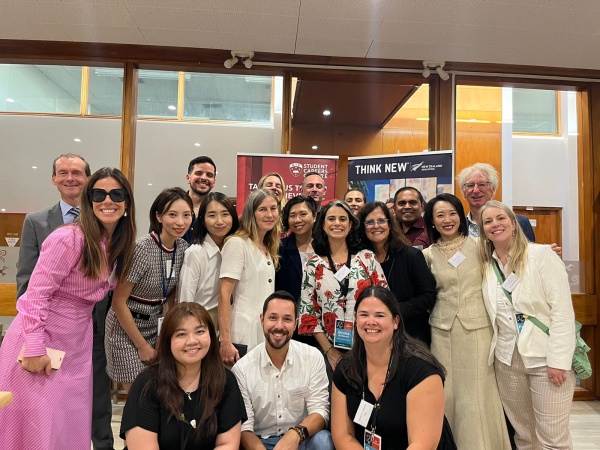
The Brazilian agents attended a networking event hosted by AIS for Auckland-based English Language providers.
“We also look for opportunities in which we can make introductions to several providers in one go. For example, a networking function was held at Auckland Institute of Studies (AIS) with Auckland-based English Language Schools invited to meet the agents from Brazil, cultivating many new connections while strengthening existing ones,” added Lisa.
As well as showcasing the various subsectors, promoting the destination is also hugely important and famil itineraries also include time spent seeing what the regions have to offer international students. This is often organised with the help of the regional economic development agencies.
A perfect example of cross sector collaboration was seen in Ōtautahi Christchurch where Christchurch Educated, an international education organisation based in the region, hosted a networking dinner with the regional economic development agency, ChristchurchNZ. They hosted the Brazilian and German agent famil groups and education providers from various sectors in the Canterbury region.

The German agents are pictured here at the Christchurch Educated networking event with a group of Christchurch based education providers (mainly high schools). The event was hosted at Ara’s Visions on campus restaurant with the Brazilian agents in attendance too.
Stefi Porter, International Education Partnership Manager for Christchurch Educated said that bringing everyone together to mutually share the benefits of studying in Ōtautahi Christchurch was a wonderful thing.
“There is certainly strength in numbers and a perfect example of where collaboration between providers and regional economic development agencies can really deliver greater bang.
“Instead of competing against one another, we are sharing resources, time and energy to show the best of our region and the breadth of study options we can offer international students.”
A key outcome of the various famil groups visiting New Zealand is that they become advocates for New Zealand as a place to study, ensuring a steady pipeline of students for years to come. In the post-famil survey, all attendees reported they were either much more likely (87.5%) or somewhat more likely (12.5%) to recommend New Zealand as a place to study for prospective students.
Other positive outcomes, include the positive media articles and social media posts produced by visiting journalists and individuals to their networks in their home countries. This positive coverage not only showcases the quality of New Zealand's education system but also shares the New Zealand education experience with prospective students in their home countries through stories featuring students and alumni.
The India media famil has achieved five in-depth stories to date in Education Times, India's largest newspaper supplement (circulation 500,000). The stories showcase the research prowess at New Zealand universities, including in biotechnology, managing climate change related disruptions, and feature the New Zealand education experiences of a range of students from India.
In Viet Nam 10 articles and four social media posts have been published so far, reaching an audience of 557,000, with more coverage expected in the coming months. Of note is HHT, the top teen magazine in Viet Nam has created a column “letters to New Zealand”, which shares weekly articles about New Zealand written about alumni.
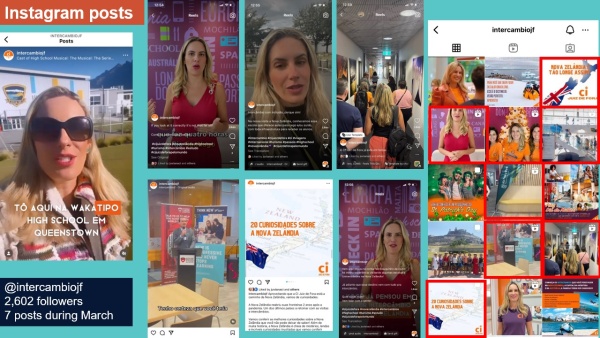
An example of some of the coverage these visits receive. Featured is a compilation of posts that Brazilian agent, Juliana Viana Silveira, owner of CI Intercambio in Juiz de Fora, made on Instagram to her followers during March while in New Zealand. The role of agents in Brazil in international student recruitment is becoming increasingly more important as reported by StudyTravelNetwork here -https://studytravel.network/magazine/news/0/30492
ENZ would like to extend a huge thanks to the education providers and regional representatives for hosting our international visitors and leaving them with a strong sense of New Zealand’s education offerings. The way in which ENZ is able to work collectively with providers and the regional economic development agencies to collaboratively plan the famil is ideal to ensure a good mix of experiences and a balance of activities. This approach helps regions feature strongly in any future famil plans and also helps develop the regional international education ecosystem.
We look forward to hearing about more connections with education representatives at the ICEF ANZA conference in Christchurch.
Check out our image gallery of the famils which shares further details of each of the groups including who attended, where they went and who they met with.
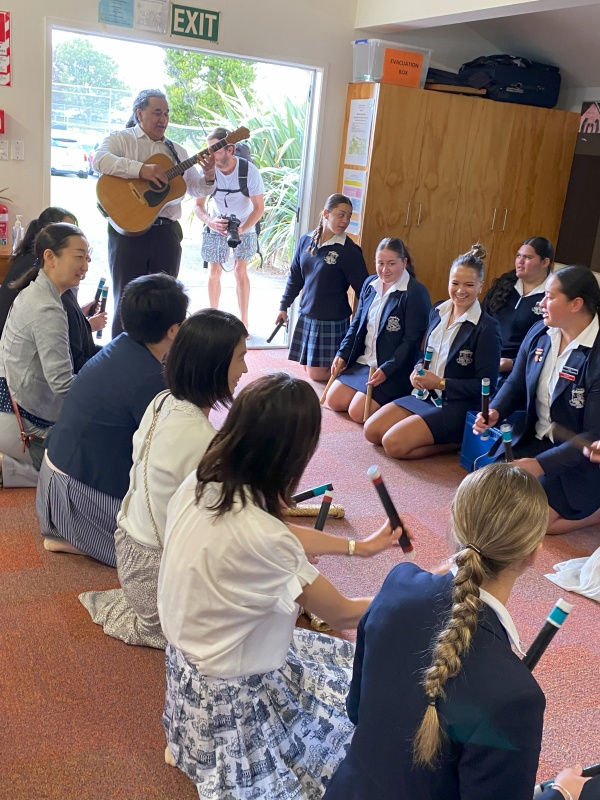
The Japanese All Girls School Teachers participated in a kapa haka class at New Plymouth Girls High School in New Plymouth. Here they are pictured playing the Tītī tōrea Māori Stick game, a traditional New Zealand game which has been played for generations.
-
Register for NZIEC 2019
Click here to register, or find out more at www.nziec.co.nz.
NZIEC 2019 centres on the theme of ‘Navigating our changing world’. As our education system is reshaped over the coming decade, as international competition continues to intensify, and learner behaviour and technology rapidly evolves, how can we create a distinctive, competitive and valuable education proposition?
We’ll explore some ideas with our keynote speakers Dr Lisa Coleman, Guy Ryan and Chris Gallavin.
 Dr Lisa Coleman
Dr Lisa Coleman is New York University’s Senior Vice President for Global Inclusion and Strategic Innovation, and Chief Diversity Officer, working to promote and build inclusion, diversity and equity initiatives. She previously held a similar role at Harvard University.
Dr Coleman has spent more than 20 years exploring global inclusion, diversity, innovation and technology. She sits on many national and international boards and is the recipient of numerous awards, recognitions, and honours for excellence in teaching and leadership.
Dr Coleman is known to be a dynamic speaker and we look forward to hearing her challenge our thinking on everything from unconscious bias to the benefits of workforce diversity.
 Guy Ryan
Guy is an Edmund Hillary Fellow, was awarded Young New Zealander of the Year in 2015, was a finalist for Most Inspiring Person in the NZ Innovator Awards and has served on boards and strategic groups for business and government. Guy has spoken internationally and at home to more than 25,000 people, including TEDx and World Forums.
As the founder and CEO of Inspiring Stories, Guy has built an impressive track record of programmes and partnerships, supporting more than 7,000 young New Zealanders to build their entrepreneurship and leadership capability.
 Chris Gallavin
Professor Chris Gallavin is Deputy Pro Vice-Chancellor of the College of Humanities and Social Sciences at Massey University. Before joining Massey, Chris was Dean of the Faculty of Law at the University of Canterbury.
As an internationally recognised thought leader on tertiary education, Chris has a Master’s in tertiary management and governance from Melbourne University and has published in the area of university reform.
In 2018, Chris became an Eisenhower Fellow for New Zealand. His project, ‘The Global University 2.0’ looked at reshaping tertiary education to solve the problems of humanity.
-
Indigenous women leaders see international education as key to the future
They were speaking at a new webinar in the Kōrerorero: Conversations that Matter series – organised by Education New Zealand’s North America and Latin America teams in partnership with The Chronicle of Higher Education.
The webinar attracted almost 800 academics, international education professionals, government officials and businesspeople, with 275 joining live and the rest registered to view it later. The event drew on the Chronicle’s large subscription base to reach an audience of high-ranking academics in the Americas and attracted an all-star panel of indigenous women leaders in education and business.
Dr Alina Namuncura Rodenkirchen of Chile’s Universidad Católica de Temuco explained the challenges faced by Mapuche women, whose accessibility issues are amplified by rural living and lead to exclusion.
“Education is the key to face all these obstacles. International education can show opportunities, can give us a bigger picture, can empower us,” she said.
“At the same time, we can look back. When we are far away, we can cherish our people and feel what is missing, feel where we want to go back, to support and to collaborate.”
Indigenous entrepreneur and consultant Rachel Petero shared her experiences as a Māori wāhine connecting with the Mapuche.
“Think of entrepreneurship (as a way) to own your own self-determination, your sovereignty. We need to decolonise entrepreneurship and how we do that is (by) connecting,” she said.
“International education is even more important now than ever before because it gives us hope. … It takes us out of this global pandemic mindset that we are stuck in and gives us hope to develop ourselves and move forward.”
Carrie L. Billy, President and CEO of the American Indian Higher Education Consortium, said indigenous people had a special perspective on international education.
“The cultural and societal responsibilities of women are the centre of our collective ability to maintain balance and harmony and wellbeing within the community. When that's out of balance, everything else follows,” she said.
Associate Professor Ella Henry, Senior Lecturer in International Business, Strategy and Entrepreneurship at Auckland University of Technology, said international education could help to turn the tide for disadvantaged communities.
“International education is very important, particularly for addressing some of the discrimination and disadvantage that indigenous communities and indigenous women face. Indigenous education is an important vehicle. What is also strengthened by that process is our indigenous identity,” she said.
Dr Henry, of Ngātikahu ki Whangaroa, Ngāti Kuri and Te Rārawa, addressed non-indigenous educators interested in supporting indigenous international education, asking them to “learn to walk with us, alongside us, as allies.”
Watch the full webinar episode – Kōrerorero: International Education and Developing Indigenous Women’s Leadership.
The Chronicle of Higher Education – Education New Zealand’s webinar partner for the event – has an audience of 10 million higher education employees and 1,600 organisational subscribers to its web content and publications.
