Search
Showing 10 of 7355 results
-
Find out more about what international students think about their NZ experience
Director of Insights for Education New Zealand Manapou ki te Ao (ENZ), Marie Clark, and Student Experience Manager, Ross Crosson will be hosting a webinar on 22 August 2024 from 7-8pm NZST on the recently released 2024 Student Experience Survey results. The webinar is for anyone in our sector who is interested in delving more into the data.
Marie and Ross will talk about the overall student experience for international students enrolled with a New Zealand education provider and where improvements can be made to enhance the international student experience.
You can register via the following link: https://enz.zoom.us/s/81600505051
If you can't make the live session, a recording will be available on Intellilab from Friday.
ENZ’s media release which includes links to the report and data sets can be found on our website - Rise in international students rating New Zealand experience positively » Education NZ (enz.govt.nz) .
- Factsheet support for international students in NZ 20 Apr
-
International recognition for New Zealand educational robot KaiBot before official launch
The AI-enabled robot, KaiBot, which has won the award two months before its official launch date, is designed to support 5 to 15-year-old children to develop coding skills.
The Smart Toys competition is coordinated by the Dubai Future Foundation in collaboration with the World Economic Forum to highlight the best-emerging AI toys in education. The competition attracts innovators, entrepreneurs, toy developers, and start-ups from 20 countries globally.
Education New Zealand Manapou ki te Ao (ENZ) has been offering wraparound support to Kai’s Education over the last year, including supporting them to participate at EduTech Australia in August, profiling them with a spotlight feature with EdTechNZ, and offering support and insights as they venture into the UAE region.
ENZ’s Business Development Manager Alana Pellow, who has been working with Kai’s Education, said this was a fantastic outcome for New Zealand’s edtech community.
“KaiBot is a great example of how innovative and fun technology can positively impact education outcomes for young learners. It’s wonderful to see the Kai’s Education team achieve international recognition for the transformative impact their edtech has on learners.”
Read more about EdTech company Kai’s Education and KaiBot on this link.
-
Latest insights on international education
“As we approach the end of 2022, we have an opportunity to take stock, and importantly look forward to next year, one in which we all hope to welcome increasing numbers of international students back to New Zealand,” says Marie Clark, Director Insights at Education New Zealand Manapou ki te Ao (ENZ).
“Despite the long period of border closure there has been only slightly altered demand for international study. Our annual brand tracker shows the New Zealand brand is holding a strong position globally.”
ENZ has been closely tracking the beginnings of recovery. As New Zealand's border reopens, the immediate priority is for international education providers to build back their onshore offerings and attract students back to Aotearoa. The content of this issue is focussed on toward data and analysis related to our initial observations of the sector's recovery.
The Insight Story - Issue 6 includes insights on:
- Student visa applications and Study with New Zealand web stats
- New Zealand's education brand health
- Agent perceptions about international education
- 2021 international student enrolments
- New Zealanders' perceptions of the value of international students
- and more……
Visit IntelliLab to download The Insight Story here.
- india marketo
- ENZ Agent Seminar Programme 24 August Thailand Final
- Insights Accelerator Learn New Every Day
- IMG 0744
-
International student speakers lay the wero at NZIEC KI TUA
Sean Teow, Aria Ngārimu, Ibuki Nishida, and Albert Lu, each shared stories and insights with NZIEC KI TUA attendees that offered a reminder to those working in international education about why they do what they do.
The students’ speeches laid a worthy wero for the international education sector to continue the good work and keep international students at the centre of our work long after they arrive in New Zealand.
In this context, a wero is a traditional Māori challenge, performed by Māori warriors at a pōwhiri to test the intentions of visitors – by wielding weapons and laying down the challenge, with a token, such as a small branch for visitors to pick up and show they come in peace. Wero can also be used to convey a 'challenge' in other settings besides the traditional usage.
President of the New Zealand International Students' Association (NZISA), Sean Teow (Malaysia), spoke candidly about the full range of his student experience – offering insights on how he came to choose New Zealand to what the international education sector could focus on to better the student experience further.

Sean Teow speaks at NZIEC KI TUA.
Sean spoke about the need to focus on the “level of heart” that New Zealand exudes when interacting with prospective students alongside “bread and butter” attributes such as the high quality of education, lifestyle and beautiful natural environment.
“Be proud of the quality of New Zealand education, but also you as people, there is a level of heart that exudes itself when talking to students. That intention can be felt by a prospective student who may be afraid and anxious to embark on that path, a simple feeling that these people know how to take care of me, and they mean well.
“Don’t forget that the next time you recruit or interact with students for that could make the very difference with students remembering New Zealand and enjoying their time here. Embrace and embody manaakitanga,” Sean urged delegates.
Prime Minister’s Scholarship recipient Aria Ngārimu (Ngāti Porou, Ngāti Kahungunu ki Wairoa, Rongomaiwāhine, Te Whānau-ā-Apanui), a domestic student at Te Herenga Waka - Victoria University of Wellington visited India as part of her scholarship experience.

Aria Ngārimu at the Taj Mahal in Agra, India during her scholarship experience. Photo credit: Aria Ngārimu.
In her address, Aria aptly used an Indian folk tale of five blind men attempting to describe an elephant that they had encountered for the first time to highlight how individual perspectives can be wildly different yet equally accurate. Her speech was a powerful reminder of the need to be open to points of view different from our own.
International representative of the University of Otago Students' Association, Ibuki Nishida (Japan), offered a challenge to the sector to remember that every international student has a story and the importance of staying connected to their experience and story while they were in the country.

Ibuki Nishida laid a wero for the sector to remember that every student has a story.
“Don’t forget about those of us that are already here. I challenge you to not set a “finish line”, but instead learn from, and be a part of, each student’s ongoing story while we are here, that we can take to our loved ones to inspire them back home.
“Do not underestimate the power of word-of-mouth. When looking at growth, it might be one of the most important. And the way you tap into that, is to make sure students have a great experience while they’re here too. And remember that each international student is a story waiting to be told. So help us make it one for the books,” Ibuki said.

Albert Lu spoke about the differences in school life in his native Taiwan and New Zealand and what he likes about studying in Wellington.
Albert Lu (Taiwan), a Year 11 student at Wellington High School, noted the differences in life in Taiwan and New Zealand as he spoke about his experience in New Zealand.
Albert spoke about the NCEA curriculum providing an opportunity to students to enjoy a good balanced lifestyle, how confidence was the key to settling into life in New Zealand and importantly, ‘another way to improve language faster is to hang out with friends whose first language is not my first language’. Albert does this through joining student groups, attending church and generally being proactive about life here in New Zealand.
“Everyone is friendly, I love it,” Albert said.
*Wero: In this context, a wero is a traditional Māori challenge, performed by Māori warriors at a pōwhiri to test the intentions of visitors – by wielding weapons and laying down the challenge, with a token, such as a small branch for visitors to pick up and show they come in peace. Wero can also be used to convey a 'challenge' in other settings besides the traditional usage.
-
NZGCC for teachers
Specifically designed to support teachers to teach in multicultural settings and deliver on the United Nations’ Sustainable Development Goals, the NZGCC Educator version was completed by 118 teacher participants from Malaysia, South Korea, Thailand and Vietnam in this cohort.
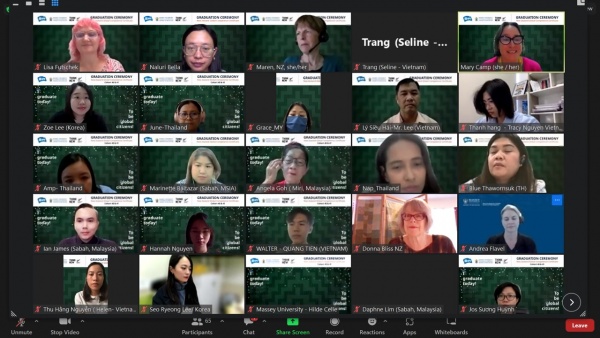
Since late 2020, around 1,415 participants have benefited from the NZGCC programme – both domestic and international students from high schools and tertiary institutions, as well as domestic and international teachers.
The NZGCC develops self-awareness, empathy, critical thinking, cross-cultural communication, conflict resolution and flexibility—skills that bridge differences and develop true global citizens. The next stage of this initiative is expected to include delivering the NZGCC to Prime Minister’s Scholars before they head off for their international education experience.
Here is a selection of the enthusiastic feedback we received from participants in these last cohorts:
“It has taught me a lot about global issues, my role as an educator and most importantly, I have learnt about myself. This course has forced me to look into who I really am as a person and how I could be a better global citizen.”
“I learnt how to be a global citizen, and the things I can do to make this world a better place, whether as an individual or as an educator.”
“Thanks to the new tools I have received from the course, I’m more confident to inspire more people from all walks of life, to step up their journey to enhance cultural competence and cultural intelligence.”
“The course is not only about how to be a global citizen. I learnt so much practical knowledge which helps to improve my skills such as communication, teamwork, and problem-solving. Thank you so much ENZ, Massey University, and AFS for such a valuable program.”
“Thank Massey University, Ms. Donna (facilitator) and ENZ for giving me such an honourable scholarship. I can’t imagine that I will have a chance to study with people from different countries with different backgrounds. By studying and doing research on the modules in the course, I not only understand myself but also know how to sympathize with others who are quite different from me. Besides, I can also apply what I have learnt to my teaching at school. I feel so lucky and proud of myself because I can step out of my comfort zone to communicate and share my own experiences with the participants as well as my beloved teacher, Ms. Donna. I love the way she listens to us and conveys her lessons. Wish Massey University, Ms. Donna Bliss and ENZ health and happiness. Hope one day I can have a chance to meet all of you in real life. See you soon. Love from Vietnam.”