Search
Showing 10 of 7355 results
-
Impact of demonetisation on Indian student recruitment
The government has implemented a deadline of 30 December for people to exchange the old currency notes at banks.
In the student recruitment market, key impacts have already been felt:
- There are maximum daily limits for banks to exchange money, which is creating delays in student loan processing for international students, and in Immigration New Zealand’s (INZ) ability to verify financial documents and process visas.
- Study abroad has become more expensive but conversely, New Zealand has become relatively more cost effective as the Indian rupee has dropped more against the Euro and USD than the NZD and AUD.
Longer term, the supply of ‘grey money’ to finance significant purchases will be reduced, including for education. This may impact study abroad numbers. However, student loan costs may fall as a reduction in overall money supply (some grey money will not be exchanged) will reduce loan interest rates and inflation. It’s too soon to tell the significance of these impacts, but it’s more likely that rural and agricultural cash-based regions such as the Punjab will be affected.
ENZ’s Regional Director South, Southeast Asia and the Middle East, John Laxon, said the repercussions of this change are still playing out.
“The changes are likely to result in some delays in Indian student applications over the next few months for all countries, while any significant longer-term impacts are still to be worked through,” said Mr Laxon.
“We have provided an update to education agents to keep them informed of New Zealand’s student visa approach. We will monitor visa numbers with INZ and keep education providers updated,” added Laxon.
-
One million reasons to follow Study in New Zealand
The SiNZ social media community includes Facebook, Twitter, Weibo, WeChat, Instagram and Snapchat.
Olivia Silverwood, ENZ’s International Social Communities Manager, said while the one million milestone is a big achievement, the engagement from followers is just as good a reason to celebrate.
“In the education sector, even 1% engagement is seen as successful. Over the past 12 months, we have seen an average 8% engagement with Study in New Zealand’s social media content,” said Olivia.
“We know our followers are engaged and enthusiastic about New Zealand education and it’s positive to see results reflect this.”
Engagement is a measure of how users interact with content, such as sharing a Facebook post, retweeting a tweet, ‘favourite’ an Instagram image or clicking a link to a website. Social media engagement is an important metric as it indicates how effective content is.
To further measure the effectiveness of the social media activity, Olivia has benchmarked the SiNZ Facebook, Twitter and Instagram accounts against competitors, including Study in Australia, Study in the UK, Education in Ireland, Study Melbourne, Study in Canada and Study in the States.
“SiNZ consistently outranks all competitors’ Facebook and Instagram pages in terms of followers, follower growth, reach and engagement,” said Olivia.
“Our Twitter pages also outrank competitors in all areas except followers, where we are second to Education in Ireland.
“This is a fantastic space to be in and we aim to stay at the top.”
Olivia added that SiNZ wouldn’t have been able to achieve these great results without the student stories from institutions.
“There’s always an opportunity to collaborate more with our institutions’ social media team members,” she said.
If you’re interested in joining a social media working group, please email social@enz.govt.nz.
In the meantime, keep an eye on the SiNZ Facebook page to see how the milestone is being celebrated.
-
India communications campaign wins top honours at PRWeek Awards Asia 2015
The awards, in their 14th year, are among the most prominent and competitive ones in the region. Organised by Haymarket Media Ltd, they celebrate the most inspired and successful campaigns, companies and individuals in the Asia-Pacific communications industry.
The integrated campaign developed by ENZ’s India team along with support from industry partners created new ways of engaging with Indian students to study in the country’s institutions. ENZ used a combination of public affairs, public relations, advertising, consumer promotions and digital amplification, to highlight its offerings to the Indian student market. Initiatives introduced by ENZ in India were supported by NZ Inc. agencies and ENZ’s India PR agency partner Genesis B-M.
Speaking about the awards, Ziena Jalil, Regional Director – South and South East Asia, Education New Zealand said, “We are delighted with this recognition. It is a privilege to be considered for these awards with the likes of the UN Foundation and USAID and emerge winners.”
The PR Week Awards complete a hat-trick for the India PR campaign, following its win at the Public Affairs Asia Gold Standard Awards in November last year.
“Industry recognition is a great validation of what we have tried to achieve in terms of raising New Zealand’s profile as a quality student destination and education business partner in India,” says Ziena.
To learn more about the India PR campaign email: india@enz.govt.nz
-
Attracting PhD students to New Zealand
The PhD page highlights the initiatives that have given New Zealand an international marketing advantage in attracting PhD students from around the world.
The page promotes the five key benefits of studying for a PhD here. International PhD students:
- pay the same fees as domestic students
- can enrol their children as domestic students in our state schools
- can work full-time
- are able to apply for a 12-month post-study work visa after graduating
- entitle their partners to apply for an open work visa.
Students can check out the page to find out how our PhD programmes are structured, discover the career benefits of studying for a PhD in New Zealand, read case studies from current international students and learn how to apply – there are links to the PhD areas of each university’s website.
Vietnamese student Tan Duc Do, for instance, decided to study undertake a PhD in Mathematics at the University of Auckland because of the inspiring teaching of his supervisor.
“Most of the lecturers here are working mathematicians, so they can give insight and inspiration into the subject,” says Tan.
For Jeffery Garae, a student from Vanuatu, the major attraction of studying Cyber Security in New Zealand was that international PhD students pay the same fees as local students.
“I was looking at doing a Masters here and when I read about the PhD fees I thought, ‘Whoa – that’s an even better advantage,’” says Jeffery.
The new PhD page also shines a spotlight on the academic and research performance of New Zealand universities, and on the wide range of subjects available for doctoral research.
-
Government announces International Education Going for Growth Plan
The Plan outlines an objective to double the international education sector’s economic contribution by 2034. This target has been set at $7.2 billion.
In the short term, the Plan will have Education New Zealand (ENZ) focus its promotional efforts on markets with the highest potential for growth while continuing to maintain New Zealand’s strong presence and reputation for high-quality education in other markets.
ENZ Chief Executive Amanda Malu says New Zealand reaps a broad range of economic, social and cultural benefits from having international students in our classrooms and communities.
“A New Zealand education experience transforms lives, creating lifelong connections between students and Aotearoa. International education fuels innovation, boosts our economy, creates business opportunities, and delivers essential cross-cultural skills for a more connected world. The International Education Going for Growth Plan brings to life a vision to grow New Zealand as the destination of choice for international students,” Ms Malu said.
The plan to grow the international student sector has three objectives:
1. raise awareness of New Zealand as a study destination from 40% in 2024, to 42% in 2027 and 44% by 2034.
2. grow student enrolments from 83,400 in 2024 to 105,000 in 2027 and 119,000 by 2034.
3. increase the proportion of prospective students rating NZ among their top three choices of study destination from 18% in 2024 to 20% in 2027 and 22% in 2034.
In November 2025, in-study work rights will increase from 20 to 25 hours per week for eligible student visa holders and in-study work rights will be extended to all tertiary students in approved exchange or Study Abroad programmes, including programmes one-semester long.
The Ministry of Business, Innovation and Employment (MBIE) will progress work on medium-term immigration actions under the Plan - design of a new short duration visa for some sub-degree qualifications not eligible for post-study work rights and ways to make it easier for students to apply for multi-year visas. MBIE will seek input and views from key stakeholders to inform the development of this work.
You can view the International Education Going for Growth Plan document here.
-
Building online brand ambassadors
In June this year, to make sure we were getting the best out of our social media we merged 11 local Facebook pages into one global Facebook page – www.facebook.com/studyinnewzealand
This move was important to both grow our online community of brand ambassadors and deliver a consistent global message to prospective students.
At the time of the merge, our Facebook community had 120,679 ‘likes’. The global page has well and truly surpassed all our initial goals, rocketing to 268,300 fans in just five months. On average we reach 3 million fans a week, including 80,000 engaged fans each week.
Breaking it down, our Facebook audience is 45 percent female, 55 percent male and is aged between 18 and 24. Our largest audience is in India followed by Thailand, Brazil, Malaysia and Colombia.
Compared to competitor countries, Study in New Zealand is performing very strongly with more ‘likes’ than Australia, Canada and the UK – we just have the USA to catch.
In recent weeks our global community manager has noticed a significant shift in the conversation among prospective students on Facebook. When we first launched the global page, most of the questions were very high level – ‘how do I study in New Zealand?’ and ‘what is New Zealand like?’ The questions we’re getting now are much more specific and qualified;
“I am from Bangladesh. I am interested to pursue a diploma at SIT, will Invercargill be an affordable place to live?”
“What is the different b/w diploma and masters? Which is more job oriented?”
“I want to know how’s New Zealand for aeronautical engineering in bachelor program & what is the cost for it?”
Another notable change is that our community is starting to self-moderate – answering each other’s questions with great advice or helpful links. We have a number of New Zealand institutions and agents who are joining in to provide great support through this channel to prospective students with questions.
In November a social campaign will be launched to further grow and stimulate this online audience with further activity planned for 2015. With an absence of Facebook in China, we are currently developing an equivalent social media platform on the popular site Weibo .
Join the conversation at www.facebook.com/studyinnewzealand.
-
NZ-China Tripartite Partnership Programme Update
First established in 2005, the NZ-China Tripartite Partnership Fund is an ENZ sponsored initiative to support the development of diverse research relationships between New Zealand and China. This Fund supports our wider goals to develop strong global connections and highlight the quality of New Zealand education and research.
ENZ is pleased to announce the 2023-24 New Zealand – China Tripartite Partnership Fund recipients:
- “Teaching physical education for the 21st century: Building collaborative partnerships to enhance the teaching of PE in schools” Associate Professor Alan Ovens, the University of Auckland will partner with Beijing Normal University and Gannan Normal University.
- “Identification of molecular biomarkers of pain in red deer” Associate Professor Kevin Lawrence, Massey University will partner with City University of Hong Kong and Qingdao Agricultural University.
- “The Digitalization of School Governance: A Comparative Study of School Governance between China and New Zealand” Liuning Yang, University of Auckland will partner with Peking University and Guangdong University of Foreign Studies.
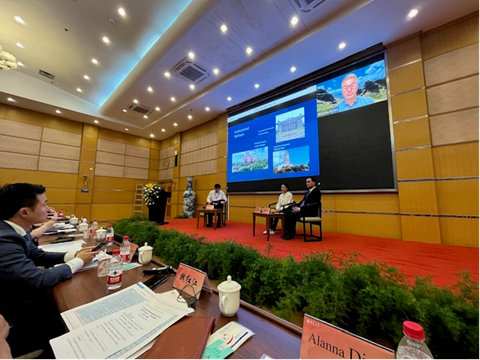
ENZ also recently caught up with the 2022 NZ-China Tripartite Fund recipients to hear how their Tripartite Partnership research projects are tracking a year on. Professor Nicholas Rowe at the University of Auckland visited their research partner in May to provide a workshop at Beijing Normal University.

Workshop participants at Beijing Normal University
Professor Rowe also virtually presented on their project, Teacher training for creativity and collaboration at the NZ-China Higher Education and Development Symposium 19 May at Yangzhou University.
The research project Professor Stephen Croucher and Associate Professor Ming Li from Massey University are working on with their Chinese partners was recently featured as a case study in a publication commissioned by New Zealand China Council. You can learn more about this Tripartite research project, “Protection of the Endangered Languages and Cultural Diversity in West China: A Case study of Miao Minority Language in Guizhou Province, China” in Collaborative Horizons.
Dr Shengnan Wang at the University of Auckland is currently recruiting participants for “The Project Hui: An innovative virtual exchange programme for preservice teachers in New Zealand and China.” Wang will travel to China in October to meet with research partners at Beijing Normal University to discuss publication and future collaboration opportunities.
The New Zealand China Tripartite Partnership Programme is experiencing a surge of activity as researchers between New Zealand and China plan and embark on travel to continue their research.
-
What’s new in IntelliLab
ENZ’s Intelligence team has added new content to IntelliLab:
- Visa dashboard for December 2017 (full year summary)
- IVY – an interactive visa tool
- Market factsheets (for China, India, Korea, Japan, Columbia, Vietnam)
- International student Barometer survey results for university and ITP sectors
- Updated country forecasts from The Economist Intelligence Unit
IVY contains a wealth of visa information and will replace the 50-page monthly visa trends report (the last visa trends report was November 2017). The monthly visa summary dashboard will continue in its current form.
IVY is updated monthly, so users will need to download a new copy each month to access the most up-to-date information. (Please note: IVY has a large file size, so some patience may be required while we explore ways to improve it.)
Our interactive enrolments tool TED (The Enrolments Data) is being updated. You may notice revised student numbers when comparing student nationalities by New Zealand region – this is due to the large number of unfunded PTE and ELS students now being assigned to regions based on their provider. The top-line numbers, such as total number of students and students by country, remain unchanged.
We appreciate any feedback you may have – please use the ‘contact us’ button on IntelliLab.
-
English New Zealand’s new Accredited Pathway Assessment opens up cross-sector collaboration
Bridge International College, Kaplan International Languages and Languages International are now able to offer the Accredited Pathway Assessment (APA).
Although there are already agreements between individual English New Zealand schools and universities, the APA puts in place a structure for acceptance of proficiency across all of the universities, English New Zealand executive director Kim Renner says.
“This will enable greater collaboration between English Language schools and the universities,” Renner says. “With inevitable changes coming for the export education industry due to COVID-19, seamless pathways into further study and close collaboration will become more important than ever before.”
In Australia, the rate of students who transitioned to further study is significant – according to a report released by the Australian government in January, 54 percent of English language students go on to attend an Australian university or vocational training provider. Anecdotally, we know the rate in New Zealand is much lower. There is room for New Zealand to encourage more of the 20,000 plus students who study at unfunded English language schools in New Zealand to make much more of pathway opportunities.
Accredited schools will use the APA to attract those students who are interested in studying at a New Zealand university, but may not meet the current English Language standards.
The APA is also a way that English Language schools can prepare students for New Zealand’s academic teaching style.
“The assessment is built into a school’s teaching – it’s not a one-off test,” Renner says. “Key goals are to increase cross-sector collaboration and provide a great student experience.”
This announcement is a result of a Memorandum of Understanding signed by English New Zealand and Universities New Zealand in June last year. The APA is only available to English New Zealand member schools.
- Student stories