Search
Showing 10 of 7355 results
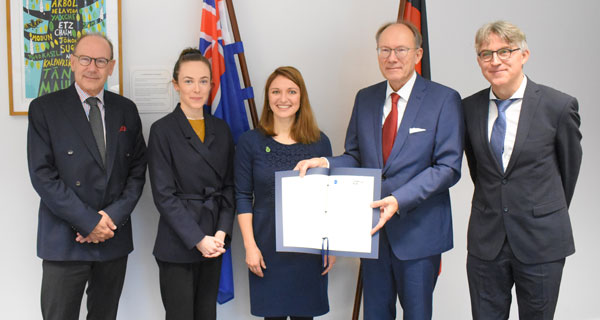
- Joint Agreement DAAD ENZ 600x300px
- mt lauguage school MG 7772
-
Spring has sprung so let’s refresh your Study in New Zealand profile
Euan Howden, ENZ’s Student Attraction Director, says an institution’s SiNZ profile is an important digital flag that ENZ can help promote through its digital work programme.
“Think of your SiNZ profile as the digital shop front that links to your own website. For many schools, and especially smaller providers, this profile is a key way that a prospective student can find you through ENZ’s marketing efforts.
“We want to make your profile as good as we can. Over the next few months, ENZ will be undertaking a scan of all profiles and where needed we’ll refresh a profile so it’s ready for the new year.
“We’ll start by looking to see where a profile hasn’t been updated for quite a while or where key information isn’t included. We’ll then refresh profiles with information from your own website and check in with you to ensure you are on board. We’ll also check that we have the correct administrator details so that you can update it in the future.”
Want to refresh your own profile? Have questions? Email info@studyinnewzealand.govt.nz and we’ll be in touch.
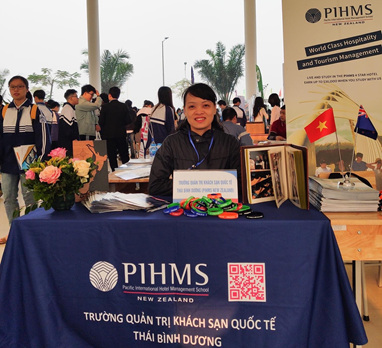
- vietnamfeb21
- 17
-
One million reasons to follow Study in New Zealand
The SiNZ social media community includes Facebook, Twitter, Weibo, WeChat, Instagram and Snapchat.
Olivia Silverwood, ENZ’s International Social Communities Manager, said while the one million milestone is a big achievement, the engagement from followers is just as good a reason to celebrate.
“In the education sector, even 1% engagement is seen as successful. Over the past 12 months, we have seen an average 8% engagement with Study in New Zealand’s social media content,” said Olivia.
“We know our followers are engaged and enthusiastic about New Zealand education and it’s positive to see results reflect this.”
Engagement is a measure of how users interact with content, such as sharing a Facebook post, retweeting a tweet, ‘favourite’ an Instagram image or clicking a link to a website. Social media engagement is an important metric as it indicates how effective content is.
To further measure the effectiveness of the social media activity, Olivia has benchmarked the SiNZ Facebook, Twitter and Instagram accounts against competitors, including Study in Australia, Study in the UK, Education in Ireland, Study Melbourne, Study in Canada and Study in the States.
“SiNZ consistently outranks all competitors’ Facebook and Instagram pages in terms of followers, follower growth, reach and engagement,” said Olivia.
“Our Twitter pages also outrank competitors in all areas except followers, where we are second to Education in Ireland.
“This is a fantastic space to be in and we aim to stay at the top.”
Olivia added that SiNZ wouldn’t have been able to achieve these great results without the student stories from institutions.
“There’s always an opportunity to collaborate more with our institutions’ social media team members,” she said.
If you’re interested in joining a social media working group, please email social@enz.govt.nz.
In the meantime, keep an eye on the SiNZ Facebook page to see how the milestone is being celebrated.
- Four Year Excellence Horizon Education New Zealand to 2020
-
Celebrating excellence: ENZ hosts inaugural New Zealand Universities Awards in Viet Nam
The event highlighted New Zealand’s commitment to supporting Vietnamese students and reaffirmed the strong education partnership between the two countries during the 50th anniversary of diplomatic relations.
The NZUA programme was officially announced by Prime Minister Rt Hon Christopher Luxon during a visit to Viet Nam earlier this year. It is the first New Zealand Government-backed undergraduate scholarship exclusively for Vietnamese students.
Following a competitive selection process, eight outstanding high school students were awarded the inaugural NZUA scholarships. Each recipient distinguished themselves not only through academic excellence but also through their personal aspirations, resilience, and commitment to engaging with the world.
At the ceremony, the students were formally presented with their scholarship certificates by Trade Commissioner Scott James and ENZ Regional Director – Asia (excluding China), Ben Burrowes. The celebration was witnessed by families, representatives from New Zealand universities and education agencies.
In his address, Scott highlighted the significance of this milestone.
“The inaugural NZUA cohort are not only exceptional students, but also cultural and intellectual bridges between our two nations. They stand as a vivid testament to the strong and enduring educational partnership between Viet Nam and New Zealand,” he said.
Ben also emphasised the value of the programme.
“The NZUA scholarship reflects the spirit of valuing both knowledge and people – a core principle of New Zealand’s education system.
“We are proud to welcome the first generation of NZUA Vietnamese students to New Zealand’s leading universities, where they will grow, integrate, and contribute to the shared progress of our world,” he said.
A particularly symbolic moment of the ceremony was the connection ritual between university representatives and the scholarship recipients. Students received congratulatory gifts and placed stars on a map of New Zealand to mark the cities and universities where they will soon study – a visual representation of the “first steps” of the NZUA generation.

Among the recipients, Do Tran Phuong Uyen said that she feels the scholarship is much more than financial support.
“It represents belief – belief in our potential, our dreams, and our ability to contribute to our communities and to the ongoing relationship between Viet Nam and New Zealand,” she said.
“It shows that young Vietnamese students can become leaders, innovators, and responsible global citizens,” Do added.
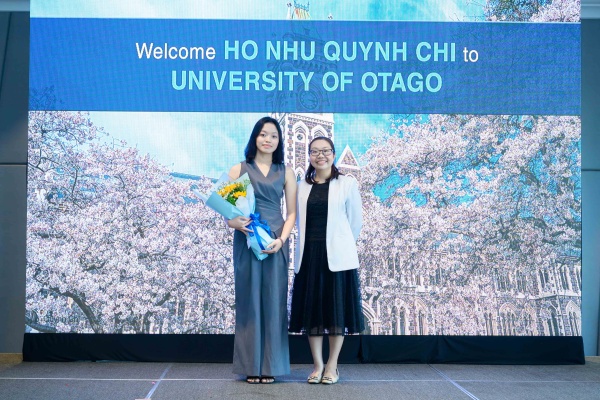
Parents also expressed their trust and confidence in New Zealand’s education system.
Ho Tuyen Truyen, father of recipient Ho Nhu Quynh Chi, said he places his full trust in New Zealand’s safe, high-quality education system.
“I believe that in this environment, my child will be nurtured with knowledge, resilience, and compassion,” he said.
As the first NZUA cohort prepares to begin their journeys, the scholarship stands as a powerful symbol of New Zealand’s commitment to Viet Nam’s young talent.
These students are poised to become influential ambassadors, helping to strengthen educational collaboration and foster deeper people-to-people connections between New Zealand and Viet Nam.
-
NZ’s education brand remains stable despite border closures
A recent presentation by Jason Cate of Kantar, who carried out the 2022 annual brand survey for ENZ, considers two broad questions:
- How is the demand for international education changing post-Covid 19?
- How is New Zealand’s brand as an education destination being impacted?
“This programme tracks perceptions of New Zealand as an education destination globally, but also specific association statements and overall sentiment, appeal and attractiveness,” Jason Cate says.
“It’s always interesting to see how this develops and changes over time, particularly over the last couple of years, given all the challenges.”
More than 4,800 potential students were surveyed online across 11 priority countries, as well as their parents in some markets. The 16-24 year olds surveyed were mostly current students, and all of them were considering further study in an offshore, English-speaking country.
Jason Cate says the survey shows the overall nature of demand for offshore education is stable in 2022, and only slightly lower than before Covid-19.
The core reasons why students are considering studying offshore haven’t changed:
- to live and travel overseas
- to meet new people
- to enhance their employability.
The survey shows there has been a significant reduction in the proportion of students delaying their studies because of Covid-19 (from close to half of students to around one third), but the proportions of students considering both study offshore and at home, or study offshore and online, have increased. In other words, there is a shift in their preferences for the mode of delivery.
Across most of our key partner countries, perceptions of New Zealand are relatively constant, with the only change being a small decline in awareness. New Zealand again tussles with Singapore for the fifth strongest brand in student mobility among English-speaking countries.
For more details about global demand and perceptions of New Zealand’s education brand in individual markets, you can listen to the full presentation on Intellilab here, by registering and logging in through MaiENZ.
-
Virtual events around the world
Viet Nam: Career fair at Nguyen Sieu School (NSS)
Representatives from eight New Zealand providers attended a career fair at Hanoi’s Nguyen Sieu School (NSS) last month.
With no cases of community-transmitted COVID-19 for the past six weeks, Viet Nam has started to return to normal life. Schools have reopened just ahead of the end of the academic year.
Usually, the NSS Career Fair only allows in-person representatives from foreign institutions. However, thanks to ENZ’s strong relationship with the school, our institutions were represented by proxy – either an education agent or alumnus. A representative from the institution was also permitted to join via video link.
As a result, New Zealand’s presence was well ahead of our competitors like Canada (with two institutions), the UK (also two), or Australia (three).
ENZ Viet Nam Market Manager Van Banh says this is a great example of how key in-market relationships will be critical as international education looks to conduct usual activity online.
“This year’s NSS Career Fair was an exciting example of how we can incorporate digital technology into our in-person events,” she says.
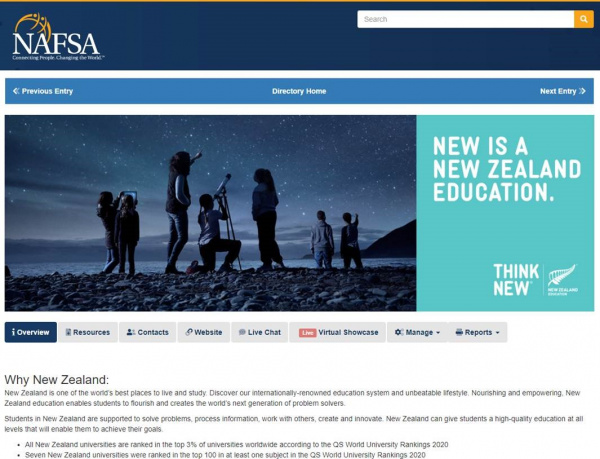
North America: NAFSA eShowcase
For the first time ever, the world’s biggest B2B international education conference was held entirely online.
More than 9,000 international educators from over 100 countries were expected to attend the conference in St. Louis, Missouri over 25-29 May before COVID-19 forced organisers to take it to the digital world. In the end, over 2,000 attended the eShowcase.
Participants were able to visit ENZ’s virtual booth and engage either through chat or live video conversations at designated times.
New Zealand universities and ITPs had dedicated times to host a ‘Virtual Showcase’, which is a mechanism by which NAFSA exhibitors presented, met or collaborated with attendees via a dedicated Zoom session.
“The process of moving the largest in-person B2B international education conference in the world online has been a big learning curve, not only for ENZ and the individual booths and attendees, but for NAFSA themselves,” ENZ Director of Engagement – North America, DuBois Jennings, says.
“With no live, conference-wide chatroom or method to see a list of conference participants it felt isolating at time on the booth, which is very different from the normal, in-person NAFSA conference. However, it has been a valuable learning experience as the international education industry looks for new ways to connect virtually.”
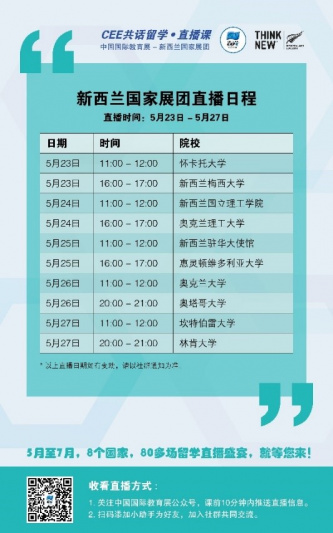
The official NZ CEE schedule.
China: China Education Expo (CEE)
In late May, representatives from ENZ, all eight of New Zealand’s universities and the NZIST were offered a unique opportunity to engage directly with students from China and their parents.
The annual China Education Expo (CEE) is one of the biggest events in the Chinese international education calendar. But ENZ Market Development Manager, Jane Liu, says this year’s engagement through the virtual platform is greater than they would usually expect.
“Although ENZ has worked with the CEE for years, this is the first time we’ve been collaborated with them online. We can see this being useful to New Zealand institutions even after COVID-19.”
Each university provided a one-hour presentation sharing their programmes and how they can work with interested students once COVID-19 precautions have been lifted. The NZIST representative also gave a detailed introduction to the reforms the ITP sector has recently gone through.
The webinars have garnered a combined total of 1000 views, and have been recorded and hosted on WeChat so that students and parents can watch them at their leisure.