Search
Showing 10 of 7355 results
-
New research shows New Zealand is a top‑three study choice for international students
The latest Global Brand Health and Awareness Survey found that 22 percent of prospective international students now place New Zealand in their top three study destinations, achieving the target set out for 2034 in the Government’s International Education Going for Growth Plan, nearly a decade early.
ENZ’s key focus is to bring New Zealand’s education brand to life internationally, highlighting the factors that most influence student choice, high‑quality providers, great student experiences, and strong graduate outcomes.
ENZ Acting Chief Executive Dr Linda Sissons said the findings show New Zealand is increasingly being seriously considered, not just recognised.
“This research shows New Zealand is firmly positioned alongside established global study destinations,” Dr Sissons said.
“What matters most is preference – a strong signal of intent – and we are seeing that grow across a wider range of markets.”
The survey expands brand tracking beyond the traditional “Big Four” markets, including the United States, United Kingdom, Australia and Canada to a broader group of 11 global study markets, offering a clearer picture of New Zealand’s competitive position.
Across these markets, preference for New Zealand is growing across its priority markets, supporting a more diversified and resilient approach to growth.
Awareness of New Zealand as a study destination is high at 79 percent across key source markets, on par with leading European and Asian destinations.
Dr Sissons said while awareness is an important foundation, preference is a stronger signal of genuine student intent.
“Awareness of New Zealand has been consistently strong. What’s particularly encouraging is seeing more students now move beyond awareness to actively considering and showing a preference for study in New Zealand,” she said.
The findings, which build on strong growth in New Zealand’s international student enrolments in 2025, excellent student experience results and strong public support for international education, will also inform ENZ’s 2026-27 market planning and investment decisions.
The full 2025 Global Brand Health and Awareness Survey will be published on ENZ’s IntelliLab, alongside market‑specific insights and a sector briefing.
For further information:
Sai Raje | Senior Communications Advisor, Education New Zealand Manapou ki te Ao
sai.raje@enz.govt.nz | +64 21 479 649
About Education New Zealand Manapou ki te AoEducation New Zealand Manapou ki te Ao (ENZ) is the government agency dedicated to helping New Zealand realise the social, cultural, and economic benefits of international education. Our role is to promote New Zealand as a high-quality education destination offering excellent education and student experiences.
With approximately 85 staff in 13 locations around the world, ENZ works closely with New Zealand’s diverse education sector which includes schools, English language providers, Private Training Establishments, Institutes of Technology and Polytechnics (New Zealand Institute of Skills and Technology Te Pūkenga), and universities.
Internationally, we work with a range of education stakeholders, including government agencies and education providers to identify and encourage sustainable growth opportunities for New Zealand’s education sector.
- ENZ Annual Report 2015 16
-
Insights Accelerator - 3 things for 30 minutes for PTE and ELS providers
The goal of the Insights Accelerator sessions is to offer concise information and insights to support our PTE and ELS providers. By focusing on three things within 30 minutes, Education New Zealand Manapou ki te Ao (ENZ) hopes to efficiently deliver useful takeaways while being mindful of busy schedules.
ENZ’s General Manager, Sector Engagement and Innovation, Wendy Kerr said that two Insights Accelerator sessions have been held so far and were well received by attendees.
“My team is constantly reviewing ways we can better engage with the sector and add greater value. With this platform, we hope that we can support providers in their strategic planning endeavours through the sharing of useful information about our services, as well as market insights.
“These sessions also provide an avenue for us to understand more about our customers. We will be hosting more of these sessions in the coming months so please keep an eye out for the invitation”, added Wendy.
For the launch session, Nick Sinclair, ENZ’s Global Brand Manager presented on the international advertising campaign: Learn New Every Day, and talked about the campaign rationale, channels and target markets, and campaign assets as well as where and how the sector can use these.
In the second Insights Accelerator, ENZ’s Director Insights Marie Clark presented information on ENZ Intellilab, including 2023 Ministry of Education Student Enrolment Data. Marie shared how providers can access Intellilab and the range of information available. The session also looked at the survey findings from the 2023 New Zealanders’ perceptions of the value of international education research and 2023 International Students Experience research.
If anyone missed the sessions, the slide pack and presentation can be accessed via the links below.
For further information, please contact Jane Yang, ENZ Business Development Manager – jane.yang@enz.govt.nz
- Programme HK Agent Seminar
- IEGF Successfull Applicants June 2013
-
Calling all China research specialists
Since its inception in 2005, the Tripartite Fund supports the development of strategic research relationships between New Zealand and China.
Universities are invited to submit proposals for the latest round, with up to $30,000 available per application to support quality, high-level research and collaboration. The fund seeks to initiate new tripartite partnerships and facilitate the development of existing partnerships between a New Zealand university and two Chinese “Two Brother” partner universities.
Eligible Tripartite Fund subjects now include the arts, humanities, social sciences, sciences and applied sciences. These are now in addition to the original categories of agriculture, food safety, conservation, forestry, advanced materials engineering and environmental science.
The Tripartite Fund has enabled many high-achieving New Zealand academics to develop relationships with Chinese research partners.
Shihezi University, Peking University and Massey University signed the first Tripartite Agreement in China in 2005. Professor Hugh Blair of Massey University was awarded a prestigious China Friendship Award in 2016 for his research and collaboration on animal science with Chinese universities and institutions. The initial relationship has expanded to now include the Chinese Academy of Science, the Xinjiang Production and Construction Corps, the Xinjiang Academy of Animal Science and the Hebei Agricultural University.
“My working relationship with China has grown out of the Tripartite Fund and helped make longstanding partnerships possible,” said Professor Blair.
The deadline for applications is 2 March 2018, with a project start date of 1 May 2018, and end date of 30 April 2019.
Please download and complete an application form and submit it to china@enz.govt.nz
-
New Zealand universities showcased to global education leaders at QS India Summit 2025
The initiative was well aligned with ENZ’s goal to build global connections for New Zealand education and explore solid opportunities that will help New Zealand thrive through world-class international education.
Education New Zealand Manapou ki te Ao (ENZ), along with the University of Canterbury, University of Waikato and Massey University made an impactful presence across a range of sessions and workshops.
The summit had the New Zealand contingent showcase the quality of our universities and engage in discussions focused on university-industry collaborations, workforce development, global research leadership, while discussing the importance of building resilient, education institutions that can adapt to a rapidly changing world.
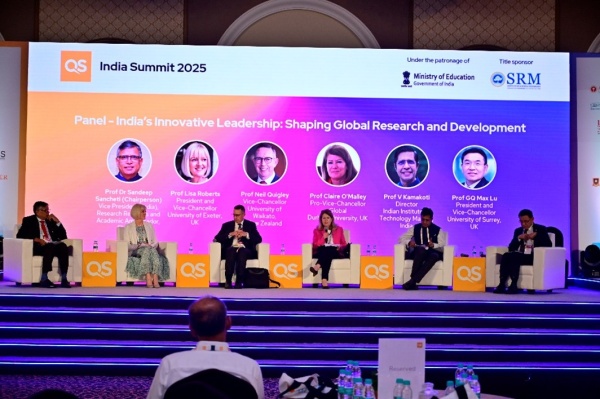
Prof. Neil Quigley, Vice-Chancellor of the University of Waikato, exploring India’s leadership in cost-efficient R&D and its role in supporting global partnerships to address pressing challenges at the QS India Summit 2025.
ENZ’s Director of Engagement, East Asia & India, Jugnu Roy, led a discussion on aligning curricula with emerging job market demands to better prepare students for global careers.
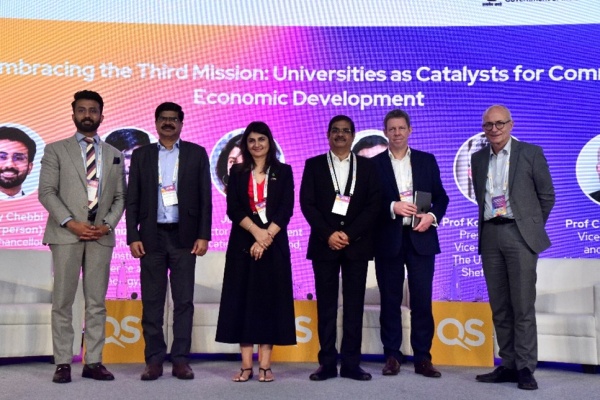
ENZ’s Jugnu Roy discussed how universities could drive social and economic impact beyond their primary roles of teaching and research at the QS India Summit 2025.
Considering how well recognised New Zealand universities are globally, with all eight ranked in the top 2 percent in the 2025 QS World University Rankings, the QS Summit was an opportunity for New Zealand education to strengthen its relationships with key global and Indian education leaders, Jugnu said.
“New Zealand universities are also known for their sustainability stewardship, with our universities ranking first for sustainability stewardship and second for sustainability outreach in the Times Higher Education Impact Rankings 2024.
“Within this context, the summit was a strong platform for us to share best practices and explore new avenues for collaboration between New Zealand and India.
“We look forward to collaborating with global and Indian leaders in education to shape a brighter future together.”
-
ICL Education Group wins at 2016 Export New Zealand awards
ICL won the award for Endace Services Exporter of the Year 2016. This award recognises excellence in building extraordinary and sustainable export growth, working in the areas of ICT, tourism, education and consultancy services.
“I would like to salute the dedication and focus of the 100 ICL staff who have achieved this award, and of whom we are immensely proud. We are particularly honoured that the judges have highlighted the ethics and professionalism of our Group, principles which we believe ultimately underwrite our success,” says Ewen Mackenzie-Bowie, Chairman of ICL Education Group.
The award is one of seven categories, which have been held annually since 2009 to inspire New Zealand exporters to expand their businesses and grow internationally.
ICL Education Group includes ICL Graduate Business School, Auckland English Academy, Bridge International College and New Horizon College.
The judges were impressed with ICL’s approach to marketing, with a broad spread of target markets, and the introduction of new courses to meet identified demand, particularly at a post-graduate level.
It was clearly evident that ICL is a strong contributor to New Zealand’s success in continuing to attract fee-paying international students. ICL’s research culture and policy of employing and retaining highly qualified staff was also seen as a positive factor.
- TIBE20Wendy20Pye
-
Masterclasses for German audience to launch Sustainability Guide
Organised by Education New Zealand Manapou ki te Ao, the online masterclasses gave students a taste of New Zealand education from two high-calibre speakers, Prof Krushil Watene from Massey University and Dr Regina Eisert from Victoria University of Wellington.
Prof Watene outlined a Māori perspective on sustainability and explained how indigenous viewpoints help to solve global problems. Dr Eisert shared insights about life and research in Antarctica, and photos and videos of her up-close experiences with Antarctica’s wildlife.
The Masterclasses were promoted through a tailored social media campaign. Our in-market team worked closely with our German PR agency and leveraged their wide networks in both Germany and New Zealand.
“The Masterclasses were a great initiative to raise awareness of New Zealand’s education system and its long-standing expertise in many sustainability-related areas. The strong engagement in the Q&A sessions showed how interesting New Zealand’s perspectives are to a German audience,’’ says Olga Elli.
For every participant ENZ has donated a native tree in New Zealand by partnering with Trees that Count, a New Zealand conservation charity.
For more information on the Masterclasses and the Sustainability Guide please contact Olga Elli, Market Development Manager Europe, olga.elli@enz.govt.nz.