Search
Showing 10 of 7355 results
- goldstandard2
- IMG 0490
-
Haere ra Afiqah, Haere mai Vikram
We spoke recently with the former NZISA National President for 2021, Afiqah Ramizi, and with the National President for 2022, Vikram Selvaraj.
Afiqah Ramizi, NZISA National President 2021
Afiqah has been in New Zealand since 2015, when she left Malaysia to undertake tertiary study here. After completing a foundation course at ACG (now known as UP International College), Afiqah started on a six-year medical degree at the University of Auckland (UoA) and is now in her final year.
Afiqah’s advocacy work started during her time at ACG, when she was selected to represent the college under an International Student Ambassador programme, run by the New Zealand Police in Auckland. The main focus was to support engagement with the student community, and lift students’ understanding about how to keep themselves safe in a foreign country and what support is available.
At university, Afiqah joined the Malaysian students’ association and became Vice President. In 2019 and again in 2020, she was elected as the International Students Officer for the UoA Students Association. During these years, she became involved with NZISA through their multiple lobbying efforts and community engagement. Afiqah was elected NZISA’s Vice President in 2020, before being elected National President in 2021.
Looking back on her experience at NZISA, Afiqah says she is proud to have been involved in making sure that the voices of international students were heard as New Zealand responded to COVID-19, amongst many other achievements of NZISA since 2017.
“Last year we were successful in lobbying for temporary changes to international students’ maximum working hours, so they could work more during alert levels 3 and 4,” Afiqah says. “This was really important for students at a time when their studies were disrupted, and some students were facing financial hardship. This temporary increase was also appreciated by local employers, as they were needing more people able to work full-time, to keep their businesses running.”
In her role as National President, Afiqah was involved in supporting the groups of international students coming back to New Zealand while the border was closed. Her team’s continuous advocacy to government bodies saw more international student cohort border exceptions announced, which meant more international students were able to return and resume life in New Zealand.
“Staying in managed isolation and quarantine was a big extra cost for these students, and we know many hesitated to return because of that. By talking with the institutions involved and advocating for subsidies, we were able to encourage them to cover part of the costs for their returning students. This was a win-win for both the universities and the students.”
Supporting students over the holidays was another key focus for NZISA during the past two summers, primarily to help onshore students who couldn’t reconnect with their families while borders were closed.
“We worked with ENZ and our regional networks to encourage summer internships, to remain connected in the international community and to indulge in the real Kiwi summer,” Afiqah said.
Afiqah herself spent the last summer at the coalface of the COVID-19 response work, drawing on her medical knowledge to support public health. She was initially working to find the source of COVID-19 when contact tracing was a key focus, and through the Omicron surge, she has learned other public health skills as the nature of her work changed from eliminating to managing COVID-19.
Now it’s time for her to pass on the baton to the 2022 President, and an opportunity to focus on her final year of medical school!
Vikram Selvaraj, NZISA National President 2022
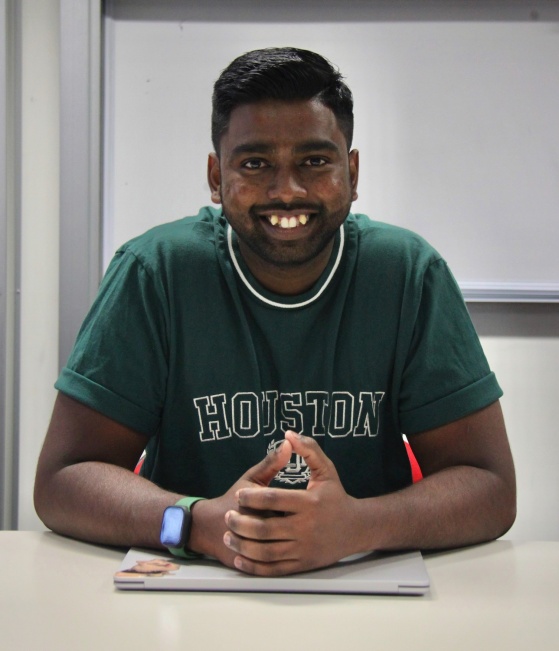
Now in the final semester of a Bachelor of Criminal Justice degree at University of Canterbury, Vikram came to New Zealand in 2018 from Singapore with his partner and began studying here the following year.
“The Bachelor of Criminal Justice was a new degree, and I realised it was exactly what I wanted to study,” Vikram says. “It combines law with a range of other subjects, all related to criminal justice.”
Vikram is the eldest of three siblings and the sole breadwinner for his family, having lost both parents. His two siblings are still living in Singapore, and Vikram has continued to run a hairdressing salon there during his years in NZ. It’s more than three years since Vikram last saw his family in Singapore, but he isn’t planning a trip home any time soon, because of the risk that border settings might change again.
Vikram brings a range of relevant experience to his new role as NZISA National President. At University of Canterbury (UC), he was a UniLife Leader, the first to be in charge of mature students, both domestic and international. It was his role to support them, provide pastoral care and a voice on the issues they were facing. His work was recognised with a Blues Award from UC Students Association in 2021, for Outstanding Achievement in Community Engagement.
Vikram is excited about his new role as NZISA National President. He was elected in December and took up the role in late January, along with an all-new executive team of eight students.
“We’re planning a number of projects for the year ahead,” Vikram says.
UC joined NZISA last year and continuing to increase membership will be one of the priorities for Vikram and his team this year.
“We also have ideas for a range of projects for students that different members of the team will lead during the year. This includes working with NZ Police to help students understand the risks of scams and online gambling; supporting students with resources to combat racism and discrimination; and empowering women.”
Vikram says it’s his belief that he can do something that has brought him to where he is today. He’s very conscious of the challenges faced by many international students, for example when their financial situation changes, and they find it hard to get the support they need.
“Kiwi students aren’t always aware that international students are paying a premium price for their studies,” he says.
“Sometimes students feel homesick, or experience racism – whatever the particular challenge, it’s important for them to know that someone is listening to them.”
Fun fact about Vikram: Vikram has a Japanese Spritz dog called Tiger that he brought with him to New Zealand.
Sahinde Pala, ENZ’s Director Student Experience & Global Citizens, says ENZ sets great store by our relationship with NZISA.
“We have really valued the contribution Afiqah has made during her years with NZISA, and we look forward to working closely with Vikram and his team over the coming year,” Sahinde says.
-
The Education New Zealand Journalism Fellowship for US students
An independent report from the Economist Intelligence Unit recently ranked New Zealand’s education system as the best in the world for preparing students for the future.
All eight of our universities are ranked in the top 2.5% of the world (QS World University Rankings 2018) and New Zealand has the seventh highest performing graduates in the world, ahead of graduates from many elite universities in the US, Canada and England (2016 OECD Programme for the International Assessment of Adult Competencies).
Education New Zealand will work with recipients to structure a programme of interviews and visits that most interest you, and can help suggest potential story ideas and angles and interviewees.
We will cover the cost of return economy class flights from the US, internal travel within New Zealand, shared meals and accommodation. Recipients will also have the opportunity to experience some uniquely New Zealand cultural and environmental visits.
Students will be expected to produce at least two news stories or one feature article, to be published in the US.
The student who is most successful in placing their stories will also be awarded the prestigious Top Education New Zealand Journalism Scholar award, and US$500.
Who can apply?
Students currently enrolled in US institutions or recent graduates working for media outlets. Applicants who are not working for publications should either be enrolled in a journalism programme and/or write for media outlets. Successful applicants must be available to travel to New Zealand for a week in June, 2018.
For more information please email: Lucy.Johnston@enz.govt.nz
Click here to apply.
-
Fun and games at Christchurch student welcome
The event was held at the Christchurch Art Gallery Te Puna o Waiwhetū, and offered free food, games – including jenga, table tennis, and a Rugby 101 workshop led by the BNZ Crusaders – as well as a number of live music and cultural performances such as kapa haka, Indian Bangara dancing and a traditional Chinese lion dance.
Canterbury’s community groups and tourism operators were also on hand to greet new students, alongside Christchurch Deputy mayor Andrew Turner, who gave a welcome speech.
ChristchurchNZ International Education Programme Manager Bree Loverich was pleased to see such a strong turnout.
“This event was a fantastic opportunity to bring together new students, international education staff, homestay families and volunteers to celebrate our different cultures and showcase all there is to see and do in Christchurch and Canterbury,” said Bree.


- 2021 237 Report from the IE CEs meeting
- Hero Image - Brazil
-
New Zealand and China share cultural connection through conservation
In many ways New Zealand’s management of protected lands is world-leading, but there is still much to learn from others. Collaboration is key to improving outcomes and shaping policy in the years ahead. Dr Mick Abbott, professor of Landscape Architecture at Lincoln University, has been collaborating with researchers in China since 2014, with support from Education New Zealand’s Tripartite Fund. The fund assists New Zealand universities to join in research partnerships as the “Third Brother” with two Chinese Universities - one “emerging” and the other “established”.
Dr Abbott has been working with Tsinghua University in Beijing and Kunming University of Science and Technology in Yunnan province on research projects, field trips, workshops, student courses, and the production of bilingual learning materials.
“While we achieve very good conservation outcomes in New Zealand, it is essential that we look beyond our borders for further research and understanding” - Dr Mick Abbott, WildAtlas project lead and Tripartite Fund recipient
Need to look beyond our borders
“Conservation underpins our value proposition to the world,” he says.
“While we achieve very good conservation outcomes in New Zealand, it is essential that we look beyond our borders for further research and understanding.”
While China looks to New Zealand for leadership on how to effectively protect pristine environments from the impacts of recreation and tourism, New Zealand stands to learn a lot from how China celebrates its cultural connections with nature, Dr Abbott says.
“Protected lands in China are associated with cultural value. In Chinese thinking ecological civilisation underpins wider civilisation. They take a holistic view and there are elements in common with Mātauranga Māori (Māori wisdom and world view).
Cross-cultural thinking important
Mātauranga Māori can enhance the cultural connection between Maori and Chinese and creates valuable synergies, he says. “Cross-cultural thinking is so important.”
Key to the success of the long-term relationship was an exhibition Lincoln University curated in Beijing in 2017, showcasing New Zealand’s protected areas and a range of eye-catching exhibits, alongside Lincoln’s research and that of Tsinghua University on the future direction of protected area management.
The exhibition attracted 50,000 visitors and kicked off the WildAtlas project which Dr Abbott has spent the past four years developing. WildAtlas is a collection of virtual tours that bring to life the stories of New Zealand’s National Parks and protected areas, both past and present.
Available in both English and Chinese, WildAtlas is principally used as an educational tool aimed at university students, but Dr Abbott would like to extend its reach to Year 12 and 13 students. “Land issues are really important in this country, and we must understand there are other ways to view the land. We need to broaden the horizons of our students.”
Conservation experiences a key attraction
Looking to the future, Dr Abbott says that New Zealand conservation managers will benefit from a better understanding of the type of National Park experiences that are attractive to Chinese visitors.
“Pre-Covid, China was New Zealand’s second largest inbound tourism market and largest long-haul market. Our conservation areas and national parks are a key attraction.”
He is using the latest round of Tripartite funding to create a corresponding Virtual Field Tour of the Protected Areas of Yunnan Province, home to Kunming University of Science and Technology.
Dr Abbott is hugely positive about the relationship which has been built with Tsinghua and Kunming universities through the Tripartite Fund and believes the collaboration will lead to business and investment opportunities in the future.
“We must foster goodwill and understanding first, share our values, and advocate for them.
Editor’s note: New Zealand’s involvement in the Tripartite Fund dates back to 2005, when the New Zealand and Chinese Ministries of Education agreed to formally support and promote tripartite relationships between New Zealand and China, in which a New Zealand university is joined as the ‘third brother’ to an existing ‘two brothers’ arrangement.
For more information on the NZ-China Tripartite Fund or to learn more about Professor Abbott’s research, please contact the ENZ team at china@enz.govt.nz
- Owairoa
- madi 4