Search

Showing 10 of 7219 results

  • NZIEC KI TUA 2024 programme now live

    Keynote speakers this year include the Minister for Tertiary Education and Skills, the Hon Penny Simmonds, Fanta Aw, CEO, NAFSA, Sir Ashley Bloomfield, and a special guest speaker from the 2024 Country of Honour – India.  

    Built on the Te Ara ki te Ao theme, the 2024 programme features sessions woven around sub-themes focused on –  

    Growth opportunities: How to sustainably grow international education exploring new products, services and markets while optimising technology. 

    Student experience: Explore all aspects of the student experience and ensure international students remain at the heart of our mahi. Insights and best practice to improve outcomes across the student journey. 

    Indigenous international education: How we take on the role of kaitiaki and foster indigenous-to-indigenous education relationships to give best effect. 

    Attraction and acquisition: Understand the unique value proposition of New Zealand education for impactful student recruitment through education agent engagement, international marketing, communications, market research and analysis and partnerships in education.  

    Market updates: Gain insights and updates from a range of global markets. 

    The conference also includes a range of engaging breakout sessions, including workshops and panel discussions hosted by experts across the sector, centred on the five sub-themes.   

    Check out the full programme here: https://www.nziec.co.nz/programme 

    We look forward to seeing you at NZIEC KI TUA 2024, register today: https://www.nziec.co.nz/registration  

  • Student Inspire Vox Pop speaker Lee Arna Nepia PMSA

  • Derek 5

  • Whakatane3

  • The20hindu

  • Statement of Performance Expectations 2014 2015

  • New Zealand ready to lead students to a more sustainable future

    Research commissioned by Education New Zealand in May found that 79 percent of participants were interested in studying sustainability and climate change. And the 2019 QS Environmental Concerns Survey of 3700 prospective international students from around the world found that more than 75 percent would be more likely to choose a degree if the content helped them learn about reducing their environmental impact.

    New Zealand is often viewed as a progressive nation delivering new solutions to problems while at the same time valuing people, place, and planet. Our world-class education system prides itself on preparing graduates with the practical skills and innovative thinking sought by future employers. Those skills must also now empower them to address issues of global consequence.

    Tertiary education providers boost sustainability education options

    New Zealand tertiary education providers are playing an increasingly important role in shaping this enthusiastic generation of learners, with many institutions incorporating a sustainability focus into their research and in many of the courses they offer.

    Waikato University has gone one step further, announcing it will offer the world’s first Bachelor of Climate Change degree from next year. The three-year course will take a multi-disciplinary approach combining science, economic, social, and political systems, plus mātauranga Māori (Māori knowledge and wisdom).

    “We all agreed that science alone can’t come up with all the solutions,” says Dean of Science Professor Margaret Barbour, one of the key players in the development of the programme. “We need people who can think across knowledge systems.” She is enthusiastic about the contribution international students will make, working alongside domestic students.

    “International students will broaden our perspectives. They will bring new ideas from their home country and that can only be positive because climate change is a global issue,” she says. “The whole world needs to work together on this. We can’t be constrained by national boundaries.”

    “Very soon New Zealand, and the world, will have these graduates who will have a thorough understanding of climate change and the impacts on environment and people, and they’ll be able to think critically and holistically,” says Prof Barbour. “They will have expertise in a particular area related to climate change, but they’ll also have the ability to engage with cultural competency outside their area of expertise.” Whether it’s about protecting our land or our oceans, Aotearoa New Zealand is making its mark. While there is still much work to be done, learners are looking our way for both leadership and collaboration.

    Students choose New Zealand for sustainability studies 

    German PhD student Alexandra Lischka has travelled the world for her research in marine biology but says she chose New Zealand for her doctorate studies because it offered her the opportunity to work with internationally respected marine scientists across three universities.

    “There are so many problems facing our marine environment, and I want to help solve them. The old ways of thinking aren’t working when it comes to solving some of the biggest problems facing our oceans. I know I need to forge another path if I want to make a difference.”

    Heinrich Blass came to New Zealand from Germany to learn more about sustainable and ecological building practices. He chose to spend two semesters last year taking Building Science courses at Victoria University. “I was able to learn a broad approach to sustainable concepts from design to building technology and engineering systems to green building certification,” he says. “This gave me a deep insight as well as extensive expertise in sustainable building.”

    International education experience takes New Zealand thinking to the world 

    In 2019 and 2020, Auckland University topped 850 institutions from 89 countries in the Times Higher Education Impact Rankings which assessed universities against the 17 United Nations’ Sustainable Development Goals across research, outreach, and stewardship.

    Vice-Chancellor Professor Dawn Freshwater says the ease of access to oceans and land provides a “natural emphasis” for environmental research. This, combined with the value placed on kaitiakitanga (guardianship) and mātauranga Māori helps to shape “a unique and distinctive approach to sustainability in this country”.

    For students who seek a brighter future with a lighter footprint, an international education experience in New Zealand will take our thinking to the world, open pathways to collaborate on global causes, and help make the world a better place.

    Mō tātou te taiao ko te atawhai, mō tātou te taiao ko te oranga.

    It is for us to care for and look after the environment to ensure its wellbeing; in doing so we ensure our own wellbeing and that of future generations.

  • From the Acting CE: NZIEC KI TUA a great success

    Kia ora e te whānau, 

    What a few weeks it has been! The 31st New Zealand International Education Conference (NZIEC) KI TUA was the absolute highlight of the past month. It was a huge success and a huge undertaking involving all parts of the Education New Zealand Manapou ki te Ao.  

    It was an incredible honour for Manapou ki te Ao and the international education sector to have the President of India, Honourable Smt Shrimati Droupadi Murmu, address delegates.  

    In her keynote, President Murmu spoke about the strong and growing education ties between India and New Zealand and about how she saw education institutions in both countries collaborating in a number of fields, including vocational education, machine learning, AI, environmental studies, as well as cultural exchanges. She also placed great importance on the power of knowledge as an enabler of connections between our people. In closing, she expressed heartfelt gratitude to ENZ and our Government for honouring India in such a special way. 

    I also attended the State banquet at Government House in honour of the Indian President and took the opportunity to brief Ministers and senior New Zealand Inc officials present on the value of the President’s attendance and words at our conference.  

    Ahead of the conference, ENZ Board Chair Tracey Bridges and I were delighted to welcome Dr Fanta Aw, the Executive Director and CEO of NAFSA, and Dr LaNitra Berger, a NAFSA Board member, with a mihi whakatau at our Wellington office.  

    NAFSA, which is the Association of International Educators, annually hosts the largest global professional learning and networking event for all international educators and organisations that support international education. The meeting was a welcome opportunity to connect with the leaders of this important organisation. Dr Aw’s keynote laid clear the importance of international education and the challenges it faces.  

    I am incredibly proud of what was achieved collectively by ENZ and the whole sector at NZIEC KI TUA. It speaks positively of the progress made over the past two years since the borders reopened and the energy and drive we are all bringing to keeping the momentum. 

    To those of you that made the time and for the many who travelled from afar to attend, thank you! It was an absolute pleasure to have you in Te Whanganui-a-Tara Wellington. 

    Ehara taku toa i te toa takitahi, engari he toa takitini  

    My success should not be bestowed onto me alone, it was not individual success but the success of a collective.   

    Ngā mihi  

    Dr Linda Sissons 

    Acting Chief Executive 

    Education New Zealand | Manapou ki te Ao  

  • International student speakers lay the wero at NZIEC KI TUA

    Sean Teow, Aria Ngārimu, Ibuki Nishida, and Albert Lu, each shared stories and insights with NZIEC KI TUA attendees that offered a reminder to those working in international education about why they do what they do 

    The students’ speeches laid a worthy wero for the international education sector to continue the good work and keep international students at the centre of our work long after they arrive in New Zealand.  

    In this context, a wero is a traditional Māori challenge, performed by Māori warriors at a pōwhiri to test the intentions of visitors – by wielding weapons and laying down the challenge, with a token, such as a small branch for visitors to pick up and show they come in peace. Wero can also be used to convey a 'challenge' in other settings besides the traditional usage. 

    President of the New Zealand International Students' Association (NZISA), Sean Teow (Malaysia), spoke candidly about the full range of his student experience – offering insights on how he came to choose New Zealand to what the international education sector could focus on to better the student experience further.  

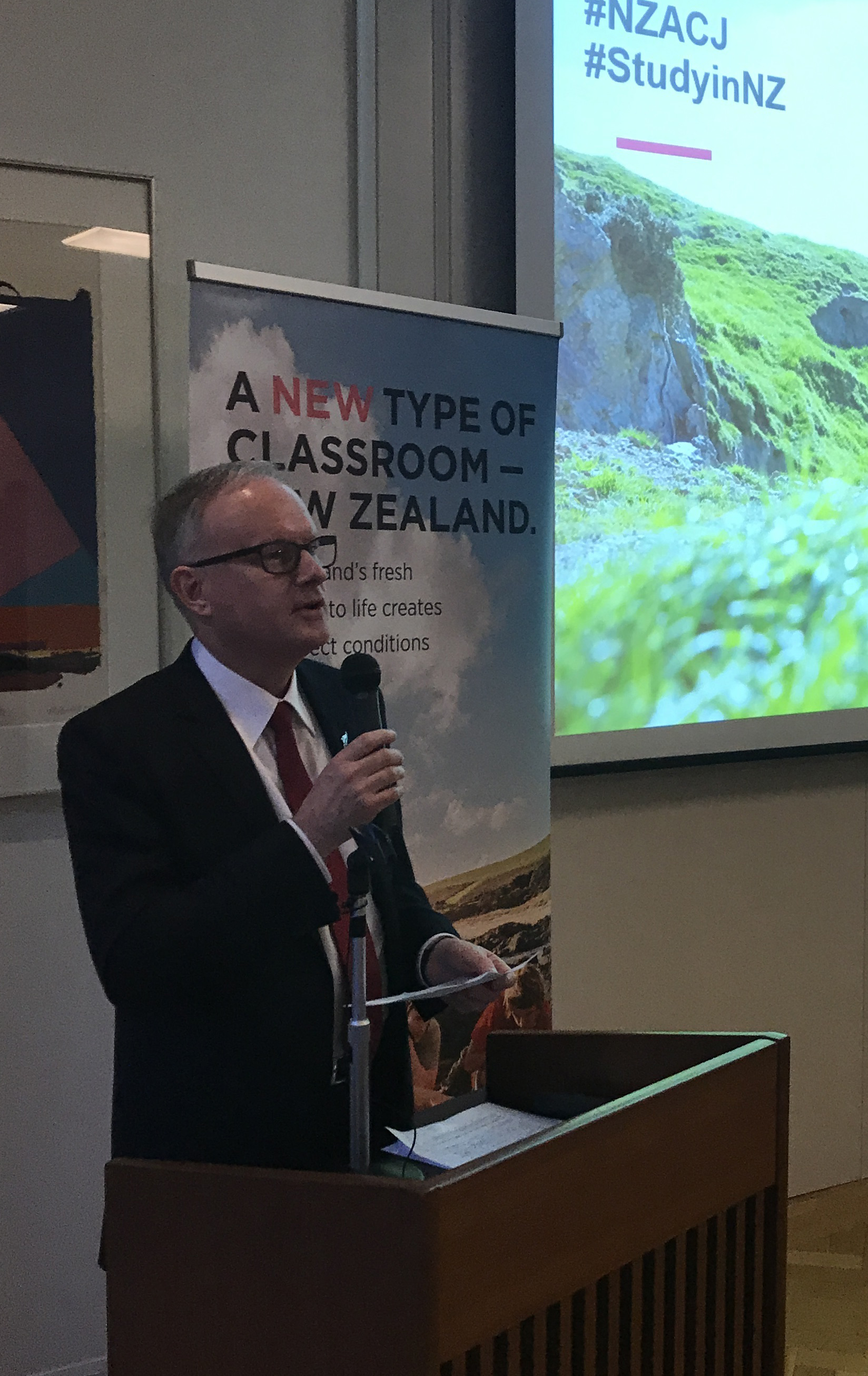
    Sean Teow speaks at NZIEC KI TUA.

    Sean spoke about the need to focus on the “level of heart” that New Zealand exudes when interacting with prospective students alongside “bread and butter” attributes such as the high quality of education, lifestyle and beautiful natural environment. 

    Be proud of the quality of New Zealand education, but also you as people, there is a level of heart that exudes itself when talking to students. That intention can be felt by a prospective student who may be afraid and anxious to embark on that path, a simple feeling that these people know how to take care of me, and they mean well.  

    Don’t forget that the next time you recruit or interact with students for that could make the very difference with students remembering New Zealand and enjoying their time here. Embrace and embody manaakitanga,” Sean urged delegates.  

    Prime Minister’s Scholarship recipient Aria Ngārimu (Ngāti Porou, Ngāti Kahungunu ki Wairoa, Rongomaiwāhine, Te Whānau-ā-Apanui), a domestic student at Te Herenga Waka - Victoria University of Wellington visited India as part of her scholarship experience.  

    Aria Ngārimu at the Taj Mahal in Agra, India during her scholarship experience. Photo credit: Aria Ngārimu.

    In her address, Aria aptly used an Indian folk tale of five blind men attempting to describe an elephant that they had encountered for the first time to highlight how individual perspectives can be wildly different yet equally accurate. Her speech was a powerful reminder of the need to be open to points of view different from our own. 

    International representative of the University of Otago Students' Association, Ibuki Nishida (Japan), offered a challenge to the sector to remember that every international student has a story and the importance of staying connected to their experience and story while they were in the country 

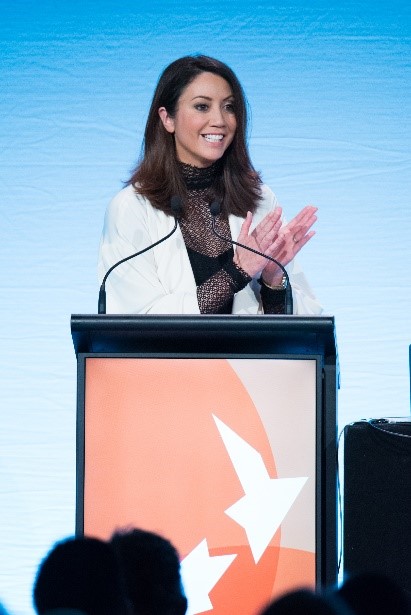
    Ibuki Nishida laid a wero for the sector to remember that every student has a story.

    Don’t forget about those of us that are already here. I challenge you to not set a “finish line”, but instead learn from, and be a part of, each student’s ongoing story while we are here, that we can take to our loved ones to inspire them back home. 

    “Do not underestimate the power of word-of-mouth. When looking at growth, it might be one of the most important. And the way you tap into that, is to make sure students have a great experience while they’re here too. And remember that each international student is a story waiting to be told. So help us make it one for the books,” Ibuki said. 

    Albert Lu spoke about the differences in school life in his native Taiwan and New Zealand and what he likes about studying in Wellington.

    Albert Lu (Taiwan), a Year 11 student at Wellington High School, noted the differences in life in Taiwan and New Zealand as he spoke about his experience in New Zealand.  

    Albert spoke about the NCEA curriculum providing an opportunity to students to enjoy a good balanced lifestyle, how confidence was the key to settling into life in New Zealand and importantly, ‘another way to improve language faster is to hang out with friends whose first language is not my first language’. Albert does this through joining student groups, attending church and generally being proactive about life here in New Zealand.  

    “Everyone is friendly, I love it,” Albert said. 

    *Wero: In this context, a wero is a traditional Māori challenge, performed by Māori warriors at a pōwhiri to test the intentions of visitors – by wielding weapons and laying down the challenge, with a token, such as a small branch for visitors to pick up and show they come in peace. Wero can also be used to convey a 'challenge' in other settings besides the traditional usage. 

  • NZIEC2023558of404

What's in it for me?