Search
Showing 10 of 7165 results
-
Fermented flour a food waste breakthrough
Ninna Granucci, a former University of Auckland international student, is part of a new generation of thinkers contributing solutions with out-of-the-box thinking.
Ninna grew up in Brazil and saw for herself the amount of food waste primary producers there generated. Learning about the scale of the problem globally, she resolved to apply her skills to help bring about change.
“I wanted to use science in an area which fascinates me –microbiology and specifically, fermentation – to try and find a solution to this huge problem.”
University of Auckland a great place for new ideas
Ninna chose to study for her PhD in Biological Sciences under Dr Silas Villas-Boas at the University of Auckland in 2014. “The university environment was a great place for new ideas, to promote the spark to find solutions to problems, with the scientific approach to support it.”
It clearly worked. After only 18 months, she had a breakthrough in the lab which she knew could make a real difference. She refined a fermentation process to successfully convert waste pulp and peel from selected fruit and vegetables into a nutritious flour. Widening the range of ingredients in her trial, she proved she was on to something.
Data from the UN’s Food and Agriculture Organisation (FAO)shows that almost 32 percent of plant-based product is wasted annually. Ninna’s technology has the potential to make substantial progress on this.
It turned out that the ingredients also tick all the boxes for health and sustainability-conscious consumers: high protein, high fibre, low calorie, gluten free, rich in vitamins, minerals and natural antioxidants. And the bonus is that they also have lowest CO2 footprint compared with other ingredients in the market today.
Entering her prototype into the University’s Velocity 100K Business Idea Challenge sparked media interest and a flurry of inquiries from supermarkets and other businesses wanting to buy the product. “That was when we realised it was not only an academic project but also something which could be much bigger and could help to address the problem of food waste,” Ninna says.
Green Spot Technologies has global plans
With support from Velocity, she and Silas co-founded sustainable food innovation company Green Spot Technologies, which has ambitious plans to go global. Ninna is now CEO and based in Toulouse, France, where the business is established in a start-up accelerator environment and employs 15 people.
But back in the early days, it was pretty nerve-wracking. “My plan was to complete my PhD first and then set up a company based around the project. But after the success in the Velocity Challenge, we decided the time was right to forge ahead with the start-up. It was quite challenging. My background is all scientific, I didn’t have any experience in business, and I had a lot to learn.”
She is grateful for the support she got at the University of Auckland and believes that her career path would never have progressed as quickly if she hadn’t chosen New Zealand as a study destination.
“I give a lot of credit to New Zealand for how things worked out”
“New Zealand was the catalyst,” she says. “I managed to secure a scholarship through Callaghan Innovation available to students looking to add value to waste streams. It allowed me to focus on the work and find opportunity. I give a lot of credit to New Zealand for how things worked out.”
Ninna worked in Auckland with other international students from around the world and says that, too, helped contribute to her success. “When you are in the same situation you can support each other and that was super important during my PhD.”
New Zealand education the right decision
Ninna remains passionate about sustainability and reducing food waste. It is at the heart of her business and is important to her personally. The mission of Green Spot Technologies is “challenging the food waste paradigm to feed the future”. The company has won multiple awards, both in New Zealand and in Europe, highlighting the unique nature of its technology and products.
With food insecurity spreading to hundreds of millions of people around the world, the UN has set a Sustainable Development Goal (SDG) to halve food waste by 2030. It is an ambitious target and needs innovative thinkers like Ninna to make it achievable.
“I think it is incredible that we waste so much food, knowing that we need more food in the world. It doesn’t make any sense, but it motivates me to work on solutions,” she says.
The decision to study in New Zealand was a critical part of Ninna’s journey from international student to international businesswoman and innovator. “I could not have imagined that it would lead to such huge changes in my life in such a short time,” she says.
“A New Zealand education provides a truly enriching experience. I really think I made the right decision.”
-
Following his own path – International student builds life, family, and community in New Zealand
Luke Qin has never been afraid of a challenge. Born in Sichuan, China, his childhood was a rich mix of classical Chinese literature, table tennis, badminton, basketball, football, and music.
Early intensive schooling means he can read, write, speak, think and dream in Chinese and draw on traditional Chinese virtues, but a desire to follow his own path, experience something new and explore education options overseas, led him to New Zealand as a high school student.
Selecting New Zealand was a relatively easy choice at the time – English-speaking, safe, ‘clean and green’ and affordable – it ticked all the necessary boxes. But his desire to test himself drew him to Christchurch because “fewer Chinese students there” meant he would have no choice but to fully immerse himself in the new environment.
And what an immersion it was. Luke credits his first years at Linwood High School as the perfect place to experience “an excellent introduction to the New Zealand way of life” and in his first year in New Zealand, he was playing on the wing for Linwood High School’s First XV rugby team!
“With a little help from All Black stars!” Luke tapped his rugby passion to enlist support for the Dragonboat Festival in Wellington from All Blacks Ardie Savea (left) and Dane Coles.
“I wasn’t very big and didn’t know the rules of the game when I arrived, but I had some wheels back then.” Luke explains. If it looked like trouble was coming my way, I’d just try to outrun it!” But he also knew he had to prove himself to his teammates. Once, while tackling his opposite wing, a strapping Samoan teammate joined in and sent them all to the ground. “I felt something hot dripping down my forehead but charged straight back into the ruck, only to be dragged off the field and sent to the hospital.” Three stitches later, he knew he had earned the respect of his teammates and become ‘one of the boys’.
Luke credits his school experience with developing his self-belief and preparing him for what was to come, through his university years and beyond.
After graduating with a Bachelor of Commerce from the University of Canterbury, he relocated to Wellington to join the banking industry, and completed a Master in Applied Finance from Victoria University of Wellington. He then continued on with his quest for lifelong learning and experience by achieving qualifications in Sustainable Finance, Te Reo Māori, Medical Co-Response, Citizen diplomacy and Urban Fire and Rescue, and volunteering for a number of causes.
His banking experience broadened, and several promotions later he joined Kiwibank in Auckland, leading the development of its International Strategy and Trade Finance offering, and working closely with NZ Inc partners to help New Zealand exporters and importers with risk mitigation and working capital funding.
Nowhere has his quest for a challenge been more evident than in his decision to become a volunteer firefighter 10 years ago.
“My younger self had been watching ‘Spiderman’ and saw Peter Parker leap into a burning building to save the day. At the time I thought, ‘I wonder if I could do that?’ Then I heard a call for volunteers from the NZ Fire Service on the radio while driving to work so decided to contact my local fire brigade in Seaview, Lower Hutt.”
“I thought I might be the first Asian volunteer in the station, but I was beaten to it by a Chinese lady.”
“The Fire Service is where you find the real New Zealand,” says Luke.
“Teachers, accountants, plumbers, builders, people from all walks of life - all bonded by the same commitment to serve their community. The camaraderie and environment was addictive.”
There, with the support of Fire and Emergency New Zealand, he completed the Sky Tower Stair Challenge with fellow firefighters from across the country to raise funds for Leukaemia and Blood Cancer New Zealand.
Scaling 1103 steps and 51 flights of stairs in full fire-fighting gear with a steel cylinder on his back was one of the most physical tests he has put himself through.
1,103 steps and 51 flights of stairs behind him, Luke was happy to complete the Sky Tower Stair Challenge - “Man of Steel” with other firefighters dressed in full gear with steel cylinders on their backs to raise funds for leukaemia and blood cancer in New Zealand.
“I have benefitted so much from all the opportunities and adventures since coming to New Zealand, especially from my volunteer roles. It’s a small way I could repay my second home for its kindness.”
“I hope I can encourage more international students and members of our diverse ethnic communities in New Zealand to become volunteers and join activities that benefit the community. There is so much we have to offer, and the reward in terms of friendships and life skills is amazing.”
From Sichuan to Wellington waterfront, leading the Dragon Dance during Chinese New Year Parade.
Luke Qin’s journey as an international student began with a desire to immerse himself in a new environment. Grateful to his family, friends, colleagues, and mentors for the opportunities and adventures New Zealand has given him, he takes pride in being able to go home whichever way he travels between his ‘little shire’ in Sichuan and ‘Middle Earth’ New Zealand.
-
Former international student represents Aotearoa in Ecuador
With his career as an agronomist under way, Juan Pablo came to New Zealand on an MFAT-administered scholarship in 1988, wanting to build on his agricultural qualifications. After taking English courses at Victoria University Wellington Te Herenga Waka, he completed a two-year Diploma in Rural Studies at Massey University Te Kunengaki Pūrehuroa.
His time in New Zealand had such a profound impact on his life that he returned home determined to establish lasting bonds between the two countries. And there is no doubt that his appointment reflects just how much he has achieved.
Juan Pablo says he had dreamed of coming to New Zealand long before he got here. He had read ‘Grass to Milk’, Campbell McMeekan’s 1960s account of New Zealand’s dairying management practices which was well-known among dairy farmers in Ecuador. “I read the book and decided this is the place I want to go.”
Learning from the best
Very few students travelled to New Zealand from Ecuador at that time, most went to the United States for further education, he says. “Many people asked me why I was going to New Zealand, and people still ask me about it today. I tell them I went because I wanted to learn from the best.”
Juan Pablo says he was inspired by his lecturers, especially the late Professor Colin Holmes, a respected researcher, mentor, and advocate of the dairy industry.
“I came from an education system where the teacher held all the knowledge, where it was always black or white. In New Zealand it was totally different because learning was inquiry-based. Critical thinking was the method of developing knowledge.”
He says his experience was transformative on both a personal and professional level.
“The things I saw and learned, the New Zealand way of doing things, and the care and respect people had for each other had a powerful effect on me.”
Over the decades since Juan Pablo’s education experience in Aotearoa, he has built a highly-regarded career in Ecuador, founding and leading primary industry companies, accepting numerous board appointments, representing Ecuador in international free trade agreement negotiations, and being recognised with multiple honours for his contribution to the livestock and dairy sector.
Enduring ties to New Zealand
But he never forgot his ties to New Zealand, working tirelessly to strengthen the bilateral relationship and boost both business and education opportunities. He initially established a company to import agricultural products from New Zealand. When he later secured the role of General Manager of the Cattlemen’s Association, he passed on all his business contacts, and the organisation has been importing electric fencing components and seeds from New Zealand companies ever since.
“In 1988, we brought some cattle in from New Zealand for a breeding programme. Now many farms in Ecuador, including the ones I oversee, have cattle from New Zealand stock. And in the 1990s I helped to establish an education programme with Massey, which saw lecturers come to Ecuador to take short courses in dairy management.”
“When it comes to dairy farming, almost everything I know I learned in New Zealand - pasture management, milk production systems, electric fencing, animal welfare – and farmers have applied these practices successfully in Ecuador,” Juan Pablo says.
“New Zealand is top of mind for every farmer here. When you talk about New Zealand here, everybody knows about its reputation in agriculture. Going to New Zealand is on the wishlist for many people.”
Honoured to represent Aotearoa
Juan Pablo says he was deeply honoured to be asked to be New Zealand’s Honorary Consul in Ecuador, a role which is all about connections and creating opportunities which benefit both countries.
“I am very proud, and I’m happy because I now have the chance to advocate for Aotearoa,” he says. “The better the relationship with New Zealand, the better it is for Ecuador too. We must focus on what we have in common and make the most of it.”
He firmly believes international education is at the heart of relationship-building and collaboration between countries, even more than tourism and business. “You learn the values of a nation through education. Time spent studying in New Zealand will make you a better person.”
“International students will become New Zealand’s ambassadors to the world.”
-
From Russia to New Zealand: "I've lived two different lives"
Home was Petropavlovks-Kamchatsy, on the far eastern seaboard of Russia, almost 7000km from Moscow, and the decision to leave was a relatively spontaneous one. “The whole experience was pretty surreal.”
He was introduced to the possibility of an education experience in New Zealand by ACG (Academic Colleges Group), which held a fair in his hometown back in 2008. “I had never heard of them visiting Russia before, let alone my hometown as it’s so remote.”
Andrey admits that at the time he wasn’t keen to stay on in Russia and “jumped at the opportunity” to come to New Zealand for a six-month stint in Year 13 at ACG Parnell College.
“Looking back on it, I really wanted to go somewhere far from home and different. I placed all my hope on it being a better place and it turned out that it was. That internal drive to explore took over and I followed my intuition.”
Student life provides connections
Having improved his English, Andrey went on to study for his Bachelor of Commerce in finance and economics at the University of Auckland, where he found his tribe. “Life in Russia did not resonate with me in the way that life in New Zealand did,” he says. “I think what was missing for me at home was the kind of openness and connectivity which is so apparent here.”
Coming to New Zealand I was exposed to other people’s perspectives and backgrounds, and I really connected with that.
"I felt a sense of belonging and that I could be who I am without judgement. Breaking away from being expected to fit a certain mould at home was a big thing for me.”
With new-found confidence and his degree completed, Andrey travelled the world on modelling contracts before “returning to the original plan” and establishing a career in e-commerce and project management.
And he has the perfect credentials for his current role at The Mind Lab, helping to launch Mission New Zealand, an online education portal aimed at international students. “It provides short courses and micro-credentials as a taster of what education in New Zealand is like and what it can provide. It’s a full circle moment for me.”
Mission New Zealand highlights what makes an education experience in Aotearoa unique through the lens of creativity, sustainability, tech innovation, and culture. “I think it puts us on the map in terms of global education.”
Looking back, Andrey says he would have loved the opportunity to access a platform like this as a student travelling to a foreign country, “to really get an understanding of what it’s like on the ground”. He says he is excited to see what impact Mission New Zealand can have.
Life-changing move
The decision to leave Russia for New Zealand has been life-changing for Andrey. He is now a citizen and knows his future lies here. “There is so much social and career mobility here and that’s exciting for me.”
He arrived determined to carve out a new path in life and he has certainly achieved that. “I have grown into a person who is more confident and assured, and not afraid to explore new opportunities.”
He now has plans to explore and better understand the significance of te ao Māori. “I want to immerse myself in that space. I love that in New Zealand there is more than one way of seeing the world. It is so important that there is an alternative perspective,” he says.
“I would like to get a deeper understanding of the tenets of te ao Māori, to see the challenges we are facing and the potential solutions through a different lens.”
His advice to students considering coming to New Zealand is to get fully immersed in the culture “and absorb it all”. “Don’t come to recreate what you had at home. If you do, you’ll miss huge opportunity for personal growth.”
Andrey says his life now looks nothing like his old life. “It’s like I’ve lived two different lives.” And he’s not done yet.
“Coming to New Zealand has drastically changed how I view myself in the world,” he says.“ Through international education you realise that your actions do matter, that you do have the potential to make a real impact. You start seeing yourself as an individual in a connected system.”
“Keep exploring is my motto for the future.”
-
Graduate’s Kiwi know-how helps reduce water use in UAE desert
Rather than travelling to New Zealand and undertaking theoretical research with limited relevance back home, Wafa was able to carry out hands-on work addressing critical water management issues in her arid home country, while being supervised by New Zealand-based experts.
It was a personalised and practical kind of international education experience which Wafa is grateful for. “It allowed me to continue working, while at the same time learning and finding solutions to the water management issues facing the UAE.”
The education partnership grew out of a New Zealand G2G (Government to Government) relationship with the UAE which dates back to 2014. “The aim is to build the capacity of local people and find solutions to real problems through scholarships for study,” she says.
Already qualified with a Bachelor’s degree in ecology and environmental science and Master’s degree in water and environmental engineering, Wafa was working as an environmental scientist for Environment Agency - Abu Dhabi (EAD) when asked to be involved in the programme.
The region needs to find ways to manage the growing demand for groundwater in a hyper-arid, saline environment. Abu Dhabi, the capital of the UAE, has about 19 million planted trees in desert “forests”, a precious legacy of founding father Sheikh Zayed Al Nayhan. They provide a range of ecological benefits but are heavily dependent on groundwater irrigation.
With EAD given a government mandate in 2016 to protect groundwater reserves, water meters were introduced and areas of wastage identified. Wafa’s research was required to determine the exact water needs of the plants through the implementation of New Zealand technology, and experimentation with the use of treated sewage effluent, or “grey water”.
Distance learning partnership with Massey University
She worked with a team at New Zealand’s Plant & Food Research and her project was supervised by Principal Scientist Brent Clothier. The programme was managed by Lesley Kennedy of Wellington-based consultancy firm OnlyFromNZ.
“I travelled to New Zealand once or twice a year to meet Massey University requirements such as attending exams, presentations, or conferences. Likewise, Brent would come to the UAE with his team and help oversee the research.”
“It’s fit-for-purpose academic knowledge with real practical utility,” Dr Clothier says.
Wafa used Plant & Food Research’s heat pulse technology, which has been employed successfully in New Zealand and other parts of the world, but never in a region where temperatures can reach close to 50degC in summer. Once up and running, the technology provided readings every 30 minutes which allowed Wafa to calculate precisely the amount of water being absorbed by the plant.
“The data provided new and exciting information for us. We found that many of the trees had already adapted to the summer heat and did not take up as much water as we were providing through irrigation,” she says.
“By the end of the study we determined that we could save 35 - 70 percent of the water we have been supplying through irrigation.”
The technology was extended to other crops, and farmers are now provided with crop calculator software which provides guidance on the specific water needs of a tree, according to the month of the year, location, and soil type. “It’s a very important tool for growers in the UAE.”
“It’s good for countries to work together and find solutions to our challenges.”
Enduring relationship with New Zealand
Wafa is proud of the fact that her research is helping to solve a critical environmental issue in her country and knows that the collaboration with Massey through the NZ G2G partnership has been an integral part of her success. It has also paved the way for two other Emirati students to follow in her footsteps.
“I met other international students from the Middle East while at Massey and they were envious of me. They said I was very lucky because I was doing something for my country.”
She believes international education plays a key role in the exchange of information with other countries. “It’s good for countries to work together and find solutions to our challenges. If we are talking about the environment, we are all living in one world so it’s important that we work together to solve issues.”
But this academic partnership has not just produced practical results. It’s also seen a special bond develop between the New Zealand scientists and their Emirati students.
“I have built a long-lasting relationship with New Zealand,” Wafa says. “I know that I can always call my contacts in New Zealand to discuss an issue and they will be there for me.
“The relationship is much bigger than the life of the project and this is very important for me as a scientist and a researcher.”
-
Homestay host grateful for her international student whānau
Over a six-year period, Anne hosted 20 homestay students from all corners of the world and says she has remained in contact with a number of them.
Anne started hosting students when her son Jonas was just a baby. Now seven, Jonas has picked up the basics of Mandarin, Japanese, and Portuguese, and is relaxed with new arrivals in his life.
“He’s great at welcoming people and he’s very interested in languages. He might even go on to study language when he’s older,” she says.
Instead of a life which could, at times, have felt isolating as a mum bringing up a child on her own, Anne says her house was always a busy place. She loved the involvement the students had in her son’s life and the excitement they shared in his achievements and milestones.
“It was really an amazing experience for all of us.”
Rewarding to share cultural experiences
“There were times we shared the cooking, and some of the students taught me how to prepare meals they enjoyed in their culture.
Anne says she would show the students around Auckland, often taking them for day trips to Piha and sometimes to her father’s place in Whitianga for a classic Kiwi BBQ.
“It was important to me to show them New Zealand and our culture. They joined in family events and felt a sense of belonging.”
Anne has hosted students from China, Japan, Korea, Vietnam, Taiwan, Brazil, Saudi Arabia, and Germany, and experienced the many surprising ways in which they were enriched by each other’s cultures.
“I remember sitting on the beach with King, who was from China. He asked why people were smiling at him. I said that in New Zealand we tend to smile at each other and chat to people we don’t necessarily know. He said that didn’t happen in China and it was something he really enjoyed about New Zealand.”
Homestay experience broadened horizons
Now able to afford her own home, Anne says her experience as a homestay host opened her mind to accepting flatmates from a range of nationalities.
“We love having the mix of cultures in the house. I don’t think this would have happened if we hadn’t had the homestay students. I just feel grateful to have hosted them and think of them as extended whānau.”
-
Hong Kong student wins Wellington award for unstinting community service
The Year 12 student from Wellington Girls’ College has been named a winner at the annual Wellington International Student Excellence Awards for her contribution to the city’s international student community and her tireless community service.
She was among a group of 24 high-achieving secondary and tertiary international students recognised at the event for excelling academically, in the arts, sport, community, or online.
As the only child of a teacher and a primary school assistant, Jasmine came to New Zealand in November 2019 to complete her education. Leaving behind a competitive school environment, and a tense and complex political environment, she arrived in Wellington ready to embrace the open and culturally diverse environment she found herself in.
Jasmine says that she had always wanted to get involved in community activities, but until arriving in New Zealand she lacked both the confidence and the opportunities.
“As an international student here, I have been given so many opportunities. I want to treasure all of them and get involved.”
Jasmine quickly understood the value of participation and leadership.
“Arriving in a new country where you don’t know anyone can be a lonely experience, and it’s easy to just hang out with people from your own country, but I have made great friends, both from New Zealand and around the world, and gained support through the organisations I’m involved with.”
From helping to reinvigorate the International Club at school, Jasmine went on to be a key player in the establishment of the Wellington International Students’ Association, which not only connects international students across city schools, but also seeks to build relationships between domestic and international students.
Domestic and international students learn from each other
She believes there is much that domestic students stand to learn from international students.
“They get to see a perspective from another part of the world. Coming here to study has allowed me to immerse myself in New Zealand's culture and learn far more about the country than I would if I was a tourist.
“I’m sure the same applies to New Zealand students who haven’t had the opportunity for exchanges or travel. Through encouraging domestic students to get involved in our events we have built stronger connections.”
But Jasmine hasn’t stopped there. From Mary Potter Hospice to Conservation Volunteers New Zealand to the Student Volunteer Army (SVA), she has put in the mahi. She recently earned her SVA Silver Service Award pin for clocking up more than 250 volunteer hours working to meet the UN Sustainable Development Goals.
Taking her community service to the next level, Jasmine has been selected to represent Wellington Girls’ College in the National Ambassador programme. She will join other like-minded students from around the country working to connect, support, and empower international students.
All of this while juggling studies, sport, mentoring, and music. However, she insists that she has gained more from her community service than she has given.
Volunteering builds skills and network
“Volunteering gave me the opportunity to get out there and build a strong network with experienced people. I’ve gained important inter-personal skills like customer service and communications, and I’ve also learned a lot about New Zealand culture.”
Jasmine says being an international student in New Zealand has also allowed her to appreciate some of the important issues which other communities, such as the LGBTQIA, face.
“I appreciate the inclusiveness towards gender minorities here. In Asia, people are much more reserved about their beliefs and opinions but here we can have open discussions and everyone can be passionate about sharing their thoughts. It has had a powerful influence on me.”
Global citizen skills important
The global citizen skills acquired through international education are so important for the current generation of students heading off to Uni or into the workforce, Jasmine says.
“It’s important to know people from other parts of the world, understand some of the issues they face, and appreciate their culture and beliefs. Building relationships in-person is so much more valuable than learning from the internet.”
“The diversity of ethnicity and cultures, religious and political opinions here in New Zealand has really enhanced my worldview.”
Jasmine is delighted to have been recognised for her contribution to the community, and says her parents were thrilled when her name was announced at the awards ceremony. “Not only are they proud of my own achievements, but they feel that I am representing Hong Kong well in New Zealand.”
Jasmine’s parents were among 214 friends and family of recipients who joined the livestream of the awards ceremony from around the world.
As for the future, Jasmine is looking forward to completing Year 13 and being a member of the student executive next year, striving for the SVA Gold Award for volunteering, being a National Student Ambassador, and ultimately heading to the US to study Computer Science.
-
International education drives soft power in offshore markets
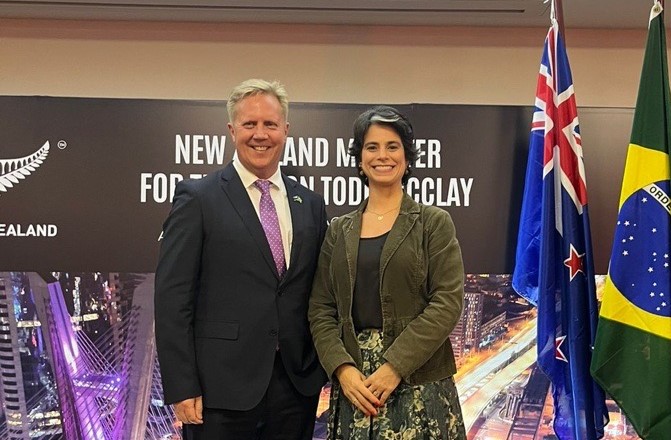
Former Ambassador to Brazil Caroline Bilkey knows this only too well. She says our strong reputation in international education is a “success story” which pays dividends down the line, as former students happily help to build our profile globally.
In her role progressing New Zealand interests offshore, Ms Bilkey has seen first-hand the benefits of working within networks of local people who studied in New Zealand.
“Not only is their experience in New Zealand a great conversation starter, but it also means you are more likely to be given the benefit of the doubt, and the person may be more willing to advocate your issue with their peers, because they know and like New Zealand, having studied there.”
Trade and business can benefit from link to international education
With more than 30 years’ experience with the Ministry of Foreign Affairs and Trade and multiple offshore postings, Ms Bilkey knows of countless instances where trade and business have benefited from a direct, or indirect, link to a former international student’s New Zealand education experience.
One such example is an Argentinian-Brazilian woman who returned to Brazil after studying in Auckland, to work for Fonterra and Zespri. Ms Bilkey describes the woman as “able to talk enthusiastically about the New Zealand story behind the products coming in”.
She believes there is something “quite special” about the links built through international education, largely because students are usually young, and their experiences are intense and formative.
Whether it is international students coming to study in New Zealand or Kiwis studying abroad, Ms Bilkey believes that there are many benefits associated with international education, beyond diplomacy, international trade, and the obvious economic benefits.
Positive international education experience opens hearts and minds
There are higher-level, public good benefits, she says. “A positive international education experience contributes to the global good, as it opens hearts and minds and encourages tolerance.”
Other benefits for all of us include the exposure to cutting-edge thinking and breakthroughs resulting from research collaboration between New Zealand and international students’ home countries. “The idea that if you get outside the box and have people coming in with a different approach, that can sometimes generate really positive, new and innovative ideas.”
Ms Bilkey is in no doubt that a positive international education experience in New Zealand boosts our connectivity with the rest of the world by building long-term relationships, enhancing business, opening doors to trade opportunities, and helping shape global citizens, all badly needed in a world facing unprecedented challenges.
-
International graduate helps strengthen New Zealand’s cyber-security
Qualified with a Bachelor of Business Administration from Taiwan and a Master of Science from the United States, Eric saw further international postgraduate study as a good opportunity to enhance his overseas life experience.
So, having spent many years working in the IT industry in Taiwan across a range of roles including systems engineering, information security, and personal data protection, he decided to move his family to New Zealand in 2018 to pursue a Master of Cyber Security at the University of Waikato.
“The University of Waikato is recognised among the world’s best in computer science and has the country’s first Master of Cyber Security focusing on malware analysis, penetration tests, cloud computing and legal compliance,” he says.
Master’s programme “challenging and complex”
Eric says he enjoyed the challenge of the master’s programme.
“Security in the IT field is challenging and complex, and covers many technical and non-technical aspects. Being a trusted IT security player is an intellectually and financially rewarding job, which can make our lives, communities and society better by ensuring IT is applied and managed securely.”
While at Waikato, Eric spent much of his time working on assignments in one of the computer labs. “I have many unforgettable memories that took place in the 24-hour computer areas where classmates and I would have countless discussions, exchanges of ideas, and even arguments.”
Since graduating in 2019,he has been working as a professional consultant at an audit firm in Auckland, putting his cybersecurity skills to good use implementing adequate security controls and incident management procedures to protect his clients.
Eric credits his international education experience at Waikato for putting him on a pathway to success. “The new literacy of cybersecurity risks, cloud computing technologies and legal compliance requirements I received from studying at Waikato has equipped me to make professional judgements on each security assessment, which has been extremely beneficial for my clients.”
New Zealand a great study destination
Based on his experience, Eric is keen to encourage any aspiring international student to seriously consider New Zealand as a study destination.
“Studying abroad is an exciting journey,” he says. “If you want to earn a qualification from a prestigious university, study new things in a multi-cultural environment, and have a laid-back and affordable lifestyle then New Zealand is the place for you.”
-
International students cap off education experience with Mural
Three students have rounded off their international education experience in Aotearoa New Zealand by teaming up with respected artists and local iwi to create a large street-side mural which celebrates the culture and diversity of Tāmaki Makaurau, their host city.
In the first collaboration of its kind, international students Nikita Sharma from Unitec, and Celia Lee, and Jenny Zhong from Auckland University’s Elam School of Fine Arts, were chosen to design and paint one panel of a three-panelled mural after Study Auckland invited art students from tertiary institutions across the city to join the project.
Nikita, who came from India to study in New Zealand, enjoyed working on the project along with Chinese-born New Zealander Jenny and Taiwanese international student Celia. “Our panel depicts diversity, inclusion and culture,” she says. “The project has given us the chance to give something back to the city and to the people who have welcomed us. We hope people feel a sense of connection to the artwork.”
International students were given the opportunity to connect with local iwi
The aim of the Study Auckland panel was to give international students the opportunity to connect with local iwi and work with respected local artists, including Hana Maihi of Ngāti Whātua Ōrākei, to explore what it means to make public art in New Zealand.
To help with the design process, the students joined Hana in a three-day wānanga at Ōrākei Marae to immerse themselves in Māori history, and learn about the significance of the mural’s location in Te Tōangaroa, on Ngāti Whātua Ōrākei owned land.
Study Auckland business development manager Beth Leyland, who led the project, is thrilled with the outcome and says the students are too.
“Auckland Unlimited’s Head of International Education Henry Matthews says the project truly reflects the principle of hospitality amongst the diverse cultures that make up our collective world right here in Tāmaki Makaurau.”
The students’ panel was funded through a $20,000 grant from the Ministry of Education’s International Student Wellbeing Fund. The other two panels were designed and painted by Hana and Te Whetū Collective member Poi Ngawati to bring awareness to the rich Māori heritage and taiao (environment) on which the city was founded.
Collectively, the three panels depict the importance of welcoming different cultures and diversity in Tāmaki Makaurau.
The vibrant 12-metre-high mural, incorporates elements of biodiversity which were once part of the landscape of the area. The students’ panel includes the poutama, a well-known step-like pattern seen in tukutuku panels adorning the walls of wharenui.
In 2019, 115,713 students from 180 countries enrolled to study in Aotearoa New Zealand, and became part of our communities. This injected $4.9b into our economy and supported more than 48,000 jobs. Just over 63,000 of those students were based in Tāmaki Maukaurau. The city currently hosts just under 13,000 international students.