Search
Showing 10 of 7355 results
- hb1
-
New Year brings new resources for international students
The ENZ team has been undertaking thorough research to address the big question on every international student’s mind: how much does it really cost to study and live in New Zealand?
After talking to students and seeking feedback about their experiences, ENZ has compiled a Cost of Living page.
This will be a centralised source of information for students that addresses the subject with clarity and transparency, setting realistic expectations on what they will need to budget for.
The page covers different budgets for a range of study options, noting the varying tuition fees depending on type of course (English language courses through to postgraduate) location and length of study.
Along with links to sites with further information on immigration and accommodation, the page also acknowledges that a typical student lifestyle goes beyond the bare necessities, and outlines everyday expenses in order to help students gain a comprehensive picture.
Of course, the cost of living is just one area of interest of prospective students – ENZ has also created a “Quick Facts” page where students can find 10 key reasons why New Zealand is the ultimate study destination.
- A3 infographic 2015 final
-
Putting a healthy smile on the dial of Fiji’s children
“I love working with children, particularly those living with disabilities and special healthcare needs who require more inclusive oral health policies and programmes.”
He spent the early years of his career working as a hospital dentist and teaching at the Fiji National University’s School of Dentistry and Oral Health but was ambitious to accomplish much more and knew he would have to study overseas to achieve his goals.
He travelled first to Portugal to enrol in a Master’s in Public Health and then to the University of Otago’s Faculty of Dentistry to undertake his Postgraduate Clinical Doctoral Degree in Paediatric Dentistry.
As a third generation Fijian of Indian descent, he describes his international education experience as “life-changing, academically and culturally fulfilling.”
But Jason says he could never have afforded to study in New Zealand without the support of a Manaaki New Zealand Scholarship, funded through the Ministry of Foreign Affairs and Trade. The programme sets out to build future leaders in developing countries by supporting students to upskill here.
Advocating for better oral health outcomes
Improving the oral health of young people drives Jason’s clinical and research work and he knows that implementing a preventative approach to tooth decay is key to achieving sustainable outcomes.
“The mindset in the Pacific is that people mostly don’t come to the hospital clinics for dental care, they wait for pain or symptoms before seeking help,” he says. “But we need to advocate strongly for prevention which is more cost-effective and acceptable.”
Arriving at the University of Otago in 2019, Jason embarked on his thesis researching the remineralisation potential of selected peptides (one of the building blocks of protein) in preventing tooth decay.
“Dental decay is prevalent, especially among children, but it is reversible in its early stages. The mainstay of prevention has been fluoride, but we proved that the peptides do have remineralisation potential. Investigation is now under way to learn how it performs alongside fluoride.”
“I think it has huge potential for the future. The dream would be that we have the next generation of children growing up without fillings in their mouths.”
Jason says this kind of research would not have been possible in Fiji. “I was very grateful for the experience at Otago. It was an environment that was both supportive and collaborative. It opened up networking opportunities for me. And those networks still support me today.”
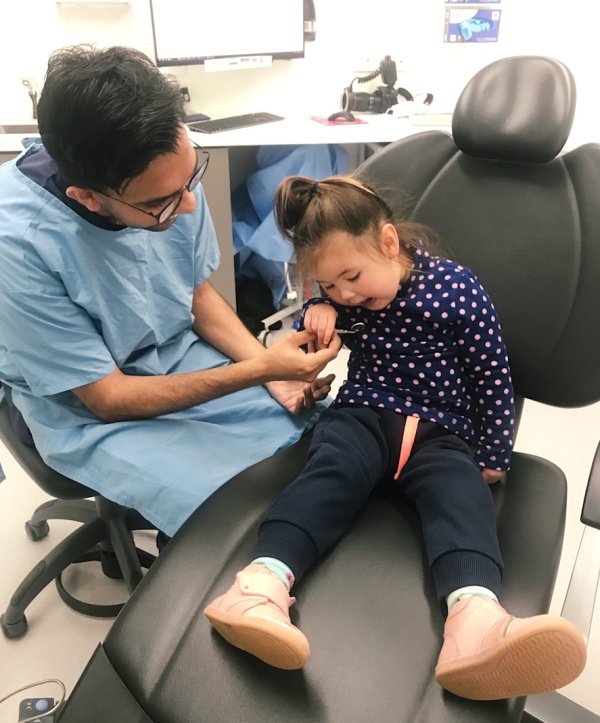
Jason also cared for patients at the faculty’s clinical facilities and theatre suites and provided on-call dental services for emergency patients after-hours at Dunedin Hospital, building close bonds with some of his young patients, especially those with special needs.
"The dream would be that we have the next generation of children growing up without fillings in their mouths."International education builds skills and confidence
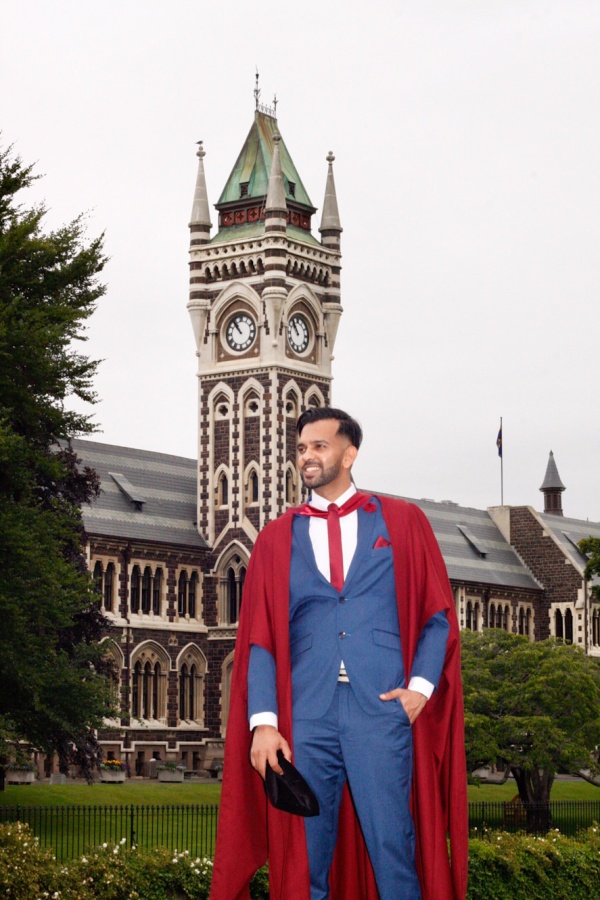
After his graduation in December, Jason returned to FNU School of Dentistry with additional skills and new-found confidence. “I think that gaining a formal specialist qualification has given me a voice to continue to advocate for children’s oral health through dental education.”
He wants to establish preventative oral health programmes in schools and help improve the curriculum being taught to dental students in the region, integrating recent innovations and research evidence.
It’s something he has been thinking about for many years. “Hopefully now we’ll get this done.”
“I’ve expanded my knowledge, upskilled, and I think I have become more confident as an academic, and as a person. I’ve got my international education and training to thank for that.”
Manaaki scholar gives back to the community
Jason is certainly fulfilling the brief of the Manaaki Scholarship to give back to his community. He is maintaining his clinical hours, teaching the next generation of dental students, volunteering his services at an NGO-run paediatric cardiac care hospital, and mentoring students wanting follow in his footsteps by studying overseas.
“International education is very important to Fiji as a developing country,” he says. “I thought it would be valuable to be able to guide students who would benefit from international scholarships in meeting their professional goals, while building capacity in the region.”
At heart, though, he is an academic and he hopes that in the coming years he can raise the research profile of the Pacific region and build a solid database which will help to secure the funding for much-needed oral healthcare programmes.
“My message is that there is no general health without oral health. It’s not going to be easy, but we need to start somewhere to get a voice for children and for the profession.”
-
Exploring a vision for the ‘Future of International Education’ in Aotearoa
It was an action-packed week in Wellington for Emeritus Professor Bean and his business partner Helen Souness. They were invited to Wellington by Education New Zealand Manapou ki te Ao (ENZ) to facilitate discussions on what the future may look like for Aotearoa New Zealand’s international education sector.
Professor Bean is former Vice Chancellor of The Open University in the United Kingdom and RMIT University in Australia, and is now CEO of the Bean Centre. Along with his business partner Helen Souness, former CEO of RMIT Online, they partner with education experts, education providers and technology companies to shape an education future that works for the rapidly evolving needs of learners, and the evolving landscape of work they will eventually be part of.
On Tuesday 1 August, ENZ hosted a cross-section of representatives from our international education partners in government, industry and tertiary education institutions at a full-day workshop. The aim of the workshop was to bring together our sector and collectively explore a vision for the future of international education in Aotearoa New Zealand. This work is a key part of Focus Area 2 of the New Zealand International Education Strategy 2022-2030 (NZIES) and how we can diversify our educational products and services and modes of delivery to create a more sustainable and resilient future.
ENZ’s Chief Executive Grant McPherson opened the event and said that it was a privilege to host experts in the field of international education and have them share their knowledge and experience on what is disrupting the world of tertiary and international education globally and what other countries are doing in the face of these challenges.
''I would like to thank everyone that came along with such energy and great ideas. It was a fantastic day and the collaboration between government, industry, and the education sector served to generate some inspiring ideas on how, as a country, we can innovate and differentiate our international education sector to remain competitive on the world stage.
''This is especially important work given the challenges that the international education sector is facing not just in Aotearoa but also around the globe. Professor Bean and Helen Souness really inspired us to think about the future of our sector from the point of view those around us including learners, communities, and industry, in the face of these challenges’’, said Grant.
Professor Martin Bean and Helen Souness had this to say about the 1 August workshop.
YouTube YouTubeProfessor Bean also said “I was delighted to participate in a week of deep thinking as we collectively imagined a brighter future for New Zealand’s international education sector.
“It’s clear that the world of work and tertiary education is changing rapidly and it’s great to see that colleagues in New Zealand are determined to meet the challenges and build a strategy to thrive in turbulent times”.
Another highlight of the day included a presentation from social innovators Hinepounamu Apanui-Barr and Briana Te Haara-Barr on the work that Tokona te Raki: Māori Futures Collective is doing in finding indigenous solutions to global challenges. Their case study and discussion provided valuable input to the day as we then discussed Aotearoa’s unique value proposition.
ENZ’s Sector Engagement General Manager Wendy Kerr, whose team is leading the work involved with Focus Area 2 of the NZIES, said that in the days following the workshop, the ENZ innovation team met with our international education agency partners to reflect on the discussions and wonderful ideas that were brought to the table during the day’s workshop.
“It’s not often we get a chance to shape the future and this week has proved a valuable foundation for many in our sector to contribute to the course of the future of international education for Aotearoa. And what an exciting privilege that is.
She added, ''Now the hard work really begins, and ENZ will be leading the development of a green paper that will be the basis for consultation with our international education partners including government, education providers, industry, iwi, the wider community, and of course, our learners. Watch this space for the exciting developments to come!’’


- GYjCncMTTR6NetqTj2mf 1932ENZ ThinkNew New Horizons L2
-
NZQA update for Thai students
The Council of University Presidents Thailand has agreed to support continuation of the NCEA Level 2 - Matthayom 6 qualifications recognition arrangement, whereby Thai universities will continue to use the equivalence criteria to make their admission decisions.
This arrangement provides two options for students to meet requirements for NCEA Level 2 - Matthayom 6 equivalency. Students who meet either of these options are eligible to apply for study at a Thai university under the Thai University Central Admission System.
The criteria for these options can be found on the NZQA website, which should be used to advise students on their programme planning and subject choices.
For more information visit www.nzqa.govt.nz/thailand.
-
Around the world in five
Around the World in Five
NEW ZEALAND
How New Zealand inspires and cares for international students
The government has recently announced that 1,000 students will be allowed to return to New Zealand in stages from April 2021 onwards. This initiative is just the tip of the iceberg in a series of efforts set to eventually unfold –– all part of a rigorous recovery plan for its international education sector. “It underscores the government’s commitment to the international education sector, which is important in the country’s long-term economic recovery from COVID-19,” says education minister Chris Hipkins.
UNITED STATES
Looking ahead into the unknown: US study abroad sector predicts cautious recovery
Pent up demand to travel and a resilient sector is giving US outbound program specialists hope – following the collapse of business as a result of the global health pandemic. But some warn that recovery will be gradual and the market will not return to its usual vitality until after 2024.
AUSTRALIA
‘Very concerning’: Indian students abandon Australian universities
The number of new Indian students choosing to study at Australian universities collapsed by more than 80 per cent in the second half of 2020, in a further blow to the country’s more than $30 billion international education system.
GLOBAL
New edtech startups aim to reinvent the online classroom
The chaos of 2020 forced educators to quickly adopt video conferencing tools such as Zoom and Google Meet to teach their students remotely. While none of those services had been specifically built for education, it hasn’t taken long for a new generation of edtech providers to enter the marketplace.
GLOBAL
Why universities will need to digitalise to survive
Universities, and the role they play in society, are under threat from the impact of the ongoing pandemic.
- Whakatipu 3
-
Student Visa Dashboard for October 2016
Student visas only capture students who enter New Zealand with a student visa. These students are mostly those who are planning to study for more than three months.
Student visa data is a reliable indicator of whether students are entering, remaining or leaving New Zealand. The dashboard contains detailed tables and graphs on the numbers of both first-time and total international student visas issued, with commentary on the trends to date.
The October 2016 dashboard includes summary level trends comparing to the three year average, year-to-date and the same month in the previous year. It also includes more detailed breakdowns by markets, sectors and regions focusing on year-to-date and monthly trends.
Download the Student Visa Dashboard for October 2016.
Please feel free to send feedback to intelligence@enz.govt.nz