Search
Showing 10 of 7165 results
-
Apply early and get ahead of the student visa peak
Immigration New Zealand (INZ) is approaching a peak period for student visa processing, which typically occurs between October and March as international students who are overseas prepare for the first half of the 2026 academic year.
Get your application in early
During peak periods, applications may take longer to process. To ensure timely visa decisions, prospective international students who are overseas are encouraged to submit their applications around 3 months before the intended travel date, as this provides the best chance of receiving a decision in time to begin study in New Zealand.
Late submissions risk missing the start of study and may result in declined applications if key documents are missing.
Students who are offshore and apply very early (for example, 6 months or more), may receive an approval in principle, allowing them to provide confirmation of study, funds transfers and tuition fee payment closer to their study commencement.
Check the recent processing times for student visa applications.
Changes to student visa work rights
Visas granted on or after 3 November 2025 will include a condition allowing up to 25 hours of work a week during term time, including those approved after that date from earlier applications.
If your visa is granted before 3 November 2025, the current 20-hour a week work limit will still apply. If you would like to work more hours after that date, you will need to apply for a variation of conditions to update your visa.
Upcoming changes to student visa work rights
To support a smoother and more transparent application process, INZ has moved international student visas to a new enhanced Immigration Online system.
The new form is tailored to each applicant’s situation. It asks only relevant questions and provides clear guidance throughout. It also provides real-time status updates and email notifications, giving students and their advisers greater visibility of application progress and clarity around any required actions.
While the new form may take slightly longer to complete, the additional information collected upfront is expected to reduce overall processing time.
Applying on enhanced Immigration Online
Students applying for the following visa types will be automatically directed to a redesigned, dynamic application form:
- English Language Student Visa
- Exchange Student Visa
- Fee Paying Student Visa
- Pathway Student Visa
- NZ Government Scholarship Student Visa
- Foreign Government Supported Student Visa
Applications submitted on or before 17 August 2025 will continue to be processed, and students will retain access to upload documents and respond to Immigration New Zealand requests until a decision is made.
Draft applications not submitted by 17 August 2025 can still be completed and submitted until 17 September 2025.
After 17 September 2025, all remaining drafts will be deleted, and a new application using the enhanced form will be required. The new student visa application forms on enhanced Immigration Online include built-in guidance to support applicants. It helps ensure they understand what is being asked and provides easy access to information to help them answer questions accurately.
Help us process your application faster
To avoid delays, students should ensure their application includes all required documentation. INZ may not contact applicants if key documents are missing, and incomplete applications may be declined.
INZ understands that some students may face delays in obtaining final academic documentation required for their application.
We recommend you apply as soon as you have the required documentation or contact your education provider to see if a conditional Offer of Place is available, so you can submit your student visa application and get the process underway.
If you do apply late, your application may not be processed in time for your study in New Zealand.
-
New Zealand shines at the 35th annual EAIE Conference
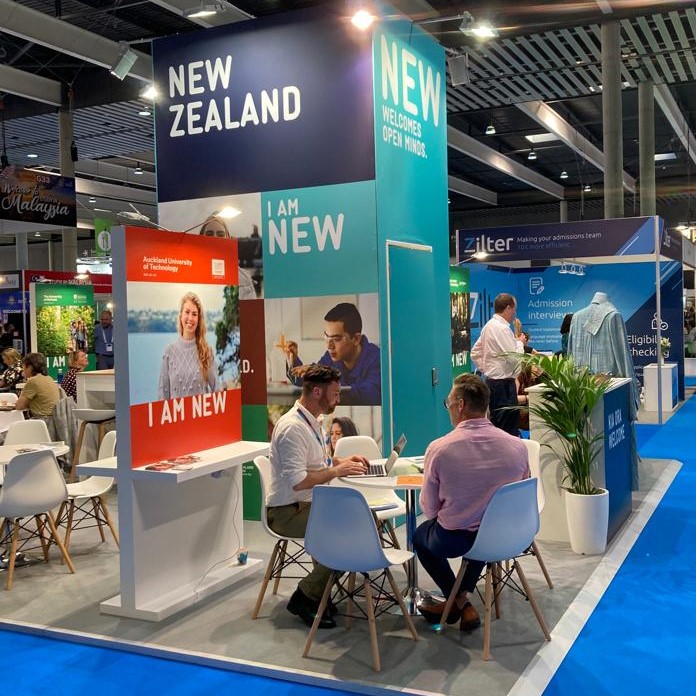
Education New Zealand Manapou ki te Ao (ENZ), in collaboration with all eight New Zealand universities and UP Education, demonstrated a commitment to international education and partnership.
The conference’s theme 'Go Create!' set the tone for a flurry of meetings and engagements between New Zealand representatives and international partners centered on innovation and collaboration in international education.
The New Zealand Pavilion proudly unveiled the refreshed Education New Zealand brand, featuring a sleek, modern design that aligns with the iconic New Zealand Government fern. This updated visual identity reflects the quality, ambition, and global impact of New Zealand’s international education offering.
The pavilion also showcases imagery from the new global campaign, "New Zealand Taught Me", which highlights how knowledge is nurtured across the country. Through powerful alumni stories, the campaign illustrates the transformative experiences international students gain in New Zealand.
From L to R: ENZ Chief Executive Amanda Malu, New Zealand Ambassador to Sweden HE David Taylor and ENZ Associate Director of Engagement Europe Olga Elli at the New Zealand pavilion.
A key event of the week was the New Zealand networking function, hosted by New Zealand Ambassador to Sweden and the wider Nordic region, HE David Taylor. ENZ representatives and visiting New Zealand institutions utilised the opportunity to connect and share with partners from across Scandinavia.
EAIE is one of the most significant global gatherings for international educators, government agencies, and academic leaders. It provided a valuable opportunity for New Zealand education institutions to engage with peers, present their offerings, and foster meaningful partnerships all in one place.
ENZ Chief Executive, Amanda Malu, said EAIE was a powerful reminder of the opportunities that lie in international education.
" From reconnecting with long-standing partners to exploring new possibilities, the energy and interest in New Zealand education was truly exciting,” she said.
-
New Zealand Taught Me: Campaign toolkits now available
Stakeholder-specific guidelines are now on ENZ BrandLab – empowering our partners to make the most of this campaign.
Check out the guidelines
-
View the New Zealand Taught Me guidelines for agents
-
View the New Zealand Taught Me guidelines for New Zealand education providers
Where to view the New Zealand Taught Me campaign assets
ENZ has a tailored NZ Taught Me campaign toolkit for our international education sector partners.
The toolkit is now available on BrandLab to download, click here to view the campaign resources available to you.
These comprehensive resources includes all campaign assets, social copy and translations, which you can use across your communication channels. It also provides clear guidelines to help you adapt the campaign messaging and create your own content that highlights the value of a New Zealand education.
Together, we can amplify the campaign and strengthen New Zealand’s global position and tell a distinctive story to set New Zealand apart from international competitors.
Contact ENZ Acting Brand Lead Rachel Stanion via Rachel.Stanion@enz.govt.nz if you have questions or ideas about leveraging the campaign assets. If you have a success story on how the campaign assets have supported your work, please also get in touch.
-
-
International students report high satisfaction as New Zealand sees steady recovery in enrolments
This year, 87 percent of students gave a positive rating of their overall experience, maintaining the upward trend seen in 2024 (86%). The proportion of students who rated their experience as ‘excellent’ rose to 43 percent, a two percent increase from the previous year.
These strong satisfaction results come as international student enrolments in New Zealand continue to grow. Between January and April 2025, 63,610 international students were enrolled with New Zealand education providers, a 16% increase compared to the same period in 2024 (54,690), and a 49% increase on 2023 (42,700).
All education subsectors saw growth, with Private Training Establishments (PTEs) showing the strongest increase at +41% compared to 2024.
China and India remained the top source markets, followed by Japan, South Korea, Sri Lanka, USA, Nepal, the Philippines, Thailand, and Germany. Notably, Sri Lanka rose to fifth place (from ninth), and Nepal to seventh (from eleventh), reflecting shifting dynamics in student mobility.
What students value most
Students were most positive about the people and connections they made in New Zealand (92%), the quality of their education (90%), their arrival and orientation experience (89%), the ease of making study arrangements (87%), and their overall living experience (87%).
International students’ experiences of making study arrangements have notably improved, with 80 percent of students rating their experience with the visa application process positively (up from 78% in 2024), and 74% positively rating the time taken to get their visa (up from 64%).
Education New Zealand and Immigration New Zealand will continue to collaborate on provision of information to students to ensure an enhanced student experience.
The survey also shows an increasing proportion of international students regard New Zealand as offering good value for money, with positive perceptions rising from 65% to 76%.
Education New Zealand's Chief Executive, Amanda Malu, said the results reflect New Zealand’s ability to provide a high-quality education within an environment that fosters meaningful connections and relationships.
“This is encouraging news for New Zealand. The fact that students continue to rate their experience here as excellent is a credit to our education providers and speaks to the warmth of the welcome our communities extend to international students,” she said.
“We’re seeing a steady and encouraging recovery in international education. It’s not a boom, but a sign that our collective efforts are making a difference. What matters most is that students are not just coming to New Zealand, they’re having a high-quality experience that supports wellbeing and a sense of belonging.”
“Under the International Education Going for Growth Plan, we’re focused on thoughtful, sustainable growth. These insights help us ensure that our progress is not just about numbers, but about delivering long-term value to students, communities, and the wider economy.”
Education New Zealand’s Director Insights and Performance, Marie Clark, said the survey continues to be a key piece of work for ENZ and a useful tool for the international education sector.
“It remains the only national survey focused on international student experience in all subsectors in New Zealand. With several years of data now collected, we’re building a meaningful picture of student experience over time,” she said.
“The ability to break down insights by variables like country, sector, and gender makes the dataset especially useful. We expect the report and Tableau dashboards will be very practical resources for anyone working in the sector,” Clark added.
For further information:
- Visit Tableau Public to access the data sets: International Student Experience Survey 2025 | Tableau Public
- Sai Raje | Senior Communications Advisor, Education New Zealand Manapou ki te Ao
sai.raje@enz.govt.nz | +64 21 479 649
Notes to Editors:
About the New Zealand International Student Experience Survey 2025
The survey aims to better understand the overall experience of international students enrolled with New Zealand education providers, as well as recent graduates. It also identifies areas for improvement to enhance the student journey.
Fieldwork was conducted from 28 April to 19 May 2025 with 5,420 respondents across all education subsectors and stages of study.
About Education New Zealand Manapou ki te Ao
Education New Zealand Manapou ki te Ao (ENZ) is the government agency dedicated to helping New Zealand realise the social, cultural, and economic benefits of international education. Our role is to promote New Zealand as a high-quality education destination offering excellent education and student experiences.
With approximately 85 staff in 13 locations around the world, ENZ works closely with New Zealand’s diverse education sector which includes schools, English language providers, Private Training Establishments, Institutes of Technology and Polytechnics (New Zealand Institute of Skills and Technology Te Pūkenga), and universities.
Internationally, we work with a range of education stakeholders, including government agencies and education providers to identify and encourage sustainable growth opportunities for New Zealand’s education sector.
-
Update from Immigration New Zealand
Update for international students: In-study work hours increasing from 3 November
From 3 November 2025, eligible international students will be able to work up to 25 hours per week during the semester - an increase from the current 20-hour limit. This change applies to all new student visas granted from that date, even if the application was submitted earlier.
If international students hold a student visa with a 20-hour work limit and want to take advantage of the new 25-hour allowance, they will need to apply for a variation of conditions (VOC) or a new student visa and pay the relevant fee
They can choose to apply now for the extra five hours or if their visa allows full-time work during summer vacation then they do not require the extra five hours and may choose to wait until later to apply for a variation. Some students will choose not to apply for a variation of conditions at all, and wait until their next student visa application
The process for applying for a variation of conditions depends on which system a visa was submitted through i.e. the old system or through enhanced Immigration Online.
For more information, visit Upcoming changes to student visa work rights: Immigration New Zealand
If they’re unsure which system their visa was issued in or which form to use, they can contact us for support before applying: Contact us: Immigration New Zealand
Update for international students: Changing your education provider or lowering your level of study from 3 November 2025
If a student visa holder is planning to change education provider or lower their level of study (for example, from a degree to a diploma), they’ll need to apply for a new student visa - not just a variation of conditions.
Upcoming changes to student visa work rights: Immigration New Zealand
This requirement ensures their visa accurately reflects the new study situation and complies with immigration requirements.
Before making any changes, students or their representatives should check the INZ website for guidance on how to apply for a new student visa on enhanced Immigration Online and ensure they apply in advance to avoid any disruption to their studies.
For more information, visit Study visas: Immigration New Zealand
Update for international students: Keep your visa photo filter free
We all like to look our best, but to avoid delays or declines, visa application photos must be a true, unedited likeness. That means students must abandon those filters and submit an accurate photo in order to avoid processing delays or declines.
Immigration New Zealand uses facial recognition, so filters, AI edits, or beauty enhancements interfere with identity checks. Photos must meet international biometric standards - natural skin tones, clear lighting, and no digital alterations.
Edited images including smoothing skin, changing eye size, reshaping facial features, or cropping your head onto a plain background will cause delays in processing and may lead to declined applications.
Key tips:
- Don’t use selfies - get someone to take your photo or use a professional.
- Tell photographers not to apply digital enhancements, like beauty filters or AI adjustments.
- Some photo apps or online tools may not be suitable for visa applications.
More information and examples of acceptable photos can be found on our website: Acceptable photos for a visa or NZeTA : Immigration New Zealand
Guardian visitor visa applications moving online from 3 November
From 3 November 2025, all Guardian Visitor Visa applications should be submitted on Immigration New Zealand’s enhanced Immigration Online system. This update is part of INZ’s broader digital transformation, aimed at improving the visa experience for families supporting international students.
While the information required remains the same, the application form may look a little different.
The enhanced system offers better application tracking and a more streamlined experience for applicants. Updated guidance and support materials are built into the form.
If you have an application in draft or submitted under the old application form, you will still be able to access or submit this application after 3 November 2025. We will notify you when the old application form is due to close.
For current visa holders, if your child is applying for a new student visa and you intend to apply for another Guardian Visitor Visa, both applications should be submitted through the enhanced system.
This change is particularly relevant for education providers, agents, and advisers supporting families of international students. Please share this update with your networks and encourage early preparation ahead of the transition.
Guardian Visitor Visa applications moving to enhanced Immigration Online: Immigration New Zealand
-
From the CE: Global New Zealand education promotions backed by positive international student experience
Kia ora koutou,
I am delighted to share this update with you from Beijing, where I am attending the China Annual Conference and Expo for International Education (CACIE), which is among the largest and most influential international education conferences in the Asia-Pacific.
New Zealand, as you know, has the proud distinction of being Country of Honour at CACIE 2025. What’s made New Zealand’s presence even more impactful is to have Hon Dr Shane Reti, the Minister for Universities and Minister of Science, Innovation and Technology join us on this visit. It is helping us raise New Zealand’s profile in education, research and innovation space during our short time in Beijing.
With over 25 tertiary education providers from around New Zealand in attendance at the conference, including universities, wānanga, polytechnics and private training establishments, we have a diverse delegation presenting a strong and unified New Zealand education brand in China.
On Wednesday, ENZ hosted the New Zealand Education Friends and Partners Reception and attended the New Zealand-China Education B2B Networking session.
While the reception was a wonderful opportunity that enabled our education providers to extend manaakitanga to their longtime Chinese partners, the B2B networking session was an important one to help them connect with new institutional partners in China.
On Thursday, I am looking forward to attending the CACIE plenary session (attracting over 3,000 people) where Minister Reti will deliver the Country of Honour address, followed by the second New Zealand-China High-Level Education Forum that will see significant government-to-government engagement in education.
I can’t wait to share some significant outcomes from this visit with you soon.
CACIE is, of course, only the latest major opportunity in what has shaped up to be an incredibly impactful promotions season for New Zealand education across the world – from China, India, Europe and Thailand to Viet Nam, Japan and Korea. I am truly proud of the huge collaborative effort that has gone into the successful delivery of these events with the sector.
It’s reassuring that these strong global promotions of New Zealand’s education quality are backed by the stellar results of the 2025 New Zealand International Student Experience Survey that see 87% of international students continue to rate their New Zealand experience positively.
What’s better is that these highly positive satisfaction results come as international student enrolments in New Zealand continue to grow, with 63,610 international students enrolled in the country between January and April 2025, a 16% increase compared to the same period in 2024 (54,690).
It’s a great track for us to stay on!
Poipoia te kākano, kia pūawai
Nurture the seed and it will bloom into a flower
Ngā mihi nui,
Amanda Malu
Chief Executive
-
Around the world in five
Asia
More English-taught programmes, growing job opportunities and affordable options are fuelling the growth of Asian education “powerhouses” outside the big four, a new study has revealed.
Global
A recent pilot study shows that most participants in semester abroad or other short-term exchange programmes are motivated by an interest in a new type of experience, the opportunity to encounter new cultures, and the chance to build language skills and new connections.
USA
The USA continues to lead the world in the number of global leaders educated, according to the latest annual Soft Power Index, though the gap with the UK has narrowed in the latest edition, which also lists the top institutions for the first time.
Australia
Southeast Asian students have been studying abroad for decades. But preferences are changing. Can traditional study destinations keep up?
India
Foreign universities in India promise to enhance higher education but face challenges replicating the transformative experiences of their home campuses.
-
New Zealand universities on show at NACAC annual conference
Representatives from six universities – Massey University, Victoria University of Wellington, University of Otago, University of Auckland, Lincoln University, and University of Waikato joined forces to engage with hundreds of US high school counsellors.
The New Zealand booth was a standout attraction, drawing heavy foot traffic thanks to the ever-popular ENZ Kiwi plush toys, four of which were raffled off to attendees. But while the Kiwi drew people in, it was the conversation about undergraduate study opportunities in New Zealand that kept them engaged.
Over 100 high school counsellors expressed interest in learning more about New Zealand universities, with many requesting in-person visits to their schools for student and family information sessions.
The universities and ENZ held an intimate reception for conference attendees at a local flower shop. High school counsellors had the opportunity to learn about New Zealand education offerings while doing crafts with New Zealand ferns.
ENZ also hosted an intimate reception during the conference, where attendees had a chance to learn about New Zealand and take a part of it home with them, through crafting New Zealand fern boutonnieres (similar to a corsage)
ENZ Director of Engagement North America, DuBois Jennings, said that many of the guests were Hawaiian high school counsellors.
“This event has continued the strong relationships built during ENZ’s Hawaii Roadshow earlier in the year,” he said.
“All New Zealand universities have reported a notable increase in applications from Hawaii following this roadshow,” DuBois added.
Participation in NACAC is a strategic move for ENZ, providing a vital platform to strengthen connections with US high school counsellors who are some of the key influencers in students’ college decision-making.
By deepening this stakeholder network, New Zealand universities are better positioned to attract more US students to pursue full undergraduate degrees in New Zealand.
-
New Zealand highlights global education links at major Indian conference
As the International Academic Partner, ENZ helped showcase New Zealand as a trusted education partner and destination. The event brought together education leaders, policymakers, and experts to discuss the future of learning, skills, and global collaboration.
Jugnu Roy (pictured centre) representing ENZ at the SEPC roundtable on Global Academic Mobility.
ENZ’s Director of Engagement for India and East Asia, Jugnu Roy, joined panel discussions and roundtables on global academic mobility and faculty exchange. These sessions were a chance to share New Zealand’s approach to student-focused, future-ready education and explore new opportunities for partnerships with India.
Director of Engagement for India and East Asia, Jugnu Roy, said India is a key strategic partner for New Zealand’s international education sector, and that continued engagement is essential to strengthening that relationship.
“Participating in forums like this allows us to engage deeply on shared goals and support India’s ambitions through meaningful academic cooperation,” she said.
-
Tokyo fair sparks excitement around New Zealand study opportunities
Earlier this month, Education New Zealand Manapou ki te Ao (ENZ) delivered a two-day event in Tokyo that brought New Zealand education to the forefront for Japanese students, families, and education agents.
The ENZ Fair attracted around 600 prospective students and their parents, while more than 150 education agents attended the seminar. The strong turnout and enthusiastic engagement reflected growing interest in New Zealand as a study destination.
A total of 62 New Zealand education providers took part, representing schools, universities, English language institutions, private training establishments (PTEs), and New Te Pūkenga New Zealand Institute of Skills and Technology (Te Pūkenga) providers.
The school sector led the charge, with 52 providers represented, highlighting the increasing demand for secondary education pathways.
Fumiaki Tanaka sharing his personal experience studying in New Zealand.
Attendees heard from inspiring guest speakers who shared personal stories and connections to New Zealand. Fumiaki Tanaka, a former Japan national rugby player and the first Japanese athlete to play Super Rugby with New Zealand’s Highlanders, spoke about his journey as an international student. Yukiko Chiba, Executive Officer and Director at Sekai Bunka Publishing, offered a parent’s perspective, reflecting on her child’s life-changing experience studying at a New Zealand high school.
Agent seminar
At the agent seminar, ENZ provided a New Zealand market update with the latest information, guidance and promotional materials.
The seminar also included a session focused on building long-term relationships between New Zealand and Japanese institutions. Headon John Paul, who represents the Oceania region for Ritsumeikan Uji Junior and Senior High School, and Ritsu Hidume, a New Zealand alumni now studying at Ritsumeikan Uji, shared their insights and advice with New Zealand education providers.
A roundtable discussion with four education agents and members of the Japan Association of Overseas Studies (JAOS) explored how agents support New Zealand education, current trends in the study abroad market, and opportunities to strengthen collaboration.
ENZ Senior Market Develop Manager Takako Tominaga said the feedback from New Zealand providers was overwhelmingly positive.
“We were really pleased to hear that New Zealand providers were impressed by the quality of the agents who attended, and that Japanese families showed genuine enthusiasm and interest in learning more about studying in New Zealand.”