Search
Showing 10 of 7355 results
-
Applications open for group Prime Minister’s Scholarships to study in Asia and Latin America
Applications from groups, institutions or organisation who can meet the objectives of the scholarship are welcome. Last year, successful group applicants included marae, whānau Māori trusts, tertiary providers, non-profit organisations and more. Applications close on 23 April 2023.
ENZ’s General Manager Sector Services, Sahinde Pala, says the scholarships are a wonderful opportunity for New Zealanders to gain transformational education experiences in Asia and Latin America.
“We love how the scholarships allow New Zealanders from a wide range of backgrounds to continue to add a global aspect to their learning, and make meaningful, often lifelong connections with people from other countries and cultures.
Applicants are invited to think differently about what overseas learning opportunities could enrich the lives of learners or members of their community, and how they contribute to New Zealand more broadly.”
The Prime Minister’s Scholarships are funded by the New Zealand Government and administered by Education New Zealand Manapou ki te Ao to support New Zealanders on learning experiences in Asia and Latin America.
The Scholarships’ group programme offers a flexible way to organise learning experiences in Asia and Latin America. Groups apply for a certain number of people, minimum of three, and once a programme is awarded, the organiser will run their own process to select the members who make up the group based on guidelines provided by ENZ.
Scholarship awardees from the 2022 group round have engaged in a diverse range of programmes, including customised indigenous-to-indigenous cultural exchange, advancing their language skills, learning new fashion design skills, and more.
Participants in a group programme simply need to meet the same eligibility requirements as individuals, including being a New Zealand citizen or permanent resident at least 18 years old at the date of applying.
Since its launch in 2013, the Prime Minister’s Scholarship programme has seen nearly 3,000 recipients, which helps New Zealand continue to engage with key partners in Asia and Latin America.
Applications for student groups from wānanga, universities, Te Pūkenga, private training establishments, iwi and other organisations will be open from 8 March – 23 April 2022, with successful applicants advised in early June.
More information is available on ENZ's dedicated scholarship website here.
A list of successful applicants from the 2022 group scholarship round is available here.
ENDS
Media contact:
Sai Raje
Senior Communications Advisor
021 479 649
Scholarship queries: scholarships@enz.govt.nz
Education New Zealand (ENZ) is a New Zealand Government agency dedicated to international education. ENZ promotes New Zealand as a study destination globally and supports New Zealanders to broaden their horizons through international education experiences beyond our shores.
-
University of Waikato announces pioneering international partnership
In September 2017, the University of Waikato will launch a joint Institute with Zheijiang University City College [ZUCC], offering Chinese students the opportunity to enrol in one of three undergraduate degrees in China with the University of Waikato providing the degrees and teaching staff.
On completion, the Chinese students will receive a degree from both universities.
University of Waikato Vice-Chancellor, Professor Neil Quigley, says the initiative complements other joint programmes the University has been running in China over the past 20 years.
"The University is committed to growing its off-shore delivery, and transnational education plays an important role in the University’s internationalisation strategy," said Professor Quigley.
Education New Zealand [ENZ] supported the preparation of the bid for initial submission to the Chinese Ministry of Education and the redevelopment of the Academic English part of the programme.
Grant McPherson, ENZ Chief Executive, says that in a global context transnational education is not only a growth area, but an important contributor to supporting the international reputation and brand of the provider, and New Zealand.
“We are delighted to see the University of Waikato expand offshore, with an approach that builds on an existing relationship and seamlessly aligns with the University’s offering,” said Mr McPherson.
The application process for approval of the institute was rigorous, including examination by the Provincial Ministry of Education and the Chinese Ministry of Education in Beijing.
The first intake of students will be able to study for degrees in finance, media and creative technologies, and computer graphic design.
The programmes included in the partnership were selected based on demand. The finance degree has been available to ZUCC students since 2008 but the students were required to complete the qualification in New Zealand. The partnership with the University of Waikato was established in 2002.
"The finance degree was a popular choice with students when we began our partnership with ZUCC,” said Professor Quigley.
“The addition of media and creative technologies and computer graphic design relates well to the location of ZUCC in Hangzhou, which is a hub for technology and creative practices."
-
Study in New Zealand website delivers greater value
Euan Howden, ENZ’s Student Attraction Director, says prospective students are increasingly using StudyinNewZealand.govt.nz (SiNZ) to search for study options, with new statistics showing use of SiNZ’s search widgets (stand-alone applications) surged 117% from last year.
“The addition of the ‘Find a course’ search widget last year, alongside existing widgets for institutions/schools, scholarships and agents, has considerably improved engagement.
“This shows the site is delivering value to prospective students as well as New Zealand providers who want to attract students to their unique education offerings.”
Those using the new search widgets are finding what they are looking for much quicker and are spending more time reading the results, an average of 4.22 minutes, which combined with a bounce rate (people who leave without reading further) of 5.9% is an outstanding result – the industry bounce rate average is 40%.
“The recent improvements to the search widgets have significantly increased our target audience’s exposure to content about why they should choose New Zealand, and we’re very pleased with results to date,” says Euan.

The SINZ search widgets allow prospective students to search for courses, institutions, scholarships and agents.This improved search performance coincides with a suite of other initiatives designed to improve site performance and deliver greater value to students.
Other updates include:
- Default search results are now randomised if a user has not used any search filters. This is a change from the previous approach of presenting results in alphabetical order and means preference won’t be given to institutions with names beginning with ‘A’.
- The start date refinement filter has been removed due to inconsistencies in the data available from institutions, which led to inconsistent search results.
- Keyword search will be enabled in the search widgets to allow for more intuitive search results for users.
These changes are in addition to the launch of My StudyNZ, which helps to connect students to New Zealand study options.
In the last year, more than one million users visited the SiNZ website. To maximise the potential of SINZ for your institution, ensure your institution’s profile is complete and up-to-date.
-
Continuing the discussion on the impact of AI on education
Since ChatGPT’s (Chat Generative Pretrained Transformer) launch in November last year, the Artificial Intelligence (AI) tool has featured heavily in headlines around the world, sparking conversations from boardrooms, to classrooms, and around the dining room table. Discussions on the significant impact this tool and future AI technology is having on how we teach, assess, and support our students here in New Zealand’s education system are happening in all areas of our sector, including here at Education New Zealand Manapou ki te Ao (ENZ),
A particular discussion during a recent EdTechNZ panel webinar on Artificial Intelligence and the impact on Education, looked at where educators may want to focus their valuable time now that generative AI platforms are available. For example, do educators want to spend their time researching topics, analysing data, and producing unique activities of work, or spend it on building meaningful relationships and place-based experiences with and for learners; gaining insights into learners’ interests, engaging in critical thinking activities and deepening learners experience of and outcomes in education?
Following EdTechNZ’s interesting and successful March webinar which can be viewed here; Artificial Intelligence and the impact on education, ENZ hosted an in-person seminar at our Tāmaki Makaurau offices in late April. This seminar's purpose was to look deeper at how this emerging technology is changing the way we learn, teach, and innovate.
Professor Ian Watson, recent past professor at the University of Auckland, spoke to a group from across the education spectrum including secondary schools, Private Training Establishments, EdTech founders, Education Publishers, Google, about AI and its impact on education.
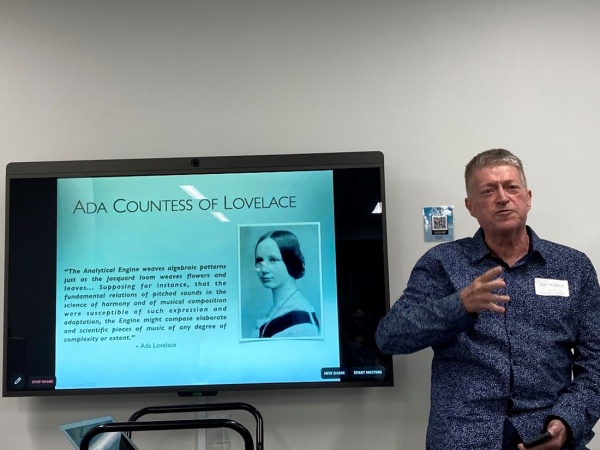
Professor Watson is considered an AI pioneer with 30+ years in the AI machine learning environment and reflected on the history of AI, including that it is not a new or sudden phenomenon, and its progress over time.
“AI imitates intelligence and is great at the specific but not so much the general. For example, aircraft use AI to be able to perform extremely specific flight tasks, but it will never be able to suggest a recipe and cook it!”, Professor Watson said.
“Within education, AI will certainly provide value in routine, mundane and repetitive tasks such as grading, lesson planning, report writing but in the hard and difficult tasks such as developing a universal design for learning and differentiated or targeted learning, it has its flaws. It is not always factually correct and still needs a human to educate it”.
Professor Watson also talked about how important it is, critical even, to teach learners how to use these tools, so they are empowered. Such tools include the likes of AI4K12 for K-12 learners.
Anyone looking for more insights and conversations about AI should check out the TechWeek23 programme with over 400 in person and online events to be hosted from 13 – 20 May.
Techweek AI focussed online events of note include:
- AI and education with AUT Monday 15 May
- AI is here to stay: Its impact on online, flexible, and distance learn with FLANZ (Flexible Learning Association) and EdTechNZ Thursday 18 May at 11:00am – 12:00pm.
-
Consultation on proposed changes to Rule 18
NZQA is consulting on the following proposed changes to the NZQF Programme Approval and Accreditation Rules 2018:
- Removing the student visa decline rate from Rule 18. This would no longer be the measure for when prior schooling with English as the language of instruction could be used as evidence of English proficiency.
- To use this provision, international students would need to have either
- a) completed their schooling in New Zealand, Australia, Canada, the Republic of Ireland, South Africa, the UK or the United States; or
- b) been awarded an internationally recognised qualification taught in English such as an International Baccalaureate Diploma or Cambridge ‘A’ Levels.
Dr Grant Klinkum, NZQA Deputy Chief Executive Quality Assurance, says the proposed changes respond to risks that NZQA and Immigration New Zealand have identified in the tertiary education sector.
“The student visa decline does not reliably reflect English language proficiency, and the countries involved had varying levels of quality within their English medium schooling options.
“We believe using prior schooling where English was the language of instruction will be a stronger indicator of English proficiency.”
NZQA is seeking feedback on the proposed changes, including what steps and how long your organisation would need to adapt to these changes, and if there are any other internationally recognised secondary qualifications taught and assessed in English that you would like to see included in Rule 18.
Consultation closes 11 February 2019.
To find out more and to complete the consultation survey, click here.
-
Engaging with Italian students and agents
Italy is New Zealand’s third-largest source of school students in Europe, the sixth-largest European market across all sectors, and our 25th largest market globally. The number of international students coming to New Zealand from Italy has grown steadily in recent years to 617 in 2017.
In October, the ENZ team attended bustling student fairs in Rome and Milan, targeting students looking for study abroad opportunities at tertiary level.
ENZ’s Market Development Manager Europe, Olga Elli, said it was a great opportunity to talk to students one-on-one – particularly at tertiary level, there is much interest in postgraduate study programmes.
“Italian students are really attracted to the idea of New Zealand but their knowledge of our education offering is still fairly low,” said Olga.
“Talking to hundreds of students and making presentations at each fair provided an opportunity to promote New Zealand education. There is also a growing focus on vocational training and pathways to employment – which fits well with our current ‘future-proof’ messaging.”
Over half of Italian students coming to New Zealand choose to study in Auckland, but education agents who attended an ENZ workshop in Milan were keen to hear more about opportunities in other areas of New Zealand.
“Italian agents are very engaged and several of the workshop attendees had recently been on a familiarisation visit to New Zealand, visiting Northland, Tauranga, Wellington and Christchurch.
“We are working with regional development agencies to run a series of webinars for agents in Europe to boost their knowledge, so they have the tools to advise their clients about what New Zealand can offer international students.”
New Zealand’s profile as an education destination for Italian high school students was boosted this year by ENZ’s Follow the Kiwi scholarship campaign which ran in France, Germany and Italy. Italy led the way in generating digital engagement, with the highest number of visits to the scholarship application page, and a strong showing in completed applications and requests for further information.
Building on this engagement, Olga paid a surprise visit to the school of Italian Follow the Kiwi scholar Gaia Leidi, from Busto Arsizio, near Milan, who will use the NZ$15,000 award to study at Kerikeri High School from January to September next year.
“Our visit to Gaia’s school generated lots of media attention. She’s a huge rugby fan and was blown away to be invited to the All Blacks vs. Italy game in Rome later this month!
“ENZ intends to build on the success of this year’s campaign and will run it again next year – watch this space!”
If you would like to get in touch with an ENZ Recognised Education Agent in Italy, please take a look here.

L-R: Olga Elli engaging with students at the student fair in Milan; and meeting Gaia during a surprise visit to Gaia's school.
-
Strengthening ties with Chilean education agents
The event brought together a group of Chilean education agents for an opportunity to connect with ENZ Director of Engagement Javiera Visedo and Whitecliffe Regional Manager Lorena Mendes.
The attending agents learned about study options for Chilean students at Whitecliffe and had the chance to ask questions in an open, interactive setting designed to support learning and strengthen relationships.
Agents highlighted an increasing interest in studying in New Zealand amongst students, noting a significant increase in meetings and enquiries.

Whitecliffe College Regional Manager Lorena Mendes presenting to local education agents.
ENZ Director of Engagement Javiera Visedo said strengthening relationships with agents and capability building is key to increasing awareness of New Zealand and its diverse study options.
“Nothing compares to a face-to-face training session, where agents can raise day-to-day questions from students and have them answered on the spot,” she said.
Whitecliffe College Regional Manager, Lorena Mendes, said Chile is a market with enormous potential and a key partner for international student growth in New Zealand.
“Here, we find professionalism, warmth, and a genuine interest in continually offering students the best opportunities for them,” she said.
- MaiENZ
-
The rise of services in our economy
Mr Holborow was commenting on a summary report prepared by MFAT of New Zealand’s goods and services trade for the year ended March 2017.
Over the last two years, New Zealand's total exports were up 5.2 per cent ($3.2 billion) – above the global average. But the real star was the services sector which grew 18 per cent ($3.4 billion), more than off-setting a $221 million (-0.5%) decline in goods exports over that period.
“The decline in the value of goods exports can be largely attributed to the declining value of dairy exports (down $1.3 billion from 2015),” the report says.
“Tourism and education travel services have more than compensated for this decline, bringing in an additional $1.8 billion and $916 million respectively over the past two years.
“Growth in the value of other goods exports, namely fruit and logs, also partially counteracted this decline.”
The report noted that New Zealand’s dairy exports have also “recovered somewhat” over the past (March ended) year, increasing for the first time since their peak in 2014.
Mr Holborow said in the face of the soft goods story, the “current glamour kids on the block in the services sector” should be acknowledged.
“The overall goods and services growth [New Zealand] achieved of 5% growth is driven off an 18% increase in services exports over the last two years (up $3.4 billion). This services growth is beginning to emerge as a trend.
“In the last 5 years our services exports, as a percentage of total exports, have increased from 26% to 31%. Today tourism accounts for 13% of our total exports, commercials services 7%, education 5%, air transport 3% and 'other' is 3%.”
-
NZTC brings ECE teaching to Malaysia
NZTC’s three-year Bachelor of Education (Early Childhood Education) degree has been approved for delivery in Malaysia through Kolej Dika – a respected specialist early childhood teacher education provider.
NZTC Chief Executive Selena Fox said this makes NZTC the first New Zealand tertiary education provider to have a degree accredited by the Malaysian Qualifications Agency and the Malaysia Ministry of Higher Education.
“This achievement is of international importance for New Zealand and Malaysia, celebrating innovation, shared commitment to excellence and creating opportunity for a specialised degree in Malaysia for teachers of young children,” said Ms Fox.
NZTC is New Zealand’s largest provider of early childhood teacher education.
Malaysian diploma students can now upgrade to NZTC’s internationally recognised and accredited degree to teach, educate and care for children and families.
“NZTC has been working on establishing educational relationships in Malaysia for a number of years and it will be exciting to see these relationships grow to a new level in the years ahead,” said Fox.
The Bachelor of Education (ECE) is also the first New Zealand qualification to be approved for National Higher Education Fund loans for Malaysian students.