Search
Showing 10 of 7355 results
-
The global citizens helping connect New Zealand with the world
The future looks like arts and crafts. In a room at the TSB Arena in Wellington in August, the Festival for the Future expo floor is packed with things to paint and fold and stick and make. At a stall for the Sustainable Development Goals I pick up a wooden bead representing the 11th goal – sustainable cities and communities – and paint it carefully orange, ready to be strung into a bright pattern with everyone else’s. As a shameless eavesdropper, this is my natural habit. I listen to two people discuss 3D printing, while another group sip ethical soda on colourful beanbags and chat about responsible investment.
At the Education New Zealand Manapou ki te Ao (ENZ) stall people line up for coffee while filling out forms about their experience of “global citizenship”. ENZ is the crown entity responsible for international education in Aotearoa. In 2019, pre-Covid-19, there were over 100,000 international students in New Zealand, studying mostly at tertiary institutions, but also at primary and secondary schools. Since 2013, more than 2,400 New Zealanders have been awarded Prime Minister’s Scholarships to study in Asia or Latin America.
"Global citizenship is an essential part of New Zealand’s international education strategy, and these inbound and outbound students represent an opportunity to create global connections, research links and broad partnerships for New Zealand."
ENZ partnered with the Festival for the Future to discuss what international education and global citizenship looks like in the unique confines of 2021. For Carla Rey Vasquez, ENZ’s global citizenship manager, the strategy’s value in an era of limited travel is the gift of a dual perspective to complex problems. It is also an opportunity to help New Zealanders understand the nuanced and mutual benefits of international education and the long-term relationships it creates with people around the world.
“Our world is characterized by complex issues. Global citizenship offers an opportunity to find ways to navigate and respond to those issues through shared understanding,” she says. “It’s about realising the value and power of your identity and knowledge, but also acknowledging the potential of others’ experience and perspectives on the world.”
This is a worldview that Rey Vasquez says is built on a relationship of local belonging and responsibility to our people as well as people across the world. International education is an essential way New Zealand builds that bond with the rest of the world, bringing diverse people, organisations and countries together.
Vasquez, a former international student herself, knows how transformational international education can be for both the student and New Zealand.

“It brings the world to our home, if we can harness the cultural value that international students bring to New Zealand we will all grow as global learners,” she says.
ENZ sees global citizenship as a way to bring shared understanding and learning between countries and cultures. Marc Doesburg, senior innovation advisor at ENZ, believes it offers new perspectives on the world, and a chance to question one’s own understanding.
“We give young people an opportunity to critique [their cultures] by going overseas, to see that things are done differently here.”
International students are a significant source of income for education institutions and the New Zealand economy, contributing more than $5b in 2019. But for both ENZ and international students the benefits students bring New Zealand are far broader than a GDP injection.
“I don’t want us just to be seen as bringing money – we bring culture, we bring international values…we want to know local people,” says Claire Lu, a Taiwanese student studying politics and international relations at Victoria University of Wellington.
That works both ways – studying abroad was an “invaluable” experience for New Zealander Anna de Boer, who studied Mandarin in Shanghai as part of a Prime Minister’s Scholarship and has been back to China several times since. De Boer now works with international students at Victoria University of Wellington. She wants to reframe the narrative that international students “come here, take something, then go back to their home country.”
There’s a huge benefit in how international students can take a piece of New Zealand home with them, and leave an important part of their own story behind in Aotearoa too, says De Boer. This builds long term relationships that have value far beyond the years they spend studying.
This was originally published on The Spinoff as part of a content partnership between Education New Zealand and The Spinoff.
- cl103 nztech advance education event suite 01
-
Graduate’s Kiwi know-how helps reduce water use in UAE desert
Rather than travelling to New Zealand and undertaking theoretical research with limited relevance back home, Wafa was able to carry out hands-on work addressing critical water management issues in her arid home country, while being supervised by New Zealand-based experts.
It was a personalised and practical kind of international education experience which Wafa is grateful for. “It allowed me to continue working, while at the same time learning and finding solutions to the water management issues facing the UAE.”
The education partnership grew out of a New Zealand G2G (Government to Government) relationship with the UAE which dates back to 2014. “The aim is to build the capacity of local people and find solutions to real problems through scholarships for study,” she says.
Already qualified with a Bachelor’s degree in ecology and environmental science and Master’s degree in water and environmental engineering, Wafa was working as an environmental scientist for Environment Agency - Abu Dhabi (EAD) when asked to be involved in the programme.
The region needs to find ways to manage the growing demand for groundwater in a hyper-arid, saline environment. Abu Dhabi, the capital of the UAE, has about 19 million planted trees in desert “forests”, a precious legacy of founding father Sheikh Zayed Al Nayhan. They provide a range of ecological benefits but are heavily dependent on groundwater irrigation.
With EAD given a government mandate in 2016 to protect groundwater reserves, water meters were introduced and areas of wastage identified. Wafa’s research was required to determine the exact water needs of the plants through the implementation of New Zealand technology, and experimentation with the use of treated sewage effluent, or “grey water”.
Distance learning partnership with Massey University
She worked with a team at New Zealand’s Plant & Food Research and her project was supervised by Principal Scientist Brent Clothier. The programme was managed by Lesley Kennedy of Wellington-based consultancy firm OnlyFromNZ.
“I travelled to New Zealand once or twice a year to meet Massey University requirements such as attending exams, presentations, or conferences. Likewise, Brent would come to the UAE with his team and help oversee the research.”
“It’s fit-for-purpose academic knowledge with real practical utility,” Dr Clothier says.
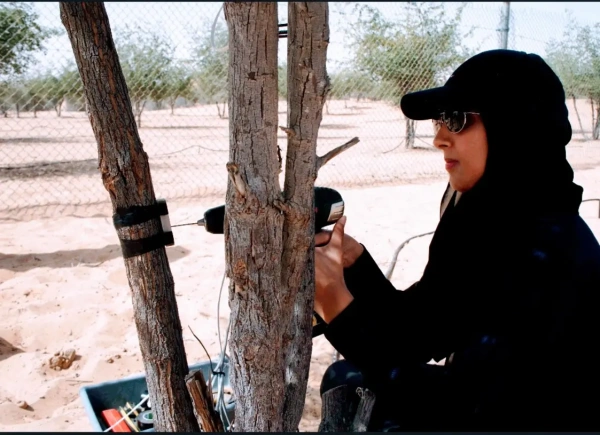
Wafa used Plant & Food Research’s heat pulse technology, which has been employed successfully in New Zealand and other parts of the world, but never in a region where temperatures can reach close to 50degC in summer. Once up and running, the technology provided readings every 30 minutes which allowed Wafa to calculate precisely the amount of water being absorbed by the plant.
“The data provided new and exciting information for us. We found that many of the trees had already adapted to the summer heat and did not take up as much water as we were providing through irrigation,” she says.
“By the end of the study we determined that we could save 35 - 70 percent of the water we have been supplying through irrigation.”
The technology was extended to other crops, and farmers are now provided with crop calculator software which provides guidance on the specific water needs of a tree, according to the month of the year, location, and soil type. “It’s a very important tool for growers in the UAE.”
“It’s good for countries to work together and find solutions to our challenges.”
Enduring relationship with New Zealand
Wafa is proud of the fact that her research is helping to solve a critical environmental issue in her country and knows that the collaboration with Massey through the NZ G2G partnership has been an integral part of her success. It has also paved the way for two other Emirati students to follow in her footsteps.
“I met other international students from the Middle East while at Massey and they were envious of me. They said I was very lucky because I was doing something for my country.”
She believes international education plays a key role in the exchange of information with other countries. “It’s good for countries to work together and find solutions to our challenges. If we are talking about the environment, we are all living in one world so it’s important that we work together to solve issues.”
But this academic partnership has not just produced practical results. It’s also seen a special bond develop between the New Zealand scientists and their Emirati students.
“I have built a long-lasting relationship with New Zealand,” Wafa says. “I know that I can always call my contacts in New Zealand to discuss an issue and they will be there for me.
“The relationship is much bigger than the life of the project and this is very important for me as a scientist and a researcher.”
-
From the CE: Committed to a quality student experience
I therefore welcome the Government’s announcement this week of a new, interim code of pastoral care for domestic tertiary students in place for 2020. New Zealand is a world leader in providing pastoral care to international students and has had a code in place since 2002.
The domestic code will complement the Education (Pastoral Care of International Students) Code of Practice, which provides assurance about the quality of the New Zealand study experience for prospective international students and their families.
The interim domestic code will not affect international students next year.
Providers, however, need to be aware of one important change that affects them. The Government is introducing new offences and penalties which will also apply to institutions enrolling international students. These offences and penalties are for severe breaches of the Code. Providers can comment on the Bill during the Parliamentary Select Committee submissions process this month.
Next year the Government is developing a permanent Code of Practice which will include opportunities for the sector to engage and contribute to its development. It also provides an opportunity to address any gaps in the current Code of Pastoral Care for International Students, in time for 2021.
ENZ is committed to a quality experience for all international students. We have worked with providers and students to develop resources for students to support their journey – from discovering New Zealand as a destination, through their decision-making process, while they study here, and up until the time they depart and become ‘ambassadors’ for New Zealand. We welcome the use of these resources by our industry partners to support your work with international students.
Resources like Study in New Zealand help students considering New Zealand as a destination. International students can search for courses and scholarships and register with My StudyNZ, which matches them with courses and institutions and enables them to track their applications.
NauMai NZ provides information on life as an international student living in New Zealand. It focuses on their support and wellbeing, helping them to make social connections and reducing the possibility of students feeling overwhelmed. It includes practical information and advice on everything from how to open a bank account to understanding Kiwi slang.
I’m also proud of our new campaign, ‘Ask New Anything’, launched last week. It features students providing unscripted answers to real questions from prospective students. It’s our most technologically advanced campaign to date using Tohu, a chatbot, to answer questions about studying and living in New Zealand.
I invite you to have a look at this and our other resources and to share them with your teams and international students.
After all, our shared goal is to ensure international students are well-informed and supported to enjoy a high-quality education and experience here in New Zealand.
Ngā mihi
Grant McPherson
Chief Executive, Education New Zealand – Kaihautū, Manapou ki te Ao
- AgentLab
- NAFSA 2026 1
- IMG 0904 jpg
- Job2078 ENZ Scholarships D01 Redrocks 0218 Final HR resized
- ENZ A3 Airport
- J001368 ENZ Year of the Snake homepage banner