Search
Showing 10 of 7355 results
-
NAFSA applauds Gilman scholarship
 The first government-to-government arrangement of its kind, ENZ signed an agreement with the US Department of State Bureau of Educational and Cultural Affairs (ECA) in January to cooperate on the Benjamin A. Gilman International Scholarship (‘the Gilman’).
Sir Richard announced the arrangement on ENZ’s behalf in his opening comments at the NAFSA conference.
The Gilman is aimed at students who might otherwise not have the opportunity to study abroad. Since its inception in 2001, more than 78,000 US students have applied for one of the 22,000 Gilman scholarships, making it one of the most prestigious and competitive scholarships for study abroad in the world.
Amy Rutherford, ENZ’s Director of Education, North America, said the partnership will help boost the profile of our institutions among US students.
“The scholarship will see increased promotion of New Zealand as an education destination, and will help to diversify the cohort of US students choosing to study here.
“Additionally, New Zealand institutions receiving Gilman scholars will be seen as supportive and inclusive partners, accepting students of all backgrounds and financial means.”
ENZ has committed to providing US $50,000 over the next two years to support Gilman scholars to study in New Zealand. This funding will be matched by ECA.
For more information about the Gilman scholarship, visit www.gilmanscholarship.org.
- e news 0
-
Letter from the CE on India student market
India is and will continue to be a large part of the international education industry. The vast majority of Indian students who study in New Zealand make a very valuable contribution to our campuses, our workplaces and our society. Every day Indian students, alongside other international students, are helping New Zealand to build its research capability and global linkages, to fill skill shortages and to enrich New Zealand culture.
However, we do currently have a small number of students from India facing potential deportation because of issues with their visa, or with illegal behaviour while they have been in New Zealand. Separately, students affected by the recent sale of an Auckland private training provider are being supported to transfer to a new provider to continue and complete their studies.
There have also been disturbing stories about some cases of the exploitation of international students from employers and others.
New Zealand government agencies are working closely together on these issues, to ensure all students are treated fairly and are well cared for, and to protect New Zealand’s educational reputation. This joint-agency work on international student wellbeing has focused in recent months on Auckland where the majority of international students are located, and involved a range of community meetings and student focus groups to ensure student needs and concerns are being heard and addressed.
It is vital that New Zealand maintains high standards across the international education industry.
It is also important that these events do not tarnish the reputation of an entire community nor devalue the significant contribution that international students from India and elsewhere, and our education providers, make to New Zealand.
To all of us involved in international education, it is a timely reminder to honour our obligations and responsibilities to students. We all – providers, agents, employers, community and ethnic groups, government agencies and other support services – have a role to play in a successful international student experience.
When I talk about shared responsibilities, I am talking about government agencies which set the regulatory frameworks (including setting rules around proof of financial means), and agencies like Education New Zealand which promote New Zealand’s education opportunity offshore. I am also talking about providers which offer students – domestic and international – a wide variety of education programmes. These programmes can act as a stepping stone to further study in New Zealand or overseas. They can also provide a pathway to residence if a student gains the skills that are in demand in New Zealand. At other times, they are very much about the overseas experience.
Education agents and students also have a responsibility for great student experiences. There has been a lot of communication about the obligation on New Zealand providers to manage their agent relationships. Information sharing on agent performance is a key part of Immigration New Zealand’s strategy to support providers’ decisions on the agents they work with. Providers can expect to see greater government engagement on this area of compliance with the new Code of Pastoral Care.
We also have a collective responsibility to share and promote the positive contribution that international education makes to our communities.
We believe that students too have an obligation to come here with genuine intent – that their primary purpose is to study and that they have the means to do so. Working in New Zealand while studying is a way to complement the classroom skills they learn and to really engage with everyday life. It is not intended as a lifeline to cover living costs which can expose vulnerable students to the risk of exploitation.
Of course, New Zealand employers are important contributors to the education experience as well. Everyone in New Zealand has the right to protection through minimum work rights, and we expect employers to uphold New Zealand employment law. We continue to encourage individuals to come forward if they have specific examples of workplace mistreatment. This is the only way we can address these issues.
We are also working alongside the New Zealand communities of international students because we see this as crucial to good outcomes. It helps to bridge the gap that may exist through the different cultural contexts which operate and where, for example, some international students aren’t aware of their rights and protections under New Zealand law.
Of the students and former students facing deportation, some are in New Zealand unlawfully, some have been found to have submitted fraudulent visa applications, and some have committed crimes here. It’s critical that only those who have the right to be in New Zealand remain. This helps to support a quality system for the majority of international students who have, and continue to come here with, genuine means and intent.
Lastly, we acknowledge the role of education providers in this process – we do not accept poor performance. For the hundreds delivering high-quality education programmes in New Zealand, the outcomes for international students are obvious. Education New Zealand has numerous student stories of success. For the small number of providers not performing, agencies are taking appropriate action, not all of which makes it into the public arena, and for good reason. But I can say that agencies are working together more closely than before, sharing information to support change where it’s needed and to continuously improve the New Zealand education experience.
International education is one of the most powerful ways to connect us across the world. Let’s all continue to take responsibility for our part in it.

Grant McPherson
Chief Executive, Education New Zealand
- E News Visiting Drivers image
- entry9
- IMG 3755 copy
- tip3
- International photo round-up
- India203 0
-
High-level delegation visit strengthens education relationship with India
The New Zealand India Education Week – held from 17-22 April – included senior level participation from New Zealand universities and was designed to further strengthen the strategic education partnership with India.
Education New Zealand Manapou ki te Ao (ENZ) Chief Executive, Grant McPherson, led the delegation across New Delhi, Mumbai, and Chennai.
Demonstrating New Zealand’s overall commitment to India, New Zealand announced an investment of $400,000 towards internationalisation and student mobility initiatives, including the relaunch of the New Zealand Excellence Awards (NZEA).
The NZEA are unique scholarships designed exclusively for Indian students that are jointly funded by ENZ and all New Zealand universities. Since their launch in 2016, the scholarships have enabled more than 200 Indian students to study at one of New Zealand’s universities.
Another key focus for the week was to re-engage with the New Zealand Centre at Indian Institute of Technology (IIT) Delhi and discuss the future trajectory of the partnership.
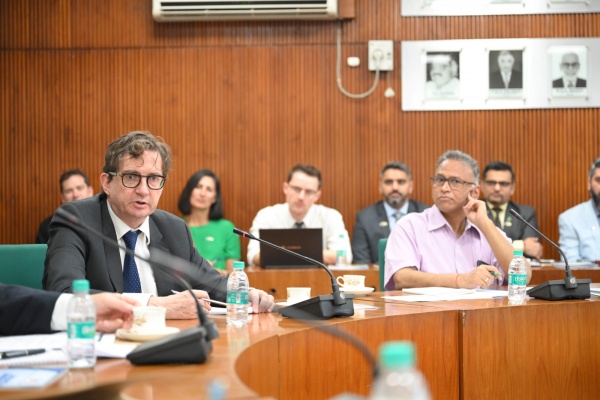
New Zealand High Commissioner to India His Excellency Mr David Pine speaking at a meeting with the Indian Institute of Technology Delhi.
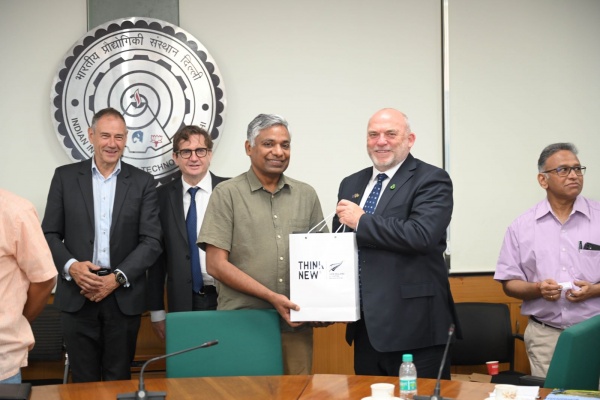
Caption: Education New Zealand Manapou ki te Ao Chief Executive, Grant McPherson (right), thanking Indian Institute of Technology Delhi (IITD) outgoing Dean International Naveen Garg (left) for hosting the NZ delegation at IIT.
Erik Lithander, Deputy Vice Chancellor Strategic Engagement at the University of Auckland, signed an MoU with IIT Delhi on behalf of all New Zealand universities to continue the relationship and further develop the New Zealand Study Centre.
The New Zealand Study Centre was inaugurated at IIT Delhi in February 2020 by Deputy PM Winston Peters, demonstrating the importance of education as a key part of the India-New Zealand relationship.
The week was bookended by two education agent fairs in New Delhi and Mumbai respectively, both of which exceeded expected student attendance numbers.
Speaking at a media briefing held at the New Zealand High Commission in New Delhi during the New Zealand India Education Week, ENZ CE Grant McPherson underlined the importance of New Zealand’s education partnership with India.
“India is one of New Zealand’s priority partner countries for collaborations, exchanges, and student mobility. We are excited that the announcements around the New Zealand Centre strengthening and the extensive package of scholarships under the New Zealand Excellence Awards scheme will further engagement with India,” Grant said.
ENZ Regional Director – Asia, Ben Burrowes, said with the sector’s focus on recovery and reconnections, the New Zealand India Education Week provided a great opportunity to refresh relationships with education sector stakeholders in India.
“India has always been a strong partner to New Zealand in the education space, and students from India consistently make up the second largest portion of international students studying in New Zealand.
“We are delighted for the opportunity that the New Zealand India Education Week offered us to reconnect and refresh our education links with India, and we look forward to building this relationship further over the coming years.”
Additional info –
To begin the week, sector representatives were provided with in-depth insights into the India-New Zealand relationship from High Commissioner David Pine, ENZ in-market staff and a consultant from EY. Representatives attended meetings with government departments such as the University Grants Commission (UGC) as well as B2B institutional networking events to support their university's global engagement. The delegation also met with two Indian Institutes of Technology (IIT), IIT Delhi and IIT Madras.