Search
Showing 10 of 7355 results
- David Downs
- Welcome pic
- Courtney Davies
- Overall Jan Aug 2014 2 2
- Grant McPherson photo edit
-
Former international student represents Aotearoa in Ecuador
With his career as an agronomist under way, Juan Pablo came to New Zealand on an MFAT-administered scholarship in 1988, wanting to build on his agricultural qualifications. After taking English courses at Victoria University Wellington Te Herenga Waka, he completed a two-year Diploma in Rural Studies at Massey University Te Kunengaki Pūrehuroa.
His time in New Zealand had such a profound impact on his life that he returned home determined to establish lasting bonds between the two countries. And there is no doubt that his appointment reflects just how much he has achieved.
Juan Pablo says he had dreamed of coming to New Zealand long before he got here. He had read ‘Grass to Milk’, Campbell McMeekan’s 1960s account of New Zealand’s dairying management practices which was well-known among dairy farmers in Ecuador. “I read the book and decided this is the place I want to go.”
Learning from the best
Very few students travelled to New Zealand from Ecuador at that time, most went to the United States for further education, he says. “Many people asked me why I was going to New Zealand, and people still ask me about it today. I tell them I went because I wanted to learn from the best.”
Juan Pablo says he was inspired by his lecturers, especially the late Professor Colin Holmes, a respected researcher, mentor, and advocate of the dairy industry.
“I came from an education system where the teacher held all the knowledge, where it was always black or white. In New Zealand it was totally different because learning was inquiry-based. Critical thinking was the method of developing knowledge.”
He says his experience was transformative on both a personal and professional level.
“The things I saw and learned, the New Zealand way of doing things, and the care and respect people had for each other had a powerful effect on me.”
Over the decades since Juan Pablo’s education experience in Aotearoa, he has built a highly-regarded career in Ecuador, founding and leading primary industry companies, accepting numerous board appointments, representing Ecuador in international free trade agreement negotiations, and being recognised with multiple honours for his contribution to the livestock and dairy sector.
Enduring ties to New Zealand
But he never forgot his ties to New Zealand, working tirelessly to strengthen the bilateral relationship and boost both business and education opportunities. He initially established a company to import agricultural products from New Zealand. When he later secured the role of General Manager of the Cattlemen’s Association, he passed on all his business contacts, and the organisation has been importing electric fencing components and seeds from New Zealand companies ever since.
“In 1988, we brought some cattle in from New Zealand for a breeding programme. Now many farms in Ecuador, including the ones I oversee, have cattle from New Zealand stock. And in the 1990s I helped to establish an education programme with Massey, which saw lecturers come to Ecuador to take short courses in dairy management.”
“When it comes to dairy farming, almost everything I know I learned in New Zealand - pasture management, milk production systems, electric fencing, animal welfare – and farmers have applied these practices successfully in Ecuador,” Juan Pablo says.
“New Zealand is top of mind for every farmer here. When you talk about New Zealand here, everybody knows about its reputation in agriculture. Going to New Zealand is on the wishlist for many people.”
Honoured to represent Aotearoa
Juan Pablo says he was deeply honoured to be asked to be New Zealand’s Honorary Consul in Ecuador, a role which is all about connections and creating opportunities which benefit both countries.
“I am very proud, and I’m happy because I now have the chance to advocate for Aotearoa,” he says. “The better the relationship with New Zealand, the better it is for Ecuador too. We must focus on what we have in common and make the most of it.”
He firmly believes international education is at the heart of relationship-building and collaboration between countries, even more than tourism and business. “You learn the values of a nation through education. Time spent studying in New Zealand will make you a better person.”
“International students will become New Zealand’s ambassadors to the world.”
- Governance of ENZs recognised education agents
-
From Education Minister Chris Hipkins
It represents a shift from international education as a revenue generating export industry to one that incorporates domestic students, boosts global skills and enriches our country socially and culturally.
We’re making strong progress towards this vision. Education New Zealand’s latest Perceptions survey shows more New Zealanders – nearly 60% – believe international education makes a positive contribution to this country. The survey also reveals an increased appreciation for benefits such as greater cultural understanding.
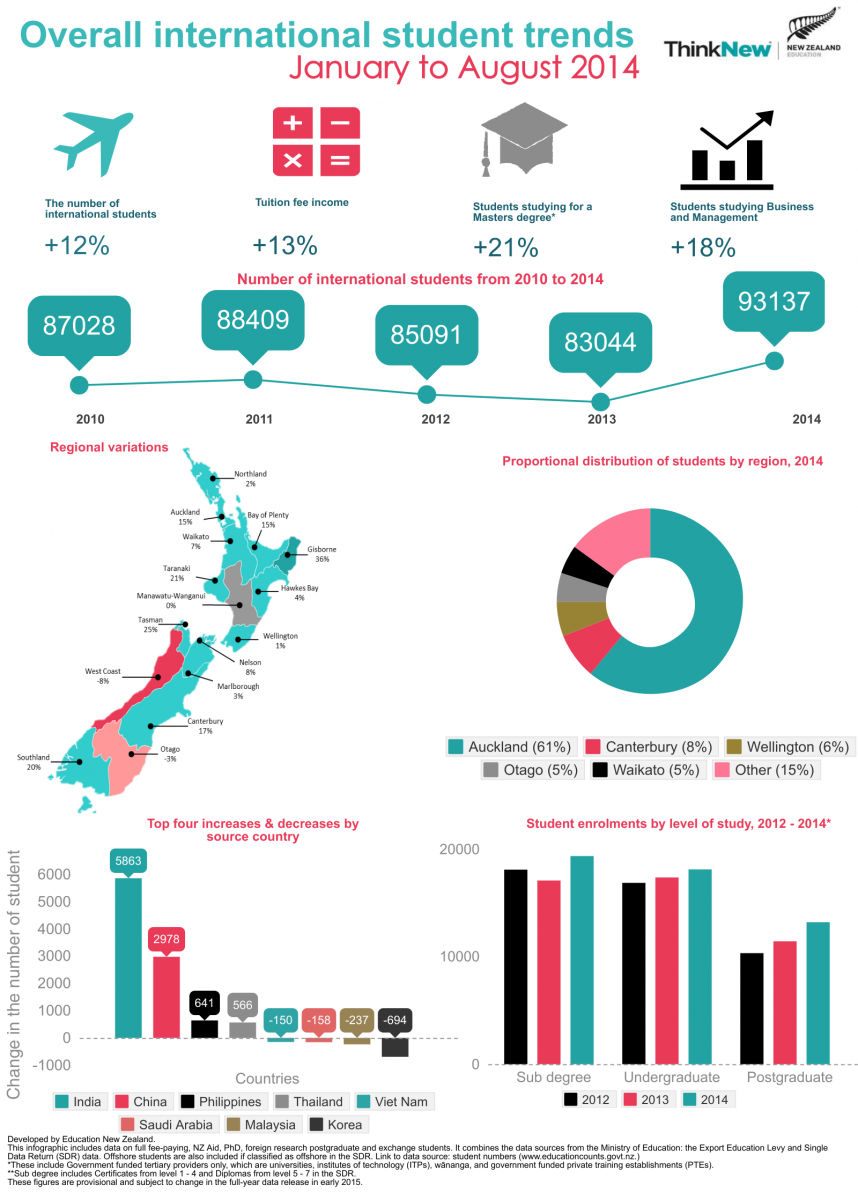
We’re seeing more international students located around the country, supporting regional economies and contributing to diversity and inclusion in local communities: the regional distribution of international students is now at its highest level in the past five years.
We are also seeing a rise in the numbers of international students enrolling at our universities – up seven percent from 2017, and also in our schools, which are up six percent.
This is evidence of the quality of the educational experience we are offering to the world. The Reform of Vocational Education is another step in the right direction, ensuring this sector is strong, unified and continues to be globally relevant in the fast-changing world of work.
The reform includes bringing together the country’s 16 ITPs under a single national Institute of Skills and Technology. This will strengthen New Zealand’s profile internationally and increase our ability to attract quality students from around the world.
Of course, an excellent educational experience is about more than just what happens in the classroom. It is about students feeling welcome, safe and supported. The International Education Strategy places wellbeing front and centre. We can be proud of the progress that has been made in this area – enhancing the pastoral care of international students and improving the information provided to prospective and current international students.
Let’s continue to work together to grow this vision. As one of the Kiwis surveyed for ENZ’s Perceptions research says: “by bringing a global perspective to our educational facilities, international students increase New Zealanders’ understanding of global cultures and perspectives – and collaborate with them".
- Malaysia roadshow 002
- vietnam story pic2