Search

Showing 10 of 7355 results

  • Screen Shot 2020 10 08 at 2.21.48 PM

  • 30631388623 8e2a0ffd45 o300

  • la20foto201202202

  • 2324 048 OIA Request koha payments to ex Board Chair and correspondence queries

  • 240518 MANAAKID1 283

  • rachel liao award web2

  • PM mission advances New Zealand and China education relationship

    The New Zealand Education Connect event on 20 June at the New Zealand Embassy in Beijing brought together leading Chinese government representatives, institutional partners, education agents, and alumni to strengthen people-to-people links and celebrate collaboration.  

    The event programme was packed, with nine Memorandums of Understanding (MoUs) signed between New Zealand and Chinese counterparts, and another MoU signed between Victoria University of Wellington and Fudan University on 19 June. 

    Providers from across the tertiary education sector signed the MoUs – with Victoria University of Wellington, Unitec, NMIT and UP Education’s University of Auckland International College and New Zealand Tertiary College formalising partnerships. 

    These agreements cover a mix of in-market delivery, joint programmes, and initiatives to grow student mobility between New Zealand and China.  

    This builds on the now over 60 approved joint education programmes and institutes recognised by the China Ministry of Education between New Zealand and Chinese institutions, and other education partnerships across early childhood education, vocational training, higher education, and research areas.  

    The New Zealand Education Connect event had senior leaders officially launching New Zealand’s Country of Honour campaign for the upcoming China Annual Conference and Expo for International Education (CACIE), China's largest platform for international education, due to take place in October this year.  

    ENZ’s Chief Executive, Amanda Malu, launches the Country of Honour campaign for New Zealand at CACIE alongside Prime Minister Luxon and CEAIE’s Secretary General Jun Yang.

    ENZ Chief Executive, Amanda Malu, said it’s exciting to see advancement of the partnerships New Zealand providers have built with their Chinese counterparts. 

    We’re eager to see the outcomes of the new agreements formalised at New Zealand Education Connect and look forward to deepening our bilateral ties by leading a delegation to CACIE later this year, she said. 

    Information on the registration process for New Zealand education providers to join the New Zealand Country of Honour events in October will be shared next month on ENZ’s event page.  

    The Country of Honour promotional video is available with Chinese subtitles on The Brand Lab.  


  • Spotlight on Japan

    When young Japanese student and talented rugby player Megumi came to New Zealand for six weeks to learn English in 2018, she loved it so much she decided to stay.

    Her welcoming host family and peers were a large part of why she chose to make the move – on top of the chance to play rugby four times a week and learn at a high-quality secondary school.

    Megumi is just one of the over 9,000 Japanese who come to New Zealand annually to study.

    In fact, Japan is the third largest source country for New Zealand’s international education sector.

    “New Zealand really values its education relationship with Japan, which stretches back over 60 years,” ENZ General Manager International, Lisa Futschek, says. “It’s economically important, but it also helps to enrich our young people’s lives and maintain strong cultural and people-to-people ties.”

    The number of Japanese students coming here to study has grown steadily since 2013, and looks likely to increase as a number of Japanese government policies centred on internationalisation take effect.

    ENZ Senior Market Development Manager for Japan, Misa Kitaoka, says 688 people visited the 2019 ENZ Fair, held in September; an all-time high and up from 500 visitors in 2018.

    “I noticed significantly more parents with young children were present at the fair and this is likely driven by the fact that English will become a compulsory subject for primary-schoolers in Japan next year from 2020,” she says.

    MG 8753

    While the market demand has traditionally been focused on short-term programmes (less than three months), Misa also saw increasing interest in the long-term studies among the visitors. Given the Japanese government’s internationalisation agenda, Japanese universities are increasingly adopting the Admission Office (AO) method of assessing applicants. This means there is less emphasis on Japan’s university entrance exam held once a year, allowing those students who return from New Zealand with NCEA certification to more easily apply to Japanese universities.

    Scholarships are also playing a part in generating interest in New Zealand. The Japanese government also support a series of scholarships. The Japan Student Services Organisation (JASSO), for example, offers monetary awards for both inbound and outbound students studying at tertiary level. The TOBITATE (“leap for tomorrow” in Japanese) Study Abroad initiative administered by the Ministry of Education, Culture, Sports, Science and Technology (MEXT) also provides scholarships for both school and tertiary students to study overseas.  

    What do Japanese students love about New Zealand?

    Most Japanese students travel to New Zealand to study at secondary school level.

    The opportunity to learn English in a safe and supportive environment is attractive to many Japanese learners, as is the chance to visit a country that is almost as rugby-mad as Japan. Programmes such as Game On English leverage both interests, bringing students here to both learn English and play sport at the same time.

    New Zealand’s unique style of teaching is also a major attraction for prospective Japanese students and their parents. From primary school on, Kiwi students are encouraged to work collaboratively with digital devices, which develops the “21st century skills” promoted by the Japanese government and outlined in a report published by the World Economic Forum. Additionally, Japanese students coming to New Zealand will experience this learning environment in an inclusive and diverse environment with many different cultures.

    Many Japanese alumni report that the Māori culture made a big impact on their time in New Zealand. Research released by the Asia New Zealand Foundation in September this year, New Zealand and Japan: To Our Future, identified Japan as the Asian country that held the most culturally similar views and values to Māori culture.

    “The importance Japanese people place on reciprocity and hospitality resonates with values like manaakitanga and kaitiakitanga. Both cultures emphasise respect for elders, take a long-term perspective and stress personal relationships underpinning business dealings.”

    2019 Rugby World Cup

    Education New Zealand, alongside other NZ Inc agencies, have concentrated efforts on raising New Zealand’s profile in Japan during the Rugby World Cup 2019.

    New Zealand and Japan: To Our Future found that many Japanese have a limited view of New Zealand. New Zealand was seen as being safe, clean and green, but also a little unsophisticated and not as technologically advanced as Japan.

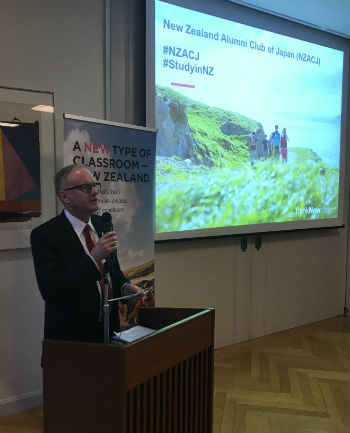
    Tourism New Zealand led the hosting of a pop-up event with support from ENZ last month. 

    Prime Minister Jacinda Ardern attended and posed for pictures with former All Blacks captain Richie McCaw and international alumni.

    ENZ’s Misa Kitaoka says cross-agency collaboration like this is one of the most effective ways to increase awareness of New Zealand among the Japanese public.

    “As destination marketing plays a key role for us, I hope to leverage high-profile NZ Inc activities and ministerial visits.”

  • CorpSite MaiENZ Now2x v2

  • 30631388623 8e2a0ffd45 o260

What's in it for me?