Search
Showing 10 of 7355 results
-
Around the world in five
UK
ELT sector concerns over rising agent costs
English language training institutions have voiced concerns that the rising commission rates of education agents are making it unsustainable for schools to pay.
GLOBAL
Bilingual education – a competitive advantage
Offering students a bilingual education could be key to improving access to higher education, provide opportunities to study abroad and improve future job prospects in an increasingly globalised world.
SOUTH KOREA
Fourth straight year of strong international student growth
Enrolments from Viet Nam are a strong factor in South Korea’s overall international student growth of nearly 70 percent since 2014.
BRAZIL
EMI courses in Brazil grow to more than 1,000
A growing number of higher education institutions in Brazil are recognising the importance of offering English as Medium of Instruction courses, with the number of EMI courses rising from 671 in 2016 to over 1,000 in 2018.
CHINA
The consolidation of private higher education
With more than 740 private higher education institutions in China, and thousands of private vocational schools, China’s fragmented private higher education industry is expected to undergo a wave of consolidation over the next decade.
-
Showcasing New Zealand education at EAIE 2022
Held from 13-16 September in Barcelona, Spain, the 32nd Annual EAIE Conference and Exhibition attracted more than 200 exhibitors and 6,300 participants for a packed programme of sessions, networking events and plenaries. This was an ideal platform for New Zealand institutions and the ENZ team to meet with key stakeholders, including government and university partners, education agents, and study abroad and pathway providers.
New Zealand’s branded pavilion featured the kākahu (garment) created for German student Malina Grube from the I AM NEW campaign, and attracted attention from European and global education professionals.
Alongside their busy schedule of meetings and appointments, the New Zealand representatives also attended a networking event organised by ENZ, which brought together more than 100 key education partners.
Speaking at the event, ENZ Chief Executive Grant McPherson said the value of New Zealand's education relationships in Europe lies in student mobility, and in the quality of the academic relationships between New Zealand and European partners, the strong research and innovation links between us, and the ties these build beyond the education sector.
“I am proud of the many educational partnerships and connections New Zealand’s institutions have with European counterparts and globally,” he said.
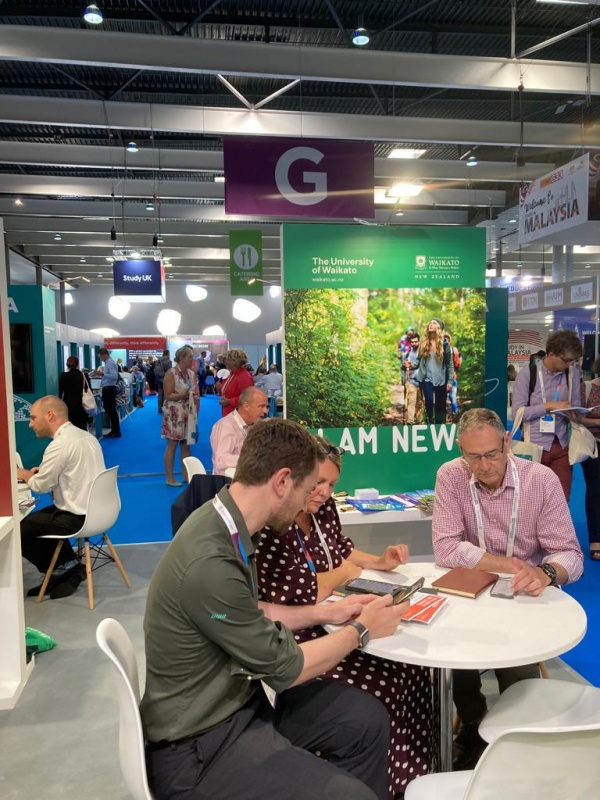
LtoR: Richard Witts, Regional Manager – Africa, Middle East & Europe, Sharon Calvert, Director, International, and Alister Jones, Senior Deputy Vice-Chancellor, the University of Waikato

Ainslie Moore, Interim Director International, the University of Auckland, meets with key contacts
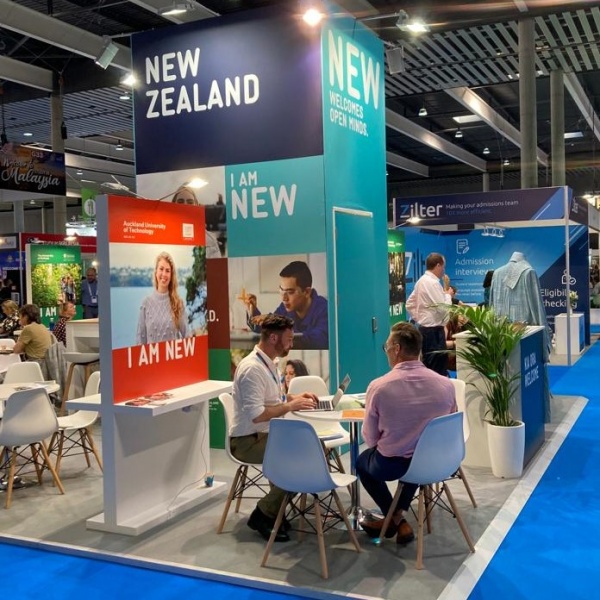
The New Zealand pavilion, with Brett Armstrong, Study Abroad Manager, Auckland University of Technology, in the foreground and the kākahu on display beside the welcome desk.
-
Student visa processing update
A very large number of applications have been submitted to INZ in January for courses beginning within four weeks of the application submission date.
Jeannie Melville, INZ’s Assistant General Manager, Visa Services reminds applicants to apply for their student visa at least eight weeks before their course start date.
“For those with an application in progress, we ask that they first check the recent student visa processing times published on the INZ website before contacting INZ to seek an update on their application. Those who submitted their visa application online should also check their online account regularly to ensure they haven’t missed any communications from INZ. If INZ needs more information to decide an application, it will take longer to assess.”
During this peak student visa application period, INZ is processing applications in some additional sites in an effort to ensure applications are decided as quickly as possible.
To ensure the sector is well informed, INZ is developing improved reporting on application processing, including the volume of work in progress and expected processing times. INZ will provide this information in regular email updates to education peak bodies.
ENZ is working closely with INZ on student visa processing matters, to help providers, students and agents understand the current situation. While INZ continues to experience high volumes of student visa applications, ENZ continues to monitor market reactions and engage constructively with INZ.
Current fee paying student visa application volumes (as at 27 January 2019)
Status
Application volumes
Assessment ongoing
7430
Approved in principle
1109
Total on hand
8539
Recent processing timeframes (calculated based on fee paying student visa applications decided 28 Oct 2018-28 Jan 2019)
Provider Type
80% decided within:
90% decided within:
Institutes of Technology and Polytechnics
38 days
50 days
Private Training Establishments
36 days
47 days
Schools
15 days
25 days
Universities
21 days
31 days
- New Zealand school sector approach to Viet Nam
-
India promotional season targets new cities
The ENZRA fairs took place in four new markets this year: Jaipur, Bangalore, Dehradun and Pune.
Jugnu Roy, ENZ’s Country Manager – India, said this offered a great opportunity to reach out to aspiring undergraduate and postgraduate students from new Indian markets.
“Indian families are increasingly choosing a New Zealand education as the best option for their children’s career paths. There was a 17% increase in Indian students enrolling at New Zealand universities in 2018, and a further 43% increase in first-time student visas in 2019.
“As part of the university strategy for India, our focus is on increasing awareness and enrolments at undergraduate levels, particularly amongst students who have traditionally been looking to the US, UK and Europe for their undergraduate degrees.”
In addition to the fairs, ENZ organised further activities for seven New Zealand universities. This included a roadshow to two prominent private schools in Delhi where they presented their strengths in the areas of business, engineering, science & technology, media, and art and design. This was followed by a high energy New Zealand-themed quiz show and some guest lectures by visiting academics from New Zealand universities.
ENZ also announced the first New Zealand Excellence Awards undergraduate package for Indian students, offering 18 scholarships worth $10,000 each to study at any one of the New Zealand’s universities. Applications close 10 June 2019.


-
Funding available for science projects with leading Indian institution
A total of USD100,000 in seed funding is available for joint research projects with the Indian Institute of Technology Delhi (IIT Delhi), under a programme facilitated by Education New Zealand Manapou ki te Ao. Applications open on 1 February 2022 and close on 1 March 2022.
The funding is administered by the New Zealand Centre at IIT Delhi, which has been set up to help researchers to collaborate, host visiting scientists and act as a forum for diplomatic and trade dialogue.
A virtual summit in late 2021 organised by ENZ attracted more than 100 participants from IIT Delhi and all eight New Zealand universities to explore opportunities for collaboration.
The summit was led by the University of Auckland’s Director International, Brett Berquist and IIT Delhi’s Dean of Research and Development, Professor Naveen Garg. They were joined by the High Commissioners from both countries.
ENZ’s Country Manager for India, Jugnu Roy, says the New Zealand Centre at IIT Delhi is a major contribution to ENZ’s strategy for building New Zealand’s academic reputation internationally.
“Academic cooperation with a key market like India, helps to enhance New Zealand’s output of joint research projects with leading institutions.
“It is an opportunity to sustain and increase the visibility of New Zealand universities, as well as their connections and rankings.
“We are delighted at the way the virtual summit has kickstarted the research conversations,” she said.
The memorandum of understanding setting up the New Zealand Centre at IIT Delhi was signed between all eight New Zealand universities and IIT Delhi in February 2020. It is the second such research centre – the other is the New Zealand Centre at Peking University in Beijing, China.
Find out more about the New Zealand Centre @ IIT Delhi and seed funding applications. If you have questions, contact Sheree.Moanaroa@universitiesnz.ac.nz
-
Education diplomacy strengthens New Zealand’s relationship with the Pacific Alliance
This initiative, funded by Education New Zealand Manapou ki te Ao, is a significant milestone in the relationship between New Zealand the alliance.
At the graduation ceremony, New Zealand Ambassador to Chile, Linda Te Puni, said “this celebration today is, first and foremost, yours but it is also a milestone for New Zealand because it reaffirms our commitment to the Pacific Alliance. We are pleased to continue to build and strengthen this relationship in various areas, including networking, educational and between peoples.”
The Pacific Alliance is a Latin American free trade area and economic integration initiative, established by Chile, Colombia, Mexico, and Peru in 2011. The bloc comprises the world’s eighth-largest economy and is home to over 220 million people. It has been identified by the Ministry of Foreign Affairs and Trade as a priority region for New Zealand, with negotiations for a free trade agreement currently underway.
The objective of the English Network of the Pacific Alliance is to develop a cooperation strategy to improve the language in the bloc, work in which it has had the support of New Zealand as an observer country.
“The promotion of the English language expands our people’s access to educational, scientific, technological and employment opportunities, while contributing to the formation of a more productive workforce, with a view to strengthening our competitiveness in global arenas,” Director of Regional Coordination and Integration Mechanisms of the Ministry of Foreign Affairs of Colombia and National Coordinator of Colombia for the Pacific Alliance, Adela Maestre, said.
The Pacific Alliance version of the NZGCC was led by teachers from Massey University. The first four weeks of the course were dedicated to the certificate, while the last two focused on creating a ‘community of learning’ for support and guidance, where methodologies, teaching practices and resources can be shared well after the course has finished.
The NZGCC was originally designed by AFS. The certificate teaches self-awareness, empathy for other cultures, and ways to build bridges in multicultural settings.
-
What’s next for ENZ events?
The trial of the EventsAIR OnAIR platform began in September with the Japan New Zealand Education Virtual Showcase and Agent Seminar, and will continue over the next few months for events like agent seminars in-market, the Viet Nam Student Showcase, and the Summer Retention Showcase.
Over and above a video-conferencing application like Zoom, the EventsAIR OnAIR platform has functions like a virtual exhibition, live Q & A, and gamification features, where users can compete to win points.
ENZ recently hosted our inaugural India New Zealand Education Week on the EventsAIR OnAIR platform. To have a look at the platform and how it works, you can register and view recordings of the event here.
ENZ has an established relationship with EventsAIR, having previously partnered with them for lead capture at in-person events.
ENZ Director – Channel Services and Partnerships, Dan Smidt, says what really clinched this new collaboration was the wide range of functionality EventsAIR had developed.
“We didn’t want a platform that would simply recreate what you’d expect from an in-person event. We wanted something that would use digital features in a creative way, to really capture the attention and imagination of our attendees.”
Participants are currently limited to providers who registered with ENZ for in-person events in-market before they were cancelled due to COVID-19. At the moment, ENZ is able to offer participation in these events at no cost to the sector.
“In the results of a survey out to New Zealand providers earlier this year, the cost of developing or participating in digital events was one of the most important factors for those considering their event options,” Dan says.
Even before COVID-19 caused global travel disruption and the widespread cancellation of in-person events, ENZ was looking into ways to host more events virtually.
“We know that education providers and students are becoming more conscious of the sustainability of long-haul air travel,” Dan says. “COVID-19 simply accelerated our work in the online event space.”
“This dynamic virtual events platform is the next logical step in the growth of the ENZ digital eco-system. We’re now able to think about how we do events in a whole new way.”
Dan and the ENZ Events Team hope to develop a virtual and hybrid calendar of events for 2021 with OnAIR. Please watch out for more updates on our events work in E-News on our website.
-
US delegation delighted by New Zealand biculturalism
Although many of the study abroad advisors were already working with New Zealand partners and sending students to New Zealand, they hadn’t experienced the country themselves.
Prior to the visit, participants listed Māori culture and heritage as one of their top three focuses for the visit to New Zealand institutions.
In Dunedin, the delegation was welcomed onto the Otago Polytechnic campus with a powhiri. In return, the delegation sang “Te Aroha” – after having practised it on the bus ride from their hotel.
The group said this moment, and similar experiences on other New Zealand campuses, was what provided them with a better understanding of New Zealand and the international student experience – even more so than the brochures they received from institutions.
“I was surprised and very impressed to see how Māori culture is so integrated and celebrated around the country. This is unique and a stark contrast to the experience of indigenous cultures in other countries,” said one delegate.
Alanna Dick, ENZ Field Director – North America, said the advisors left with a better understanding of New Zealand, and a drive to help more US students experience it too.
“It was clear to me the visit was a success when one study abroad advisor told me that now they understand the main points of difference between New Zealand and Australia! They now tell their students they would have a unique study experience in New Zealand, especially if they take a course to learn more about the indigenous culture like Kapa Haka or introduction to te Reo Māori.”
The US delegation offered suggestions for New Zealand institutions to consider when hosting international guests:
- Explain how Māori culture is embedded into curriculum
- Invite Kiwi students to sit on a student panel or lead campus tours
- More conversations over kai with faculty, staff and students and less PowerPoint presentations
- Consider having faculty give a short presentation about their area of research or courses they teach.
The US delegation also attended NZIEC to present a session on US engagement. They shared interesting initiatives and partnership models from their campuses, highlighted the importance of curriculum integration between US and overseas institutions, and shared best practices for outreach to students from diverse or underrepresented backgrounds.
-
NZISA hits the road
Congratulations to NZISA for organising and delivering these four separate events to give international students a warm welcome to New Zealand. The events were also an opportunity for students to connect with each other in person, hear from inspiring speakers from international and migrant backgrounds, and network with a range of government and NGO organisations who work closely with international students.

The Roadshow also provided a moment to celebrate NZISA’s five-year anniversary and recognise five years of advocating on behalf of international students, raising issues and concerns with appropriate government agencies.
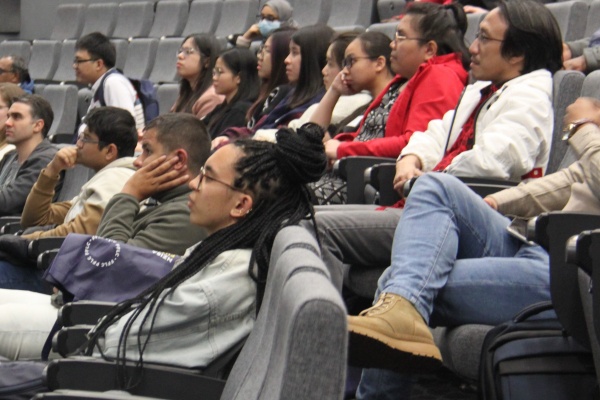
More than two hundred international students attended the events, which attracted very positive feedback. There was real appreciation for the kōrero of the guest speakers and the opportunity to connect with other students, especially from students who have just recently arrived in New Zealand.
“It was so inspiring to hear from the panellists how they were able to adapt and grow in new surroundings in a short time. I asked them about their motivation to work in New Zealand despite the cultural differences, and their answers really opened my eyes, as they mentioned that we can see challenges as a barrier, but instead look at them as opportunities to change and grow.” – Anis Aqeelah Afrina Mohd Raduan, who recently arrived in New Zealand to complete the final year of her Bachelor of Commerce at Te Victoria University of Wellington, majoring in Actuarial Science and Finance.
“It was so lovely to reconnect with past Presidents and executive members from NZISA and acknowledge just how far the association has come in five years,” says Sahinde Pala, General Manager Sector Services, Education New Zealand Manapou ki te Ao.
“Their hard work and commitment have given international students a voice with government agencies, ensuring the needs and concerns of international students studying with New Zealand are considered and addressed.”