Search
Showing 10 of 7183 results
-
Proposed changes to Export Education Levy
Currently, international education providers pay a flat fee of $185 per provider and 0.45 per cent of international tuition fee revenues.
The Ministry of Education proposes to reduce the percentage rate and remove the flat fee component, so providers pay less. The Ministry also proposes to allocate some funds from the EEL on a variety of additional activities over the next few years – with an initial focus on initiatives to improve the wellbeing and safety of international students in New Zealand.
You can find more information as well as the full version of the EEL consultation discussion document on the Ministry’s website.
The Ministry welcomes any input on the proposed changes by 8 September by email, post or via its EEL online survey.
-
2016 International Student Experience Survey for PTEs and English language providers
Find out how your institution performs compared to national and international benchmarks in terms of:
• overall satisfaction and recommendation
• the arrival experience – satisfaction with the arrival experience in New Zealand and at their institution
• the learning experience – satisfaction with their course of study, subject choice, learning environment and resources
• the living experience – satisfaction with such things as accommodation, living costs and day-to-day life
• support services – satisfaction with support services.If you participated in the 2012 or 2014 studies, see how your results have changed over time.
Participation in the study is free for institutions. If you would like to take part, please complete the registration form as soon as possible but no later than 7th October 2016.
More information about the 2016 International Student Experience Survey (including reports from the 2014 study) is available in the Frequently Asked Questions document.
Or, please don’t hesitate to contact Kyla Steenhart, Director, i-graduate New Zealand for more details – kyla.steenhart@i-graduate.org or +64 21 857 054.
-
Wellington's international students raise funds for local charity
Local Wellington businesses donated items to the auction, including Vodafone, the New Zealand Symphony Orchestra, Embassy cinema, Flight Coffee and Havana Coffee Works. In a true spirit of generosity, many students also pitched in to donate what they could, giving both financial contributions and items to be auctioned.
Together with a little help from its Auckland campus, The Campbell Institute raised over $2,000 for DCM.
“It’s a great chance for international students to contribute something extra to the community that is hosting them,” says Tim Mahren Brown, CEO of The Campbell Institute.
“It’s also a valuable language learning exercise in itself as students need to listen very carefully to follow the bidding!”
The Campbell Institute charity auction is an annual event and, in 2015, also raised funds for Sir Edmund Hillary’s Himalayan Trust to help rebuild Nepal after the earthquakes.
-
Regional Partners’ workshop a triumph
In August, Ms Favaloro joined an Education New Zealand regional partners’ workshop to lead sessions on pathways, stakeholder engagement and the art of visual storytelling.
The 15 regional education organisations represented shared their insights, learned about regional education trends and heard about Study Melbourne’s initiatives and success.
“It was absolutely inspirational to spend time with Jane. She really gave me a sense of what we should be aspiring to and how we might get there,” said Bree Loverich, Programme Manager for Canterbury Leadership Accord and Christchurch Educated.
Study Melbourne was established in 2006. For over 10 years, international education has been Victoria's largest services export industry, generating more than $46 billion for the economy. Victoria is now considered Australia’s designated ‘Education State’ with over 175,000 students studying there annually.
Greg Scott, Regional Programme Manager for ENZ, believes there are many reasons for providers to connect with their regional education organisations, chief among them:
-
Regional growth offers real benefits for education providers, regional economies, communities and students.
-
Education providers can grow their international programme by sharing regional marketing economies of scale, and gaining greater access in international markets using regional partnerships.
-
Regions offer distinctive opportunities for students to align their learning to employment opportunities and pathways to skilled residency.
"It was a pleasure to spend time learning how teams can convert a 'barrier' into an 'opportunity' when put into a room for a day and encouraged to engage,” said Jane Favaloro about the workshop.
“I look forward to hearing of the successes and, in the not so distant future, creating a superior student experience that targets specific international markets and enables mobility between Victoria and New Zealand."
Find out more about the Regional Partnership Programme here.
-
-
Minister sings praises of a NZ education in Japan and Korea
In late August, Minister Steven Joyce visited Japan and Korea to advance New Zealand’s business, innovation and education interests. Most of all, it was a great occasion to celebrate the friendship between our countries.
The visit kicked-off in Tokyo, where ENZ joined the Minister to meet with Toshiei Mizuochi, Japan’s new State Minister for Education, Culture, Sports, Science and Technology, to discuss opportunities in science and innovation. Minister Joyce highlighted New Zealand’s flexible qualification framework and expertise in vocational education, which Minister Mizuochi welcomed.
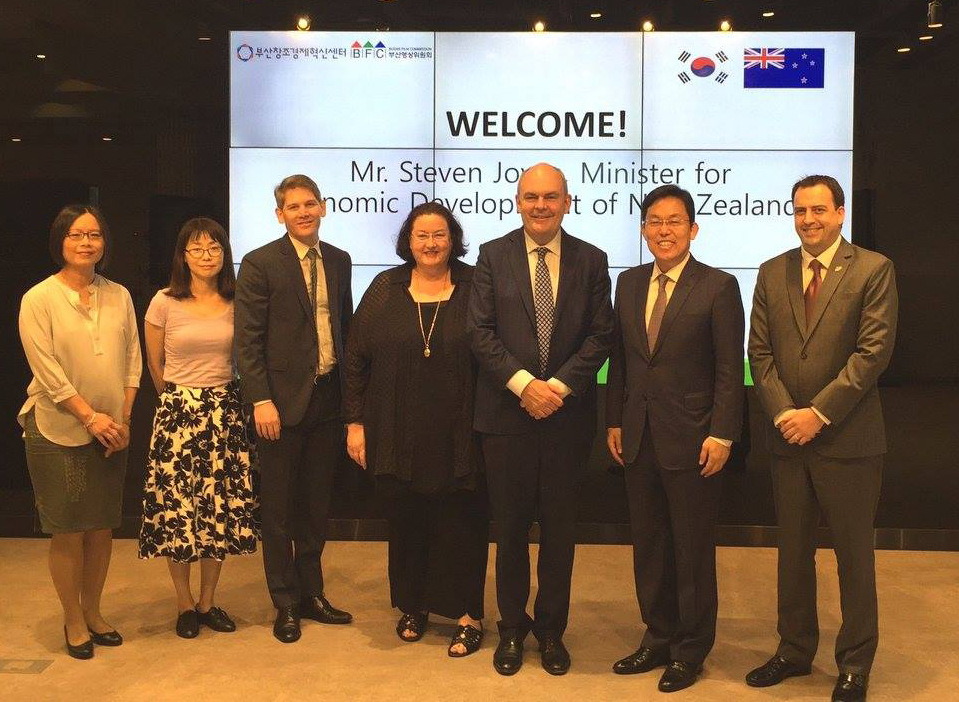
Following this, Minister Joyce went to Busan and Seoul, Korea, where he visited the Centre for Creative Economy and Innovation (CCEI) and talked about opportunities for working on film projects with Auckland. This includes a September workshop organised by Screen Auckland and AUT to teach staff and students from Busan-based Dongseo University more about film.
Minister Joyce also met with Lee Joon-shik, Korea’s Deputy Prime Minister and Minister of Education, to explore ways to grow the education relationship between Korea and New Zealand. This included the possibility of more Korean-language teaching and learning in New Zealand schools.

CCEI, from left to right: Cecily Lin, Acting Regional Lead, ENZ; CCEI staff; John Riley, Deputy Head of Mission; Clare Fearnley, NZ Ambassador; Minister Joyce; Cho Hong-geun, Head of CCEI; Ryan Freer, New Zealand Trade Commissioner
In each country, Minister Joyce hosted a reception for local guests including school teachers, agents and representatives from tertiary institutions. At the Tokyo reception, 13 high school students from Ikubunkan Institute of Education performed a haka and waiata for the Minister they had learned while studying in New Zealand. At the Seoul reception, guests were joined by Korean rappers Microdot and Sanchez who spoke with affection of their time studying in Auckland. Both evenings provided a wonderful opportunity for Minister Joyce to promote New Zealand’s education and lifestyle, the importance of an education relationship between our countries and to introduce the Prime Minister’s Scholarship for Asia.
“Education cooperation is an important way of developing a closer relationship between our countries, and encourages us to discuss and cooperate on issues of mutual interest and benefit,” said Minister Joyce.
The ENZ student fair will be held in Japan on 8 October in Fukuoka, and Tokyo on 9 October.
-
NZIEC 2016: Celebrating 25 years of coming together
With a record 650 delegates marking the occasion, including 90 speakers, six plenary and keynote sessions, and 44 breakout sessions, there was a lot going on.
Dr Adam Fraser kicked things off with an inspiring keynote address on The Third Space. It’s an ideal technique to better manage your time in the fast moving international education industry. If you didn’t manage to purchase one of Dr Adam Fraser’s books before they sold out, you can do so here.
In her Q&A with conference MC Miriama Kamo, Professor Stephanie Fahey, Lead Partner for Oceania at Ernst & Young, provided a range of insights on the future of the international education industry
Our conference dinner hit a high point as we celebrated 25 years of networking and collaboration. Cultural icon Elena wowed delegates with her personal story, which spoke to the importance of developing international connections firmly grounded in one’s culture.

On Day two, Jim Moser, Chief Executive of Clemenger BBDO New Zealand, provided insights into the future of marketing. Dopamine and oxytocin have never been mentioned more at a NZIEC than after his entertaining and insightful address!
Friday rounded off with David Bell from ASB Bank outlining how their organisation has used technology to continue innovating to stay one step ahead – including the development of the new Clever Kash cashless money box.
Feedback for the conference has been positive, with 94 per cent of attendees rating the conference good to excellent. Furthermore, some 83 per cent of delegates agreed or strongly agreed that NZIEC added value to their organisation.
You can also read some great coverage of the conference from PIE News here.
Conference presentations are available for download here.
Towards NZIEC 2017
NZIEC 2017 will be held on Tuesday 22 and Wednesday 23 August 2017 at the Sky City Convention Centre in Auckland. We’re already getting to work on designing the experience for NZIEC 2017, so please contact Sam Mackay if you have any suggestions. We’ll also be releasing a global Call for Papers in the coming months, so keep an eye out to secure your presenting slot at NZIEC 2017.
We look forward to seeing you back in the City of Sails next year.
-
NZIEC: What we learned from the panel sessions
Moving Places: Fostering the employability of international graduates
Panel MC, and ENZ General Manager Stakeholders, Communications and Intelligence, John Goulter, offered this report.
This session was focussed around what international students do after they graduate, and ways to ensure the best outcomes. The desired endpoint is for New Zealand to attract the very best international students to New Zealand for a high value, high quality education.
Emily Fabling, International Director at the Ministry of Education, outlined some hot-off-the-press research and shed some light on the international students who stay on to work in New Zealand.
Other panellists, including Kirk Hope from Business New Zealand and Steve McGill from Immigration New Zealand, discussed ways to ensure that international education plays to New Zealand’s strengths.
Darryn Melrose, Chief Executive of the Media Design School, explored ways to tailor products to attract the best students and produce graduates who are truly equipped for the needs of the job market, both in New Zealand and internationally.
There was a broad consensus that as a small country, New Zealand has the opportunity to develop niche markets and educational products. Many graduates will return to their home countries to build careers, others will go on to other countries for more education, but some will stay in New Zealand to make a long-term contribution to our economy and wellbeing.
The presentation slides of Moving places: Fostering the employability of international graduates are available to download here.
Overcoming the trials and tribulations of offshore delivery
Panel MC, and ENZ General Manager Business Development, Clive Jones, offered this report.
This panel featured four inspiring contributions from Selena Fox from New Zealand Tertiary College, Maria Johnson from Little Schools, Andrew Short from Cognition Education, and Ed Weymes of Waikato University.
While previous panels have tended to be tertiary focused, this panel had a heavy emphasis on the potential of New Zealand early childhood education and schools in offshore delivery. This could be through teacher training, establishing campuses, or the management of international schools using New Zealand’s expertise.

Clive Jones, General Manager Business Development, ENZ
The panellists outlined a common set of success factors needed, including:
-
New Zealand playing to its strengths
-
Understanding and meeting a market need
-
The critical role of in-market partners
-
The role of technology in supporting learner success
-
Retaining control of critical elements of the education and training offering in order to protect your reputation.
We had a very engaged audience, with a growing interest in understanding opportunities for New Zealand providers in the offshore delivery of training and education.
If you are interested in understanding more about offshore delivery opportunities, come and talk to ENZ and we can provide advice, guidance and connect you to experienced practitioners such as our panel members.
Social licence: International education and New Zealand communities
Panel MC, and ENZ General Manager Marketing and Channel Development, Paul Irwin, offered this report.

In order to build a sustainable international education industry in New Zealand, we will need the ongoing approval and acceptance of local communities to operate and grow.
This session explored ways to build social licence and to get New Zealanders not only supporting but endorsing the growth of international education.
Deborah Gray, GM Corporate Affairs, Tourism New Zealand, presented an interesting analysis of Tourism New Zealand’s learnings from its Visiting Drivers programme. She emphasised that building social licence is a long game.
Paul Irwin, General Manager Marketing and Channel Development, ENZ
We explored ways to use storytelling to build social licence, with New Zealand education providers, regional bodies and students all playing a key role. It is important to show the contribution students make when they are in another country, as well as the connections they make with employers (through internships, for example).
ENZ has recently commissioned research into New Zealanders’ perceptions of international education, with some 70 per cent supporting a New Zealand that is open-minded, friendly and welcoming. Reflecting this behaviour and value back to Kiwis is an opportunity for our story telling. ENZ is finalising the report with the researcher and will share it with industry in the next month.
The presentation slides from Social licence:International education and New Zealand communities are available to download here.
-
-
What happens after graduation?
“While the majority of international students are taking their New Zealand university education into the global workplace, it is positive that nearly half are staying here - at least for a period of time,” says Grant McPherson, Chief Executive of Education New Zealand.
“It suggests that there are opportunities in New Zealand for young skilled people, and is great news for employers who will have a more diverse pool of graduates to draw from in order to meet any skill shortages.”
Highlights:
- 48% of international graduates returned to live in their country of origin
- 43% of international graduates remained to work in New Zealand
- 9% international graduates currently live elsewhere overseas
Nearly 9,000 final-year university students participated in the baseline survey in 2011, and 70 per cent of these completed the first follow-up survey in 2014. Some nine per cent were international students.
The survey is part of the Graduate Longitudinal Study New Zealand (GLSNZ) which aims to determine how the lives and career goals of students are progressing. Over 80 per cent of the participants say they are currently employed.
The study was commissioned by Universities New Zealand with funding support from the Ministry of Education and Ministry of Women’s Affairs. It is being carried out by the Dunedin-based National Centre for Lifecourse Research.
The researchers will complete further follow-up surveys five and 10 years after graduation.
-
Whānau 4 Life: New Zealand to Vermont
The pedestrians in Burlington, Vermont USA had no idea they would stumble upon haka and poi performances as they strolled up Church Street on a recent Saturday evening.
The North American Whānau Council held its second annual event which included a BBQ, a hike up Mt. Philo and a dinner with waiata (songs) before taking its performance to the streets of Burlington. There was also an emotional ceremony, where the co-presidency was passed to two successors.
The North American Whānau Council is an organisation that sustains the relationship between North Americans who have been positively affected by Māori culture during their study abroad experience at Auckland University of Technology. The relationships are re-established each year through the North American Whānau Council Weekend, which continues the cultural exchange between alumni and their Māori whānau, or family.

Teaching poi to the next generation of AUT Whānau at Mt. Philo
The initial concept of the Whānau Council was started by AUT alumni in Denmark, and soon expanded to other countries in the region to create the European Whānau Council. Members are AUT alumni who took classes offered by the Faculty of Māori and Indigenous Development, and participated in the Noho Marae, a three-day event held at Ngā Wai o Horotiu Marae where AUT introduces international students to Māori culture, customs and the concept of ‘whānau’ or family.
Last year, two students from the University of Vermont (UVM) started the North American Whānau Council. AUT partners with two institutions in the Burlington area, which is one of the reasons why AUT whānau is so strong in Vermont.
The University of Vermont and AUT also have a partnership between their education departments. UVM students enrolled at AUT participate in a teaching internship at a primary school in Auckland, gaining a new perspective from the international setting. There have been more than 40 students in the programme over the last six years, with this year containing the largest cohort so far.
Dr Ellen Baker, head of UVM’s education department, says the international exchange has many benefits.
“Students can continue their professional trajectory, which is enriched by their experience in New Zealand. AUT has welcomed them through the orientation and the Noho Marae experience – students immediately feel a part of the community.”
Jason King, Senior Lecturer of the Faculty of Maori & Indigenous Development, AUT with the North American Whānau Council on top of Mt. Philo
Dr. George Burrill, Trustee to Champlain College and the Honorary Consul from New Zealand to Vermont, encouraged Champlain College to offer scholarships for a reciprocal exchange between Champlain and AUT students. At a recent awards luncheon, Connor, a scholarship student from Champlain College, told how despite his busy academic schedule at AUT he also coached a boys’ basketball team, and was also able to find time to explore New Zealand where he “geeked out for a few days and was a hobbit in Middle Earth,” exploring all the way down to Queenstown. Connor ended his speech with gratitude for the scholarship opportunity.
“I thank you once, I thank you twice, I thank you a thousand times for helping me in my journey. This opportunity has truly changed my life and the memories I made will not be forgotten.”
Thank you to the North American Whānau Council and the AUT staff for allowing me to join the Whānau in Burlington for the weekend.
Key takeaways
• Alumni are very eager to share their stories and participate in alumni events.
“I never get sick of talking about New Zealand.” – Monica
• Before students leave New Zealand, ask them how they will stay connected. The education graduates at UVM are developing a unit on Māori history and culture to teach in their classrooms.
“Most incredible semester I’ve ever had.” – Megan
• Connect your alumni with your contact at their international office so they can talk to prospective students during orientation, info sessions or a study abroad fairs.
Students are the driving force of alumni events abroad. Even when US students only come to New Zealand for one semester, their connection to Māori culture and the people of New Zealand lasts a lifetime thanks to the welcoming and positive learning culture.
-
Wellington schools team up for international education
Samuel Marsden Collegiate School, Chilton Saint James School and Scots College will market collectively as the Wellington Private Education Network, and will jointly fund an office in China where an onsite Marketing Manager can grow key relationships in the market.
The model has already seen a positive return, with Scots’ international student numbers more than doubling in the last 18 months. The schools are looking to develop a similar model in Thailand.
“This collaboration project sees us able to fully utilise shared resources which no single school could do on their own. Given we all offer the same world class education experience, it makes sense,” says Graeme Yule, Scots College Headmaster.
The collaboration will also implement StudyCare, a pastoral care programme to enhance the experience for international students that will also “help welcome and support new students to Wellington,” says Kathy Lloyd Parker, Principal of Chilton Saint James.
The programme has been developed by students and will be shared across all three schools.
Jenny Williams, Principal of Samuel Marsden Collegiate School is excited to see how the initiative will impact the wider community.
“The reaction been very positive and we have already seen an increase in interest for placement at our schools. Wellington has a wonderful offering for international students. There is real benefit to our current students and the wider Wellington community in increasing international numbers and internationalising our city.”
John Goulter, ENZ's General Manager, Stakeholders, Communications and Intelligence, is supportive of the collaboration.
“This initiative is a great example of regional collaboration to bring more international students in to Wellington. As a capital city, Wellington has so much to offer international students, and this is a great step to round out the region’s appeal.”