Search
Showing 10 of 7355 results
- Philippines
- WellingtonStaff 28
-
EdTech famil programme provides eyes on New Zealand for innovation
The programme included visits to Singapore, Viet Nam and Indonesia by a New Zealand delegation that included nine companies. The nine companies had a diverse range of education expertise, products and services from cutting edge Neuroscience for early childhood education to delivering TV-style drama series for English language education young adults. Six core companies participated across the three counties - Language fuel, Neurofrog, Chasing time English, StepsWeb, Jix Reality, and PipiLearning, while three additional companies already in the regions Writers' toolbox,Komodo wellbeing and Kami, joined the Singapore programme for specific elements.
The programme included meetings with the Ministries of Education of all three countries, specifically to understand the digital adoption and education roadmaps of each. Singapore shared their Transformation of education technology masterplan 2030 as a capability multiplier for educators and learners, and Viet Nam shared their focus on and investment in technology and management systems and using education technology to build the human potential of their citizens. Indonesia shared their Super App which allows for their 646.2 thousand schools, 4.2 million teachers and lecturers and 71 million students to all benefit from the large-scale acceleration of an economy moving at pace with a firm policy that ‘no one is left behind’.
Alana Pellow, ENZ’s Business Development Manager, led the delegation and said that the programme was carefully put together to ensure the visit was as much about showcasing New Zealand’s expertise and innovation in EdTech as it was to learn about what other countries and leaders in this space are doing.
“Across the three countries, the EdTech companies had the opportunity to meet and visit education providers from schoolteachers and leaders, vocational education providers and universities to education enrichment centers. They also heard from New Zealand business leaders and government agencies in each region, as well as had briefings and networking with local EdTech owners to gain a deep understanding of the economic and EdTech landscapes in each country.
“The public, private and enrichment education landscapes, which offer significant opportunity for EdTech’s, was a great eye opener particularly in Early Childhood Education (ECE), English language, literacy and English language teacher’s space.
“For example, in Viet Nam it is not uncommon for parents to spend 30% of their income on education – including after school enrichment education such is the ambition of parents for their children,” said Alana.
The private school market across all three markets is viewed as particularly significant for New Zealand. During the visit, it was noted by a number of diverse education related professionals how the New Zealand EdTech group were subject matter experts with education specific capabilities and expertise across many areas from linguistics, literacy, English language, teaching, academic R&D and collaboration with recognised and respected global experts such as – Oxford University Press, Oxford University, Royal Melbourne Institute of Technology, National University of Singapore, Institute of Technolgy Education and the University of Auckland.
Interest in New Zealand’s Education Technology was picked up by the local press in Indonesia and Viet Nam, with Viet Nam in particular seeing 17 stories feature across its various media channels. This has provided valuable visibility of New Zealand’s innovation and expertise in digital education across a wide education subsector value base from ECE and K-14 to R&D at tertiary level. Positive leads have followed and the founder and CEO of SIS and Inspirasi schools, which has schools across Indonesia, South Korea, Myanmar, and India, has already been in touch with two of the NZ EdTech companies to explore future collaboration.
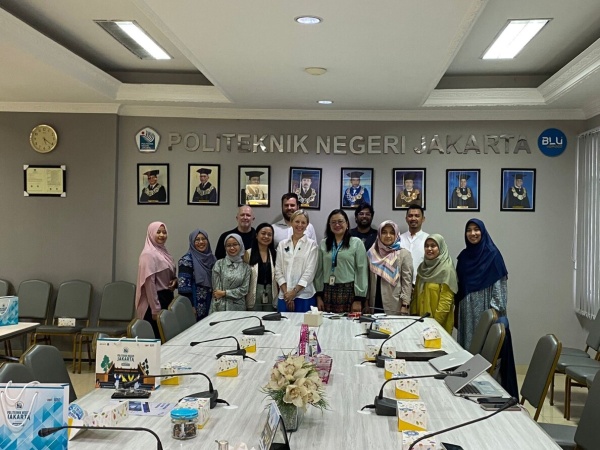
Meeting with Politeknik Negeri Jakarta (VET) Indonesia.
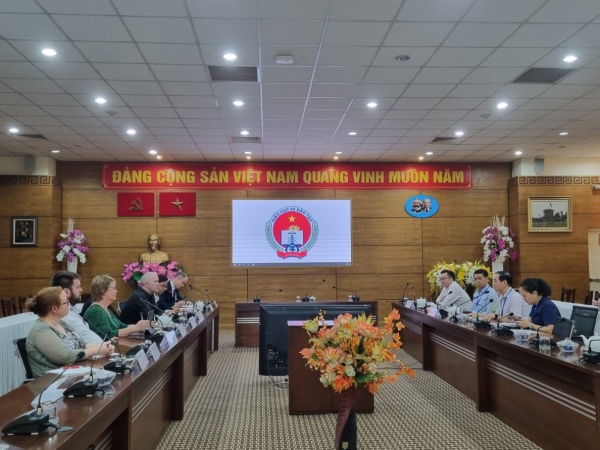
ENZ’s EdTech delegation meeting with Mr. Nguyen Bao Quoc, Deputy Director (Digital Transformation), and colleagues at the HCMC Department of Education & Training, Ho Chi Mihn City, Viet Nam.
The delegation also attended the EDUtech Asia Policy Summit in Singapore where education, education policy makers and education technology solution providers came together from across Southeast Asia. Highlights included:
- The pace and scale at which many SEA countries are upskilling and shifting their policy and philosophy to equip their educators, citizens and systems to be meaningfully productive.
- That digital literacy training is not just the domain of learners. Educators also need high quality digital training, materials and resources.
- Artificial Intelligence is forcing a rethink on everything and in assessments, what do we care about assessing? Knowledge attainment or the deep skills for being human?
- Partnership is hard but offers competitive advantage and ‘’success’’ when human skills are done well, and many global universities are doing partnership well and reaping the rewards.
Any New Zealand EdTech and Education publisher companies interested in finding out more about the SEA market can contact Alana Pellow - alana.pellow@enz.govt.nz
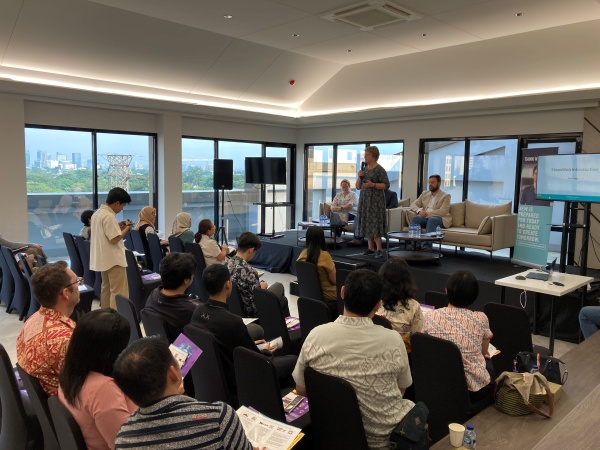
ENZ’s EdTech delegation meeting with Mr. Nguyen Bao Quoc, Deputy Director (Digital Transformation), and colleagues at the HCMC Department of Education & Training, Ho Chi Mihn City, Viet Nam.
-
Government delegation from South Korea visits New Zealand to reconnect with several of our education providers
New Zealand and South Korea have strong education links and one unique partnership is the education cooperation under the Korea-New Zealand Free Trade Agreement (KNZFTA) which has historically included education programmes for Korean school and tertiary students.
The visiting delegation included representatives from the Korea Ministry of Food, Agriculture and Rural Affairs (MAFRA), the Korea Ministry of Oceans and Fisheries (MOF), the Korea Agency of Education, Promotion and Information Service in Food, Agriculture, Forestry and Fisheries (EPIS) and Korea Fisheries Resources Agency (FIRA), the implementing agency for the MOF-funded project.
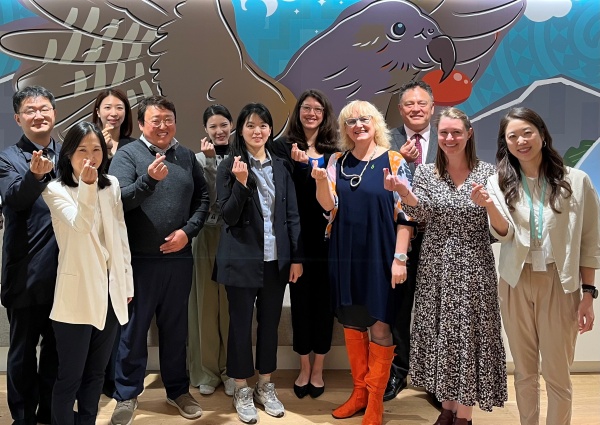
The delegation was welcomed to the ENZ Wellington office with a mihi whakatau on their first day. ENZ, Ministry of Education (MoE) and Ministry of Foreign Affairs and Trade (MFAT) colleagues joined together for waiata and kai with our Korean guests.

Following a welcome and mihi whakatau in Wellington, the group travelled on to Nelson where they visited Te Pūkenga Nelson Marlborough Institute of Technology (NMIT) and Nayland College. The visit to Nayland College was an opportunity for the Korean representatives to gain a better understanding of the pastoral care for school students and the unique offerings such as outdoor education and horticulture programmes.
Kay Lee, ENZ Senior Market Development Manager – Korea, said it was important for the Korean delegation to experience firsthand the welcoming and safe environment of New Zealand schools to regain confidence in the Schools Visits Programme.
“After the COVID-19 pandemic, the Korean Government was concerned about sending students, especially younger students, overseas to study particularly on scholarship programmes because parents wanted assurance their children will be well looked after. In the debrief with the Korean representatives, it was clear they gained confidence from speaking to the New Zealand institution representatives around the procedures and systems in place to support students.”
“We hope that this renewed confidence will mean that we start seeing Korean government scholarship school students studying in New Zealand again in the near future”.
High on the agenda during the delegation’s visit were the School Visits and Tertiary Training Programmes, both of which were affected significantly during the pandemic.
From 2016 –2019, the School Visits Programme provided 150 high school scholarships per year for South Korean students from rural areas to attend New Zealand schools for eight weeks. The Korean Government planned to continue the Schools Visits Programme with its own funding in 2020, however, the programme was cancelled due to travel restrictions during the pandemic.
An alternative programme was run by MAFRA and MOF from December 2022 which involved short-term English Language Training for school students in Korea with three New Zealand teachers travelling to Korea to teach English (Read about their experience here).The Korean organisers have decided to run the English language programme in Korea again with six New Zealand teachers traveling to Korea to teach English in January 2024.
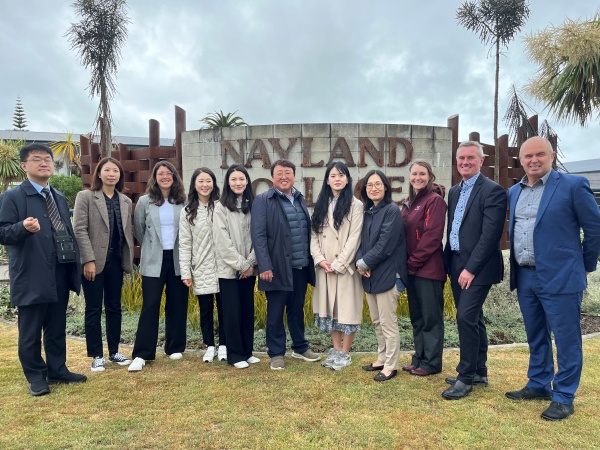
Nayland College demonstrated manaakitanga by welcoming the group to rainy Nelson but provided an Asia Kiwi lunch complete with meat pies and sushi!
Like the Schools Visits Programme, the pandemic interrupted tertiary programmes and the revised programme ran in January 2023 with short term group programmes. The site visits in November to Te Pūkenga NMIT and Lincoln University provided an opportunity to discuss the institutions’ proposals to host Korean tertiary students in January 2024.
Also discussed was the importance of reciprocity and it was noted that Korea is a popular destination for New Zealanders under the Prime Minister’s Scholarship for Asia (PMSA) scheme. Since 2016, the scheme has awarded scholarships to 196 individuals or groups for study, intern or research programmes in Korea. Lincoln University, in particular, has been successful in facilitating group PMSA programmes focused on agriculture to Korea.
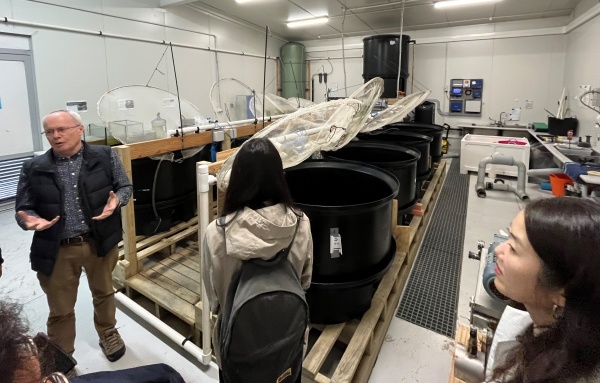
Dr Mark Burdass, Aquaculture Programme Coordinator and Tutor, introduces the hands on learning in the aquaculture programme at Te Pūkenga NMIT.
At the conclusion of their visit, the Korean delegation expressed their gratitude to the institution hosts for making their time in New Zealand memorable and valuable through fruitful discussions. The delegation emphasised the importance of conducting these meetings in person and visiting the campuses to meet with institution staff and academics. The ENZ Manapou ki te Ao team is pleased to continue close cooperation with our Korean education partners to facilitate connections with New Zealand education providers for the education programmes.
If you are interested in finding out more about the education initiatives originally outlined in the KNZFTA, you can read about this in a 2016 E-News article here - New opportunities for New Zealand and Korea.
- Discipline and Dismissal Policy
- WR72Oge1TOWIOe1iw2za 1932ENZ ThinkNew New Workflows Option2 P
- EAIE Lockwood
- CHCHC Card
- Chile uni 4
- International photo round-up