Search
Showing 10 of 7355 results
-
Around the world in five
United Kingdom
International education leaders in the UK have expressed concerns about new proposals to place a levy on the income that institutions earn from international student fees.
Global
A new global survey makes it clear that the more restrictive visa policies that have been introduced in leading destinations over the last 18 months continue to have a profound impact on international student mobility.
India
New research reveals that career advancement is the primary motivation for Indian students choosing to study abroad.
Europe
In the wake of Trump’s moves, the EU is hoping to offer a political safe haven for US scientists and academics.
Australia
Following the recent federal election in Australia, the makeup of Prime Minister Anthony Albanese’s new ministry is beginning to take shape.
-
New Zealand institutions strengthen ties with Latin American education agencies
In April, ENZ supported the Study in New Zealand Agent Seminars – an event series organised by Kiwi EdLink, a New Zealand-based organisation that represents education providers across the country.
New Zealand’s educations offerings for Latin American students were showcased to education agents at the seminars. From English language programmes for children, youth, and adults to short or long-term school studies in New Zealand.
The participating institutions from New Zealand were the Kiwi English Academy, Glendowie College and Onslow College.
ENZ teams in Santiago and São Paulo hosted networking events at the New Zealand Embassy in Chile and the Consulate in Brazil, inviting selected agents aligned with Kiwi EdLink’s strategic goals in the region.
In addition to facilitating these connections, the ENZ team also provided market insights and engaged in conversations about future steps to deepen engagement and opportunities in Latin America’s dynamic education landscape.
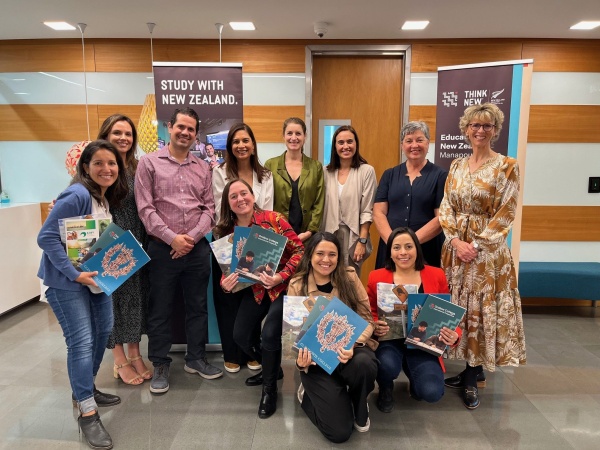
Attendees of the Study in New Zealand seminar in Santiago, Chile. This event was hosted at the New Zealand Embassy.
During the event in São Paulo, Director of Kiwi English Academy, Kathryn Herbert, said “This is a moment to reconnect with our Latin American partners so we can better understand how to offer relevant programs to Brazilian students.”
The feedback from sector attendees was positive. Director of International Students at Onslow College, Robynne Bloemstein, said that the institution is very excited to reengage with the Latin American market and welcome students from the region into its student body, which already includes 45 international students.
It was the first visit to Brazil for the Director of International Students at Glendowie College, Rebecca Johnstone. She said “We love Latin American students—we currently have 47 international students in total, including two Chilean students and a new Brazilian student starting in July. They all contribute greatly to the multicultural environment of our school.”
Check out the video report the ENZ team put together with the representatives of New Zealand schools at the São Paulo event.
- DSC 1391
- Aki in Tauranga 4
- Vic pathway workshop
- Skills lab screen shot
- Mabel Ye student story2
-
Around the world in five
Italy
Italy announces its “biggest language training and international mobility programme ever”
An important new scholarship programme will send 150,000 Italian youth to other European countries to learn languages and immerse themselves in different cultures. The €420 million in scholarships will cover all aspects of students’ expenses.
Global
The international student recruitment industry needs a reset
As student expectations shift and competition intensifies, institutions can no longer measure success by enrolment figures alone. Lasting success depends on trust, partnerships and supporting students long after they submit an application.
Europe
France, Germany and UK see record international student enrolment as study abroad preferences shift
France, Germany and the UK are witnessing record international student enrolment as stricter visa policies in traditional destinations such as the US and Australia reshape global study abroad trends. Rising enrolments from India and Africa, coupled with high visa approval rates and growing demand for alternative destinations, are driving a shift in student mobility for the Fall 2026 intake.
United States
5 takeaways from new data on international student enrolment in the US
As international enrolment drops, institutions are re-evaluating where and how they recruit international students.
Viet Nam
Riding the wave: Vietnamese students adapt as global study-abroad trends shift
As Western universities face soaring costs and tightening visa policies, emerging Asian hubs and local transnational campuses are capturing a new generation of Vietnamese talent.
-
Charan overcomes obstacles to finally return to New Zealand study
Having to dig deep to overcome the disruption to his education caused by the Covid-19 pandemic, he recently returned to Lincoln University to pick up where he left off. He is part of the second cohort of 1000 international students able to come back to New Zealand to complete their studies after being caught offshore when border restrictions began in March 2020.
As Covid spread, the Indian student was recalled to New Zealand only six weeks into his semester exchange at Wageningen University in the Netherlands, but our border closed while he stood in line at Amsterdam’s Schipol Airport.
“It was pretty tense,” he says. “The flight I had initially booked was cancelled, so I had to book the next earliest flight which was at 7am the next day. I reached the airport around 2am but while waiting for my boarding pass, I received a call from New Zealand asking me not to board the flight as the borders were closing that night.”
Charan could not even get back to India, as the airports he would need to transit in were closed. At the time, he was in the third year of his Bachelor of Agricultural Science degree, with one year left to complete.
He says the staff at both universities were super-helpful and after many flurried emails and calls, it was agreed he could return to his studies at Wageningen. With no sign of the border opening in June he was granted permission to stay until the end of the year, and he managed to secure an extension to his Erasmus scholarship which funded his living costs.
“I decided I was going to treat what was happening as an adventure”
Covid disruption a stressful time
But the disruption came at a price. The high-achieving student failed his first test after the stressful experience at the airport. “It took me some time to accept what had happened. I just couldn’t focus on study.” But his second attempt was successful, and he never looked back.
“I decided I was going to treat what was happening as an adventure, and to make the most of my time in the Netherlands.”
By the end of 2020, Charan was still unable to return to New Zealand and he made the decision go home to India. “The first four months were pretty chaotic, but I was really blessed I could be with my family.”
He didn’t know how long he would be in India but was committed to getting back to Lincoln to complete his degree. “I didn’t want to study remotely. I decided it was better to have time off and then return to do my Honours year.”
In the end, it took another year and multiple attempts at securing a place in MIQ before he could return to New Zealand. “When they brought in the lottery system, I had to wake up at 3am each week to log in and try and secure a place. I’m still trying to look at the experience positively and I know that I have stories to share in the years to come!”
Charan arrived back in Christchurch in January and is excited to be underway with his Honours year. He is working with Professor Clive Kaiser at Lincoln University’s new Centre of Excellence for Potato Research and Extension.
Potato research of value internationally
He is researching the development of a rapid test for the identification of Candidatus Liberibacter in potato leaves and tubers. The bacterium causes Zebra chip, a disorder of potatoes which creates distinctive stripes in the flesh and poses a threat to commercial potato growers. Rapid identification of affected plants in the field will help reduce cost and wastage for the $1 billion potato industry in New Zealand.
“I was keen to be involved in this research because I like solving problems and this is a real-world problem with big implications here and overseas,” Charan says. “Potatoes are grown all around the world and almost every culture uses them as a staple part of their diet. So, this research will be of value internationally.”
Charan is eyeing a future in vertical farming, an intensive form of horticulture where crops are grown in trays indoors under controlled conditions and he hopes to one day run his own business.
He says studying at Lincoln has been “an amazing experience” where he has made friends with New Zealand students and other international students. “I learned a lot about different cultures from them.”
Charan describes the challenges that Covid has thrown at him as “daunting” but says that overcoming them has made him more resilient. He is grateful to be back on track with his international education in New Zealand, a place which “keeps you grounded and allows you to focus on your study”.
-
Employers embrace influence of international students
These employers know that, along with their skills, the international graduates bring rich cultural context, a fresh perspective, an innovative mindset, and a solid work ethic to the office each day.
Assurity Consulting, a New Zealand-owned digital delivery services consultancy, has been hiring international students for their graduate programme almost since the company’s inception 17 years ago. Last year it won the International Student Workplace category at the Wellington International Student Excellence Awards.
“From very early on we took an approach of inclusive selection,” says Aron Chantelau, General Manager, People and Capability. “We wanted to find people whose values aligned with ours instead of simply trying to select based on people’s background and whether or not they went to Uni.”
Assurity has also partnered with Wellington NZ’s Employer Connect programme, established to provide insights into the business environment and networking opportunities for graduating international students; and the Work Ready programme, offering support on CV writing, cover letters, and what to expect from the hiring process.
“For the students, it is an opportunity to build their own network in a place where that might not otherwise be easy. For our staff, they get to connect with new people outside the industry and learn about the challenges the international students face, which gives them greater perspective.”
Aron says the students who attend both programmes are engaged, good at taking feedback, and highly motivated to start their careers.
Learning from each other
For Assurity, employing international graduates is about much more than filling jobs in the tech sector. “Our international graduates bring diversity of thought to our teams, which benefits our clients,” Aron says. “They also bring innovation, introducing new ideas and fresh perspectives which has led us over the years to try new things. And, culturally, it makes for an enjoyable workplace because there’s lots to learn from each other.”
He acknowledges there can be challenges, especially for students with English as a second or third language but says it’s all about providing the right structure and level of support. “We have a People Lead in all our teams. That role can be about supporting career progression, but it can also involve pastoral care - understanding what challenges that person is facing and helping to mitigate them.”
In Southland, Blue River Dairy is another company which recognises the value which international student graduates bring to their business. Since 2018, Blue River has hired more than 30 international students from the Southland Institute of Technology (SIT) and other institutions.
“The culture within an organisation is so important. Hiring only for skills is short-sighted,” says People and Capability Manager Abbigail Surridge. “With many of the international students that we have hired, we’ve been able to harness their life experience, dynamic exposure, and untapped potential as they have grown in their roles.”
“Diversity adds value to our organisation, by introducing different ways of thinking and problem-solving. When we collaborate, those differences help to create success.”

Jacky Shen arrived at SIT from Beijing in 2017 to study for his graduate diploma in Information Technology (IT). He already had a Master’s degree in Communication and Information Systems but wanted to better understand the New Zealand tech environment. He is now a software engineer at Blue River, leading a team of three.
Not only does the company benefit from Jacky’s technical skills, but also his language skills. “We have a number of Chinese suppliers, so I can speak to them easily and provide quick solutions for them,” he says. “Many companies want applicants to have local experience, but Blue Dairy allowed me to gain that experience on the job. It’s been a great opportunity.”
Economic and cultural influence
He believes that international students bring real value to the workplace. “We come with good technical skills, but we also contribute to the economy and to the cultural diversity of the country. It’s a win-win.”
Aron Chantelau says the international students who work in New Zealand have a bright future, whether here or overseas.
“They make a huge difference to our economy, both in terms of digital outcomes for New Zealand but also improving the quality of life here through the work they do,” he says. “Some of them will move overseas but if they’ve had a good experience here, they will become ambassadors for New Zealand.
“It’s great to be part of their journeys.”