Search
Showing 10 of 7355 results
- DSC06969 web resize
- SiNZ enrolment guide
-
Education New Zealand launches Brand Protect 2.0 Campaign
On 23 November, ENZ will be launching a digital brand campaign informally known as ‘Brand Protect 2’.
This is a direct continuation of the Brand Protect campaign that ran July to August, and became our most successful brand awareness campaign to date. Research shows us that global sentiment towards New Zealand remains positive, so this is a key moment to leverage this attention to tell the education story in-market.
The new iteration will run in Indonesia, the UK, and Viet Nam from 23 November-23 December, with China following in January. Our campaign activity will be supported by a range of content on our own social media channels.
In addition to the content, a new landing page has been developed to further underline New Zealand education values and draw a connection between our global reputation and the strength of our education system. As well as this, audiences will be directed to explore their future study options on SINZ and join our social communities.
Please email brand@enz.govt.nz for all questions and enquiries, or speak to your ENZ representative.
-
Languages International turns 40
Around 90 people, including the school’s founders Chris and Frances Woolcott, attended the evening event at its Merchant House buildings in Auckland.
Darren Conway, CEO Languages International, said the school has come a long way since it opened four decades ago.
“Over the years, Languages International has brought tens of thousands of young people into the country, from all over the world, for a language and travel experience. We’ve also helped more than 1,500 English teachers into jobs across New Zealand and abroad,” said Mr Conway.
“Initially, our students came for a study, travel and cultural experience, and this ‘edu-tourism’ segment is still the core market. However, more students are now wanting to take work experience home or develop their English in order to pursue higher education or training in New Zealand.”
A key project for Languages International in 2019 will be preparing to host the annual IALC (International Association of Language Centres) workshop in March 2020. IALC is an association of 140 leading independent schools teaching languages – IALC members and over 100 education agents will travel to Auckland in March 2020 to take part.

L-R: Chris and Frances Woolcott, the founders, with Larissa Merz, Russia Marketing Manager and her husband, Dmitri.
-
Around the world in five
CHINA
Luring back talent is top priority to fuel innovation
Attracting Chinese students back from abroad has become policy at the highest level of the Chinese government in a bid to fuel innovation as the country moves away from reliance on manufacturing.
MALAYSIA
You can now get a visa to study in Malaysia within a week
Under new regulations, international students can obtain their student visa in just seven days – part of the government’s aim to double Malaysia’s international student population to 200,000 by 2020.
FRANCE
Emmanuel Macron ‘to double the number of Indian students coming to France’
Indian Prime Minister Narendra Modi held talks with French President Emmanuel Macron to explore ways to deepen bilateral cooperation. The French President interacted with students in New Delhi, where he invited students to pursue education in France.
EUROPE
Germany ranked as most attractive study destination in Europe
An annual ranking of European study destinations places Germany as the most attractive option for international students, thanks to a growing number of courses offered in English and with the lowest unemployment rate for university graduates in Europe.
UK and AUSTRALIA
UK and Australia seek to 'turbocharge' higher education links
Universities UK and Universities Australia will work together to boost joint research, student and academic exchanges, and mutual recognition of each other’s qualifications.
- E News Agent Seminar Seoul 2016 2
-
Summerland Primary joins SIEBA
The programme, supported by ENZ, helps to grow international programmes at smaller schools that don’t have the resources and capabilities to do it on their own.
By centralising administration of international programmes, schools can focus on the educational and pastoral aspects.
Barb Dysart, a Co-Principal of Summerland Primary, said as a school new to the sector, creating networks, administering programmes and managing all the paperwork on their own was a challenge.
“We had no time to market our school and we were reliant on ‘word of mouth’ or agents to bring international students.”
Barb says working with SIEBA made it easy to enrol prospective students, and provided clarity and good practice around the policies and procedures.
“With SIEBA’s involvement, we’ve seen a large increase in international students attending our school – in part because of our confidence and ease in the process.
“If we are unsure of any situation, SIEBA is an email away. With their advice and support, we are able to focus on what we do best – teaching.”
Richard Kyle, ENZ Business Development Manager, said for many schools the work load of managing an international programme often fell on already busy principals or senior staff. This was a barrier to get more actively involved.
“SIEBA already has the insight and expertise so reaching out to them saves schools from having to reinvent the wheel,” said Richard.
“Welcoming international students to your school is a big commitment, and to make it sustainable and as stress-free as possible, peak bodies such as SIEBA can be a big help.”
To find out more about SIEBA’s primary schools programme, please contact Robbie Pickford, Project Manager: robbie@sieba.nz
- IMG 1334 copy3
- ENZRA
-
Brazil and New Zealand united on sustainability – check out the Kōrerorero: Voice of the Oceans
Science, sustainability, and innovation were the focus of a special edition of Kōrerorero, which presented the Voice of the Oceans initiative. The online event, held in late August, showed the importance of education for building a more sustainable planet and highlighted the potential of cooperation between Brazil and Aotearoa New Zealand on issues related to the future of the planet.
Kōrerorero was produced by Education New Zealand Manapou ki te Ao (ENZ) in Brazil and featured an introduction by Bruna de Natale, ENZ’s market development manager in Brazil. It was the first time that the event was broadcast in Portuguese, with simultaneous translation into English.
New Zealand Ambassador to Brazil, His Excellency Mr Richard Prendergast formally welcomed attendees to the event.
“The ocean and its resources are under pressure due to human activities, such as overfishing and pollution,” said Richard. “New Zealand’s approach to promoting a healthy ocean and ensuring good management of its resources involves education, to reinforce decision-making based on traditional knowledge and support development,” he added.
The kōrerorero featured the CEO of Voice of the Oceans, David Schurmann, who is an alumni from Aotearoa New Zealand – he has a degree in Cinema from Auckland University of Technology and, in addition to his work at Voice of the Oceans, is a filmmaker. His film “Little Secret”, from 2017, was chosen as the Brazilian representative in the competition for one of the places in the best foreign film category at the Academy Awards. He is part of the Schurmann Family, which since 1984 has carried out maritime expeditions around the world to promote sustainability.
Currently, the sailboat Kat, from Voice of the Oceans, is sailing around the world to raise awareness about the importance of combating pollution caused by plastic in the oceans. In November the boat will arrive in Auckland, at the end of its journey around the globe. The boat was named Kat after Kat Schurmann, David's kiwi sister.
“Voice of the Oceans was created because we are eyewitnesses of what has been happening in the oceans, which is plastic pollution,”, warned David Schurmann during the Kōrerorero. “Over the last twenty years, as we've travelled around the world, we've noticed an increase in plastic waste in the seas,” he added.
David also explained the role Aotearoa New Zealand played in creating Voice of the Oceans: “Part of it all has a direct connection to New Zealand – I lived and studied there for six years, where I trained as a filmmaker in the 90s. It was during this period that I realised that the New Zealand population already had a very strong ecological awareness, and that was the seed that helped me create Voice of the Oceans”, said David.
In 2016, upon returning from a trip around the world, David and his family decided it was time to give the oceans a voice, to unite humanity around environmental protection. The objective of the initiative, according to him, is to unite people and countries in favor of practical solutions for the preservation of the seas.
Alexander Turra, professor at the Oceanographic Institute of the University of São Paulo, classified as the best in Latin America in the latest edition of the QS World Rankings, also participated as a panelist in Kōrerorero. “We need to put the sea in people's heads, hearts and souls, so that they realize that we are intrinsically connected to it,”, said Alexander. “The ocean is the foundation of what happens on the planet, so preserving the Earth starts there.”
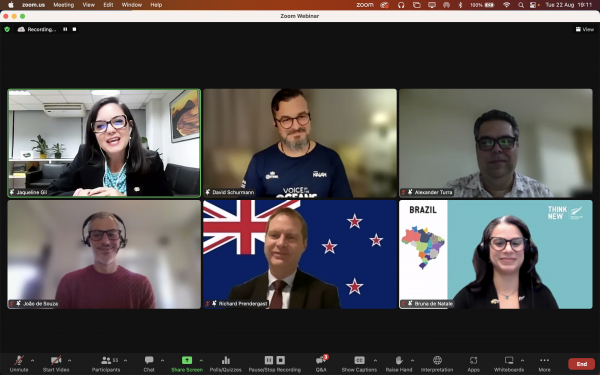
Kōrerorero also had the contribution of New Zealand based Brazilian researcher João Souza, leader of the Moana Project, which seeks to understand the impact of climate change and extreme events on the main food sources linked to the ocean, in Aotearoa New Zealand. According to João, the project works through partnerships with the fishing industry and communities living in coastal regions, making use of their traditional knowledge.
“We have sensors on fishing nets, so every time fishermen throw that net into the sea, our sensors pick up signals. Thus, we are able to generate information about the ocean, even predicting the occurrence of extreme events. The knowledge acquired is shared with everyone involved”, explained João.
The debate was mediated by Jaqueline Gil, director of international marketing and sustainability at Embratur – Brazilian Tourist Board. There were 185 registrants before the event, which was accompanied live by 69 people, who received a certificate of participation. The Kōrerorero recording is available in Portuguese and English on the ENZ online platform.