Search
Showing 10 of 7355 results
-
Prime Minister unveils 2025 Tripartite Fund recipients at Fudan University
During his remarks at Fudan University, Prime Minister Christopher Luxon announced the 2025 New Zealand–China Tripartite Partnership Fund recipients, as well as plans for a second high-level Education Forum to be held during China Annual Conference and Expo for International Education (CACIE) 2025.
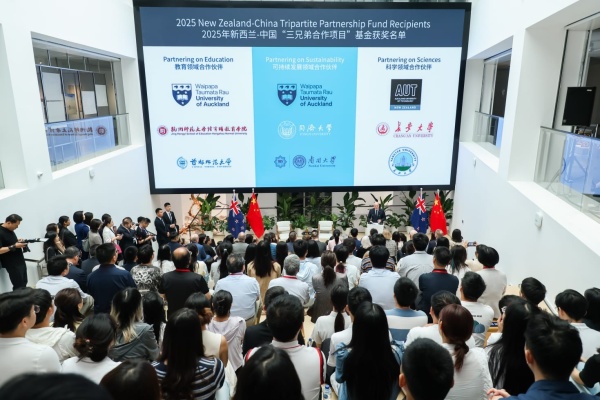
2025 marks 20 years of the New Zealand – China Tripartite Partnership Programme. Photo credit: New Zealand Trade & Enterprise.
ENZ congratulates the following researchers whose projects exemplify the high-quality research collaboration between our two countries:
-
Dr Fiona Ell (University of Auckland): Working with Hangzhou Normal University and Capital Normal University to enhance mathematics and science teacher education through comparative studies and exchanges.
-
Dr Sihong Wu (University of Auckland): Partnering with Tongji and Nankai Universities on sustainable production and carbon neutrality in manufacturing joint ventures.
-
Dr Yiming Ma (Auckland University of Technology): Collaborating with Chang’an and Yangtze Universities to explore mechanisms behind silent earthquakes.
Dr Fiona Ell said she is looking forward to working with her Chinese research partners to enhance mathematics and science teacher preparation, an important focus for education systems in both New Zealand and China.
“Our study brings together teacher educators from two Chinese universities, and teacher educators at the University of Auckland to exchange ideas and techniques for mathematics and science teacher preparation. The Tripartite grant allows us to visit each other, see teacher education practices in each country and compare policy directions in teacher education,” she said.
This will enhance the understanding and skills of all participants and help us find ways to improve mathematics and science teacher education in both countries,” Dr Ell added.
The Tripartite Fund, managed by ENZ in collaboration with several government agencies, supports strategic research partnerships between one New Zealand and two Chinese universities. The programme celebrates its 20th anniversary in 2025.
Learn more about the Tripartite Partnership Fund here.

Professor Nic Smith, Vice-Chancellor Te Herenga Waka – Victoria University of Wellington exchanges a Memorandum of Understanding with Fudan University President, Li JIN. Photo credit: New Zealand Trade & Enterprise.
Another key part of the event was Victoria University of Wellington renewed an agreement with Fudan University to revitalise the relationship, achieve resumption of student flows, and pursue research cooperation in the areas of public health, bio-tech and climate science.
-
-
PM mission advances New Zealand and China education relationship
The New Zealand Education Connect event on 20 June at the New Zealand Embassy in Beijing brought together leading Chinese government representatives, institutional partners, education agents, and alumni to strengthen people-to-people links and celebrate collaboration.
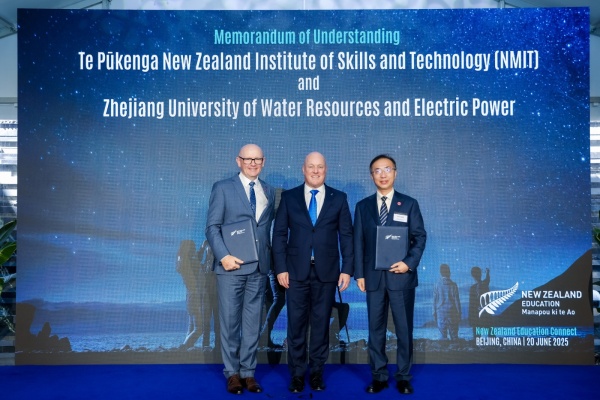
The event programme was packed, with nine Memorandums of Understanding (MoUs) signed between New Zealand and Chinese counterparts, and another MoU signed between Victoria University of Wellington and Fudan University on 19 June.
Providers from across the tertiary education sector signed the MoUs – with Victoria University of Wellington, Unitec, NMIT and UP Education’s University of Auckland International College and New Zealand Tertiary College formalising partnerships.
These agreements cover a mix of in-market delivery, joint programmes, and initiatives to grow student mobility between New Zealand and China.
This builds on the now over 60 approved joint education programmes and institutes recognised by the China Ministry of Education between New Zealand and Chinese institutions, and other education partnerships across early childhood education, vocational training, higher education, and research areas.
The New Zealand Education Connect event had senior leaders officially launching New Zealand’s Country of Honour campaign for the upcoming China Annual Conference and Expo for International Education (CACIE), China's largest platform for international education, due to take place in October this year.
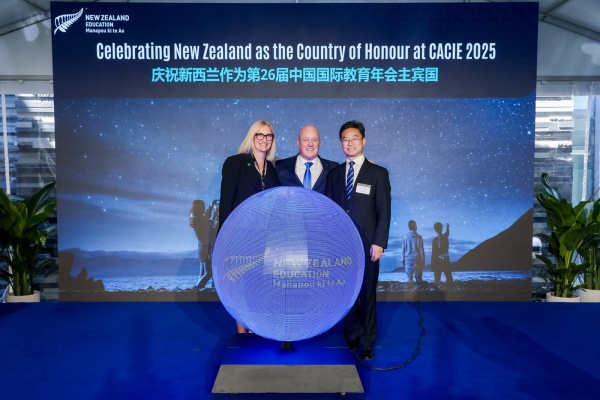
ENZ’s Chief Executive, Amanda Malu, launches the Country of Honour campaign for New Zealand at CACIE alongside Prime Minister Luxon and CEAIE’s Secretary General Jun Yang.
ENZ Chief Executive, Amanda Malu, said it’s exciting to see advancement of the partnerships New Zealand providers have built with their Chinese counterparts.
“We’re eager to see the outcomes of the new agreements formalised at New Zealand Education Connect and look forward to deepening our bilateral ties by leading a delegation to CACIE later this year,” she said.
Information on the registration process for New Zealand education providers to join the New Zealand Country of Honour events in October will be shared next month on ENZ’s event page.
The Country of Honour promotional video is available with Chinese subtitles on The Brand Lab.
- NZIEC2023536of404
- Prime Ministers Scholarships for Asia Awardees PMSA 2019 20 Round 1 Dec 2022
- Hargest
- Closed4
- 2549 ENZ International Education Strategy 38 CG FA Hindi proof
- Overall full year 2014 PDF
-
Prime Minister's Scholarship shakes up geology student's plans
Soltice Morrison was only 15 when that earthquake happened, but she is part of a new generation of students and researchers wanting to equip themselves with the latest knowledge and technology to better understand New Zealand’s vulnerability to quakes. The best way to achieve this is through international collaboration with other countries which face the same risks.
Having already completed a BSc in Geology and Oceanography from Otago University, Rotorua-born Soltice secured a Prime Minister’s Scholarship for Asia during her Honours year in 2018, which allowed her to enrol in a post-graduate short course in geology at Hokkaido University in Japan and stay on to complete most of her Honours research.
Prime Minister’s Scholarship allowed joint research
Under the guidance of her supervisor, Dr Virginia Toy, she was involved in a project which studied the characteristics and behaviours of New Zealand’s Alpine Fault and Japan’s Median Tectonic Line to better understand what causes earthquakes in both countries.
"We’re both very seismically active countries but Japan is much more advanced in its use of technology. We were able to bring some of that knowledge back to New Zealand."
Soltice says that without the funding she received through the Prime Minister’s Scholarship (PMS), she would not have been able to study abroad.
The scholarship programme to Asia was established in 2013 and extended to Latin America in 2016. To date, 2400 students have been given financial support to study abroad. While currently on hold due to Covid travel restrictions, the programme is poised to restart once borders reopen.
Importance of New Zealanders studying abroad
Funded by the government and administered by Education New Zealand, the programme recognizes the importance of giving New Zealanders the opportunity to have an international education experience in countries where we have key trade and business relationships.
There are few restrictions on study options, with the programme having broad goals to enhance understanding of other cultures and business practices; establish new friendships and networks; and upskill the New Zealand workforce through overseas experience.
“It’s very important to connect with students and colleagues internationally in order to get ahead,” says Soltice. “We can get caught up thinking that the New Zealand way is the only way. Studying overseas helps you broaden your horizons, your knowledge, your understanding of different cultures, and the way things can be done.”
In geophysics, Soltice says international collaboration is essential.
“We’re able to learn a lot from Japan and the advances they have made in technology and monitoring.”
The time Soltice spent in Japan ended up taking her career in a new direction. “While I was there, I was able to understand the effects of seismic activity on buildings and how we can strengthen our cities to ensure they’re resilient, so I’ve ended up in the engineering space working for Aurecon.”
But her work also has an environmental focus and she is currently part of the multi-disciplinary team working on the Lakes 380 project, which seeks to combine best scientific thinking with mātauranga Māori (traditional wisdom and knowledge) to better understand the social, cultural, and environmental history of Aotearoa’s lakes. “It’s rewarding work and I love it.”
Reawakening of cultural identity
Soltice says her time in Japan prompted a reawakening of her own cultural identity. “I had always tried to blend in at home, but the questions I was asked about my background while I was away made me realise I was proud of my Māori ethnicity and also taught me the value of indigenous knowledge.”
Building on this confidence, she has set up a Māori strategy group with colleagues at Aurecon “looking at ways we can weave cultural understanding with scientific knowledge into the work we do.”
Soltice says she made life-long friends during her time in Japan and built a valuable network of contacts. “I work closely with the geophysicists here at Aurecon and sometimes when we have questions, I will reach out to my contacts offshore.”
Three years on, she remains a passionate advocate for Prime Minister’s Scholarship programme. “The overall experience – the research, the culture, the living situation, I would 100 percent say it was one of the best times of my life.”
Students value flexibility, networks, and personal growth
The positivity of Soltice’s experience was echoed by other scholarship recipients in a recent survey conducted by Education New Zealand. Close to 300 students participated, with 98 percent saying they would recommend PMS to others. Benefits they identified included the unique flexibility of the programme, the networks they built, the opportunity for personal and professional growth, and the chance to better understand New Zealand’s place in the world.
As for life after the programme, 57 percent said they would become involved in global causes, 50 percent would become involved in political or policy issues, and 44 percent would become involved in their local community or iwi.
-
Putting a healthy smile on the dial of Fiji’s children
“I love working with children, particularly those living with disabilities and special healthcare needs who require more inclusive oral health policies and programmes.”
He spent the early years of his career working as a hospital dentist and teaching at the Fiji National University’s School of Dentistry and Oral Health but was ambitious to accomplish much more and knew he would have to study overseas to achieve his goals.
He travelled first to Portugal to enrol in a Master’s in Public Health and then to the University of Otago’s Faculty of Dentistry to undertake his Postgraduate Clinical Doctoral Degree in Paediatric Dentistry.
As a third generation Fijian of Indian descent, he describes his international education experience as “life-changing, academically and culturally fulfilling.”
But Jason says he could never have afforded to study in New Zealand without the support of a Manaaki New Zealand Scholarship, funded through the Ministry of Foreign Affairs and Trade. The programme sets out to build future leaders in developing countries by supporting students to upskill here.
Advocating for better oral health outcomes
Improving the oral health of young people drives Jason’s clinical and research work and he knows that implementing a preventative approach to tooth decay is key to achieving sustainable outcomes.
“The mindset in the Pacific is that people mostly don’t come to the hospital clinics for dental care, they wait for pain or symptoms before seeking help,” he says. “But we need to advocate strongly for prevention which is more cost-effective and acceptable.”
Arriving at the University of Otago in 2019, Jason embarked on his thesis researching the remineralisation potential of selected peptides (one of the building blocks of protein) in preventing tooth decay.
“Dental decay is prevalent, especially among children, but it is reversible in its early stages. The mainstay of prevention has been fluoride, but we proved that the peptides do have remineralisation potential. Investigation is now under way to learn how it performs alongside fluoride.”
“I think it has huge potential for the future. The dream would be that we have the next generation of children growing up without fillings in their mouths.”
Jason says this kind of research would not have been possible in Fiji. “I was very grateful for the experience at Otago. It was an environment that was both supportive and collaborative. It opened up networking opportunities for me. And those networks still support me today.”
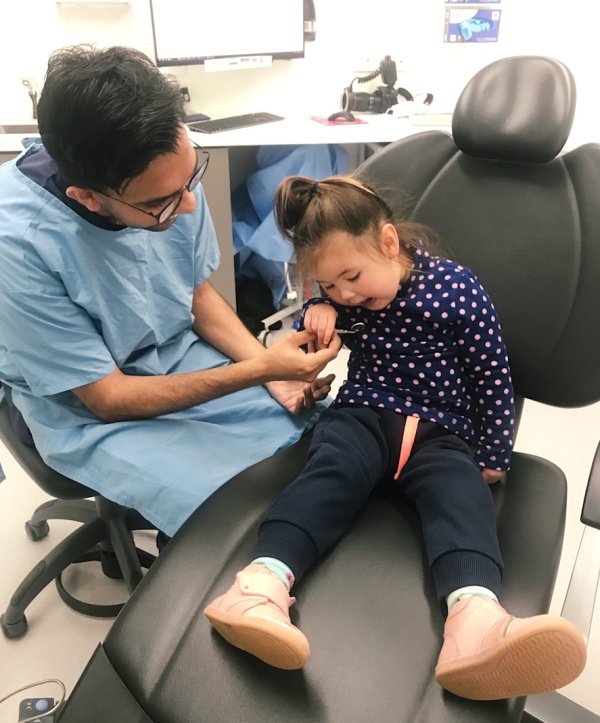
Jason also cared for patients at the faculty’s clinical facilities and theatre suites and provided on-call dental services for emergency patients after-hours at Dunedin Hospital, building close bonds with some of his young patients, especially those with special needs.
"The dream would be that we have the next generation of children growing up without fillings in their mouths."International education builds skills and confidence
After his graduation in December, Jason returned to FNU School of Dentistry with additional skills and new-found confidence. “I think that gaining a formal specialist qualification has given me a voice to continue to advocate for children’s oral health through dental education.”
He wants to establish preventative oral health programmes in schools and help improve the curriculum being taught to dental students in the region, integrating recent innovations and research evidence.
It’s something he has been thinking about for many years. “Hopefully now we’ll get this done.”
“I’ve expanded my knowledge, upskilled, and I think I have become more confident as an academic, and as a person. I’ve got my international education and training to thank for that.”
Manaaki scholar gives back to the community
Jason is certainly fulfilling the brief of the Manaaki Scholarship to give back to his community. He is maintaining his clinical hours, teaching the next generation of dental students, volunteering his services at an NGO-run paediatric cardiac care hospital, and mentoring students wanting follow in his footsteps by studying overseas.
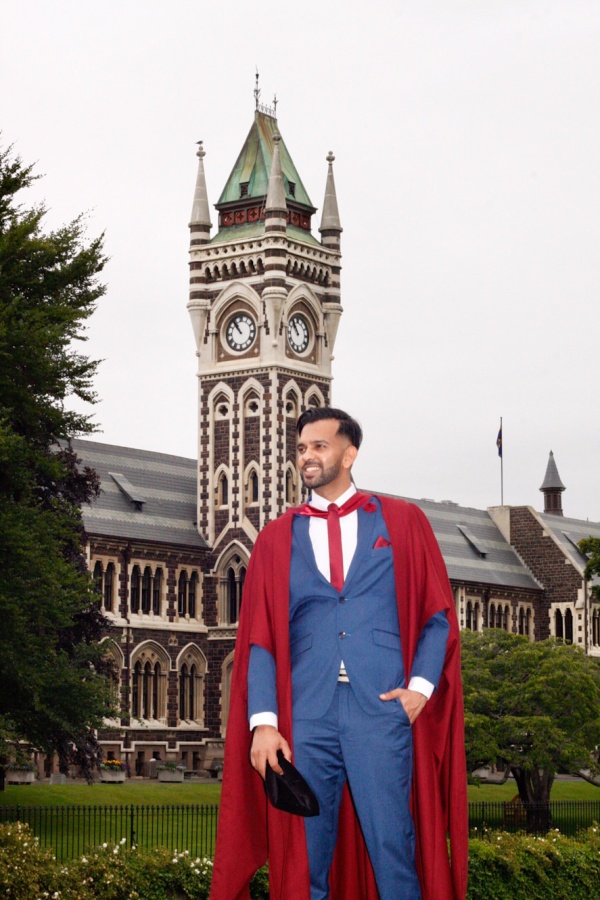
“International education is very important to Fiji as a developing country,” he says. “I thought it would be valuable to be able to guide students who would benefit from international scholarships in meeting their professional goals, while building capacity in the region.”
At heart, though, he is an academic and he hopes that in the coming years he can raise the research profile of the Pacific region and build a solid database which will help to secure the funding for much-needed oral healthcare programmes.
“My message is that there is no general health without oral health. It’s not going to be easy, but we need to start somewhere to get a voice for children and for the profession.”