Search
Showing 10 of 7183 results
-
New approach for Korean middle schools
The Korean government wants to improve levels of student happiness, and move on from students validating their success and self-worth only in terms of academic performance. A priority is to support students to pursue “non-core learning areas” (such as music, arts, physical education, career exploration, club-oriented activities, etc). Each school will now designate a semester that is exam- and test-free to allow students to experience a wide range of these activities.
This approach represents a big change in the Korean education environment. To date these students have relied heavily on simple memorisation and rote learning instead of thinking creatively or critically. The government now expects students to freely discover their competencies and capability, free from the stress associated with exams. Korean President Park Geun-hye describes this initiative as a “key task to fundamentally change Korea’s education system”.
Under this new initiative, schools will teach students using diverse and engaging methods such as discussion, experiments, outdoor activities and team projects. Opportunities for students to engage with activities that may inform their thinking about future career options and/or future subject choices is also encouraged.
The initiative began as a pilot in September 2013 with 42 Korean middle schools (1 percent of all Korean middle schools). It was expanded in 2014 to around 800 schools (25 percent), and to 1,500 schools in 2015 (nearly 50 percent). This year, all 3,204 middle schools – and their 1.5 million students – will implement this approach.
Opportunities for NZ schools
This new way of working not only requires a significant paradigm change in thinking for educators and parents, it also requires Korea to develop new infrastructure outside the classroom. It may therefore take some time to fully develop.
This new initiative presents an opportunity for New Zealand schools; two groups of Korean parents may be interested in sending their children to study abroad during the exam-free semester:
-
Families that wish to take advantage of the New Zealand curriculum, teaching expertise and existing infrastructure in terms of these broader subject areas (especially opportunities to learn outside of the classroom that are available at New Zealand’s intermediate schools); or
-
Families that have a more traditional Korean academic education preference and wish to provide their children with an intensive learning experience (such as significantly develop their English language skills).
New Zealand schools may therefore wish to reframe their marketing collateral for parents to demonstrate the strengths of their school’s programmes to deliver quality educational outcomes for Korean middle school students during these exam-free semesters.
FAQs
What age and year level are Korean middle school students?
Students in Korea start school at age seven, rather than five, the usual age in New Zealand. Korean middle school students are in years seven and eight and aged 13-14 years. The table below compares the age and year of the two school systems.
What are the Korean school semester dates?
Korean school year is divided into two semesters, running from 1 March to mid-July, and from mid/late August to February.
Who decides which semester will be exam-free? Will it be the same semester for all schools in a region, for example?
Individual principals, in consultation with their school staff decide which semester will be selected as the ‘exam-free’ semester. This could be any semester between the first semester in the first year and the first semester of the second year.
Would this be an opportunity for students to spend the whole semester away from Korea, or are we talking about short (say 2-3 week or 4-5 week) programmes for groups?
This will likely be predominately an opportunity for individual students to study for a full semester in New Zealand.
That said, it is possible that schools with MoUs with Korean schools could promote an exchange or short course study abroad programme, but New Zealand schools who are interested in this should carefully canvas existing sister schools first to confirm whether this approach would meet the requirements.
What does experiential learning mean in Korea?
The following four types of activities have been recommended by the Korean Ministry of Education:
-
Topic of interest: students choose topic(s) of interest and participate in a programme of activities around the topic, such as: entrepreneurship, design, animation, film, barista skills, smartphone app development, robotics, cooking, science etc.
-
Arts and physical education: students undertake activities that are not part of their regular school curriculum such as: participating in a musical or in a band, curating, industrial design, or physical education activities such as sports leisure industry experience or exploring career options around soccer, dancing etc.
-
Club activities: student clubs can be organised by students around topics of interest. These could be linked to other activities such as sports, career or volunteering such as a hospital volunteering group of 20 students who go to local hospitals to help out.
-
Career: students discover what employment options await; giving a chance for them to begin thinking about the sort of work they would like to do in the future and to gather information that will help them make good decisions about the courses they will undertake when they enter secondary school. This could include going into workplaces to experience, observe etc. and could also include a career counselling component.
The New Zealand curriculum, teaching techniques and education outside of the classroom experience and infrastructure appears to be a good fit with this initiative.
-
-
Joint initiative supports school group visits
To make the most of every opportunity to grow international education in schools across the country, Education New Zealand (ENZ) and the Schools International Business Association (SIEBA) have established a ‘clearing house’ for school student group visits.
There is increasing interest from such groups in visiting New Zealand, particularly from Japan, China, Thailand and Korea. Schools aren’t always able to accommodate these visits however, so ENZ and SIEBA are working together to channel the enquiries through a clearing house that aims to say ‘yes’, as a starting point, to any request. The clearing house then works behind the scenes with its members to identify schools that are keen (and have the capacity) to host, determine appropriate pricing for the visit, and ultimately improve the experience of, and bring efficiencies to, group visits to New Zealand.
ENZ is promoting the SIEBA clearing house service to its in-market networks, including agents and schools who are considering New Zealand as a destination for school group visits.
The service is another ‘value add’ by SIEBA and is free to its members. If you are a school (irrespective of whether or not you are a SIEBA member) that receives requests to host a group but is unable to, ENZ asks that you forward the request on to SIEBA. For more information on the clearing house please contact groups@sieba.nz
In the 17 February issue of E-News, we let you know about the Ministry of Education’s new online form for state and state-integrated schools to make it easier to register visiting groups of international students. Find out more about this here.
-
New code for student care established
You are invited to contribute to the development of guidelines that will accompany the new Code.
Launched by Minister Joyce on 10 March, the new Code better reflects the outcomes expected by students and their families, and the high standards of student support that our industry seeks to maintain.
Find out more about the Code and the new contract disputes resolution scheme on the Ministry of Education’s website here.
As the administrator of the Code, NZQA is inviting our industry to contribute to the development of guidelines to help providers understand, in practical terms, what being a Code signatory involves and offer best-practice examples of pastoral care of international students.
Ensure your voice is heard as NZQA drafts these guidelines. As an industry we want to have a high bar of expected practice when it comes to the pastoral care of students. The guidelines should demonstrate examples of what good practice looks like and what, as an industry, you see as the minimum that should be expected.
The Ministry of Education, along with NZQA and Education New Zealand would like to acknowledge the important contribution many of you made to the development of the new Code by sharing your ideas and suggestions throughout the consultation process. It is through this sort of industry participation and commitment that New Zealand continues to be at the forefront of best practice in international student care.
We encourage you to take part in developing the guidelines.
-
Around the World in Five
USA
Recognising the need for Americans to improve their international awareness, this article views study abroad as a “solution” to American foreign policy isolation. The article discusses the imbalance between the number of international students who study in the US (975,000) and the number of US students who study overseas (304,000), the Generation Study Abroad initiative that aims to double the number of US students who study abroad (and which ENZ is a signatory to), current US government support of study abroad and ideas around potential policy changes to further support study abroad.
China
During the National People’s Congress (NPC) and Chinese People’s Political Consultative Conference (CPPCC) annual sessions in March 2016 (called the “Lianghui”, or “Two Meetings”), it was identified that skills in the high-end manufacturing industry, the science and technology service industry, IT, the cultural products and creative industries and the finance industry will likely become the most sought-after over the “13th Five-Year Plan” period (2016 – 2020).
Taiwan
The number of Taiwanese people with a college, university or other type of higher education degree has increased to 5 million (42.68 of the population) in 2015, according to the latest statistics released by the Ministry of the Interior (MOI) on Saturday. This is higher than the OECD average.
Brazil
Jose Celso Freire, head of the international office of Sao Paulo State University (UNESP) and also president of the international education association of Brazil, FAUBAI, is optimistic about the future of the Science without Borders scholarship programme. Mr Freire said, “I don’t believe they will just cut the programme, but there’s a huge push that scholarships will be more focused on postgraduate studies.”
Vietnam
Transnational education, study abroad and opportunities for collaboration were all on the agenda at an international education conference on integration in education jointly held last week by the Association of Vietnam Universities and Colleges (AVUC) and the Vietnam International Education Consultants Association (VIECA). Held at the Government Guest House Hanoi, the one-day conference welcomed international education experts from both provider and agent sides of the industry and was attended by more than 200 AVUC members, foreign embassy officials and representatives from several government ministries.
-
EdTech World Tour in New Zealand
The Franco-German researchers have been assessing global edtech trends and ecosystems which support edtech adoption and innovation, and will present their findings to the EdTechXEurope conference in June.
While the US dominates the edtech sector Svenia and Audrey were curious to find out and report on what is happening in other parts of the world. Their Edtech World Tour started in France in October 2015 and included the United States, Chile, Australia, Korea, India and South Africa.
Education New Zealand Business Development Manager, Adele Bryant, hosted Svenia and Audrey’s visit to New Zealand from 7-14 December 2015 between the Chilean and Australian leg of the tour. During their time here, they visited education institutions, edtech companies and government agencies in Auckland, Wellington and Dunedin, recording what they saw and heard on their social media platforms.
From an inspiring Point England School in Auckland, to a Wellington edtech community meetup, and on to Dunedin’s ADInstruments and its high quality life sciences educational products, Audrey and Svenia were welcomed and impressed by New Zealand’s approach to using and developing edtech.
Audrey and Svenia made the following observations from their time in New Zealand: “New Zealand has been of great inspiration to us as we feel the country has understood the way Edtech has to be implemented. No need to roll out devices and new edtech tools if neither the infrastructure nor the teacher training is there.
“The combination of the government’s efforts – together with Network for Learning – to bring high speed internet connection to all New Zealand schools and the work of MindLab in training New Zealand teachers in new technology has a huge potential to make New Zealand the next model for successful edtech use in schools.”
At each call they asked the same question “What does edtech mean to you?” The resulting videos have been uploaded to their website, providing insights into the different perspectives of teachers and developers. View a compilation of the New Zealand videos here and go to the tour’s Twitter feed to see more about the whole tour.
In the New Zealand newsletter they compiled after their visit, Svenia and Audrey noted that “New Zealand’s high quality and innovative education system has proven a perfect ecosystem for Edtech when combined with its entrepreneurial and creative culture”. You can read about their time in New Zealand visit here.
-
Confidence in Christchurch
Murray Strong, Chair of the Canterbury Leadership Accord, joined Christchurch Educated Chair, Mike Hadley, in opening the day with a reminder of the Strategy vision and 2025 targets to lift student enrolments to 25,000 and economic value to $937 million. Murray noted that good progress is being made in a range of product and market development projects.
The Chief Executive of the Canterbury Employers Chamber of Commerce, Peter Townsend, indicated that, with $100 million additional investment each week, the Christchurch rebuild will maintain its momentum for some time to come. Drawing on material produced by the Canterbury Earthquake Recovery Authority, Peter emphasised the bright future for the city as a place to learn, live and work.
Peter noted that; “The future of this region depends on the way we apply technology to our natural capital on a platform of product and service integrity”.
He challenged our industry to ensure that “service integrity” is central to all we provide for our customers.
Carl Everett, International Director, Christchurch Boys’ High School, commented; “There was a lot of talk about innovation, being flexible and thinking of new ways to approach the market, and then sharing all of that information together – especially here in Christchurch, where we are particularly good at sharing.”
Deanne Gath, International Director, Kaiapoi High School, particularly liked the definition of collaboration suggested by keynote speaker, Education Consultant, Chris Clay; “I like the idea that collaboration is working together to an end goal, but not necessary all doing the same thing. It’s about not putting all our eggs in one basket, but trialling different things to see what works – with the end goal being that we all want to increase international student numbers in the Canterbury region,” she said.
The Conference was closed by Christchurch City Councillor Jimmy Chen, representing Mayor Lianne Dalziel, who emphasised the contribution of international education to the region and the commitment of local government to support future growth aspirations.
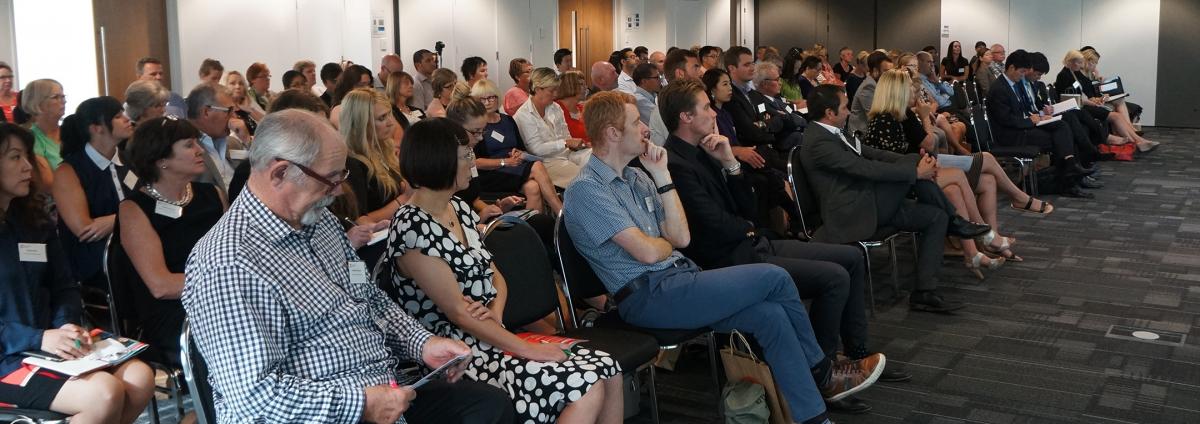
Above: Conference attendees -
Planning for success in Taranaki
The Taranaki International Education Strategy was launched by Minister Joyce in New Plymouth on Tuesday 23 February, when he announced that the government is investing $162,000 in the initiative over two years, through the RPP.
And, the news of the launch reached China!
A partnership between Venture Taranaki and local education providers will allow the group to share resources and make strategic and targeted investments. It will also enable collateral and pathway products to be developed, agent familiarisation visits to take place, and make it possible for the region to be represented at the Australia New Zealand Agent (ANZA) Workshop on 13 – 15 April 2016.
Minister Joyce’s visit to Taranaki sends out a strong message that international education in New Zealand’s non-metro regions is high on the agenda.
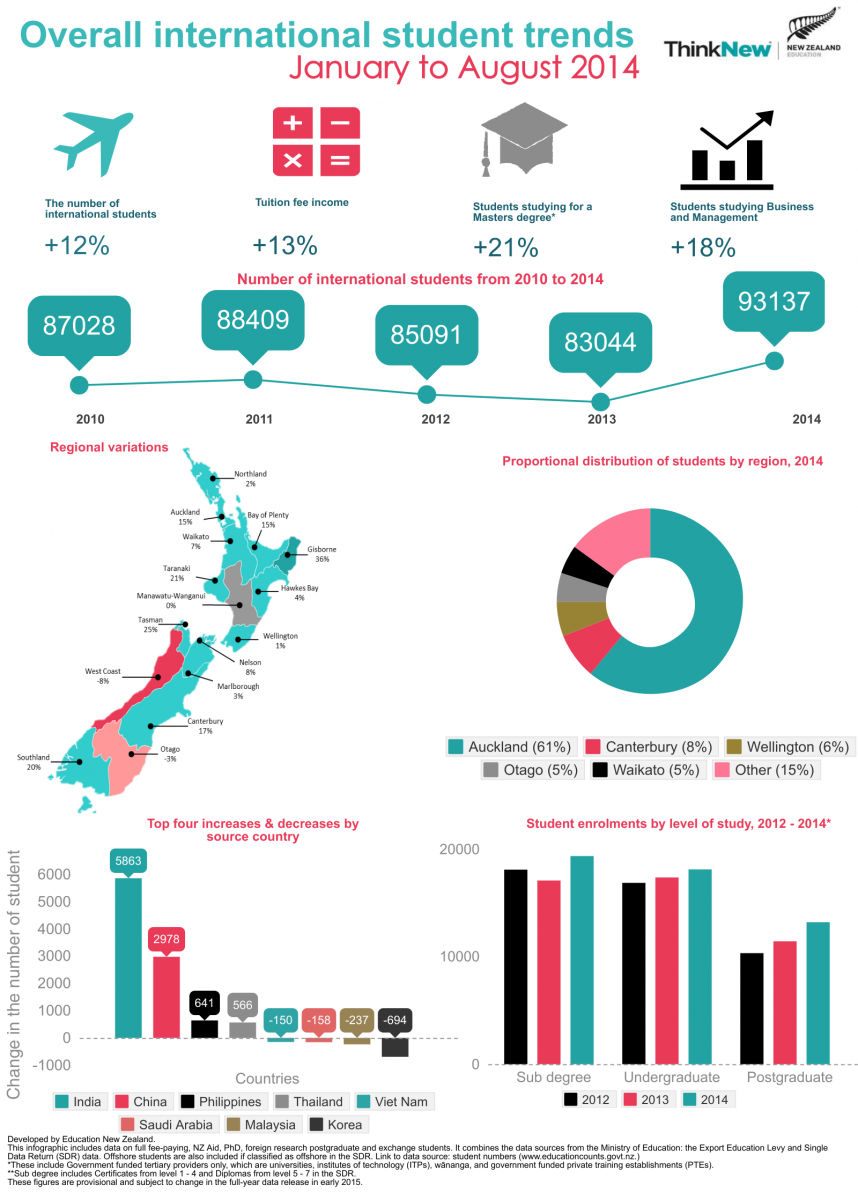
The government has committed an additional $2 million in 2016/17 to ENZ’s RPP for supporting growth initiatives in the regions. The additional funding is to build on the successes in 2015, with 11 out of 14 regions experiencing an increase in international student numbers.
The RPP will support the implementation of growth projects involving our regions outside of the metro centres. As announced previously in E-News, three new Regional Project Managers join our Business Development Managers in supporting regional growth initiatives: Sahinde Pala, based in Auckland with a focus on the regions north of Taupo; Jo Keane, based in Wellington and supporting our central regions from Taranaki to Nelson Marlborough; and Sarah Gauthier who will manage a range of pan-regional projects including New Zealand’s regional presence at ANZA, the development of an online regional resource and an agent familariisation programme.
For more information about ENZ’s RPP contact Greg Scott, Programme Manager Regional Partnership: greg.scott@enz.govt.nz Phone: 64 3 3795575 Mobile: 64 21 2422868
-
How IEGF helped BIOZONE
Considering applying for IEGF support? E-News caught up with IEGF recipient, Richard Allan, CEO of BIOZONE, at last year’s Edtech for Export conference in Wellington and found out how the co-funding grant helped them grow their business.
ENZ: What is BIOZONE?
BIOZONE International is a publishing house that specialises in the production of student and teacher resources for use in high school science programmes (grades 9-12) in the United States, United Kingdom, Australia, and New Zealand. We also provide editions that are tailored to other international programmes, and BIOZONE books have been translated into Chinese, Japanese, Polish, and Slovenian, as well as specific English-language editions compiled for Italy. BIOZONE’s goal is to improve science education performance in schools across the world.
We produce a hybrid that’s part textbook, part study guide and part activity workbook all rolled into one. We use an infographic style of presenting information, with annotated diagrammatic explanations that have a lot of added value. Our programme and pedagogical approach requires learners to apply what they’ve learned in a previous activity to a new situation, not merely recall data. It’s an enquiry-based approach.
I was a biology teacher for 11 years before I became a publisher, so I have a pretty good idea of what’s required for teachers and students to succeed in the classroom environment.
ENZ: What has IEGF funding enabled you to do?
We’ve been successful in two IEGF rounds – one in 2014 and one in 2015. The first lot of funding enabled us to market our new Next Generation Science Standards (NGSS) series in the US before other publishers got up to speed. The NGSS provides students with internationally-benchmarked science education.
Being nimble and innovative is key to our success, and the grant meant we could significantly ramp up the number of state and national science teachers’ conferences we could attend. To give you an idea of the demand – at one conference in Los Angeles in December 2014 I had over 200 teachers trying to cram into a room that only had the capacity to hold 100 people, to hear my presentation. They were sitting on the floor and around the edges of the room. That’s not untypical of what happened at other events, so we were obviously in the right place at the right time with the right product.
ENZ: And the second grant?
The second grant helped us enhance and improve our digital platform, and get it ready for commercial release. It made a huge difference in the timing of the launch and accelerated our development.
ENZ: How’s business going?
It’s been hugely successful in our markets that, so far, include New Zealand, Australia, the US, and the UK.
The opportunity for BIOZONE in the US is with the NGSS. One of our customers is Stuyvesant High School in New York City. It’s a very prestigious school, with 34,000 kids competing for 850 places, and they bought our entire programme, which is a huge accolade from them.
We also won the ‘Best Supplemental Resource’ award for science, for the whole of US, at the education publishers’ ‘Content in Context’ conference in 2015 which was pretty cool.
ENZ: Do you have any words of advice for educators new to working in the edtech space?
I think we should encourage our teachers to embrace education technology and provide them with the ability to upskill so they can use the tools. Many schools are already technologically savvy and are hungry for new ways of delivering curriculum using smart tools.
For educational publishers the digital landscape is evolving rapidly, not only with new opportunities and competitor activity, but also in the way teachers are wanting to engage with digital delivery of content.
-
Reminder of new data collection requirements
Private Training Establishments who do not receive SAC and/or Youth Guarantee funding from the Tertiary Education Commission, and are also signatories to the Code of Practice for the Pastoral Care of International Students are reminded that they are required to submit new data on their international students from 31 March 2016.
The August 2015 change to the Private Training Establishment (PTE) Registration Rules made it a condition of PTE registration to submit specific data to the Ministry of Education.
Consultation with exempted PTEs
A temporary exemption was granted to PTEs that provide English Language training only. For further information on the exemption please refer to the NZQA website.
An independent facilitator, Pania Gray of Kororā Consulting, is consulting with exempted PTEs on their approach to the new data collection requirements. Pania is consulting with exempted PTEs who are members of English New Zealand, via this representative body. Exempted PTEs who are not members of English New Zealand, and who would like to discuss the issues with Pania, are invited to contact her at: pania@kororaconsulting.co.nz.
Background about the data collection project
The Ministry of Education, Education New Zealand and the New Zealand Qualifications Authority (NZQA) have been working on a project which will gather better information from Unfunded International Education Providers (UIPs) using an automated data collection system.
The aim of the data collection project is to provide better market insights and analysis, and more targeted risk assessments, that will to help inform plans and activities relating to international education.
Good data and in-market intelligence can influence government strategy and policy, and enable informed data-driven decisions to be made. These decisions can work to the benefit of international education providers, international students and the wider international education industry.
More about the data and how to submit it
The UIP Data Collection – SMS Specification document explains which providers are required to submit data and how the data must be submitted.
Further information is available on the Services for Tertiary Organisations (STEO) website.
If you have any questions, or need clarification on who the exemption applies to, please email UIP.Datacollection@education.govt.nz.
The rule change took effect on 1 March 2016 and the new data must be submitted from 31 March 2016. If you require assistance with setting up the data return, please email UIP.Datacollection@education.govt.nz.
-
Consultation next step for agent programme
Thanks to those in the international education sector who contributed their time and expertise to this review.
Findings recommend change
The findings make it clear that, while there are some positives, there does need to be change. The programme is not performing well for our stakeholders or for ENZ in our drive to grow, support and promote a quality international education industry for New Zealand.
The report recommends a number of potential areas for ENZ to consider regarding agents, including:
-
Better supporting providers to develop effective relationships with quality agents
-
Making available a publicly searchable database of agents who have completed our online training
-
Our work in better recognising the market differences between countries and sectors
-
Supporting agents by continuing to make available New Zealand promotional materials
-
Strengthening the rigour, scope and quality of online training, including more information on relevant New Zealand laws and regulations
Consultation is the next step
ENZ’s next step is to consult broadly, including with institutions, agents and government agencies about the future of ENZ’s work around agents. We understand that changes we have made to agent programmes in the past have been disruptive for agents and providers. As such, our thorough consultation will ensure any future solutions are effective, workable and sustainable, and supported. Our engagement will start shortly and, depending on what we hear, decisions are most likely in the second half of this year.
The ENZRA programme remains on hold
As we have shared already, while the consultation is underway we will not be progressing any current ENZRA agent applications or accepting any new ENZRA agent applications. During the consultation phase, there will be no change for agents with current ENZRA status.
We appreciate this may be frustrating for some but believe it is preferable to pause while we ensure any potential changes are carefully considered and well-supported.
Please note agents are able to assist students to enrol with New Zealand education providers regardless of whether they have ENZRA status or have completed the Trained Agent online programme.
Communication
We’ll stay in touch and keep you updated as the consultation unfolds. If you have any questions in the meantime, please get in touch with your contact at Education New Zealand.
-