Search
Showing 10 of 7355 results
-
International Student Barometer Results: school sector
The results of the International Student Barometer (ISB) survey for the school sector are now in, and New Zealand has maintained very high overall student satisfaction.
ENZ commissioned the ISB survey of students at schools to investigate the decision-making, expectations, perceptions and experiences of over 2,000 international students aged 16+.
Unlike the surveys of the other sectors, there is no global benchmark, because New Zealand is the only country which undertakes the ISB survey in the school sector. However, we can compare ourselves with our own performance in 2012, which was also very high.
Ninety-four percent of school students surveyed were satisfied with their experience. This is on par with the 2012 survey. Students showing the highest satisfaction level were from France, Hong Kong, Germany, and Brazil.
This is a great result for the NZ school sector – maintaining high satisfaction levels, while growing student numbers.
Eighty-eight percent are happy with their life in New Zealand. Three out of four students would recommend their school to other students thinking of studying there.
It’s worth noting that overall satisfaction levels vary noticeably by institution and by nationality. Most participating institutions have received their own results to analyse and help inform the development of services and support for their student cohorts.
Generally speaking, the areas with lowest student satisfaction are around making friends with locals, and some aspects of arrival support – elements of which are issues for international students globally, not just in New Zealand.
Education New Zealand will be using this data to identify follow-up actions and deliver professional development support to schools.
One particular point to note is that, of those students who plan to stay in New Zealand after school (26 percent), two thirds intend to go to university. And, 26 percent of all students don’t yet know what they will do post-school – an opportunity for local tertiary providers.
A point of comparison is Australia’s International Student Survey 2014, in which 82 percent of school students were satisfied with their overall experience.
More in-depth results of the New Zealand survey are available in the ISB School Sector Summary Report 2015 and the ISB School Sector Presentation.
- Akl20student20welcome20event
-
APAC TVET Forum: Bringing us together
The inaugural Asia Pacific Technical and Vocational Education and Training Forum will be held online on the first two Fridays in November 2021. The event – themed “Bringing us together” – will allow people in the sector to share best practice and foster new connections despite COVID-19 travel restrictions.
The APAC TVET Forum will be opened by New Zealand’s Minister of Education, Chris Hipkins, and will feature an address by the Chief Executive of Te Pūkenga New Zealand Institute of Skills and Technology, Stephen Town.
The forum is driven by partners Te Pūkenga, Education New Zealand and Skills Consulting Group.
ENZ Chief Executive Grant McPherson says with an increasing emphasis on applied learning and work-ready graduates, the applied vocational sector in Aotearoa New Zealand has much to offer.
“A New Zealand education produces in-demand graduates with the skills and knowledge they need to join the workforce with confidence,” Mr McPherson says.
The APAC TVET Forum will bring together experts from the three sectors vital to effective technical and vocational education – government, industry and education. It will offer government-to-government, business-to-business and system-to-system content streams – bringing people together for a cross-system conversation.
There is no cost to register for forum sessions on 5 and 12 November, and there are networking opportunities and sessions on the days in between.
The international heft will come from speakers including Professor Christina Hong, President of the Technological and Higher Education Institute of Hong Kong and Marc Gomes, Group Senior Vice President and Head of Training for ADECCO Global.
The Pacific representatives include Dr Isimeli Tagicakiverata, Director of the National Training and Productivity Centre at the Fiji National University, who is presenting on upskilling, reskilling and lifelong learning as part of the system-to-system content stream.
The APAC TVET Forum builds on the strong foundations of the Sino-NZ Vocational Education and Training Model Programme, a forum for sharing best practice that is widely acknowledged as beneficial to both countries. Under this programme, Chinese and New Zealand institutions have taken turns to host the annual New Zealand-China Higher Vocational Education Conference.
China’s Central Institute of Vocational and Technical Education – a China Ministry of Education thinktank – has supported and presented at the previous conferences and will deliver a keynote presentation at the APAC TVET Forum.
Wherever we live in the world, a thriving future is what we all want. Governments, industries and educators are all working together to upskill and reskill workforces disrupted by the pandemic. The APAC TVET Forum is a chance to be part of the solution. To register or find out more, go to www.apactvetforum.com.
-
BPO Intelligence to make a splash at NZIEC 2018
The innovative marketing and communications company works closely with many providers across the country, including 85 percent of universities in Australia and New Zealand, to aid them in their international marketing endeavours.
“We are thrilled to be the lead partner for NZIEC for a fifth consecutive year,” says BPO Intelligence chief executive Naresh Gulati.
“NZIEC is becoming one of the most significant conferences on the global international education circuit. We are delighted to be able to once again share our expertise in leadership and innovation, as well as helping to explore new strategies and new technologies for growth and development in international education,” says Naresh.
“We appreciate BPO’s commitment to supporting the development of New Zealand’s international education industry through its backing of NZIEC,” says ENZ chief executive Grant McPherson.
“BPO has been a strong supporter of NZIEC for the past four years and it’s great to have them involved for the next phase of the conference’s development.”
“I encourage all conference delegates to head along and touch base with the BPO team at the Expo Hall.”
NZIEC selling out – fast!
In just two weeks we’ve sold over 50% of the available places at NZIEC 2018. That makes it our fastest selling conference yet – and we’re on track to sell out. With fewer than half the spots now available, you’ll have to get in quick to avoid missing out on the international education event of the year.
NZIEC 2018 will be held on Thursday 9 and Friday 10 August at Te Papa Tongarewa in Wellington. Pre-conference workshops will be held on the afternoon of Wednesday 8 August.
-
NZ EdTech breaks into Middle East market with ‘Play Code Learn’ teaching solution
ByteEd is a New Zealand EdTech company with a mission to empower future generations to become creators of technology rather than just users. The company started out in 2018 by teaching industry-standard programming to high school and university students to create virtual reality worlds. However, a need to start reaching a younger audience was identified due to a lack of foundational concepts.
This led Founder and CE, Peter Dong and his team, to develop a comprehensive solution for students in their early years, using ‘Play Code Learn’ hands on kits combined with augmented reality and artificial intelligence to address this gap.
It is this solution that has been adopted as a core resource by Higher Colleges of Technology (HCT) in the United Arab Emirates for its new Computational Thinking course. All Emirati graduates from their six colleges will learn computational thinking and then using the Play Code Learn resource will teach this in schools where they will become teachers.
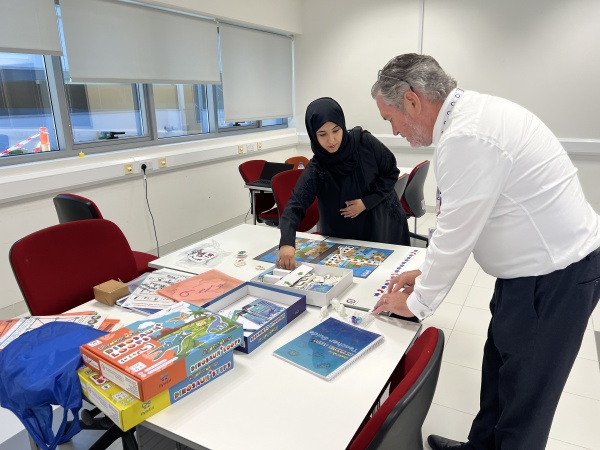
Dr Robert Miles and Haya Al Nuaimi undertaking training on the Play Code Learn kits at HCT Ras Al Khaimah
Peter says that getting to this point has been the culmination of several years of hard work and relationship building, with patience and persistence being key to their success.
“We went into this process knowing that it would take time. We started with a real understanding of our customers’ needs and in particular those of HCT. HCT is a large organisation and we needed to build relationships with multiple key decision makers.
“We are so excited to have made this breakthrough into the UAE and hope it paves the way for more New Zealand EdTechs to do the same;” said Peter.
“As more educators at HCT in the UAE use our solution and collaborate with ByTeEd, then we’ll be building New Zealand’s reputation for our country’s capability in developing innovative and valuable EdTech solutions,” he added.
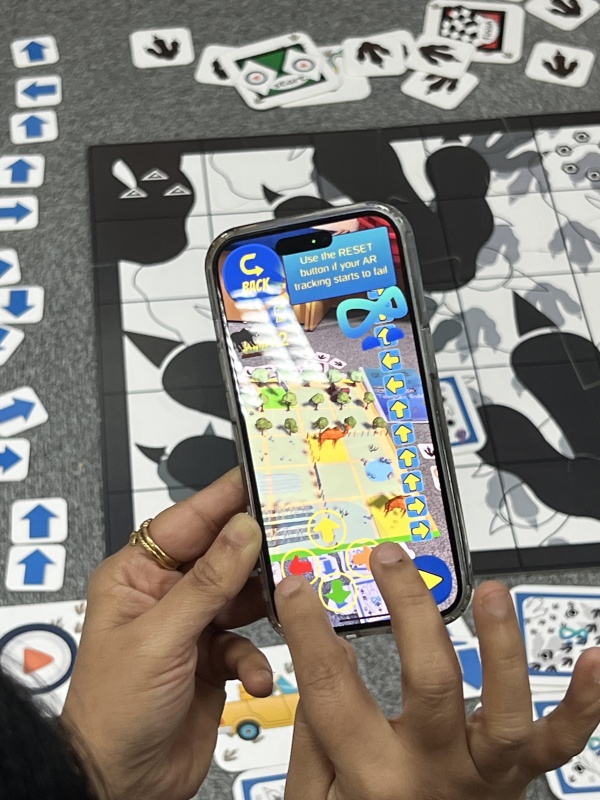
A student using augmented reality to program while the physical learning kit can be seen in the background.
The opportunity to work with HCT all came about from an introduction that was facilitated by Education New Zealand Manapou ki te Ao (ENZ) at the New Zealand Pavilion at the Dubai World Expo in early 2022. Several New Zealand EdTech companies were invited to be part alongside other New Zealand education providers.
Dr Angela Fitzgerald, Executive Dean – Faculty of Education at HCT commented that the work that her Faculty was doing with ByteEd is powerful.
“Their approach empowers teacher educators through lived experiences of computational thinking to prepare future teachers in equally dynamic ways to equip young children with these very skills and knowledge. This will be necessary as they navigate their future worlds,” said Dr Fitzgerald.
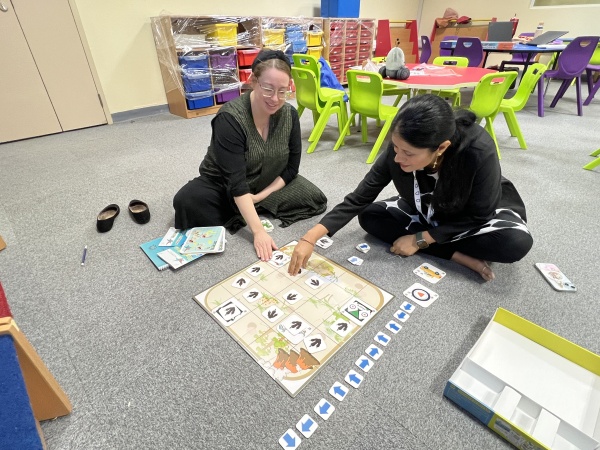
Lecturer Jennifer Filinuk and Senior Lecturer Savita Parashar are using the hands-on learning tools to learn computational thinking before combining it with augmented reality.
When asked what advice ByteEd would give to a fellow EdTech looking to expand their business overseas, and specifically into the Gulf Cooperation Council countries, Peter had some nuggets of advice.
He said that taking the first step to explore the market and gauge interest from target customers is key to gaining that initial understanding of the potential, as is gaining a clear understanding of the problem that you’re aiming to solve for this market.
“Show that you’re not just another visitor and be prepared to make multiple visits and build relationships.
“There are many opportunities in the Gulf region for New Zealand EdTech companies, with more funding available here due to a strong focus on education. The region is also one of few where the younger population is growing,” said Peter.
“There is also significant competition in this region however, so make sure to research potential competitors and consider how to position your company and product effectively”, he concluded.
For more information
ENZ, alongside EdTechNZ, recently hosted a Middle East EdTEch market deep dive with a presentation delivered by Nick Sheppard, Trade and Commercial Advisor from New Zealand Trade and Enterprise based in Dubai. Joining him in the session were the Founders of New Zealand EdTech’s ByteEd, Komodo Wellbeing and EDconnect. You can watch a recording of the presentation here with the slides available here.
If you have further questions about the support that ENZ can provide New Zealand EdTechs overseas, please contact ENZ’s Business Development Manager, Alana Pellow – alana.pellow@enz.govt.nz.
-
Update from Immigration New Zealand
New Immigration New Zealand website now live
The new Immigration New Zealand (INZ) website is now live, with clearer information and guidance to help INZ customers navigate their immigration journey more easily.
The new visual design and structure makes it easier for customers to know what the visa process means for them and how to apply for a visa and comply with their visa conditions.
Visit the new INZ website.Apply early to get ahead of the student visa peak
Applying for a student visa at least three months before intended travel date gives students the best chance to have a decision made in time for their study.
The processing of student visas is a priority for INZ, particularly as it gets closer to peak times.
Immigration New Zealand is in the mid-year student visa processing peak, which is between May and August each year.
Applications take longer to be decided during this peak period, so it is important that students apply early if they want to come to New Zealand to study.
Wait times for international student visa applications are published in our visa wait times section.
Help us process applications faster
To help INZ process applications quicker and avoid unnecessary delays, students should provide full and complete applications, including all necessary documentation.
Students can use our student visa information sheets to make sure their application has all the information and documentation required.
Student visa information sheet – first-time international students
Student visa information sheet – continuing international students
If students apply late, their application may not be processed in time for their study in New Zealand.
Due to the high volume of visa applications expected, we will not contact students if documents are missing from their application. If the missing information is key to the assessment, then the application may be declined.
Student visas moving to enhanced Immigration Online
From 18 August 2025, international student visa applications are moving to Immigration New Zealand’s enhanced Immigration Online system.
The aim is a simpler, faster and more user-friendly visa application process to reduce waiting times, provide clear communication on application statuses, and increase self-service capabilities so everyone feels more informed and better supported.
How applications during this transition will be managed
As we are in a peak period for student visa applications, we encourage applicants to submit applications when they are ready, and at least 3 months ahead of the intended travel date to help avoid delays that may impact them starting their study on time.
There are some important things applicants need to know if they are submitting an international student visa application around August 2025.
If applicants start a new draft application on or before 17 August, they will be applying in our current system. They will need to submit the application by 17 September, otherwise the draft application will expire.
If they start an application on or after 18 August, they will be automatically directed to our new system.
Please read our news item for more detailed information on the visas affected and the transition process.
-
Revised code of practice for international education providers
The code outlines ten outcomes sought from education providers for the care and support of international students.
- marketing and promotion
- managing and monitoring agents
- offers enrolment and contract
- immigration criteria
- adequate orientation
- safety and well-being
- student support, advice and services
- managing withdrawal and closure
- dealing with grievances
- compliance with International Student Contract Dispute Resolution Scheme
The New Zealand Qualifications Authority will administer the code and impose sanctions against education providers who breach it.
New Zealand was one of the first countries in the world to adopt a code of practice in 2002. This new code will ensure New Zealand remains a world leader in the pastoral care of international students.
The international education sector has been growing strongly. To sustain this growth, it is imperative that we ensure international students receive a high quality education and have a positive, well-supported experience whilst studying in New Zealand.
A new International Student Contract Dispute Resolution Scheme (DRS) has also been established to resolve contractual and financial disputes between international students and education providers.The new dispute resolution scheme will provide a faster and more effective forum for resolving contract and financial disagreements between students and providers. More information on this can be found here.
Both the code and the disputes resolution scheme come into force on 1 July 2016.
The revised code and the dispute resolution scheme are part of the Education Amendment Act 2015 and follow extensive consultation across the sector.Further information about the revised code can be found here.
-
Signing up to a bright future for the Deaf community
A serious encounter with Ménière’s disease partway through his PhD studies was a life-changing event in more ways than one for Arash Tayebi.
The inner ear disorder resulted in him losing the hearing in one ear and facing up to the possibility he could become deaf in the future. Studying at Auckland University, and feeling far from his home in Iran, he says the experience hit him hard.
But Arash turned one of the biggest challenges in his life into an opportunity. He became the driving force behind Kara Technologies, an award-winning start-up using digital sign language avatars to make communications of all kinds accessible to those with hearing issues.
His own situation made him question the noticeable lack of deaf people studying at universities, becoming entrepreneurs, and holding leadership positions in the workplace. “I asked myself if I become completely deaf will I not be able to succeed in study and work?”
Engaging with the Deaf community he learned of the real shortage of teachers of sign language, and the complexities in resolving that. Bringing in teachers from overseas is not the answer because they do not know New Zealand Sign Language (NZSL). Closed captioning, which can automatically caption speech is of limited use as young children cannot read, and existing avatars are not expressive enough for Deaf people.
“I said let’s work together to come up with a solution.”
Turning a vision into reality
What started as a small project with Kelston Deaf Education Centre, now part of Ko Taku Reo Deaf Education New Zealand, ultimately morphed into Kara Technologies. But it took vision, determination, and “mind-blowing” support from people he met along the start-up journey.
"The cool thing about New Zealand is that if you have a vision nobody will call you crazy, they’re here to help and happy to take a risk. That’s fantastic."
“There was so much I needed to learn about running a business. I wasn’t rich, so I needed funding. And as the concept was new, I needed the support of the Deaf community.”
Arash’s first break came when Kara Technologies was named Social Enterprise winner in Auckland University’s start-up business competition Velocity $100K Challenge in 2017, giving him access to seed funding and a mentorship programme. Then there was UniServices, which helps to commercialise promising student ventures through investment, advice, and connections. And in the wider community there was GridAKL, an innovation support community with a downtown campus. “If I had a problem, I could always find someone there who was happy to offer advice,” he says.
Estimates of NZSL users vary significantly, from about 4000 for whom it is a first language to more than 20,000 who have some knowledge of it. Arash and his team are committed to their vision of improving meaningful access to information for the Deaf community, and they are already making an impact.
Kara Technologies has produced a diverse suite of avatars, signed children’s books and a range of videos. It has been recognised many times for its innovative work, most recently being named a 2022 finalist in the Public Good category at the NZ Hi-Tech Awards.
Looking to the future
The team at Kara sees a future where TV shows, bank machines, travel websites, online registration forms, live theatre, social media, gaming, and virtual reality technologies are all equipped with sign language avatars. “We want the daily life of a Deaf person to be as easy as a hearing person,” Arash says.
The company is currently trialling emergency messaging by using a set of pre-recorded motion-captured animations, making it possible to relay time-critical information quickly.
Kara is already attracting interest in the US and Canada, where Deaf advocates are excited by the technology. “They are impressed that a small country can make such a contribution. It makes me proud because I call New Zealand home.”
Arash says it’s hard to believe the decision he made to come to New Zealand to study in 2013 has led to where he is now. “I thought I would probably complete my PhD and end up in an academic teaching role. But I have a company, a team, a vision, and fantastic friends. It’s all happened because of the great support I’ve received here.”
He only wishes it was easier for innovators like him to stay on when they finished their studies. He would love New Zealand to introduce a Talent visa like Australia and Canada have. “If you have a cool project they will welcome you, but in New Zealand, you need to secure a job. I already have a job, but it is in my own company,” he says.
“When New Zealand encourages international students to come here it needs to be able to harness their talent, nurture them, and benefit from their talent.”
But Arash says he would always encourage students to come here. “Take yourself out of your comfort zone and you will meet amazing people. New Zealand is a crazy, creative country which could easily be your second home.”
-
Korean education relationship strengthened
Minister Joyce took part in three key education-related events while there.
NZ/Korea joint qualification recognition one step closer

Minister Joyce and Republic of Korea's Deputy Prime Minister and Minister of Education, Hwang Woo Yea (left) exchange gifts following the bilateral meeting.
Minister Joyce met the Republic of Korea's Deputy Prime Minister and Minister of Education, Hwang Woo Yea, on 19 October, and announced the completion of a research project which confirmed the comparability of the two countries’ senior secondary school curricula and qualifications. They also discussed other bilateral cooperation matters, such as increasing the two-way flow of students and Korean language teaching in New Zealand.
“Working towards joint recognition of secondary schools qualification will encourage more Korean and New Zealand students to study in each other’s country, particularly as New Zealand and Korea are set to become even closer partners as we implement our new Free Trade Agreement,” said Minister Joyce.
Game On English - Golf scholars and Minister exchange swing and putting tips

Minister Joyce demonstrates his putting prowess
Four aspiring Korean golfers will get the opportunity to walk the footsteps of world-famous Kiwi-Korean golfers thanks to a Game On English - Golf scholarship awarded to them in Seoul on 19 October by Minister Joyce. Game On English - Golf provides intensive English language classes and top quality golf coaching to talented young Koreans who want to become professional golfers.
ENZ’s Regional Director for Japan, Korea and the Americas, Lisa Futschek, explained, “‘Game On English - Golf’ brings together New Zealand’s expertise in golf coaching with our education system that consistently ranks amongst the best in the world.
Fifteen year-old scholarship recipient, Ms Lim Hee Jeong, commented at the awards ceremony, “I am honoured to be the first Game On English - Golf scholarship winner. I will train very hard at New Zealand’s best golf training academy, the Institute of Golf, and study very hard at Unique New Zealand, and [one day] become a top professional golfer!”

L-R, scholarship recipients: Kim Beom Soo (age 17), Jung Teayang (age 15), Lim Heejeong (age 15). Absent: Kim Sojung (age 17)
Kiwi Alumni Association supporting New Zealand graduates in Korea

There was a warm and friendly atmosphere at the Kiwi Alumni reception
More than 100 graduates of New Zealand education institutions turned up to the second networking event organised by the Kiwi Alumni Association and held at the New Zealand Residence on 19 October.
The Kiwi Alumni Association was launched in March 2015 during the Prime Minister’s visit to Seoul as a way to tap into the growing number of New Zealand-educated Koreans who are returning to Korea. Maintaining contact with the alumni, who go on to work in diverse industries, helps build a constituency of supporters for New Zealand across Korea.
“The Kiwi Alumni Association provides opportunities to develop and grow partnerships between New Zealand and Korea. The networking opportunities offered by the Kiwi Alumni Association are hugely important, providing a strong basis on which partnerships and other collaborative prospects can be formed,” said Minister Joyce.
- TIBE20Alex20presso202a