Search

Showing 10 of 7183 results

  • Understanding Indonesia’s education market

    Every year, more and more Indonesian students look to further their studies overseas. There is an awareness of the need for a better quality of education and the current circumstance in Indonesia is that facilities and quality education are somewhat still below expectations, especially when compared to abroad. International schools based in Indonesia also take a part of the increasing number of Indonesian students looking for an international education. After finishing at these high schools with an “overseas” qualification, these students usually opt to pursue their tertiary study abroad.

    With the number of Indonesian students choosing to go abroad increasing each year, why has New Zealand not truly benefited? It is simply because of the lack of information about New Zealand and the perception that New Zealand is a very quiet country with more sheep than people. We in Indonesia seldom see advertisements about New Zealand or the institutions while other countries have put lots of effort in branding their country and their institutions consistently. People are all the same. We tend to remember products that have a strong branding.  So, if you want people to always remember your product, you need to keep reminding people by persistently branding your product to the market.

    At first, I had the same perception of New Zealand being quiet too. Joining the May 2013 trip was my very first time to see New Zealand. I was so excited.

    I got a chance to visit representative institutions in Auckland, Hamilton, Wellington, Christchurch and Dunedin. In the South Island, my first destination was Christchurch where I found lots of major work to rebuild and renovate its buildings.

    The first day touching down in Auckland, and seeing the city itself, changed my perception. Auckland is not as crowded as in my country, Indonesia, of course. But it is not as quiet as what I thought! The city has everything that a student needs - shops, cafes, restaurants, flats, shopping centres and even the education institutions are all within walking distance.

    New Zealand is such a perfect place to study. You have everything in town, people are so nice and friendly, and it’s very safe. I don’t need to worry about pick-pockets or drunken people when walking with my female friends back to hotel at night.

    After seeing these cities, and visiting various institutions, I also found that New Zealand has a great education system. Students are taught in a very practical way, both, in high schools and tertiary institutions. And this is what New Zealand needs to show. You need to educate the Indonesian market about this and change the perception of New Zealand.

    Indonesian families are unique. They have a strong family relationship. Their children’s study destination is also influenced by their relatives and friends. Parents feel more comfortable about letting their children study in a country where they have relatives or friends staying. Most of the time, the experience and opinions from their relatives play a great part in their decision. Apart from that, Indonesian parents will usually send their children overseas after they graduate from high school. They believe at this stage their children are mature enough and can take a good care of themselves overseas. Therefore, tertiary education is more attractive to the Indonesian market.

    Recently, the postgraduate market for Indonesian students has also been growing significantly. For postgraduate students, study duration, value for money and the opportunity for job placement are the key areas they are usually looking at. Little do they know that New Zealand offers a postgraduate job search visa and the opportunity to work and stay in New Zealand after they graduate.

    So, by understanding Indonesian market better, I believe institutions can plan a better strategy for their marketing activities. Together we can promote New Zealand as one of the top destinations for Indonesian students to consider as a study destination.

    Key points:

    • New Zealand has a low profile in Indonesia

    • To change this we need persistent and consistent marketing in Indonesia

    • The Indonesian market is primarily a tertiary education market, but there are opportunities for other sectors

    • The postgraduate market is growing significantly.

    SUN Education describes itself as the “most complete” International Educational Consultancy firm in Indonesia, providing the largest selection of quality education and country destination under one roof with its main focus being Australia, Singapore, UK, USA, Malaysia, New Zealand, Switzerland and Canada. Suwarni has more than eight years of student recruitment activity and currently works with 10 countries including New Zealand.

    Suwarni Puspita, Branch Manager, Mal Ciputra, with Indonesia’s SUN Education Group recently took part in a visit to New Zealand with other education agents from Indonesia. She offers some impressions of the opportunities and challenges for New Zealand institution, and in particular tertiary institutions, in Indonesia.

  • Immigration physician panel update

    The agreement will improve the quality of health examinations visa applicants receive from doctors and radiologists undertaking immigration health examinations. Implementation of the aligned network will take place in three phases and is expected to be fully completed by mid 2014. 

    Removals and additions to INZ’s panel physician list in this phase of alignment will become effective on 30 June 2013. Panel physicians being removed from INZ’s list have been informed not to accept appointments after 29 June 2013.

    Applicants who have had a medical and/or chest X-ray certificate completed by a panel physician being removed from INZ’s panel will still be able to submit these certificates with their visa application if they have been completed prior to 30 June 2013.

    The aligned network will be jointly managed and co-ordinated by INZ and the Department of Immigration and Citizenship (DIAC).

    The benefits of alignment include:

    • improved customer service;

    • targeted communication, administration, performance management and training for a single panel physician network, and related cost savings;  

    • enhanced integrity through robust auditing and analysis;

    • expansion of tuberculosis screening and treatment networks; and

    • progression of the immigration Five Country Conference objectives including: the promotion of health protection and efficiency through effective shared management and quality assurance, and promoting best practice, partnership and shared investment.

    A key consideration in developing this agreement is that the panel physician network remains responsive to the needs of INZ and DIAC visa applicants.  INZ and DIAC are working closely together to develop and implement a joint management framework.

    The INZ panel physician list is on the INZ website.  If applicants are unsure whether their medical certificates have been completed by a panel physician they should refer to the INZ website, or contact their nearest INZ office for further advice.

    INZ have also published additional information on the Questions and Answers section of its website.

  • ENZ’s latest Statement of Intent is out

    While the overarching goals and objectives for New Zealand's international education industry remain the same, the strategic framework of our next steps to support the industry to reach these goals are reflected in more detail.

    The two intermediate outcomes of these next steps include activities to increase both the economic value of international students studying in New Zealand and increase the economic value of our products and services delivered offshore.

    Alongside these marketing and industry development activities, we also support government-government liaison work and will launch our outbound scholarship programme.

    Download the Statement of Intent 2013-2016.

  • How New Zealand education compares around the world

    Education at a Glance provides comparable national statistics measuring the state of education worldwide. The report analyses the education systems of 34 OECD member countries, as well as Argentina, Brazil, China, India, Indonesia, Russia, Saudi Arabia and South Africa.  Most of the recent data in the report relates to 2011.

    The findings show New Zealand is performing well.

    In terms of international education, key findings include:

    • New Zealand has the 11th largest market in absolute market share terms (at 1.7 percent), about the same as last year, but much higher than its share in 2000 (0.4 percent)

    • In 2011, we ranked fourth in terms of proportion of tertiary-level students who were international (16 percent). In particular, we had the highest proportion of diploma-level students who were international (at 21 percent ), and the fifth highest (with 13 percent ) at degree level

    • The level of international doctorate students has continued its significant rise since 2005 (since the introduction of domestic-fees policy). Nearly 40 percent  of doctorate-level students were international in 2011 (the third highest level after UK and Switzerland).

    The report shows that New Zealand is:

    • investing 7.3 percent of its GDP in education - the seventh highest in the OECD

    • ·investing 20 percent of all public expenditure in education, which is the second highest percentage in the OECD

    • in the top third of countries for participation in early childhood education - 95 percent of four year olds enrolled in 2011

    • in the top 10 of the OECD for the highest proportion of tertiary qualified adults, with 39 percent of 25 to 64 year-olds and 47 percent of 25 to 34 year-olds in New Zealand having a diploma or higher qualification

    • increasing significantly the number of 15 to 19 year olds enrolled in study - 81.5 percent in 2011, up from 74 percent in 2008.

    The OECD report, Education at a Glance 2013 is available here

  • GCC strategy released tomorrow

    Like other NZ Inc strategies, such as the ones for India and China, the GCC strategy will include international education goals.

    The GCC countries are: Bahrain, Kuwait, Oman, Qatar, Saudi Arabia and the United Arab Emirates.

    Watch the Ministry of Foreign Affairs and Trade website to get a copy of the strategy.

    There is more information on the NZ Inc strategies here.

  • Changes to ENZ in Vietnam

    Nga Phuong Tran, who has worked with many in the New Zealand international education industry over the last three years, is again working fulltime for New Zealand Trade and Enterprise (NZTE).   

    ENZ is in the final stages of appointing a new, fulltime Market Development Manager (MDM) in Ho Chi Minh City (HCMC). Once appointed, the MDM will be responsible for all support and logistics around the education fairs usually provided by ENZ, other recruitment activities as well as helping New Zealand education providers expand their engagement with Vietnam. 

    Until the new MDM in HCMC is appointed, please direct all enquiries related to Vietnam to the ENZ Regional Director, Izak Human.

    When this latest appointment is made, ENZ will have fulltime representatives in Malaysia, Indonesia, Thailand and Vietnam. All of these Southeast Asian regional representatives are able to provide information on:

    • education opportunities in their respective countries;

    • local regulations regarding provision of education services;

    • assistance with finding suitable partner institutions; and

    • how to connect with national education ministries and officials.

    ENZ representatives also maintain regular contact with a network of regional education agents and would welcome information on specific programmes or study options that you may want to promote in South East Asia.

    Nga’s farewell message is that over the last three years “I have had the privilege of working with over 90 New Zealand education providers from all over New Zealand. I have met with so many memorable and wonderful people from different institutions. Many of you have taken a proactive and innovative approach to promoting New Zealand education in the Vietnamese market – so keep it up!

    Thank you for your support and friendship.”

  • Wānanga capture India’s interest

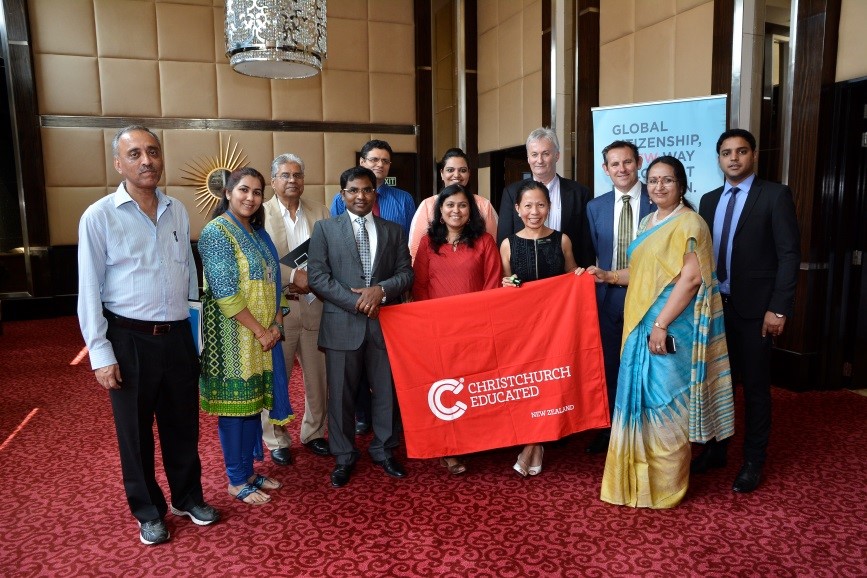
    Yesterday the delegation took part in the second meeting of the India New Zealand Education Council (INZEC) and the first to be held in New Zealand.

    A focus of the visit was to explore New Zealand’s approach to Māori-centred learning in the tertiary sector. On Monday the delegation visited Te Whare Wānanga O Awanuiārangi at the University of Auckland.

    Dr Raju was interested in New Zealand’s approach to integrating Māori culture into modern-day education frameworks and how New Zealand lifts the achievement of Māori learners. The Indian Government sees education as integral for supporting India’s aboriginal tribes’ prosperity and engagement with wider Indian society.

    “It was agreed by the Indian delegation, and the wānanga, that it was important to strike a balance between modernity and tradition, recognising the legitimacy of indigenous knowledge and the wider benefits of education as they relate to future employment but also wider cultural and community values,” says Ziena Jalil, Education New Zealand’s Regional Director South Asia.

    “Te Whare Wānanga o Awanuiārangi expressed their desire to progress the relationship with India given the wānanga’s capability and success in running indigenous institutions from governance and curriculum development to connecting with the mainstream education system.”

    The aboriginal tribes of India are its oldest inhabitants, making up 8.6 percent (more than 104 million people) of the country’s population.

    Discussions at the INZEC meeting, held in Wellington, highlighted New Zealand’s approach to vocational pathways and qualification recognition, accreditation and institutional linkages for Indian and New Zealand tertiary institutions.

    Ziena says “Given the short lead-in time for the second INZEC meeting, and that less than one year has passed since the inaugural meeting, the focus of the meeting was around re-committing to the relationship and critically, to agree to processes that would encourage joint activities supported by joint funding.”

    While in New Zealand, Dr Raju had bilateral meetings with Minister for Tertiary Education, Skills and Employment Steven Joyce and Minister of Education Hekia Parata. Dr Raju also visited the Education Review Office and Teachers Council. 

  • America's Cup promotions

    Education New Zealand will be in San Francisco during the week of 29 August, along with Universities New Zealand and Le Cordon Bleu, to partner in a cocktail event to promote education in New Zealand. This event will be attended by university alumni, US education representatives and VIP business guests.

    New Zealand education will also be profiled at various points around San Francisco by placement on STQRY podiums. STQRY (pronounced STORY) gives visitors access to information about studying in New Zealand through an interactive resource which can be accessed at the podium or saved through scanning a QR code.

    The America’s Cup is being held in San Francisco from this month through to September.

  • Jovem Nerds hitting the right spot in Brazil and New Zealand

    Every semester the Jovem (or 'Young') Nerds travel to a new part of the world giving viewers the inside guide to local 'nerd' culture.

    In this trip the Nerds promoted New Zealand as an English language destination to their large youth audience, and showcased some of the best that our tourism industry has to offer.

    While here, the Nerds published on Twitter and Instagram and have, since returning to Brazil, published two video blogs on YouTube, which have received more than 250,000 views collectively. There have been 550,000 downloads of the Nerdcast and 600,000 views of the videos released to date.

    Traffic from Brazil to ENZ's student website increased by 125% for the month of June, and English language schools featured in the videos have reported an increase in traffic to their websites – one school received their usual monthly traffic in one day.

    Five videos will be posted in total.

    ENZ is looking to identify key opinion leaders in other priority markets to replicate this highly-successful awareness-raising campaign.

    View the New Zealand highlights of the Jovem Nerds' trip on their blog

  • Schools' campaign kicks off

    The campaign was launched in Japan in mid-July, and in the remaining markets at the end of July. 

    The campaign targets parents who are thinking of sending their children overseas for high school. Through short video clips, students share what it’s like to study and live in New Zealand, parents share what it’s like to send their child here, and New Zealand international support staff at high schools talk about how they support their international students during their studies.

    The campaign will run through Google and Yahoo! networks, and in media specific to each country. Parents can click through to a dedicated landing page to watch the videos, read further information and then follow a link to a local New Zealand Specialist Agent (NZSA). They can also choose to download a PDF of the key information and a list of their local agents.

    ENZ has kept the NZSA network in each country informed about this campaign, which runs until 29 September in all markets.

    The campaign material features the refreshed ‘Study in New Zealand’ student campaign, which showcases to potential students and their parents that you get more from a New Zealand education: a better learning experience, greater lifestyle opportunities and the foundations for a promising future and career.

    ENZ is trialling the 'Study in New Zealand' student campaign at events, fairs and in marketing campaigns through to December 2013.

What's in it for me?