Search
Showing 10 of 7183 results
-
EdTech tour continues to raise New Zealand’s profile
Svenia and Audrey Jarre were hosted by Education New Zealand to visit edtech companies and educational institutions in Auckland, Wellington and Dunedin in December as part of their seven-country and five-month study of edtech ecosystems (see 16 March news story).
Last week, the pair released their report and New Zealand video in which some excellent initiatives from around the world and New Zealand are profiled.
Some key themes for successful edtech are:
- Local context matters – ‘there is no Uber for education’
- Requires a supportive eco-system and community
- ‘Teachers are the killer app’
- Requires infrastructure, professional development and teacher input.
-
NZ education features in Malaysia newspaper
“New Zealand offers one of the top-ranked education systems in the world,” said Jane Goh, Education New Zealand (ENZ) Marketing and Strategic Relations Manager in Kuala Lumpur.
“Unfortunately, the strengths of the New Zealand education system go relatively unrecognised or have low awareness in Malaysia, especially compared with its growing popularity in China and India.”
Jane said this represents a significant opportunity in Malaysia for institutions prepared to invest time and effort into student recruitment and partnership development. She called Malaysia “a promising but largely untapped” market.
“Malaysia is not only a vibrant market for recruiting international students but it is a popular international studying destination for Asian students and students from Islamic countries.”
Jane said there needed to be a consistent, industry-wide strategic approach taken to the Malaysia market to highlight New Zealand education quality.
“We decided to invest in a promotional project that included a series of key messages about New Zealand education, current students and alumni stories, as well as an overall picture of studying and living experience in New Zealand.”
ENZ played a major role in this project and worked closely with The Star, the largest local English newspaper in circulation.
“We wrote the content and edited several interviews into stories. The key intent was to position New Zealand as a world-class education destination.
“We wanted the market to know about our internationally renowned universities, our learning experience and to hear from Malaysian students who have studied in New Zealand.”
Jane said she was pleased to get support from the University of Auckland, Canterbury University, Lincoln University, University of Otago and Southern Institute of Technology. These universities contributed their angle of story and paid for advertising.
The feature was published in late July, just before the series of NZ Education Fair and roadshows in Malaysia.
“We then continued this effort with a media roundtable on the 2 August, to discuss the importance of holistic education in today’s employment market.”
You can read the whole feature here.
-
Getting ready to celebrate 25 years
2016 celebrates 25 years of New Zealand International Education conferences being held. During the conference, we’ll be celebrating some of the highlights of our industry’s journey.
If you’re joining us in Auckland, make sure you check out the history display in the exhibition hall. We traverse a handful of key highlights as the industry has developed and evolved over the past 25+ years.
If you’re not able to join us in Auckland, you can follow the conversation on Twitter at #nziec and on Weibo at #2016新西兰国际教育年会NZIEC#.
***
Here, Richard Smith, founding director of Auckland Institute of Studies (AIS), reflects on his time in the industry, outlining how AIS has evolved over the years.

Blazing a trail over 25 years ago
Richard Smith talks about his experience in the international education industry.“In the late 1980s, I was involved in business between New Zealand and China in both the public and private sectors, and regularly received enquiries about education in New Zealand.
So in 1990, my two business partners and I set up AIS. We were based in the Downtown Centre, Auckland, initially as an English language school, starting with a single class of international students. In our second year, we added business studies, then travel and tourism courses, and appointed marketing officers for Japan and China. AIS quickly grew to more than 200 students.

The entire roll of AIS could fit in one room back in 1991.
In the first five years, we worked seven days a week, putting in huge hours. I was on the business development and admin side, doing everything from paying staff, processing student applications, and signing up agent representatives.
In 1992, we brought in new business partners from Taiwan and Japan, and bought the old St Helens maternity hospital, set on 10 acres in Mount Albert. It had been empty for two years and was very rundown. Moving from the city to the suburbs was a good move as it allowed for expansion. Being in a residential area meant easy access to homestays for students. We also converted the old nursing home into student accommodation. In 1993, the doors of the new campus opened after a year of refurbishment.

AIS was reborn at the old St Helen’s maternity hospital.
The following year we launched our first degree, the Bachelor of International Business, becoming the first private business school at degree level in New Zealand. In 1995, we started delivering an MBA programme. Then in 2002, we opened our second campus, the Asquith Campus, where we developed new degree programmes in tourism, hospitality and information technology.
Over the years, more than 20,000 students have studied at AIS. Today, we cater for around 1,500 students from all around the world.
Looking back, we were like trailblazers really, starting from scratch alongside other new organisations like New Zealand Qualifications Authority and New Zealand Education International Ltd, and putting in the hard yards. In 2015, we celebrated our 25th anniversary.”

AIS students celebrate graduation, 1993.
-
Media roundtable highlights employers’ need for well-rounded talent
Guest speakers included Dr John Subritzky, New Zealand High Commissioner to Malaysia; Ryan Carroll, Director of Randstad Malaysia; Richard Tan, co-founder and Managing Director of lelong.com.my; and Jane Goh, ENZ Marketing and Strategic Relations Manager.
The roundtable was well-received by the 11 editors and journalists who attended.
Ryan Carroll said employers in Malaysia want talented individuals who possess various skills and competencies.
“Employers today are looking for someone who can help the organisation produce productivity gains. They want candidates who have good skills in project management, are competent in the digital and social media space, and are confident communicators. All these can be acquired through internships, part-time work or even working on charity projects.
“While it is still important that potential employees have the relevant skills and workplace experiences, they must also be able to articulate effectively about how they can contribute to the company. For example, if they have worked on a particular case study or project in university, they need to be confident talking about their experiences and what they learnt during that process,” Mr Carroll said.
Dr Subritzky spoke about the New Zealand education system and institutions are committed to developing holistic educational experiences that are relevant to the workplace.
“New Zealand recognises the importance of a well-rounded education to employability, which is why our education system focuses on helping students transition from academic life into the working world,” he said.
Richard Tan, a Victoria University of Wellington alumnus, shared his experiences studying in New Zealand.
“What I liked about the New Zealand education system is that it encourages students to pursue and develop their interests. It doesn’t force a student into a particular stream but focuses on teaching him or her how to acquire information and meaningfully apply that knowledge across various situations. This means that even as a pure science student, I was given the flexibility to explore other areas of interest to me such as accountancy.
“I was also able to work part-time at various places and this helped me pick up softer skills such as communicating effectively with peers and dealing with different types of personalities, which then eventually helped me in my career,” Mr Tan shared.
Over the last year, New Zealand has seen an increase in Malaysian student numbers.
“There was a 23 per cent increase in the number of first-time student visas approved year to-date in June 2016. In particular, we saw an increase in the number of student visas approved for the universities and Institutes of Technology and Polytechnics (ITPs) sectors,” said Jane Goh.

The media roundtable was well-received by media. A total of 11 editors and journalists attended.
-
Medals for WelTec international student at top culinary competition
Culinary students Tyler Langerveld and An, currently studying Level five diploma in cookery, went head-to-head with hospitality students from around the country to win silver at the Auckland event. Restaurant service student Reme Barkema, who also formed part of the team, picked up a bronze medal.
An has been studying at WelTec since 2011, when she started English classes. She is thrilled to have won a medal.
“I found the opportunity to demonstrate what I have learnt at WelTec in a pressured competition environment really exciting,” said An.
“After finishing Level five, I hope to work in a good restaurant in Wellington. Later I plan to travel to other countries to learn about their food and styles of cookery. I love food and travel.”
At the Nestlé Toque d’Or event, Tyler and Thuay An Lai battled it out for over three hours against 10 other teams from around the country to create their three-course menu which was served to guests by Reme.
The pressure was on throughout the live cook-off, as the team fought against the clock and scrutiny of top industry judges, including world-renowned chef, Gert Klotzke, of Sweden.
This competition success comes a month after Weltec’s School of Hospitality won the City & Guild’s International Centre of Excellence – Asia Pacific award, which is one of only five awards distributed globally, and two months after WelTec culinary student, Jamie Bell, was a finalist in the New Zealand Viet Nam Culinary collaboration held in Ho Chi Minh City.
City and Guilds Regional Manager for the Pacific, Glenn Fulcher said WelTec’s City and Guilds success was “an amazing achievement”. WelTec delivers City and Guilds culinary arts, food & beverage service, hotel reception, international barista and international tourism courses, with many of its graduates gaining employment around the world.
-
Otago Chemistry lecturer attracts a crowd at Kuching fair
Jane Goh, ENZ’s Marketing and Strategic Relations Manager, Malaysia, said that around 150 students, parents and teachers in Kuching met with representatives from higher learning institutions, high schools and polytechnics from New Zealand at the fair.
These included Riccarton High School, UC International College (UCIC), University of Canterbury, Lincoln University, The Ara Institute of Canterbury, University of Otago, The University of Auckland, University of Waikato, New Zealand Tertiary College (NZTC) and Academic Colleges Group (ACG).
During the fair, Dr David Warren from the University of Otago gave a lecture on the relevance of chemistry today to teach students how best to study and excel in the subject.

Dr David Warren delivers a lecture on ‘Chemistry and its relevance in today’s life’ during the New Zealand Education Fair 2016 held at Kuching Hilton Hotel.
After the lecture, all participants were given a chemistry quiz contest. Rebecca Chen from Lodge International School won the main prize.

Rebecca Chen from Lodge International School – the top winner of Chemistry Lecture and Quiz.
-
Gambier Islands students ‘snowstruck’
The 33 students and their guardians spent three days travelling from their home in Mangareva Island, the largest island in the remote Gambier archipelago, which is more than four hours’ flying time south of Tahiti, to reach Taupo.
This remoteness means the Gambiers are known as 'the islands at the end of the world'. With a tropical climate, coral white sands, coconut palms, mountainous peaks and expansive fishing lagoons, the French-administered Gambiers are most famous for their black pearl industry. The 14 islands are also a popular sailing destination.
Unaccustomed to Taupo temperatures, the group – a sizeable proportion of the entire 1530 Gambier population – had to borrow warm clothing from their homestay families when they arrived. There are no clothing shops and very few stores on their remote island. The teenagers quickly discovered Taupo's shops and got busy buying clothing and gifts to give to their families.
As part of their two-week English immersion course, the students took part in activities in and around Taupo, including indoor climbing, meeting pupils from Taupo-Nui-a-Tia College and visiting a marae. The visitors could understand the Māori language, as their local Marquesan language is similar.
However, the highlight of the trip was two days spent learning to ski at Happy Valley, the “magic carpet” learner slope of Whakapapa Ski Area on Mt Ruapehu near Taupo.
Parents and teachers accompanying the group said Taupo Language School was recommended by Air Tahiti nui because it could offer the skiing and adventure activities, and the town is an easy and safe place to shop. They spent nine months planning and fundraising, although some expenses were subsidised by local government.
One of the parents, Denis Salmon, said they were pleased with how much the students' English had progressed.
"Not only have they become more independent and confident, but they now realise the importance of learning this language."
Taupo Language School director Rose Blackley said attending multi-cultural classes meant the students made friends with Saudi, Chinese, Japanese, Thai and South American nationals.
-
International students dig deep
The student volunteers were a mix of high school (Shirley Boys High School, St Bedes College and Riccarton High School) and university students (Ara Institute of Canterbury, Lincoln University and University of Canterbury), said Izzie Guo, Student Experience Coordinator, Canterbury International Education Leadership Accord and Christchurch Educated.
“There was also a great mix of cultures, with students coming from China, India, Japan, Russia, Thailand, Botswana and Zimbabwe, Bolivia, Philippines, Malaysia and New Zealand,” she said.
The students took around two hours to plant 500 native plants, including rushes and sedges.
“The international students learned about native bush, while several locals stopped by to talk to the internationals and learn about the reasons they were in Christchurch, and how they were enjoying studying and living in New Zealand,” Izzie said.
The event was followed by a Kiwi-style BBQ thanks to the Christchurch City Council park ranger involved, Robbie Hewson. It finished with a soccer game, where team China and Japan competed with team Russia and New Zealand.
“After the BBQ, some of the students walked around the Sister City gardens at the quarry – they were very excited to see that the garden was built to signify the relationships between their countries and Christchurch.
”I had a wonderful time!” said Omar Sheta, from Egypt who is studying at Riccarton High School. “I met lovely people from different parts of the world, we volunteered together as one, chatted and played soccer together.
"It was definitely a fun and meaningful experience for all,” said Sigred Yamit, a Filipino who is studying at the University of Canterbury.
“Not only were we able to contribute a bit to the local gardens and community, but we also made new friends. Everyone had a great time and tons of selfies were taken at the end of the day."
This event was supported Christchurch Educated International Student Association and Ara’s student events team.
-
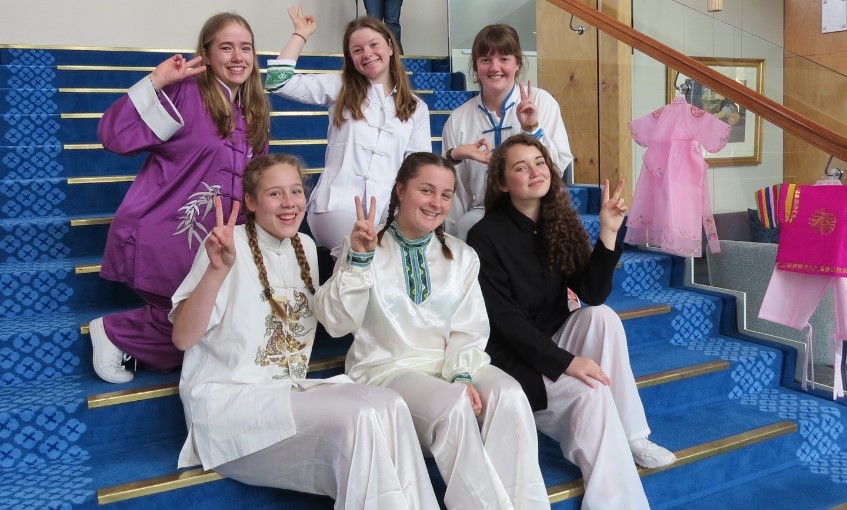
A school trip from Tauranga to Yantai
The group travelled with support from Education New Zealand’s (ENZ) New Zealand China Sister Schools Fund.
Deputy Principal, Kathy Colville, who accompanied the students along with International Student Coordinator, Annemieke Hart, said “very strong bonds were established”.
“Our students met many challenges,” she said, but “they rose to the occasion and took everything in their stride.”
The students attended school and stayed with local families. An exhibition of Tauranga photos was held as part of the sister city celebrations, and the group enjoyed giving their hosts an insight into Tauranga life. The group also spent a day in Shanghai.
Kathy said the students – all of whom learn Mandarin at school – were carefully chosen.
“It was an extremely difficult task but we chose some that had travelled with us [overseas before]. We knew that we could rely on these students to be great ambassadors of our school, city and country.”
There were lots of differences at school in Yantai, the principal one being the long school hours. The school day starts at 7.15am and ends at 5.30pm in China, with students then staying up till 11pm to complete homework.
“The long school hours were a bit daunting,” said Riley Bartosh.
The students also enjoyed learning calligraphy, and doing physical exercise Chinese-style – always carried out in groups.
The students said the experience had made them more independent and opened up their minds to further travel in the future.
“Now I’m more open to different cultures and how others live,” says Riley Bartosh.
“I am interested in pursuing a career that involves communication with other countries. China has opened up opportunities that would never have been available otherwise,” says Stephanie Austin.
“I’ve been on school trips to Portugal, Amsterdam and Turkey since I’ve been at this school,” says Ngawaka Ririnui. “It’s inspired me to travel more and experience how others live.”
“I am going to continue learning Mandarin at our school so that I can speak three languages – English, Maori and Mandarin,” says Te Wairere Te Moana.
Annemieke said Tauranga Intermediate School has offered biannual overseas school trips to its students since 2000. The school reinvests some of the revenue it receives from international students to fund these trips.
She said that in Term three, a group from Yantai Number two Middle School was making a reciprocal visit to Tauranga.
-
Scholarship applications going online
What is changing?
From 1 September 2016, there will be a change in process for ENZ’s two biggest outbound scholarships, the Prime Minister’s Scholarship for Asia and the newly launched Prime Minister’s Scholarship for Latin America. From that date, the application forms will be available here on our website.
What does this mean for scholarship applicants?
Applicants can now submit the full application online, and will be able to upload the requested documents (transcripts, CV, citizenship documents) via the online form. Even reference requests can be sent via the online form – all that’s needed is the referee’s email address. No more posting of applications or chasing on referee’s doors!
Key dates
Applications for the Prime Minister’s Scholarship for Asia go live from 1 September 2016 and close 30 September 2016.
Applications for the Prime Minister’s Scholarship for Latin America go live from 1 September 2016 and close 30 October 2016.
The Prime Minister’s Scholarships for Asia and the Prime Minister’s Scholarships Latin America are initiatives by the government to enable New Zealand students to study or complete an internship in Asia or Latin America and, in doing so, build lasting connections.
More information
For more information, please contact the scholarships team by emailing scholarships@enz.govt.nz