Search
Showing 10 of 7355 results
-
Innovative new search tool on SiNZ
Following feedback from New Zealand institutions, ENZ sought to offer better tools to institutions to tell their story on the site, with better search capabilities to help students find study options faster and more intuitively.
More than one million potential students visited SiNZ in 2017, with the website referring nearly 200,000 of them to New Zealand institutions.
Lucia Alarcon, ENZ’s International Digital Programme Manager, said by giving students a faster, more intuitive way to find study options, the innovative new search tool makes it easier for institutions to recruit high-quality international students.
“As well as providing better search listings for students, the new functionality offers institutions more advanced ways of telling their story such as improved photo galleries and separate profiles for their departments,” said Lucia.
“We now offer a powerful and comprehensive search tool to help students find the course or institutions they’re looking for, as well as offering industry more advanced features to promote their education institutions.”
The key new features include:
- A one-stop-shop profile for institutions to showcase their proposition, courses, scholarships and other key information
- More visual content, with a better display of features and photos
- Showcasing each campus separately, with words and photos
- Separate profiles for each institution department
- More contact details for each campus and department
- Better search listings – listed alphabetically with filters to refine searches.
Check out the search tool here.
- Southland Economic Impact Report 2015 16
- BizVenture 5
-
Mayoral events provide vibrant welcomes to students in their regions
Last month we shared some of the wonderful images that New Zealand schools, universities, PTEs, Te Pūkenga and English Language Schools shared with ENZ as they welcomed their new students for 2024. This month we are sharing details and images from the Mayoral welcomes that some of our regions have held for their visiting international students.
Thank you for adding to our diversity and vibrancy!
More than 40 international students were greeted by Whanganui District Council Mayor, Andrew Tripe, at a special Mayoral welcome to the community on Monday 8 April.
Speaking to the students from countries including Brazil, South Korea, Japan, Germany, China, India Indonesia, Thailand, and Viet Nam, the Mayor thanked them for choosing Whanganui and adding to the “diversity and vibrancy of our community”.
The students attending had enrolled in both secondary schools and tertiary institutions in the district such as Whanganui High School, UCOL Whanganui and the New Zealand International Commercial Pilot Academy.
Formal greeting over, the Mayor was rushed by students seeking a special ‘selfie moment’ to share with families and social media.
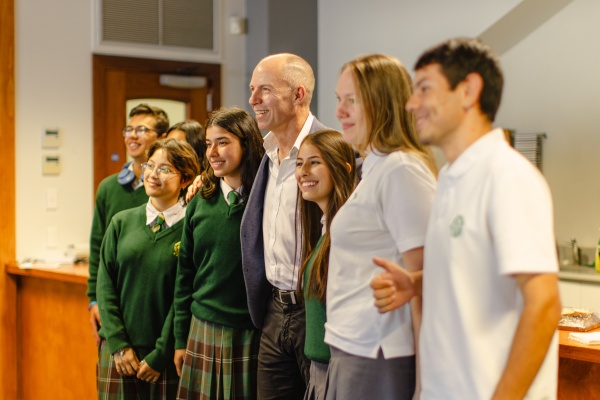
A group of Brazilian international students attending Whanganui High School take up the opportunity of a photo with the Whanganui District Council Mayor, Andrew Tripe.
Similar levels of excitement were seen in Hamilton where the Mayor of Hamilton, Paula Southgate and local performance groups welcomed approximately 250 new international students to the Waikato region. The welcome event was held at the Pā, University of Waikato and is the first welcome since the Covid-19 pandemic put these events on hold.
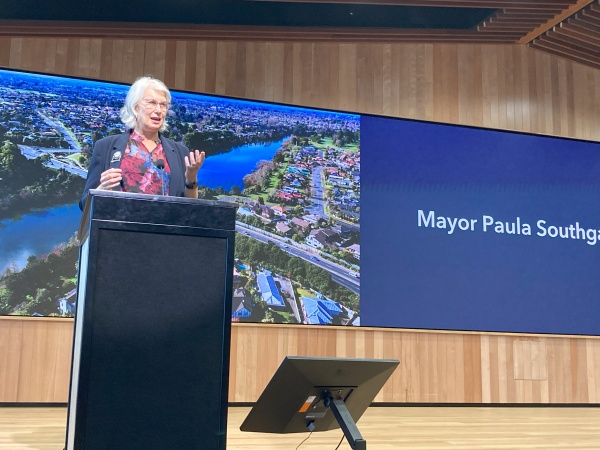
Mayor Paula Southgate providing the official welcome to the Waikato’s approximately 250 international students.
Faymie Li, Education New Zealand Manapou ki te Ao’s Senior Advisor Student Experience said, “I was deeply honoured to witness this significant event and see how we demonstrate manaakitanga to our international students.
“The diverse cultures we embrace in Aotearoa is truly something to cherish and celebrate. It was wonderful to see so many school students attending the ceremony, offering them a unique student experience they don't typically encounter.”
Jiabao Zhao (Boa), a former international student who completed a Bachelor of Management Studies with First Class Honours at the University of Waikato, shared a message of encouragement with the students. Boa’s advice for new students was: to study hard but also “talk to and meet students from outside your country. It’s easy to remain in your comfort zone but that is not the point of studying abroad. Network and build your presence”.
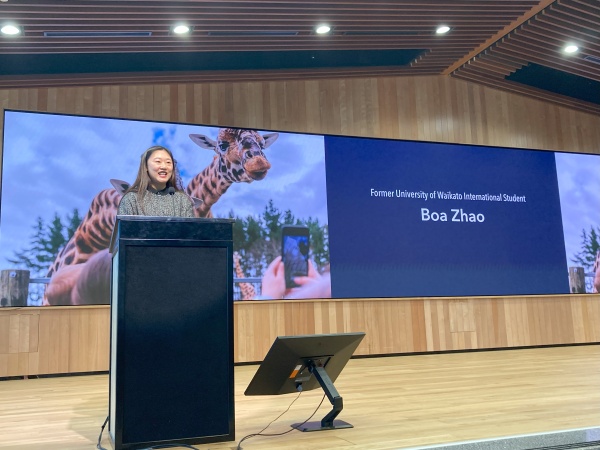
Former University of Waikato International Student sharing a message of encouragement to the new international students.
She also reminded students to take care of both their physical and mental health. There will be challenges but also great opportunities, and her own study and career journey is testament to that. She now works as an International Sales Operation Executive at Prolife Foods Ltd in Hamilton.
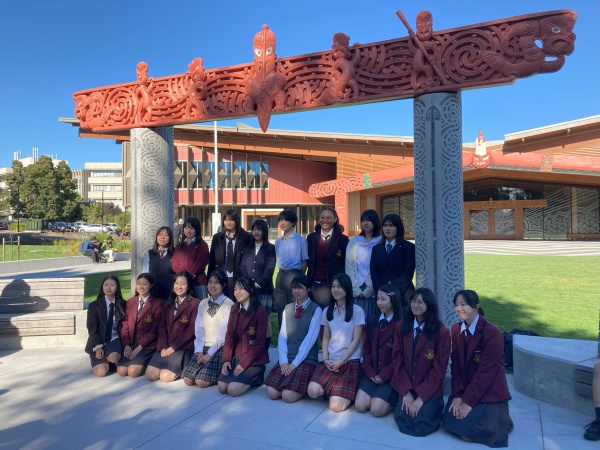
A handful of the 250 students who travelled to the Pā at the University of Waikato, for the international student welcome.
Also in March, nearly 100 international students received a fine welcome centered on the theme of connection, by Timaru District Mayor, Nigel Bowen. The Timaru District will be home to students from Japan, China, Germany, Thailand, South Korean, Hong Kong, Macau, Fiji, Philippines, Brazil and Poland, and more over the course of this year. You can read about this welcome in the Stuff article here - Nearly 100 international students welcomed to Timaru | Stuff.
-
Report from GHEDEX 2022
This year saw a welcome return to an in-person event, attracting good numbers of students and international education stakeholders. ENZ showcased New Zealand as an education partner for Oman during the “Quality in Higher Education” conference that took place alongside GHEDEX. While in Muscat, ENZ also hosted an event for Omani alumni of New Zealand universities. Twenty-eight attended, from seven universities, providing a useful networking opportunity.
Officials at GHEDEX confirmed that as our border is reopening, New Zealand is included in the just-released Omani Ministry of Higher Education’s 2022/23 handbook for scholarships. Feedback from education agents suggests that fewer scholarship students overall are expected this year.
Dr Nadia Kasto, New Zealand Academic Advisor for the Omani Consulate-General in Melbourne confirmed that from next year, all Omani scholarship students will be able to make their own decisions about the country and university that best suit their study needs.
“All universities have to work very hard to promote themselves to Omani students in order to get as many students as they can.”
- [MIN SIGNED] 2425 292 ENZ Q4 report for 4 Apr 30 Jun 2025 (1) Redacted
-
China and New Zealand discuss vocational collaboration
New Zealand ITPs, PTEs and a delegation of 51 senior leaders from Chinese vocational education institutions attended the 6th Annual Sino New Zealand Model Programme Symposium to share research and discuss collaboration in vocational education.
The symposium theme was fostering innovation and entrepreneurship skills in students at vocational and training institutions.
The head of the Chinese delegation, Mr Chen Qiaming, Chair of Council at Szenshen Polytechnic, said innovation and entrepreneurship skills are vital to China’s Made in China 2025 strategy and that Chinese TVET institutions must cultivate these skills in its students. For this reason, many Chinese institutions are looking to collaborate with New Zealand institutions for teacher and student exchanges and assistance with curriculum development.
It was apparent in discussions that Chinese delegates value New Zealand’s “integrated” multi-disciplinary approach and are keen to embed such approaches in their own education programmes. Besides an ongoing interest in vocational teacher training, there also seemed to be growing interest in work-readiness and English-language courses to help create an “internationalised” and employable workforce in China.
China’s appetite for establishing its credentials as a provider of international education also continues to grow – a number of Chinese representatives said hosting international students from New Zealand was a key priority for them.
ENZ’s Regional Director – China & North Asia, Adele Bryant, said the scale of Chinese representation there reflected the appeal of partnering with New Zealand.
“China’s interest in pursuing new opportunities with our vocational institutions is a testament to our reputation for creating creative and innovative thinkers and developing soft skills required for the modern workforce – as evidenced by New Zealand’s ranking first in the world for preparing students for the future.”
“It makes a lot of sense for our two countries to work together to leverage each other’s strengths.”
Tony O’Brien, Sino NZ Model Programme Director, said it was very unusual to get such a large group of senior leaders from China in New Zealand for such an event. It was therefore excellent to have so many New Zealand providers represented at the conference to network and form relationships with their peers in China.
ENZ Chief Executive Grant McPherson spoke at the forum, which was also attended by representatives from 11 New Zealand ITPs (NMIT, Weltec/Whitireia, SIT, WINTEC, UNITEC, Toi Ohomai, Otago Polytechnic, MIT, EIT, UCOL and NorthTec), four PTES (ACG, New Zealand Institute of Education, Tasman International Academies and Skills International), and delegates from the Industry Training Federation and New Zealand Council for Educational Research.
The Sino NZ Model Programme is part of the Strategic Education Partnership Agreement between New Zealand and China. It is a vehicle for deeper and broader collaboration between the two countries’ professional and vocational education and training sectors.
- Sister School Arrangement Template FINAL 0
-
What's new in IntelliLab
The visa dashboard has a new look, and now uses valid student visas (VSV) as the lead indicator for student numbers, as VSV is less influenced by external factors such as multiple visas for one student. First time student visas (FSV) is the other key indicator, which reveals the number of new students choosing to study in New Zealand.
More in-depth visa information is now available through IVY, the interactive visa tool. IVY is updated monthly, so users will need to download a new copy each month to access the most up-to-date information.
The interactive enrolments tool TED (The Enrolments Data) has also been updated. You may notice revised student numbers when comparing student nationalities by New Zealand region – this is due to the large number of unfunded PTE and ELS students now being assigned to regions based on their provider’s location. However, the top-line numbers, such as total number of students and students by country, remain unchanged.
We appreciate any feedback you may have – please use the ‘contact us’ button on IntelliLab.
- kiwis 1