Search
Showing 10 of 7355 results
-
Building connnections with career counsellors in India
Seven of New Zealand’s universities took part in the conference, which attracted more than 1,400 delegates, representing 56 nationalities. The university delegates engaged in panel discussions on a range of topics, including ethical counselling and preparing for education abroad, which were well attended. Education New Zealand Manapou ki te Ao (ENZ) led the New Zealand delegation as a gold sponsor of the event.
Launched in 2016, IC3 is the largest platform for connecting high school career counsellors in India with tertiary education institutions. The conference brings together school leaders, teachers, counsellors, universities, education organisations, government bodies, industry leaders and others with an interest in sustainable and inclusive counselling, focused on student success.
Jugnu Roy, ENZ’s Director of Engagement based in India, says participation in the annual conference is valuable for ENZ as well as for the universities involved.
“High school careers and college counsellors are key influencers for students in India when it comes to making choices about tertiary study and future careers. This event has been a great help with building our connections with schools across southern India, so we can develop a pipeline of international students interested in undergraduate study in New Zealand.
“The timing of the conference worked well as an opportunity for branding, visibility, and reconnecting with Indian schools soon after the opening of New Zealand’s borders. This was the first time we had been able to attend in person for two years.
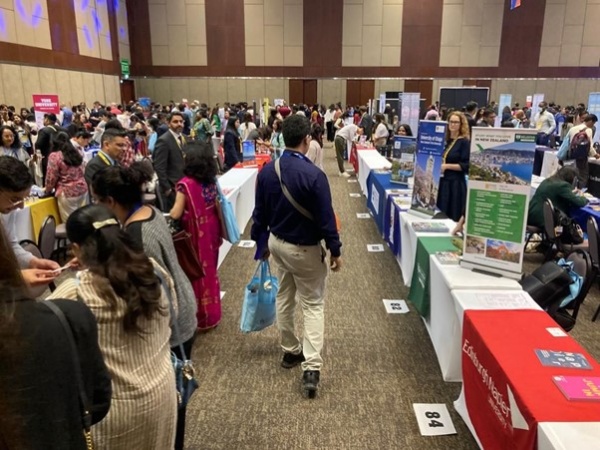
New Zealand universities interacting with schools at the networking session.
“Our participation in the event has already led to increased interest in a New Zealand education among high school counsellors, who are keen to invite New Zealand institutions to their schools for university fairs and to meet with students.
“In a country like India, where many countries are trying hard to attract international students, New Zealand’s presence sends a strong signal that we are committed and here to stay.”
The 2022 IC3 Institute Student Quest Survey Report was published during the conference. More than 10,000 students responded, naming the top three factors affecting their choice of university: programme details, financial aid/scholarship information, and potential job opportunities.
For more information about the conference, see the IC3 Conference website here.
For more information about the recent student survey, see the IC3 Institute website here
- Universities 2013 0
-
From the CE: Committed to a quality student experience
I therefore welcome the Government’s announcement this week of a new, interim code of pastoral care for domestic tertiary students in place for 2020. New Zealand is a world leader in providing pastoral care to international students and has had a code in place since 2002.
The domestic code will complement the Education (Pastoral Care of International Students) Code of Practice, which provides assurance about the quality of the New Zealand study experience for prospective international students and their families.
The interim domestic code will not affect international students next year.
Providers, however, need to be aware of one important change that affects them. The Government is introducing new offences and penalties which will also apply to institutions enrolling international students. These offences and penalties are for severe breaches of the Code. Providers can comment on the Bill during the Parliamentary Select Committee submissions process this month.
Next year the Government is developing a permanent Code of Practice which will include opportunities for the sector to engage and contribute to its development. It also provides an opportunity to address any gaps in the current Code of Pastoral Care for International Students, in time for 2021.
ENZ is committed to a quality experience for all international students. We have worked with providers and students to develop resources for students to support their journey – from discovering New Zealand as a destination, through their decision-making process, while they study here, and up until the time they depart and become ‘ambassadors’ for New Zealand. We welcome the use of these resources by our industry partners to support your work with international students.
Resources like Study in New Zealand help students considering New Zealand as a destination. International students can search for courses and scholarships and register with My StudyNZ, which matches them with courses and institutions and enables them to track their applications.
NauMai NZ provides information on life as an international student living in New Zealand. It focuses on their support and wellbeing, helping them to make social connections and reducing the possibility of students feeling overwhelmed. It includes practical information and advice on everything from how to open a bank account to understanding Kiwi slang.
I’m also proud of our new campaign, ‘Ask New Anything’, launched last week. It features students providing unscripted answers to real questions from prospective students. It’s our most technologically advanced campaign to date using Tohu, a chatbot, to answer questions about studying and living in New Zealand.
I invite you to have a look at this and our other resources and to share them with your teams and international students.
After all, our shared goal is to ensure international students are well-informed and supported to enjoy a high-quality education and experience here in New Zealand.
Ngā mihi
Grant McPherson
Chief Executive, Education New Zealand – Kaihautū, Manapou ki te Ao
- IMG 0904 jpg
- IMG 2587
- Colombo International Book Fair
- Image 3
- NZ German Research
-
ENZ survey to understand the supply of student accommodation is underway
The availability of accommodation for international students is often cited by our education partners as a potential barrier to the growth of the international education sector here in New Zealand. To date, evidence of this as a barrier has been anecdotal from individual providers and regions, with no specific data to offer a clear picture on the actual situation and extent of it.
Education New Zealand Manapou ki te Ao (ENZ) is therefore conducting a survey of international education providers with the aim to understand more about any potential or actual shortages, where and what accommodation type, and why that be, at a regional, sub-sector and national level. While the survey aims to better understand capacity issues and whether it is a barrier for growth in any part of New Zealand, we importantly want to build an evidence base to then enable tracking over time if a need is identified. Survey results will be shared with peak bodies and regions at an aggregated level to inform cross sector regional conversations and planning to address any issues found.
The survey link has already been sent out to the peak bodies who are forwarding this on to their members. If you are an international education provider here in New Zealand with experience in international student accommodation and have not yet received an email with the survey link, please email SectorEngagementTeam@enz.govt.nz. The survey will be open from now until 1 March 2024.
This is an inaugural survey and if you think a key question or aspect has been missed and should be included in future surveys, please use the free text box to capture this.
- Expense disclosure 1 July 2025 to 6 February 2026