Search
Showing 10 of 7183 results
-
NZ agricultural innovation on show in Colombia
Tru-Test, Gallagher, ISL Animal Health and Livestock Improvement Corporation showcased their world-leading pasture-based farming technologies, while we talked about the opportunities for agricultural training available in New Zealand.
“It was another great opportunity for the NZ Inc team based in Santiago to work together,” said ENZ’s Market Development Manager Javiera Visedo.
“I was able to talk with prospective students for the agriculture sector who were thinking about where to study and having New Zealand companies and technology there really answered the question of ‘why New Zealand?’."
“Now that I have participated in this event for the first time, I hope that next time we can have a couple of institutions along that can talk with students face-to-face,” said Javiera.
NZTE’s Trade Commissioner responsible for Colombia, Rhianon Berry said the goal of the expo was to show local producers how New Zealand’s agricultural innovation can be an important ally to increase productivity and efficiency in Colombian pastures.
"In recent years, Colombia has aroused the significant interest of New Zealand companies due to its great potential for doing business in the agricultural sector, in particular in the conversion of pastures into proteins, an area in which New Zealand has extensive knowledge," explains Berry.
New Zealand is experiencing a significant period of growth in numbers of Colombian students coming here to study. In the year to date student visas issued have increased by 120 percent, with the majority of the increase occurring in the PTE sector which accounts for 79 percent of all Colombian students who come to New Zealand.
-
INZ support invaluable
The active participation of INZ staff in offshore international education marketing events is particularly appreciated, enabling the latest immigration and visa information to be provided to prospective students, their parents, education agents and members of the general public.
We were very well supported recently by Cat Beach, Immigration Manager based in Shanghai, at a series of international education marketing events in Japan and South Korea. Cat travelled with ENZ staff and New Zealand institutions to September events in Tokyo, Osaka, Seoul and Busan.
She presented immigration updates to Japanese and Korean education agents, immigration seminars to attendees at the Seoul Korea Study Abroad Fair, and fielded enquiries from students, parents, and New Zealand institutions participating in the fairs and marketing events.
“Visas are at the front end when it comes to enabling a student to study in New Zealand. People often think that visa processes are difficult, so it’s really great to outline to them how easy it is to apply,” says Cat.
“I also enjoy connecting with the New Zealand providers, as it makes the work INZ does very tangible. And of course whenever I participate in ENZ’s marketing events, it always reminds me of how beautiful New Zealand is and what we have to offer. It makes me completely homesick!”
ENZ Regional Director Lisa Futschek says: “Working seamlessly with INZ at our recent Japan and Korea marketing events was mutually reinforcing. Our international education sector was able to benefit from Cat’s extensive knowledge on visa and immigration matters, and INZ was able to experience first-hand the preoccupations of Japanese and Koreans considering a move to New Zealand. A surprising number of guests to the fairs enquired about emigration to New Zealand under the skilled migrant and skills shortages categories.”

-
OECD education report out
Education at a Glance provides comparable national statistics measuring the state of education around the world. It provides data on the structure, finances and performance of the education systems in the 34 OECD member countries, as well as a number of G20 and partner countries. Most of the recent data in the report relates to 2012.
Key findings for international education globally
-
In 2012, more than 4.5 million students were enrolled in tertiary education outside their country of citizenship.
-
The United States has the largest market share of foreign students with 16.4 percent and the United Kingdom is second with 12.6 percent.
-
Australia, Canada, France, Germany, the United Kingdom and the United States together receive more than 50 percent of all foreign students worldwide.
-
Students from Asia represent 53 percent of foreign students enrolled worldwide. The largest numbers of foreign students from this continent are from China, India and Korea.
-
Europe is the top destination for tertiary level students enrolled outside their country of origin (48 percent).
-
The number of foreign students in Oceania has tripled since 2000, although this region hosts less than 10 percent of all foreign students.
Key findings for New Zealand
-
International students make up 16 percent of the New Zealand student population which is double the OECD average and ranks New Zealand fifth in foreign student enrolment as percentage of total tertiary enrolment.
-
New Zealand has the 13th largest market for foreign students in absolute market share terms (at 1.6 percent), about the same as last year but much higher than its share in 2000 (0.4 percent).
-
Three percent of New Zealand tertiary students study abroad.
-
Investment in education has risen to 7.5 percent of GDP which is the fourth highest in the OECD
-
Twenty two percent of all public expenditure is invested in education, the highest percentage in the OECD.
You can read the full report and examine the data and findings in detail at http://www.oecd.org/edu/eag.htm
-
-
Celebrating our education ties with Thailand
Students and their families were able to explore a variety of international study options available in New Zealand with 50 New Zealand institutions providing high-quality representation and advice on the New Zealand education offering.
Ziena Jalil, Education New Zealand Regional Director South – South East Asia, said: “The fact that New Zealand education institutions have visited Thailand every year for 20 years to demonstrate the benefits of studying with them in New Zealand, illustrates our long-term commitment to Thailand and to our Thai partners.”
“This year’s theme for the fair was “New Experiences, New Ideas” and it was important to have the full range of New Zealand institutions and sectors to show the true spirit of New Zealand where new thinking is celebrated and where there are multiple opportunities.”
“With more than 3,000 Thai students studying in New Zealand this year, we are already providing high quality education and life-changing experiences for many Thai students” said Ziena.
Over 400 people attended the fair representing an increase of seven percent from last year, with pre-event publicity including media releases and a media briefing to encourage student registration and boost awareness of the fair.
The fair was the peak event for New Zealand education in Thailand following our August roadshow to Thai secondary schools in Bangkok, promoting New Zealand study opportunities and particularly English language courses. As part of the roadshows ENZ visited three schools and participated in an exhibition held by a network of Thai public schools offering English language programmes.
Education New Zealand also takes this opportunity to provide you with a resourcing update for Thailand. Recruitment is well underway for a new Marketing and Strategic Relationships Manager to be based in Bangkok. Sarah Stabler, ENZ’s Lead – Public Relations/Marketing (SSEA) is your contact point for all ENZ activity in Thailand so please contact Sarah if you have any Thailand related queries sarah.stabler@enz.govt.nz. We wish to thank Gewalin Lertrasameewong, known to most of us as Nan, for her work over the years with ENZ and the former trust. Nan finished with ENZ on Friday 26 September and we wish her all the very best.

-
EAIE and Erasmus+
The annual event combines conference sessions with an exhibition hall, and a rare opportunity for institutional partners to meet face to face. This year was the biggest yet, with over 5,000 attendees from 90 countries.
For the first time, Education New Zealand hosted a networking reception which was attended by over 100 guests from European institutions. New Zealand wine and a gorgeous venue with a balcony overlooking Prague’s Wenceslas Square created a real kiwi vibe. One New Zealander commented “it made our partners feel really valued”.
Over the week in Prague, our institution representatives were kept busy meeting existing partners, while the ENZ team responded to a steady flow of enquiries from institutions seeking New Zealand partners. Our high-ranking institutions, English language teaching, exotic location and participation in credit recognition arrangements such as the Lisbon Convention make New Zealand institutions highly desirable partners.
One hot topic was the international opening of Erasmus+. Some of the key features of the programme are:
It will provide living cost and travel funding for both European and non-European students and staff exchanges.
-
Over the seven year programme, a total of 135,000 grants are planned for international student mobility
-
Periods of study could be between 3 and 12 months at any level from bachelor to doctorate degree, and from 5 days to 2 months for staff.
-
Principles of the Erasmus Charter including credit recognition and fee waiver must be followed.
For New Zealand institutions the programme provides an opportunity to build brand awareness, and give students and staff an international experience.
A call for applications from European institutions is expected in early October, closing 4 March 2015 for mobility in the 2015/16 academic year. New Zealand higher education institutions interested in taking part in credit mobility should contact a partner university in a European Programme Country, which will be able to apply for funding from their National Agency.
If you would like to discuss the Erasmus+ opportunities you can contact Shelley Robertson in Brussels
Further information about Erasmus+ is available free from the EU Bookshop.
-
-
Game On English a hit in Tokyo
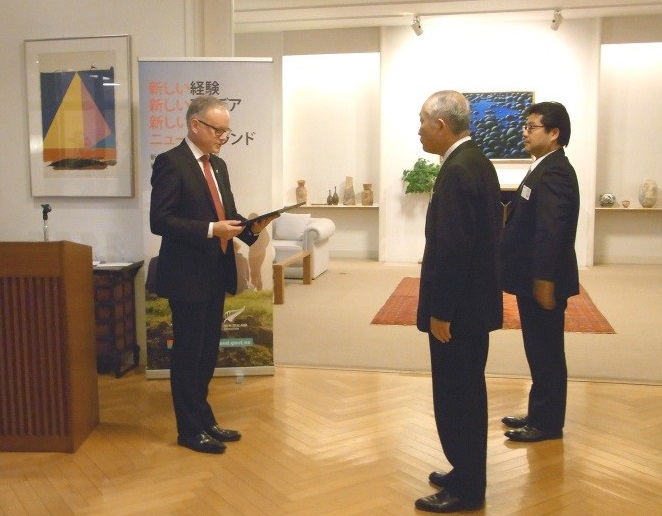
The event provided an opportunity to showcase the benefits of the programme and to get feedback from the students to help with discussions on the further development of the programme.Held at the New Zealand Embassy in Tokyo, the event brought together the students, Japanese Ministry of Education officials, Japan Rugby Union representatives, media and other stakeholders. Adding real star power to the event was Black Ferns Captain Huriana Manuel – along with a black moonboot – following up on her attendance at the launch of Game On English in Auckland back in July.Students from both of the pilots presented on their experience in New Zealand– many in English. The students were full of confidence and enthusiasm about what they had learnt and experienced in New Zealand.Vice Minister for Education Shinichi Yamanaka spent time with the students as they talked about their time in New Zealand. Chairman of the Japanese Rugby Football Union, Tatsuzo Yabe also attended the event and spoke positively about this NZ Inc. initiative. Both commented on the holistic nature of the programme, equally developing students’ English language and rugby skills which are necessary to play at the top level.Japan is now looking towards hosting the 2019 Rugby World Cup and the 2020 Olympics which will feature Sevens Rugby, sparking an increased interest in rugby in Japan. We are now exploring how the Game On English programme might be developed in 2015 and beyond.Two teams participated in the pilot programmes. The first, a top girls’ sevens team from Iwami Chisuikan High School spent four weeks in Auckland working on their English with the Auckland Institute of Studies and their rugby skills with the Auckland Rugby Academy. Their visit coincided with Japanese Prime Minister Abe’s visit to New Zealand, and he and Prime Minister Key launched Game On English in style in Auckland.Player Ran Aoki said: “The best part of the programme was the training. Auckland Rugby made it fun and give invaluable comments and feedback.“Kiwis value the quality of training in a given timeframe over accumulated hours which allowed us to get the most out of our short stay in New Zealand.”The second team in the Game On English pilot was a group of 11 boys from the 11 schools making up the Kanto Super League who were in Dunedin from mid-July through early August. The boys divided their time between the gym and training ground with the Otago Rugby Football Union and the classroom at the University of Otago Language Centre.“Partnerships between English language schools and rugby unions were key to the success of the pilot programmes. For the month they were in New Zealand, the students were fully immersed in an English speaking environment which started with their homestay families and went on the through the classroom and into their rugby,” said Francesca Hilbron, ENZ’s International Market Manager.“And they’ve had a New Zealand rugby experience that could see them on the way to being stars of the future.”

-
NZ universities feature on Chinese TV
Through Education New Zealand’s (ENZ) strong relationship with the International Channel Shanghai (ICS) the documentary All About Going Abroad was filmed at the University of Auckland, AUT, Massey University and Victoria University of Wellington.
The first season of the programme focused on the United States and we were excited to be chosen as the destination country for the second season.
Five episodes were produced on New Zealand university study options and include our own Regional Director Alexandra Grace and Guangzhou-based Education Manager Felix Ye.
ICS is available in nine million cable TV households in Shanghai, and reaches an even wider audience through its website www.ICShanghai.com, which makes programmes available online and on apps for mobile devices.
The show premiered on 20 September and will be broadcast every Saturday at 6pm until 18 October. You can watch online at www.icshanghai.com or www.iqiyi.com after it is aired on TV.
-
Record numbers at Viet Nam fairs
More than 300 students visited the fair in Hanoi and in Ho Chi Minh City attendance was up 86 per cent to more than 700 students, resulting in queues to speak to New Zealand institutions.
The fairs showcased 34 New Zealand education institutions from secondary schools, private English language colleges to technical colleges and tertiary institutions, all promoting their courses and campus life to Vietnamese students.
Students and their parents also had the opportunity to learn about the various scholarships that are available from Viet Nam International Education Development and New Zealand Aid.
Ziena Jalil, ENZ Regional Director for South and Southeast Asia said: “Viet Nam is an important market for New Zealand education institutions. With nearly 2,000 Vietnamese students already studying in New Zealand, it is the second largest source market within ASEAN for international students.
“This year’s fairs in Viet Nam helped showcase the true spirit of New Zealand’s innovative education system and the pastoral care commitment that New Zealand institutions have for all students.”

-
$10 million fund to support teaching of Asian languages
The first call for registration of interest is open from 13 October to 20 November 2014. All state and state-integrated schools can apply for funding under ALLiS.
The Government wants to increase second language learning for all students. As well as learning our national and official languages (English, Te Reo Māori, and New Zealand Sign Language), and Pasifika languages, New Zealand needs to increase the number of students learning Asian languages to support our growing trade and international relationships with key Asian countries.
ALLiS will support schools by setting up new, or strengthening existing, Asian language programmes. ALLiS funding is available for up to 90 schools or clusters of schools, with particular emphasis on those that establish language learning pathways from primary through to secondary schools. The fund will encourage greater collaboration amongst schools in partnership with external Asian Language and Cultural organisations. Once the funding ends, programmes are expected to be self-sustaining.
China, Japan and Korea are amongst our top five trading partners but the number of students learning these languages in our schools is relatively low compared to other international languages. In 2013, only two secondary schools offered Korean, fewer than 40 schools offered Mandarin Chinese, while Japanese was offered by 160 secondary schools.
For more information on the ALLiS programme and the funding process visit the Ministry of Education website.
-
Rosehill College and Te Hihi primary school partnership thrives
Just ten minutes down the road, Te Hihi School is a full primary school in rural Karaka with around 200 students and 17 staff. Rosehill College has a well-established international student programme and Te Hihi is just starting out.
“In the past we have had the odd Korean student come to our school, but with Anne’s help we have developed an international student business plan, I’ve been to an ENZ fair in Guangzhou and we’ve hosted a study group from Taiwan,” says Kevin Bush, principal at Te Hihi School.
Anne Henwood is the Director of International Students at Rosehill College and she takes Te Hihi’s marketing material with her whenever she goes overseas.
“Our relationship with Te Hihi school is a real pleasure – and it makes good sense,” says Anne.
“As well as offering families a pathway for their child from primary to secondary education, our relationship shows we have strong connection with the local community and a serious commitment to our children.”
With a pathway through to Rosehill College, a Te Hihi School student can stay within the area and possibly with the same homestay family for the full course of their schooling in New Zealand.
Kevin has also noticed the benefit of having international students in the school on his Kiwi students.
“In August we had a year 8 short term study group come from Taiwan for five weeks – our children had their eyes opened as they got to know children from another culture. Asia is an area that they don’t get a lot of exposure to but going forward as a country, Asia is going to be important to them as adults,” says Kevin.
“The children that come to New Zealand on their own show remarkable resilience. The friendships that they make while they are here, especially if they stay on for secondary school, are likely to last a lifetime – providing valuable global connections for our children.”
In June, Anne hosted a visit by an agent from Guangzhou who spent the morning at Rosehill and the afternoon at Te Hihi.
“The agent really enjoyed her visit and it was great to show her both schools in one day, to demonstrate the strength of our working relationship and what we have to offer as a package,” says Anne.
“Back in her office in China she will have a much better understanding of our education system and everything we have to offer when she is talking to parents about sending their child to New Zealand.”
Marketing as a team is a long term proposition that will only bear fruit over time. As principal of a small rural school, Kevin is realistic about their capacity for international students.
“I’m planning for around six international students to come to Te Hihi over the next couple of years which seems like a low target but I am excited by the diversity even a small number of students will bring to our school,” says Kevin.
Anne agrees saying: “International students bring culture and diversity, as well as a willingness to learn, to be part of the whole English environment.”
“Some Rosehill students may never get the opportunity to travel so the experience they get at school with other cultures becomes very important.”