Search
Showing 10 of 7355 results
-
Continuing the discussion on the impact of AI on education
Since ChatGPT’s (Chat Generative Pretrained Transformer) launch in November last year, the Artificial Intelligence (AI) tool has featured heavily in headlines around the world, sparking conversations from boardrooms, to classrooms, and around the dining room table. Discussions on the significant impact this tool and future AI technology is having on how we teach, assess, and support our students here in New Zealand’s education system are happening in all areas of our sector, including here at Education New Zealand Manapou ki te Ao (ENZ),
A particular discussion during a recent EdTechNZ panel webinar on Artificial Intelligence and the impact on Education, looked at where educators may want to focus their valuable time now that generative AI platforms are available. For example, do educators want to spend their time researching topics, analysing data, and producing unique activities of work, or spend it on building meaningful relationships and place-based experiences with and for learners; gaining insights into learners’ interests, engaging in critical thinking activities and deepening learners experience of and outcomes in education?
Following EdTechNZ’s interesting and successful March webinar which can be viewed here; Artificial Intelligence and the impact on education, ENZ hosted an in-person seminar at our Tāmaki Makaurau offices in late April. This seminar's purpose was to look deeper at how this emerging technology is changing the way we learn, teach, and innovate.
Professor Ian Watson, recent past professor at the University of Auckland, spoke to a group from across the education spectrum including secondary schools, Private Training Establishments, EdTech founders, Education Publishers, Google, about AI and its impact on education.
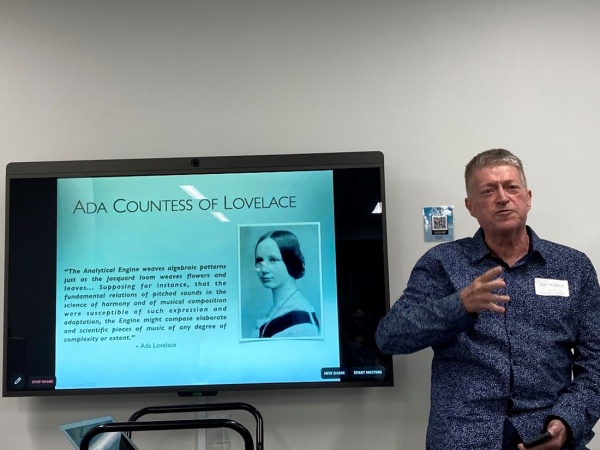
Professor Watson is considered an AI pioneer with 30+ years in the AI machine learning environment and reflected on the history of AI, including that it is not a new or sudden phenomenon, and its progress over time.
“AI imitates intelligence and is great at the specific but not so much the general. For example, aircraft use AI to be able to perform extremely specific flight tasks, but it will never be able to suggest a recipe and cook it!”, Professor Watson said.
“Within education, AI will certainly provide value in routine, mundane and repetitive tasks such as grading, lesson planning, report writing but in the hard and difficult tasks such as developing a universal design for learning and differentiated or targeted learning, it has its flaws. It is not always factually correct and still needs a human to educate it”.
Professor Watson also talked about how important it is, critical even, to teach learners how to use these tools, so they are empowered. Such tools include the likes of AI4K12 for K-12 learners.
Anyone looking for more insights and conversations about AI should check out the TechWeek23 programme with over 400 in person and online events to be hosted from 13 – 20 May.
Techweek AI focussed online events of note include:
- AI and education with AUT Monday 15 May
- AI is here to stay: Its impact on online, flexible, and distance learn with FLANZ (Flexible Learning Association) and EdTechNZ Thursday 18 May at 11:00am – 12:00pm.
- staff dr neil narns2
- May 2016 Student Visa Dashboard
- Chilean Delegation MIT
- Generation Study Abroad New Zealand Institutes of Technology and Polytechnics Excellence Awards NZITPEA application form
- Symposium2
- Japan kapa haka 2019
-
Aotearoa New Zealand reinforces strong presence at NAFSA 2026
Education New Zealand Manapou ki te Ao (ENZ) participated in the NAFSA 2026 Annual Conference & Expo in Orlando, Florida (26-29 May), joining all eight New Zealand universities under the conference theme ‘Global by Design’.
Together, the delegation presented a unified national profile, reinforcing New Zealand’s reputation as a high-quality, innovative, and welcoming study destination.
As the world’s largest gathering of international education professionals, NAFSA brings together thousands of delegates from more than 100 countries, providing a critical platform for global engagement, partnership-building, and sector leadership.
For New Zealand, this annual presence remains essential – ensuring strong global visibility, strengthening enduring institutional relationships, and positioning the country as an active, forward-looking partner in shaping the future of international education.
Two presentations highlighted New Zealand’s leadership across key sector priorities.
Associate Professor and Assistant Vice-Chancellor (Mātauranga Māori), Te Herenga Waka Victoria University of Wellington, Meegan Hall, presented ‘He Whenua Whakapiri: The Aotearoa New Zealand Model for International Student Belonging’. Her session explored how culturally grounded approaches can strengthen belonging and student success, emphasising connection, identity, and community as core to the international student experience.
“NAFSA provided a valuable space to share our distinctive Aotearoa New Zealand approach to international education, grounded in relationships and Māori values. It was a privilege to present and connect with colleagues from around the world who are committed to equitable and inclusive global engagement,” Meegan said.
In a separate session, ENZ’s Director of Engagement (North America), DuBois Jennings, represented New Zealand on a panel titled Impact of Country Partnerships on US Study Abroad Engagement alongside representatives from Germany and Portugal, exploring the US Gilman Scholarship Programme. The discussion focused on expanding access to study abroad and increasing participation from underrepresented students.
New Zealand was the first country to formally partner with the US Department of State’s Gilman Programme and will celebrate a decade of partnership in 2027 – reflecting a shared commitment to equity in international education. Jennings noted that this focus naturally aligns with New Zealand’s national approach, where inclusive pathways and tailored student support are a core priority across the sector.
Together, this collective effort marked another strong showing from New Zealand universities at NAFSA.
ENZ’s Regional Director Americas, Europe & Gulf Cooperation Council, Natalie Lulia, said New Zealand’s presence this year at NAFSA reflected the values that underpin both our society and our education system.
“Through partnership, care, and a strong sense of responsibility to our students, we’re able to achieve what is often rare at a country level. It’s this shared foundation that shapes our offering and strengthens our global voice,” Natalie said.
- Learning20Hawkes20Bay20 20stacked20logo20+20URL
- alumni