Search
Showing 10 of 7355 results
-
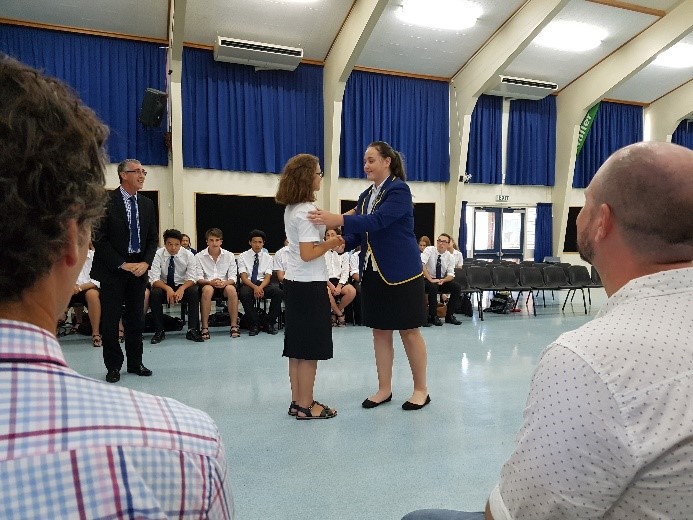
Asia comes to Marsden School
With funding from the Asia New Zealand Foundation, Marsden Head of Humanities, Fiona Crawford, organised a full day of activities for students, with the aim to increase their cultural awareness and educate them on a region with increasing ties to New Zealand.
"We want our students to thrive and contribute towards putting New Zealand on the map, so it is our responsibility to equip them for their future relationships with Asia," Crawford said.

Marsden students dressed up for Experience Asia Day.
The day included a range of activities and sessions that represented 11 Asian countries, starting off with a Tai Chi session in the gym, and ending with an inter-house KPop (Korean Pop) dance competition. In between, students broke into groups to take part in Judo, Kung Fu and Bollywood dance classes, sushi, dumpling and curry making, language learning and haiku writing, as well as origami, henna painting, sari dressing, lantern making, calligraphy, kite making – and much more.
“The students really enjoyed themselves, but also gained valuable insights into the many Asian cultures on show. Many commented on how fun it was, and hope to do it again next year,” Crawford said.
Amanda Cundy, a former Marsden student who went on the school’s first exchange to China back in 2010, stopped by Asia Day to share her experience with students. She spoke about the impact that Chinese studies had on her life, and the importance of understanding other cultures in an increasingly globalised world.

Marsden students tried their hand at sushi making, Diwali art and calligraphy.
- card4
- thai2
-
From the CE: Student visas reopen 31 July; changes to immigration settings
Firstly, there is the encouraging news that student and visitor visa processing will reopen on 31 July 2022, rather than in October as previously announced.
This is a welcome step forward and sends a strong signal that New Zealand is fully reopening to the world. Given the significant challenges faced by our international education sector over the past two years, I know this news will come as a relief for many of you.
Secondly, the government has announced changes to immigration settings arising from its immigration rebalance work. Key changes for our sector include post study work rights for international students and other student visa settings.
The recent border exception for up to 5,000 international students (cohort 4) will continue as planned, with the first students on track to begin arriving in New Zealand soon.
Post-study work rights from 11 May 2022
- International students studying bachelor’s or post-graduate courses or higher will continue to receive Post-Study Work Visas.
- Students studying non-degree courses at Level 7 and below (excluding bachelor’s degrees), will only be eligible for post-study work rights if the qualification is relevant to an occupation on the new Green List, which will replace the existing skills shortage lists. These work rights will only allow them to work in that occupation.
- The duration of work rights will reflect the duration of study undertaken in New Zealand, except for Masters and PhD students who retain the current setting of 3 years.
- International students will no longer be able to apply for a second post-study work visa.
- Students with a student visa application underway to study a qualification currently eligible for a post-study work visa and that student visa is subsequently granted; students who get a visa through the current border exception for 5,000 students; and students who already hold a student visa for a programme of study that results in a qualification that is currently eligible for a post study work visa, will be considered under the old settings if they apply for a post-study work visa within the next three years.
- There are no changes to in-study work rights for student visa holders.
Living costs and fees from 31 July 2022
- The amount of funds that students are required to demonstrate they have access to, so they can cover their living expenses while in New Zealand, will increase. For tertiary and English language students, the funds required will be $20,000 pa, and for primary and secondary school students it will be $17,000 pa. These funds are prorated for study less than a year. The current setting is $15,000pa for both. Note: This change does not affect the living costs requirements for students in cohort 4.
- Students will be required to pay tuition fees of one year or the first programme (whichever is the shorter) upfront. Note: This change does not apply to cohort 4 students.
You can see a summary of these changes including a fact sheet on international education on the Immigration NZ website here.
You can see a summary of the immigration changes on the Immigration NZ website here.
You can read the Prime Minister’s announcement here.
Grant McPherson
- Taradale
-
International student enrolments continue upward surge
“Enrolments are steadily rising to pre-pandemic levels, with 2024 enrolments (83,425) now at 72 percent of 2019 totals (115,705).
“New Zealand reaps a broad range of economic, social and cultural benefits from having international students in our midst. International education boosts our economy, creates business opportunities, fuels innovation, and delivers essential cross-cultural skills for a more connected world.
“This sustained growth highlights the international education sector’s progress towards achieving the Government’s Going for Growth Plan goal of doubling the export revenue from international education by 2034.
“Universities and government-funded private training establishments (PTEs) are close to matching 2019 enrolment numbers. We are seeing enrolments grow across universities, schools, Te Pūkenga/NZIST, government-funded PTEs, and English language schools subsectors. In 2024, the strongest year-on-year growth was seen at government-funded PTEs (+59%) along with primary (+53%) and intermediate (+32%) schools.
“Universities saw 33,485 total enrolments, schools had 18,350 enrolments, while Te Pūkenga/NZIST and government-funded PTEs each had 10,270 and 10,185 enrolments, respectively.
“More international students are now enrolled for master’s study programmes in New Zealand. Between 2023 and 2024, there has been a 68% increase in master’s enrolments, with 14,695 international students in 2024, up from 8,740 in 2023. This is an 85% increase compared to 2019 when we had 7,945 enrolments for master’s study.
“The overall rise in enrolments at the national level is underscored by a diversity of regions leading strong growth from 2023, including Waikato (+50%), Hawke’s Bay (+44%), West Coast (+185%) and Gisborne (+156%). The Waikato region is notable in that it has seen significant growth across multiple subsectors: universities, Te Pūkenga/NZIST, government-funded PTEs and schools.
“China and India remain the top two source markets for international student enrolments with 34% and 14% enrolments respectively, followed by Japan (9%), South Korea (4%), Thailand (3%), United States of America (3%), Germany (3%), the Philippines (3%) and Sri Lanka (3%),” Malu says.
More information on enrolment numbers can be found here.

Note: All numbers are current as at 1 April 2025. Full numbers have been rounded to the nearest five. One individual may enrol more than once.
Government-funded PTEs are PTEs that receive government student funding for learners who are defined as domestic students under the Education and Training Act 2020 (note that PhD and exchange students are defined as domestic students under the Act).
For further information:
Sai Raje | Senior Communications Advisor, Education New Zealand
+64 21 479 649
About Education New Zealand Manapou ki te Ao (ENZ)
Education New Zealand Manapou ki te Ao (ENZ) is the government agency dedicated to helping New Zealand realise the social, cultural, and economic benefits of international education. Our role is to promote New Zealand as a high-quality education destination offering excellent education and student experiences.
With approximately 82 staff in 14 locations around the world, ENZ works closely with New Zealand’s diverse education sector which includes schools, English language providers, Wānanga, private training establishments, New Zealand Institute of Technology/Te Pūkenga, and universities. Internationally, we work with a range of education stakeholders, including government agencies and education providers to identify and encourage sustainable growth opportunities for New Zealand’s education sector.
- Around the world in 6
- Internship Providers for PMSLA2
-
Iran trade visit seals breakthrough deal for New Zealand universities
The visit secured several major education outcomes, including a ministerial announcement that the University of Canterbury, Victoria University of Wellington and Massey University would be reclassified as ‘excellent’ by the Iranian Ministry of Science, Research and Technology. These universities will join the University of Auckland and University of Otago, who have already been given the top ranking. These classifications play a significant role in guiding Iranian students in choosing where to study abroad. All of New Zealand’s universities are now classified in the top two categories.

Above: signing the Education Cooperation Agreement
A higher education co-operation agreement was also signed between Ministers, which provides a platform for increased academic and research co-operation between the two countries.
ENZ arranged several university recruitment events as part of the visit programme. Some 80 per cent of Iranian students in New Zealand are studying at PhD level. ENZ Chair Charles Finny, who led the education delegates on the visit, said this is a key area to build on.
“These initiatives will significantly boost our universities’ recruitment of Iranian students, particularly at the PhD level,” said Mr Finny.
“I look forward to New Zealand universities making the most of this opportunity in the coming years, and commend the University of Auckland, University of Canterbury and Auckland University of Technology for participating in this ground-breaking visit.”
- 27624907 2010374865646631 2732348055595172742 o