Search
Showing 10 of 7355 results
-
New Future Proof campaign to showcase Kiwi teachers
The eight-week Future Proof campaign earlier this year achieved incredible results, including reaching over 33 million potential international students and achieving more than 14 million social media engagements.
To continue the conversation, ENZ will evolve the campaign to focus on the role that high-quality teachers play in New Zealand’s ranking as best in the world for educating students for the future. We will share inspiring stories about our teaching talent with the world through videos and other web content.
Patrick Holden, ENZ’s Digital Media Project Manager, says the upcoming campaign aims to raise awareness of the quality of our education, which research suggests isn’t fully appreciated in many of our markets.
“In line with the newly-launched International Education Strategy 2018 – 2030, we’re aiming to reach students interested in studying high-value programmes in New Zealand by showcasing the world-leading Kiwi teachers and academics that will be available to them.
“This second Future Proof campaign will run across October – November which is a key decision-making period for international students.”
Students who engage with the campaign will be “nurtured through” to My StudyNZ to connect with New Zealand institutions and agents. Institutions can make sure they’re getting the most out of this recruitment opportunity by updating their profile on the Study in New Zealand website.
“We’ll be putting a briefing pack together to help institutions leverage the campaign in their own recruitment activities. Keep an eye on future editions of E-News for this and further updates,” said Patrick.
Share your story
Do you have a great story idea about a world-leading academic or inspiring teacher? If so, please email philippa.brown@enz.govt.nz and tell us why you think they’d be perfect for this campaign.
-
From Vermont to Victoria University
Emma McDonough Faucher, a college student from Castleton in the state of Vermont, was one of 1089 applicants from 615 US universities to apply for the scholarship. She impressed the selection panel with her knowledge of New Zealand and desire to understand and experience the Kiwi lifestyle and culture, including Māoritanga.
“I have wanted to study abroad my entire life and New Zealand has been my goal,” said Emma.
“Māori culture is one of the things I am especially looking forward to learning about – I find it interesting that Maori people describe themselves by their tribe (iwi), sub-tribe (hapū), mountain (maunga), and river (awa).”
ENZ’s Regional Director for the Americas, Lisa Futschek said, “The creativity and passion of Emma’s submission distinguished it from the large number of other very impressive applications. The fact that she plays rugby also makes this a good match!”
US students choose New Zealand as an education destination because of the unique study experience we offer – a high-quality education in an English-speaking country with a distinct culture and lifestyle. Students who come here are often adventure seekers who enjoy the great outdoors and like to get off the beaten track, but also want to enjoy the vibrant city life.
ENZ partnered with leading study abroad advisory service, Go Overseas to run a six week campaign across the US from 1 September to 15 October. During this time over 26,000 people visited the campaign page, and 2,600 study abroad advisers and over 1500 universities were contacted and notified of the scholarship.
Leads from scholarship applicants and others who registered interest have been referred to participating New Zealand education providers.
“As well as giving a lucky student the chance to study in New Zealand, campaigns such as this are an important part of ENZ’s work to raise awareness around the world of New Zealand’s high-quality education offering,” said Lisa.

Left to right: Sam Hoben, Education New Zealand Market Development Manager USA, Emma McDonough Faucher, scholarship winner, and Ana Maria Alfaro-Alexander, Ph. D, Study Abroad Advisor
-
Around the world in five
GLOBAL
Four Worlds of Work: Preparing students for the global market
According to consulting firm PwC, students will need to prepare for four possible ‘worlds of work’ by 2030, including scenarios such as innovation outpaces regulation, big companies are king, and social responsibility trumps corporate agenda.
GERMANY
Germany’s foreign enrolment grew again in 2018
The number of international students in Germany has climbed once again, with 374,580 international students enrolled in German universities in 2018, up from 358,900 in 2017, according to an annual trends report from the German Academic Exchange Service.
UK
Chinese students’ applications to UK universities up by 30%
The numbers of Chinese students applying to UK universities exceed those from Northern Ireland for the first time, with UK higher education benefitting from tensions between US and China, according to experts.
GLOBAL
In the future, will acquiring relevant skills matter more than earning a degree?
There has been a lot of talk about the need for graduates to acquire certain ‘soft skills’ if they are to survive in a future fuelled by technologies such as automation and robotics.
INDIA
India allocates $86.1 million to create “world class institutions”
India’s finance minister Nirmala Sitharaman has proposed to allocate $86.1 million NZD to create “world-class institutions” in a bid to attract a greater number of international students. However, concerns have been raised over the “ambitious campaign”.
-
ENZ launches Future Proof campaign
New Zealand was ranked the #1 country in the world for educating students for the future, according to a report by The Economist Intelligence Unit (EIU) released late last year.
On 19 March, ENZ launched an eight-week global campaign to promote the ranking and encourage international students to sign-up to ENZ’s database marketing programme.
The first phase of the campaign focuses on awareness. Ten days in, the campaign video has attracted more than 6.1 million views on Facebook and over 1.8 million views on YouTube from the target audience.
Patrick Holden, ENZ’s Digital Media Project Manager, said the campaign is part of a robust media framework that ENZ developed in 2017 which can be rolled out globally.
“In the design phase, we used learnings from our previous media activity and leveraged our in-market team knowledge and we’re pretty happy with the results we are seeing so far,” said Patrick.
“We have also put a lot of work into better understanding our audience’s journey – what students first click on, where that leads them, and what other key information they seek.
“This helps us understand what information students connect with, such as the future proof ranking, and what attracts them to study in New Zealand.”
The second phase of the campaign will start in April, and will be focussed on converting the audience into enquiries to institutions.
The ‘Future proof’ campaign integrates ENZ’s social communities and digital channels via ENZ’s student attraction engine and will be the first campaign integrated with the database marketing platform.
The campaign emphasises New Zealand’s strengths outlined in The EIU Worldwide Educating Students for the Future Index, including:
- An education system that develops in-demand skills such as critical thinking, creativity, independence and teamwork.
- We offer diverse learning experiences inside and outside the classroom, and our practical, hands-on approach teaches students to use their knowledge in real-world situations.
- New Zealand is a modern, progressive and open-minded country. The experiences students have here enable them to grow personally as well as academically.
Check out this infographic to find out more about New Zealand’s top performance in the index.
To learn more about Future Proof, visit the campaign landing page.
-
Intelligence portal in the pipeline
“We’re calling it ‘IntelliLab’ – similar in concept to the SkillsLab and BrandLab but providing vital data and market intelligence,” said ENZ Intelligence Manager, Andrew McPhee.
“We plan to roll out IntelliLab in a phased approach, starting with a launch at NZIEC in August 2017.”
Andrew said IntelliLab will provide a secure, one-stop-shop to a wide variety of existing ENZ intelligence, research products and third-party market intelligence reports. Subsequent developments will provide a more interactive experience, with customised dashboards and searches.
Providers will be able to use IntelliLab via a single log-in that will also give them access to ENZ’s SkillsLab and BrandLab.
ENZ will shortly begin approaching potential IntelliLab users to participate in a workshop. This will help ensure that the portal delivers the information that providers and agencies need to better inform their work.
-
PIF Recipient: Boma
Christchurch-based Boma is a new kind of education provider, on a mission to support current and emerging leaders to be more intentional, intelligent, and courageous for the future. Boma runs events, workshops, and courses, and has worked with leading organisations in Aotearoa and around the world, from global tech companies Facebook and Zoom to locally based organisations such as Meridian Energy, Stuff, and New Zealand Trade & Enterprise.
But it’s the next phase of Boma’s expansion that’s really set to make waves on the world stage. Thanks to an award of funding from the International Education Product Innovation Fund, Boma is creating a global, cohort-based course for rugby coaches delivered in partnership with The Crusaders – the Christchurch-based professional rugby team and the most successful team in the history of the Super Rugby competition.
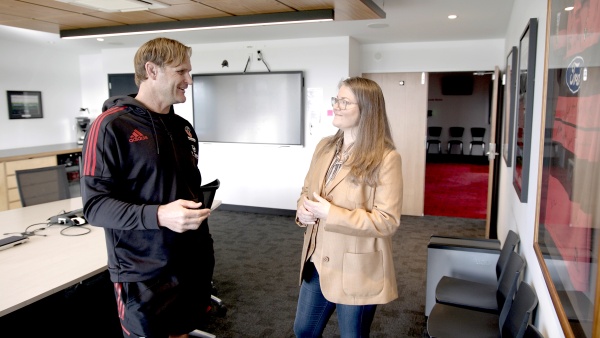
Founder and CEO of Boma NZ, Kaila Colbin with Crusaders Coach, Scott Robinson
"We at Boma are so excited to be working with Education NZ and the Product Innovation Fund. We share so many things: a commitment to excellence; an agile test-learn-iterate approach; and a passion for bringing Aotearoa's special sauce to the world. We're honoured to have been chosen as one of the recipients of the fund, and we know we'll be able to go farther, faster by working together".
Kaila Colbin , Founder and CEO, Boma New Zealand
Aimed at rugby coaches from high school teams through to professional level, the Crusaders Coaching Leadership Programme™ will run for the first time in late 2022. Unlike competitors who offer training through on-demand video but generate low completion rates, Boma’s pilot project with The Crusaders combines the flexibility of self-directed learning with the accountability of being part of a real-time cohort of learners.
Education New Zealand Manapou ki te Ao (ENZ) is the agency behind the Product Innovation Fund. As New Zealand’s dedicated government agency for international education, ENZ is helping shape a broader, more diverse international education sector with built-in resilience to future shocks such as global pandemics.
In total, seven pilot projects have been supported through the Product Innovation Fund. Together, they reimagine what a New Zealand education experience could look like and mean for global learners. Boma’s pilot project, for example, taps into a new audience – rugby coaches around the world looking to learn ‘The Crusaders Way’. Before COVID-19, rugby coaches from around the world would travel to New Zealand to learn what makes the team so successful.
By partnering with Boma, The Crusaders will be able to share their rugby and leadership expertise with learners around the world through a course offering that is high quality, consistent and scalable.
Boma has big plans for the future and sees a logical path for its course offerings to grow from rugby leadership into sports leadership, to business leadership and then into general leadership. Boma’s approach to learning is as much values-led as it is content-led, and this sets Boma apart from its competitors.
The support from ENZ through the Product Innovation Fund for Boma’s first pilot project with The Crusaders may well pave the way for more to follow. With a goal of building the leaders the world needs, Boma sees an opportunity to partner with other well-respected, values-led organisations like The Crusaders to create transformational, immersive learning experiences from New Zealand to the world.
More information:
-
New Zealand top of the world in university sustainability stewardship
New Zealand universities have come out on top of the world for sustainability stewardship in the Times Higher Education Impact Rankings 2024.
New Zealand universities’ approach to sustainability and equality has been announced as world-leading by Times Higher Education (THE) in its most recent Impact Rankings (2024). The stewardship rankings saw New Zealand score an average of 85.3 to come out ahead of Australia (84.4) and Hong Kong (81.9). All eight New Zealand universities participated in the rankings.
Now in its sixth year, the Impact Rankings is the only ranking system in the world that measures universities’ contributions to the United Nations’ Sustainability Goals (UN SDG’s). The Rankings assess the commitment made by universities to sustainability across four broad areas: research, stewardship, outreach, and teaching.
In topping the table for sustainability stewardship, New Zealand’s universities have scored well against indicators such as tracking food waste and having sustainable food choices on campus (SDG 2), the proportion of senior female academics (SDG 5), having water reuse policies and measurements (SDG 6), ensuring energy efficiency with renovations of buildings (SDG 7), and guaranteeing a living wage (SDG 8).
New Zealand universities also came second equal in the world against sustainability outreach, meaning high scores were achieved for contributing to policies addressing poverty (SDG 1), collaborating with health institutions (SDG 3), providing programmes for the local community to learn about energy efficiency (SDG 7), participating in cooperative planning for climate change disasters (SDG 13), and providing expert advice to government (SDG 16).
ENZ’s Acting Chief Executive Dr Linda Sissons welcomed the results and said the global recognition for New Zealand’s universities working hard to make a positive impact in the face of pressing environmental and social challenges world-wide was significant.
“New Zealand’s education system is guided by Kaitiakitanga (the Māori concept of guardianship). This principle instils a deep sense of connection to our land and a commitment to ensuring its health and vitality for future generations.
"Kaitiakitanga informs the approach taken by our universities to resource management, conservation, and sustainable development that all contribute to the UN’s SDGs particularly in the areas of food security, bioenergy, sustainable urban development, and climate change,” said Dr Sissons.
Dr Sissons added “It is incredibly positive to have our approach to sustainability stewardship and outreach recognised as world leading. This is particularly important to us as we know that students around the globe are increasingly prioritising environmental and social responsibility and choosing to study at institutions that align with their personal values.”
In this year's Impact Rankings, a record 2,152 universities from 125 countries/regions were assessed. Progress is measured for each of the individual 17 SDGs, and across the goals as a whole. View the full Impact Rankings 2024 results here.
Top countries/regions for sustainability stewardship in THE’s Impact Rankings 2024
Country/region
Number of ranked universities
Average stewardship score
New Zealand
8
85.3
Australia
21
84.4
Hong Kong
5
81.9
Ireland
8
81.4
Canada
24
80.5
United Kingdom
68
79.7
United States
46
69.1
South Korea
24
67.9
Belgium
5
65.2
Netherlands
6
64.5
Note: Table only includes nations with five or more ranked universities. Credit: Times Higer Education Rankings 2024
Top countries/regions for sustainability outreach in THE’s Impact Rankings 2024
Country/region
Number of ranked universities
Average stewardship score
Hong Kong
5
81.4
New Zealand
8
80.4
Canada
24
80.4
Australia
21
80
Ireland
8
76.4
United Kingdom
68
75.6
Belgium
5
71.9
Germany
8
68.1
South Korea
24
67.9
Netherlands
6
66.2
Note: Table only includes nations with five or more ranked universities. Credit: Times Higer Education Rankings 2024
For further information
Stephanie Morison, Senior Communications Advisor,
Education New Zealand Manapou ki te Ao
Stephanie.Morison@enz.govt.nz | +64223020104
Notes to Editors:
About Education New Zealand (ENZ) https://www.enz.govt.nz/
Education New Zealand Manapou ki te Ao (ENZ) is the government agency dedicated to helping Aotearoa New Zealand realise the social, cultural, and economic benefits of international education. Our role is to promote New Zealand as a high-quality education destination offering excellent education and students experiences and to encourage New Zealand students to study overseas.
With approximately 110 staff in 16 locations around the world, ENZ works closely with New Zealand’s diverse education sector which includes schools, English language providers, Private Training Establishments, Institutes of Technology and Polytechnics (Te Pūkenga), and universities. Internationally, we work with a range of education stakeholders, including government agencies and education providers to identify and encourage sustainable growth opportunities for New Zealand’s education sector.
- Final Snapshot Report full year 2014
-
2024 ENZ Events Calendar confirmed
ENZ is offering a range of 17 events in seven countries in 2024 including commercial fairs, New Zealand fairs, and agent seminars. The events are broken down as follows:
-
2 global events
-
9 agent seminars
-
5 ENZ student events
-
1 commercial event
All events can be found on the events calendar.
Registration
Registration for NAFSA 2024 is currently open. We will be opening events for pre-registration for other 2024 events over the coming weeks.
Pricing
Prices for these events have seen a 10% increase, the first increase since 2015. This is due to an increase in inflation and the resulting rise in event organisation costs. The new prices are as follows (all exclude GST):
-
New Zealand fairs $1650
-
Agent seminars $275
-
Commercial fairs $2750
Please contact events@enz.govt.nz with any questions.
-
-
Roundtable explores distance education recognition
The roundtable involved senior officials from Chinese education agencies and representatives from the University of Otago, Massey University, New Zealand Qualifications Authority, Universities New Zealand and Education New Zealand.
The recognition of New Zealand distance education programmes has been an item of discussion between New Zealand and Chinese authorities for many years. Currently all foreign qualifications delivered by distance, or with a distance component, are not recognised by Chinese authorities.
“This isn’t a New Zealand-specific issue,” says ENZ's Regional Director Alexandra Grace. “We are very much at first steps, in terms of building understanding of how we assure quality outside of traditional face-to-face qualification delivery. Greater understanding of our processes may also contribute to China’s domestic reform of its local distance qualifications."
The New Zealand-China Free Trade Agreement signed in 2008 included commitments to undertake work on “evaluation of the quality assurance criteria for qualifications which include a distance delivery component.”
Discussions on the recognition of New Zealand distance education qualifications have been ongoing since then.
The roundtable showcased Otago University’s renowned Master in Aviation Medicine qualification which is fully taught by distance and has been offered for over 26 years. Over 100 students are currently studying the programme from the Middle East, North America, Europe, Asia and Australia. Graduates of the programme meet internationally recognised ‘best practice’ standards for aviation medicine practitioners and are frequently employed by airlines including Cathay Pacific, Emirates and Qantas.
The roundtable also featured Massey University’s Master’s degree programmes in Veterinary Medicine (Biosecurity) and Public Health (Biosecurity) which has been completed by nine senior Chinese officials. The qualifications, which require four months to be spent at Massey and the remainder by distance study from China (one year in total), represent collaboration in teaching between Massey’s teaching and research groups, EpiCentre, and the Centre for Public Health Research.
Further work is slated on sharing of information and best practice.