Search
Showing 10 of 7355 results
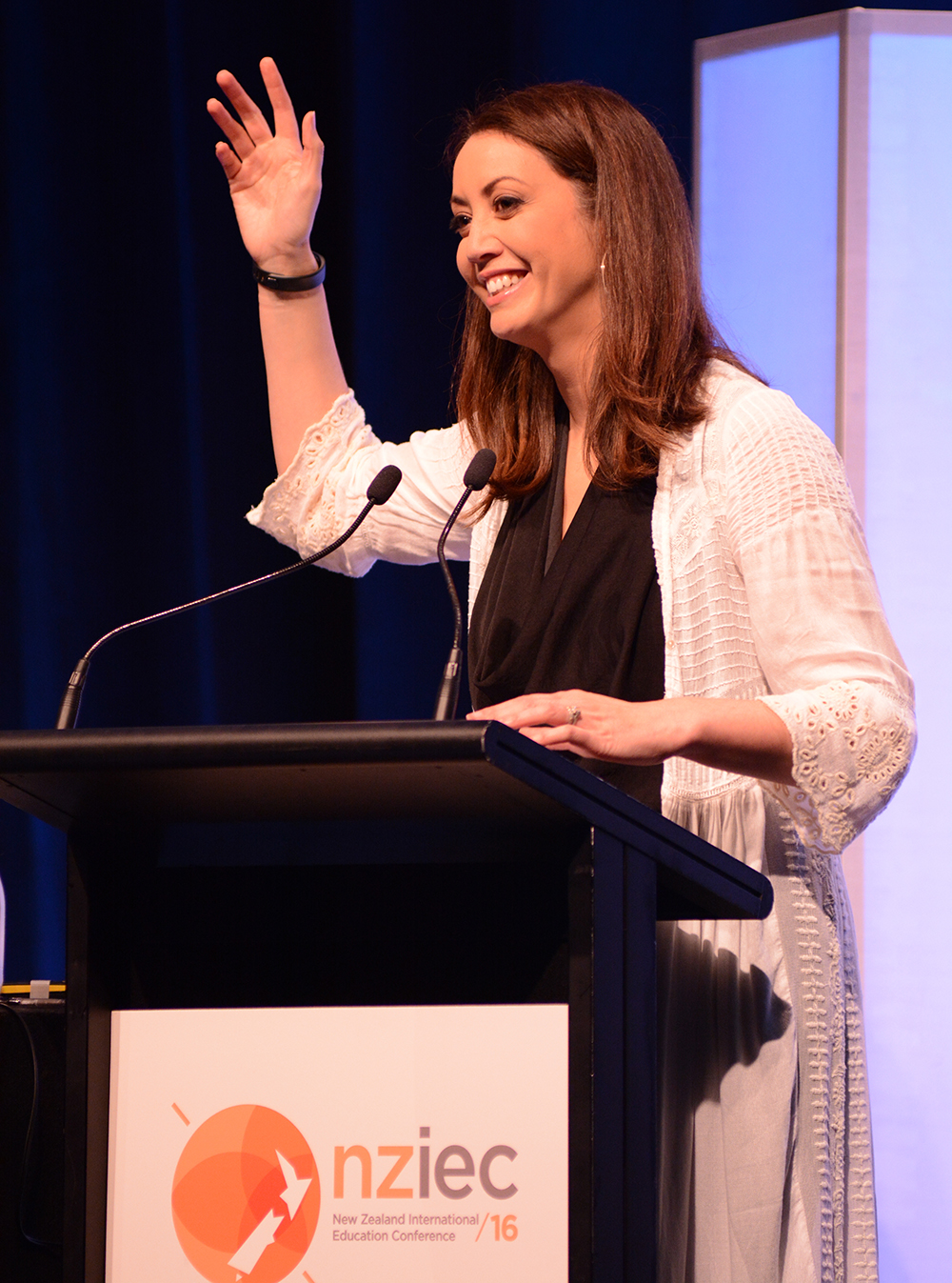
- NZIEC day1 257edit5
-
Reminder about education providers’ responsibilities when using education agents
The responsibilities for Code signatories are covered in detail in Section 38 (for tertiary education providers) and Section 58 (for school education providers). Section 38 reads as follows:
38. Process 2: Managing and monitoring education agents
Signatories must have practices for effectively managing and monitoring the performance and conduct of education agents in relation to learner safety and wellbeing under this code, including –
(a) carrying out and recording reference checks on potential education agents to ensure as far as possible that they are not involved in any conduct that is false, misleading, deceptive, or in breach of the law; and
(b) entering into written contracts with each of its education agents; and
(c) during the term of a contract, monitoring the activities and performance of its education agents in relation to –
(i) their obligations as specified in the contract; and
(ii) whether they provide prospective and enrolled international tertiary learners with reliable information and advice about studying, working, and living in New Zealand; and
(iii) whether they act with integrity and professionalism in their dealings with prospective and enrolled international tertiary learners; and
(iv) whether they have engaged in any activity or conduct that, in the opinion of the signatory, is or may be in breach of the law or that jeopardises the signatory’s compliance with this code; and
(d) managing the education agents by –
(i) terminating contracts with an agent if there is evidence which, on balance of probabilities, shows that the education agent –
a. has been involved in any serious, deliberate, or ongoing conduct that is false, misleading, deceptive, or in breach of the law; or
b. has jeopardised the signatory’s compliance with this code; or
(ii) taking appropriate action to address misconduct by act or an omission by an education agent in relation to the other matters described in subclause (c); and
(e) ensuring that its education agents have access to, and maintain, up-to-date information relevant to their duties as specified in the contracts with the signatory.
The full Code is available on the NZQA website here.
- la20foto202202
- International photo roundup
-
ENZ promotes education in Thailand
The counsellors were broken into small groups and rotated between roundtable discussions with Education New Zealand, the US Embassy, British Council, and OCSC.
ENZ’s Marketing and Strategic Relations Manager – Thailand, Chortip Pramoolpol, said this intimate road show format was helpful in sharing key information with the market without overwhelming them.
“It was a great way for school counsellors and students to gain insights into New Zealand’s education system and learn the many benefits of studying there.
“It also means information about New Zealand will be distributed into schools and to students who otherwise wouldn’t have New Zealand on their study abroad radar.”

ENZ and RMUT representatives
The following day, ENZ met with the chairman and presidents of Rajamangala University of Technology (RMUT), a system of nine universities in Thailand. With RMUT’s link to industry and practical teaching styles, it is most similar to New Zealand ITPs.
ENZ’s South, Southeast Asia and Middle East Regional Director, John Laxon gave a crash course on the New Zealand ITP system, welcoming the possibility of future collaborations with RMUT in English language training, double-degree programmes and student exchanges.
To build on this knowledge, ENZ’s Thailand team have begun planning an education road show for all nine RMUT universities starting December.
-
Last chance to register for NZIEC 2016
It's your last chance to register for the New Zealand International Education Conference (NZIEC) and we've made some changes to conference arrangements. Find out more here.
This year's conference celebrates 25 years of the NZIEC being held and we're planning a special event for over 500 delegates at the ANZ Viaduct Events Centre, Auckland.
Payment deadlines
The final date to register and pay by invoice is Monday 25 July 2016. After that, payment can only be made by credit card. Please note that payment must be received prior to attending NZIEC 2016, so please ensure your organisation has paid your invoice.
Breakout sessions
With places for the conference selling like hotcakes, a number of breakout sessions are already at capacity. Interest in our market Question & Answer sessions has exceeded our expectations so we've moved these sessions from the exhibition hall to breakout rooms. These sessions will now feature a slightly longer presentation on the specific market (no more than 20 minutes) before opening the floor to questions from the audience.
Conference app
Stay tuned for the launch of our conference app in August. The app will enable you to follow your schedule, connect with other delegates, and follow our social media conversation.
Find out more
To register, or find out more, check out www.nziec.co.nz
-
India insights snapshot
Country dashboard – India
In the year ended December 2024 New Zealand exported $398.02 million of education related travel to India and imported $3.9 million, representing a trade balance of $394.12 million and a total trade value of $401.92 million.
Broad field and level of study for Indian students in New Zealand - 2023
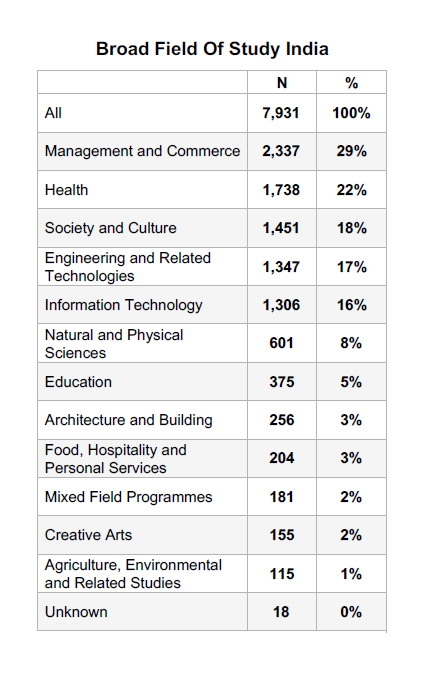
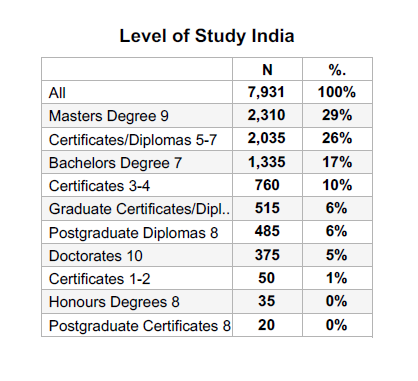
Browse the full country dashboards for India and other markets on this link.
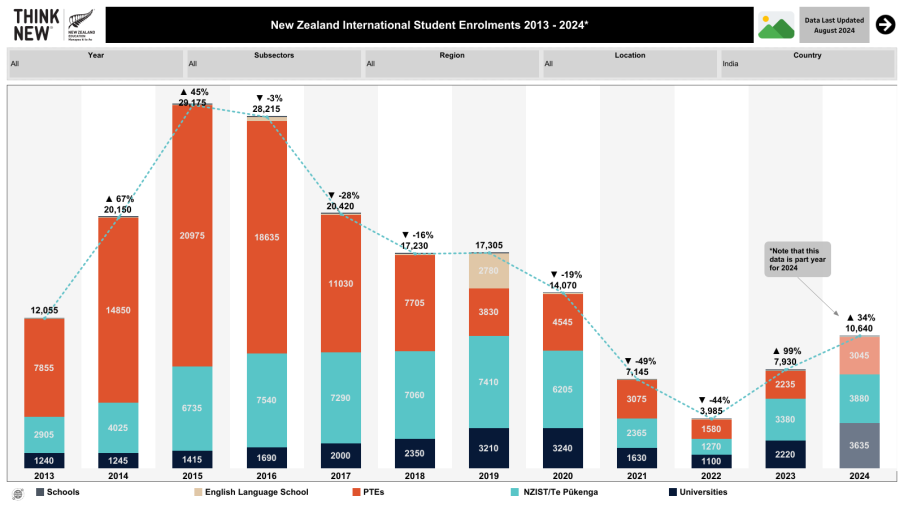
International student enrolments from India
Between January and August 2024, overall international student enrolments from India grew 34% to 10,640 from 7,930 enrolments in the full year period for 2023. Enrolments for universities grew around 64%, private training establishment enrolments grew 36% and Te Pūkenga enrolments from India grew 15% over the same period.
86% of Indian students in New Zealand rate overall experience positively
Indian students are thriving in New Zealand. The New Zealand International Student Experience Survey 2024 reveals that 86% of Indian students rated their overall experience in New Zealand positively.
From high-quality education and a warm, welcoming environment to strong community connections, these insights reflect New Zealand’s continued commitment to delivering a world-class, student-centred experience. -
From the CE: Building back New Zealand’s international education experience
One of the highlights for me was experiencing a warm Southern welcome in Christchurch and Dunedin, in late August. It was useful to hear from a cross-section of key education providers and other education-related organisations about what’s top of mind for them. There was an opportunity to hear about their plans for the year ahead and discuss what’s being planned at Education New Zealand Manapou ki te Ao (ENZ), and how we can best support each other.
People expressed cautious optimism about inbound student numbers for 2022, saying they have adequate applications in the pipeline to be comfortable with progress (as much as 50% of pre-pandemic levels for some). They mentioned that the fourth border exception group of international students, Cohort 4, is having a positive impact on student numbers. Many of the recent arrivals had started their studies with New Zealand online in their home countries – a testament to the huge effort made by providers, with support from agents and our international teams, to continue reaching out to students and offering online study options while our borders were closed.
The visit ended with a Christchurch City Council and ChristchurchNZ mayoral welcome for around 140 tertiary international students, from across the wider Christchurch region – a memorable evening.
Another successful welcome for international students took place in September, hosted by the University of Auckland. Both Prime Minister Jacinda Ardern and Education Minister Chris Hipkins spoke at the event, in a clear demonstration of the government’s commitment to international students and international education.
This week I returned from a short visit to London and Barcelona, as part of ENZ’s plans to revisit all our key partner countries now our borders have reopened. The timing coincided with the annual EAIE Conference and Exhibition in Barcelona, which attracted more than 6,300 participants from over 90 countries. EAIE is the largest business-to-business conference and international education event in Europe. It provided a great opportunity to reconnect with key partners and other contacts, and to continue to let them know we are open to welcome students. You can read more about New Zealand’s pavilion at EAIE and the providers who took part in this month’s E-News.
In London, I had a series of meetings with key government and education sector contacts, including Professor Sir Steve Smith, the UK Government International Education Champion. A range of opportunities were discussed during these meetings, and we will follow up on these with the sector in New Zealand. I also met with journalists to promote a New Zealand education, including Times Higher Education and StudyTravel magazine. The final engagement of the London trip before heading off to Barcelona involved presenting an award at the PIEoneer Awards ceremony. The four awards won by New Zealand organisations that evening are covered later in this issue.
Finally, I’d like to thank everyone involved in the Asia Pacific Technical & Vocational Education and Training Forum, which took place from 14-15 September 2022. This online event, which is run in partnership between Te Pūkenga, Skills Consulting Group and ENZ, attracted more than 2,000 delegates from 60 countries, and has resulted in significant positive feedback.
In the spirit of Te Wiki o te Reo Māori I’d like to end with a whakataukī that highlights the importance of language:
Kia kaha, te reo Māori - Let’s make the Māori language strong!
Ngā mihi nui,
Grant McPherson
-
NZISA talks student mental health and wellbeing
Held at Victoria University of Wellington, the conference theme was International Student Mental Health and Wellbeing.
Mayor of Wellington, Justin Lester, welcomed delegates, followed by presentations from academics, health professionals and government agencies working with international students. A student panel discussion wrapped up the morning.
NZISA President, Lukas Kristen, said the theme was chosen in response to a growing awareness of the need for international student support services.
“While mental health and wellbeing is an issue in domestic student communities, it is amplified in international student communities due to the separation from family and friends, cultural differences and the lack of culturally trained practitioners.
“The biggest achievement of the conference was that student leaders in attendance are now better informed about where to get help. The workshops really highlighted that help is out there and how impactful it can be.”
Presentations included a plenary on student leadership by Professor Shanton Chang, University of Melbourne, as well as a session on sexuality and diversity. Patrick Au from the Auckland District Health Board delivered an engaging session about building mental health resiliency, and Dr Cathy Stephenson, a General Practitioner at Victoria University, spoke about supporting international student mental wellbeing.
This inaugural conference was, in part, made possible by funding the NZISA received in the International Student Wellbeing Strategy 2017 funding round.

-
PIF Recipient: Virtual Medical Coaching
In the United States alone, approximately 800 women die each year during pregnancy and within 42 days after delivery. More than 60% of those deaths are believed to be preventable. In developing countries, the rate of pregnancy-related deaths is up to 300 times higher.
An important part of the solution is education. Globally, midwives are in high demand, with the UK’s NHS increasing their places for student midwives by 3000, starting this year. Australia is also planning to increase numbers, while in New Zealand, a funding boost will increase the number of Māori and Pacific students training in midwifery.
While the demand for midwifery training is growing, education offerings haven’t kept up. Childbirth is deeply personal, and feedback from mothers – validated by hospital staff – is that they do not wish to have extra staff or students in the room for training. With no effective opportunities for face-to-face learning, there is a global need for a realistic and scalable childbirth simulation.
That’s where Virtual Medical Coaching’s vision comes in, supported as a recipient of the International Education Product Innovation Fund. Virtual reality (VR) software will provide a safe and controlled environment for students to see and assist in childbirth simulations, both with and without complications and in a range of different scenarios. As the student improves, the simulations they encounter increase in difficulty. A machine-learning algorithm enables fast and accurate feedback to both the learner and any tutors.
The simulation will be interactive and responsive, meaning that any action taken by a student creates a life-like consequence and reaction. The outcome is that learners are taught to effectively make decisions and problem solve.
Existing options for midwifery training include a physical mannequin simulator, but this can be prohibitively expensive, out of reach of many training providers, and doesn’t offer students maximum learning hours. In addition, existing options don’t include the ability to witness mechanisms like rotations/restitutions or the ability to have back and forth conversations. By contrast, the VR simulation will be available to students wherever they are, and whenever they need to practice. The nature of the VR experience means that modern learning styles, such as asynchronous and remote learning, are well catered for.
With support from the International Education Product Innovation Fund, Virtual Medical Coaching’s childbirth simulation is on track to become fully released by the end of 2024. A beta-version is already used by some educators globally. The Product Innovation Fund is a New Zealand Government-funded initiative to reimagine what a New Zealand education can look like and mean for global learners.
Managed by Education New Zealand Manapou ki te Ao (ENZ), New Zealand’s government agency for international education, the fund is supporting a range of pilot projects from existing and emerging New Zealand education providers. Together, the projects rethink how an education experience from New Zealand can be delivered, and create impact, for global learners.
For Virtual Medical Coaching, it’s about finding a better solution to a serious issue. Like many other innovative Kiwi education technology companies, Virtual Medical Coaching is designing technology that will create positive impact around the world. It’s already successfully developed an x-ray simulation for healthcare professionals which has won multiple national and international awards. Now, with the support of ENZ through the International Education Product Innovation Fund, Virtual Medical Coaching is set to respond to a clear need for better midwifery training options and develop another cutting-edge learning product for both New Zealand and offshore markets.
More information: