Search
Showing 10 of 7355 results
- International Education Scanning Report October 2014
-
Continuing the discussion on the impact of AI on education
Since ChatGPT’s (Chat Generative Pretrained Transformer) launch in November last year, the Artificial Intelligence (AI) tool has featured heavily in headlines around the world, sparking conversations from boardrooms, to classrooms, and around the dining room table. Discussions on the significant impact this tool and future AI technology is having on how we teach, assess, and support our students here in New Zealand’s education system are happening in all areas of our sector, including here at Education New Zealand Manapou ki te Ao (ENZ),
A particular discussion during a recent EdTechNZ panel webinar on Artificial Intelligence and the impact on Education, looked at where educators may want to focus their valuable time now that generative AI platforms are available. For example, do educators want to spend their time researching topics, analysing data, and producing unique activities of work, or spend it on building meaningful relationships and place-based experiences with and for learners; gaining insights into learners’ interests, engaging in critical thinking activities and deepening learners experience of and outcomes in education?
Following EdTechNZ’s interesting and successful March webinar which can be viewed here; Artificial Intelligence and the impact on education, ENZ hosted an in-person seminar at our Tāmaki Makaurau offices in late April. This seminar's purpose was to look deeper at how this emerging technology is changing the way we learn, teach, and innovate.
Professor Ian Watson, recent past professor at the University of Auckland, spoke to a group from across the education spectrum including secondary schools, Private Training Establishments, EdTech founders, Education Publishers, Google, about AI and its impact on education.
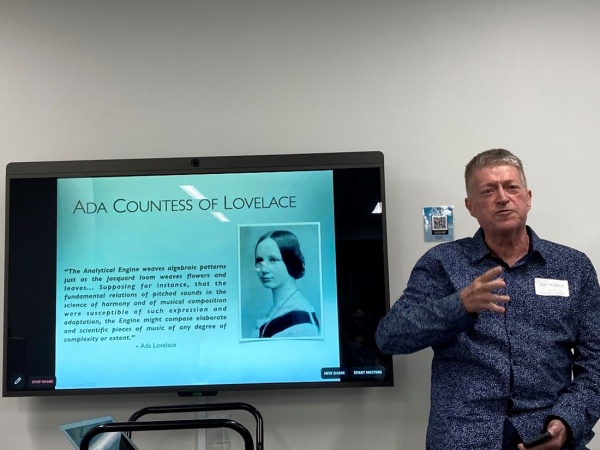
Professor Watson is considered an AI pioneer with 30+ years in the AI machine learning environment and reflected on the history of AI, including that it is not a new or sudden phenomenon, and its progress over time.
“AI imitates intelligence and is great at the specific but not so much the general. For example, aircraft use AI to be able to perform extremely specific flight tasks, but it will never be able to suggest a recipe and cook it!”, Professor Watson said.
“Within education, AI will certainly provide value in routine, mundane and repetitive tasks such as grading, lesson planning, report writing but in the hard and difficult tasks such as developing a universal design for learning and differentiated or targeted learning, it has its flaws. It is not always factually correct and still needs a human to educate it”.
Professor Watson also talked about how important it is, critical even, to teach learners how to use these tools, so they are empowered. Such tools include the likes of AI4K12 for K-12 learners.
Anyone looking for more insights and conversations about AI should check out the TechWeek23 programme with over 400 in person and online events to be hosted from 13 – 20 May.
Techweek AI focussed online events of note include:
- AI and education with AUT Monday 15 May
- AI is here to stay: Its impact on online, flexible, and distance learn with FLANZ (Flexible Learning Association) and EdTechNZ Thursday 18 May at 11:00am – 12:00pm.
-
Kōrerorero on quality education
Panellists included
- Dr Dawn Freshwater, Vice-Chancellor at the University of Auckland, who is also the first woman to hold this role
- Dr Sandra Regina Goulart Almeida, Vice-Chancellor at the Federal University of Minas Gerais (UFMG) in Brazil
- Dr Alejandro Ceballos, Vice-Chancellor at the Universidad de Caldas in Colombia.
With simultaneous interpretation in Spanish and Portuguese, the session attracted more than 100 attendees and 350 registrations from across Latin America and Aotearoa New Zealand. Panellists shared their thoughts on gender equality, integration, and inclusion, and how to achieve more equitable access to quality education. They also discussed the main priorities and focus of their institution in relation to SDG 4, and how they overcome challenges to achieve the SDG’s objectives.
Education New Zealand Manapou ki te Ao’s Kōrerorero webinar series is intended for academics, education agents and media in Latin America and New Zealand. It has been particularly effective in maintaining awareness of a New Zealand education while our borders are closed, while also contributing to discussions on important matters related to international education. Across the six episodes since its launch in 2020, more than 1,000 people have attended, with many subsequent views on YouTube.
If you would like to watch this episode, please click here
-
Strong start for Cohort 4 international students
Already more than 3,500 international students have been nominated by their education providers and confirmed by education agencies. More than 1,900 of these students have had their Request for Travel approved and have been invited by Immigration New Zealand to apply for their student visas, since the process opened on 13 April 2022.
Places remain available for students with a number of ELS and PTE providers. Only education providers can nominate students for this cohort. Interested international students or their agents should contact ELS or PTEs as soon as possible. Of the 5,000 places in this cohort, 1,000 were allocated to ELS and 850 to PTEs, with the remainder going to universities, Te Pūkenga, and secondary schools.
Once they have been nominated by an education provider and confirmed by education agencies, students have two weeks to make their Request for Travel through the Immigration New Zealand website. Following approval of the Request for Travel, students then have one month to complete and submit a student visa application to Immigration New Zealand, in time for a mid-year start for their studies.
Education providers are due to complete their nominations by 6 May 2022. Any unused places will be transferred to other providers, which means that some providers may get additional places as part of the reallocation process.
This is the fourth cohort of international students to be granted a border exception to enter New Zealand and is part of the progressive reopening of our borders. All visa categories are due to reopen from October 2022 onwards, including visitor and student visas.
For more information on this cohort of international students, see Cohort 4 » Education NZ (enz.govt.nz)
- nagisa japan school 4
- ThaiRMUTT
- NZ teachers in Korea lead
- sac mark flowers
- Student welcome
- International photo round-up