Search
Showing 10 of 7355 results
-
Looking back and looking ahead in India
“We’ve seen some successes and we also have some learnings to share with the sector,” says Jugnu Roy, ENZ’s Director of Engagement based in New Delhi.
“With New Zealand’s borders remaining closed for the first half of 2022, it was certainly a challenge to sustain the Indian student pipeline into New Zealand for higher studies. We knew going conventional wouldn’t help, and so we amped up our PR efforts.”
Aligned with ENZ’s approach of offering future-focused education, the team targeted learning opportunities for tertiary students under the umbrella of an integrated campaign – Unlock Potential for the New You. Using digital platforms as well as mainstream media, the strategy included a mix of suitable learning opportunities and unique ways of engaging with our stakeholders. This successful campaign won Gold awards at 2022 South Asia SABRE Awards, ETBrandEquity Kaleido Awards, STAKES PR & Communications Excellence Awards 2022; Silver at Adgully IMAGEXX Awards 2022 and a Bronze at Campaign India PR Awards 2022.
Kick-starting the year with the first event of its kind, ENZ’s India team hosted the ‘Women of the Future’ virtual event. To ensure maximum reach, we collaborated with leading digital platforms such as Femina India and Tweak India, among others, achieving more than 5.8 million impressions. More recently, the collaboration with popular Indian celebrity Soha Ali Khan is helping to create a stronger recall value of New Zealand among Indian study abroad aspirants.
2022 was also a year of big announcements from New Zealand such as the global I AM New Campaign, the reopening of New Zealand’s borders, new scholarships exclusively for Indian students, and a series of visits from New Zealand universities to name a few. Supported by our PR agency, Ruder Finn India, these announcements all made headlines in prominent Indian publications and portals including The Hindu, The Indian Express, Financial Express, and Education Times.
“It’s always a challenge to be heard,” Ms Roy says.
“Some types of stories are much more likely to be picked up than others. For example, stories about our borders reopening, new research on Covid-19, scholarships for Indian students, the United Nations Sustainable Development Goals (SDGs) are of interest, as well as stories about Indian students or academics.
“Our team is always interested in success stories involving Indian students, and we look to New Zealand education providers to help us with sourcing these.
“It’s also important for institutions to be selective about the timing of their announcements, so journalists have the space to focus on each story, rather than choosing between multiple announcements at the same time.
“It's good to establish a single spokesperson for a given institution, and to ensure that Indian journalists seeking information get a timely response – if it’s a wide-ranging article they are likely to go ahead without input from New Zealand, which is a missed opportunity.”
The team is busy pulling together their plans for 2023, including how best to profile these initiatives to ensure high visibility.
“Finally, I would really encourage New Zealand tertiary education providers to think carefully about what Indian students and their families are seeking from investing in an international education experience, and how individually and as a sector we can work together to meet those expectations,” Ms Roy says.
- Student panel 3
- Whakatane
- Senior Advisor Stakeholders and Governance September 2017
- sac rob mckay2
- Social Media Post.jpeg
- India20tshirt202
-
Innovative leadership programme funded by PIF proves great success
The Crusaders partnered with Christchurch-based education provider Boma to develop an engaging online leadership programme sharing the Crusaders Way with rugby coaches for all age levels. The programme draws on rugby legends Scott Robertson, Robbie Deans, Kieran Read and Samuel Whitelock to help participants build a connected and skilful team.
The Crusaders chose to collaborate with Boma because of the values alignment between the two organisations, combined with Boma’s expertise in crafting compelling, impactful, scalable online learning experiences.
Boma is a recipient of ENZ’s Product Innovation Fund, which assists in the development of programmes that deliver new, meaningful and unique learning experiences from New Zealand, for the world.
The funding allowed Boma to embark into a new area and develop the Crusaders pilot programme. Boma already runs events, workshops, and courses, and has worked with leading organisations in Aotearoa and around the world. Some of Boma’s clients include IAG, Meridian Energy, Stuff and New Zealand Trade and Enterprise.
While fully on-demand online courses have been around for a long time, they typically generate low completion rates. Boma’s approach is different, creating a cohort of learners who move through the programme together, leveraging pre-recorded video with time-sensitive community engagement.
Boma founder Kaila Colbin says their unique method delivers extraordinary outcomes.
“Our programmes are designed to offer the quality and impact of Stanford, the scalability of Masterclass, and the excitement and shared experience of TED,” she says.
Kaila explains that the coaches have the flexibility to complete the course in their own time but have a sense of urgency and accountability because of the community element.
The two-week pilot was completed by 114 coaches from 14 countries. It had glowing written feedback and earned a Net Promoter Score, or NPS, of 80%. NPS is a widely used customer satisfaction benchmark in which the potential score ranges from -100 to +100. A positive score is considered good and a score above 50 is considered outstanding.
Boma has big plans for the future, growing from rugby leadership to sports leadership to business and general leadership.
Registrations are open for the next Crusaders course, which starts on 30 January 2023.
Find out more about Boma here and find out more about the Crusaders Coaching Leadership Programme™ here.
-
BINUS School Serpong wins the KIWI Challenge 2022
The winning team’s ‘Beyond Borders’ idea involved the development of a travel planning app that streamlines and personalises the travel planning process. The team also had a strong focus on local community engagement and inclusivity across people with different abilities.
The KIWI Challenge is an annual ENZ initiative run in partnership with one of New Zealand’s universities. This year Te Kunenga ki Pūrehuroa – Massey University was nominated and chose the topic of sustainable business and entrepreneurship in the tourism industry.
The competition sees participating students from schools across Java and Kalimantan provide an innovative solution or idea on a given theme.
ENZ runs the competition in collaboration with in-market partner, Kopi Tuli (Deaf Cafe), a hearing-impaired community in Jakarta. This partnership is aligned with ENZ’s strategic framework to nurture and encourage diversity, equity, and inclusion, while also showcasing sign language as one of New Zealand’s official languages.
Education Minister Chris Hipkins officially launched the 2022 KIWI Challenge during his visit to Jakarta in October.
The top prize includes vouchers worth $1,000 NZD with team members being able to undertake a virtual internship with Massey University.
The virtual internship will teach students practical skills to ‘take their idea to the world.’ Through eight hours of customised supervision from some of Massey’s academic marketing experts, students will learn how to add value to their idea and create a digital marketing plan to effectively launch their business solution.
The judging panel included ENZ’s General Manager – Marketing and Communications, Geoff Bilbrough; Massey University’s Director of Strategic Partnerships, Dr. Jeffrey Stangl; and co-founder of Kopi Tuli, Tri Erwinsyah Putra.
“I was hugely impressed with what I saw today, you [the students] can be very proud of yourselves and feel very optimistic about the future that you have before you,” Mr Bilbrough said.
Dr Stangl added, “If the future of the planet is in your [the students] hands, then we’re in good shape. Each one of the teams have thought through some very innovative ideas and solutions to problems unique to Indonesia.”
This year, the competition had 36 teams from 18 schools across the Java and Kalimantan regions participating with their innovative ideas and business pitching skills to develop their idea and create a 2–3-minute video presentation to submit to the competition.
Five teams were shortlisted to attend the finals, which were held live in-person (Jakarta) and online (Zoom). Finalists then presented their business solution for sustainable tourism, followed by a question-and-answer session with the judging panel.
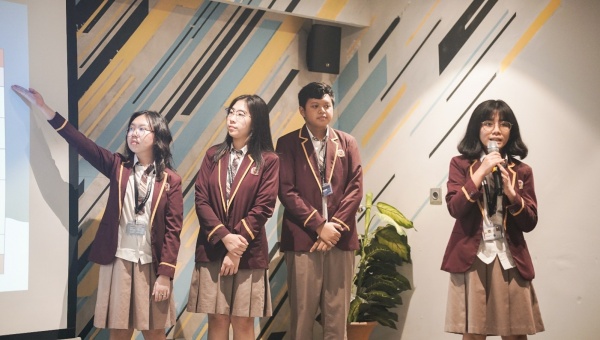
The winning BINUS School Serpong team present their ‘Beyond borders’ strategy. Pictured above (from left to right): Isabel Jo Orleans, Darlene Christabelle Wijaya, Rafael Rangga Natariano, and Calista Zahra Caesariyani
- Picture3 v2