Search
Showing 10 of 7355 results
- Korea 2
-
Around the world in five: March 2022
International
Opinion... from the News Editor, 17.03.22
India joins hands with Australian government to establish taskforce on qualifications recognition
New Zealand
New Zealand confirms details of 5,000 international student cohort
Call to end cap on number of international students allowed in NZ
Australia
Once again, international student ‘exports’ are wildly exaggerated
Australia's one-off opportunity to change its approach to international students
Only Half of International Students May Return to Australia This Year
Aus: $10m innovation fund revealed
India
Auckland University Offers 10 Virtual Internships for Indian Women Students
Everest Twins and Miss Malini share their stories at International Women’s Summit
Edtech a big draw among teachers despite covid ease
United Kingdom
Record UK University Applications from UAE
United States
Biden immigration rule will harm American college graduates, expert warns
US: international students say experience doesn’t justify cost
Vietnam
Bravery of international students after Covid-19
New Zealand offers digital technology training scholarships to teachers
- Advice from 1 Janaury 2017 regarding quality of education providers EER process and or changes to Rule 18
-
Incheon Metropolitan Office of Education deepens links in New Zealand
The delegation from Incheon Metropolitan Office of Education East Asia Global Education Institute (Incheon MOE) travelled to Ngatea, Wellington, Canterbury and Otago – visiting providers from the schools, university and vocational education sectors.
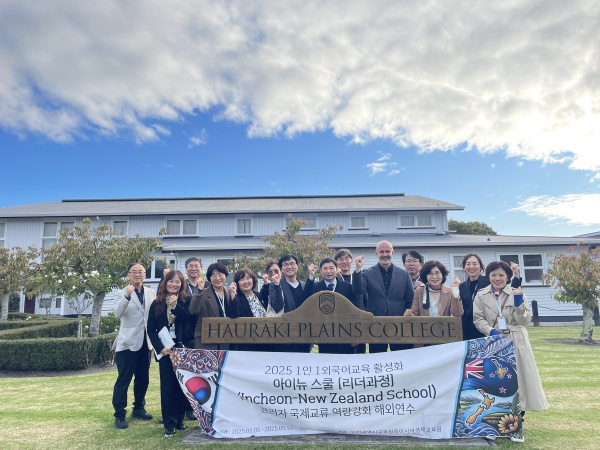
The visit began with a visit to Ngatea to connect with Hauraki Plains College and Ngatea Primary School.
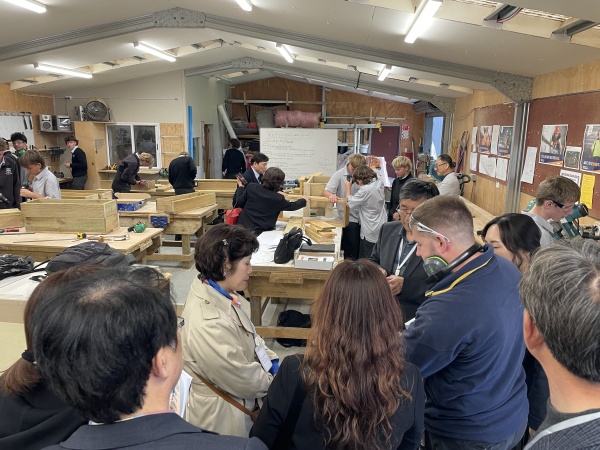
Observing the Agriculture Academy and trades-based courses at Hauraki Plains College.
A key aspect of the delegation’s time in Ngatea was the signing of a Memorandum of Understanding (MoU) between Hauraki Plains College and four schools from Incheon: Sunin High School, Shinsong High School, Geomdan High School and Youngwha International Tourism High School.
The intent of the MoU is to strengthen educational ties between the schools, which includes a reciprocal exchange program.
The first of these exchanges will see 28 students from across the four Incheon schools visit Hauraki Plains College in October 2025, 28 students from Hauraki Plains College will then travel to Incheon in April 2026.
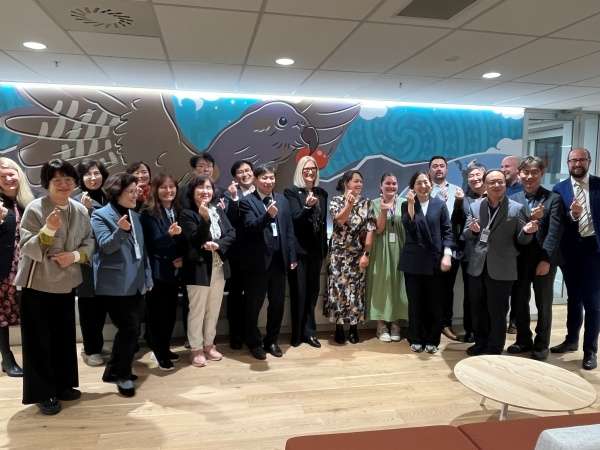
The delegation was formally welcomed to the Wellington with a Mihi Whakatau hosted by ENZ Chief Executive Amanda Malu, local staff and the Ministry of Education (MOE).
In Wellington, the delegation received a detailed briefing from the Ministry of Education and visited Scots College to observe the school in action.
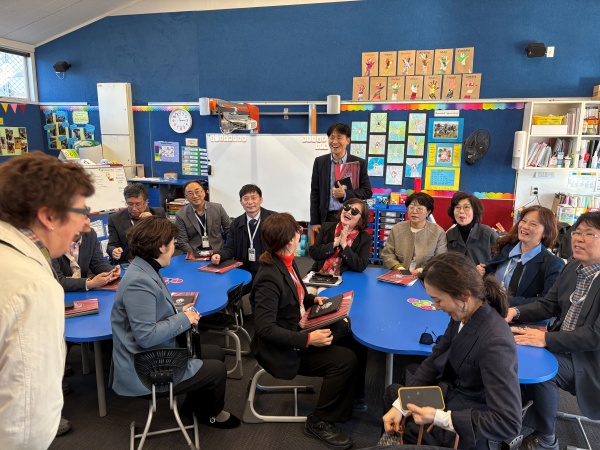
Scots College Junior School Principal, Rachael Huggins, showing the Incheon delegation around a primary-level classroom.
Down to Christchurch, the Incheon delegation visited Lincoln University to fine-tune the details of an MoU signed in January this year. The partnership arrangement will support five Incheon students to study at Lincoln University each year.
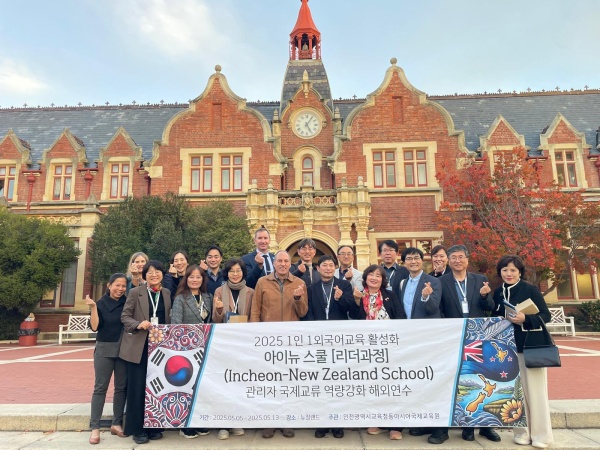
Incheon delegate members with Lincoln University staff from the Faculty of Agriculture and Life Sciences, Faculty of Agribusiness and Commerce, Academic Preparation and Pathways and International Operations.

Waitākiri Primary School Principal Mr. Andrew Barker introduces a Year 6 long-term international student from Korea to the delegates. She shared how much she has enjoyed her time at Waitākiri Primary School and expressed her sadness that her year at the school is coming to an end.
The group visited Shirley Boy’s High School and Avonside Girls High School in Christchurch, with a side-visit organised with Waitākiri Primary School.
Further South, a visit was arranged with Otago Polytechnic in Cromwell to understand the pathways to vocational education in New Zealand.
Director of Incheon Metropolitan Office of Education East Asia Global Education Institute, Jooyong Kim, said visiting New Zealand schools was a truly meaningful and deepened delegates understanding of the education system.
“We hope this visit will help strengthen the relationship between schools in New Zealand and Incheon”.
“We look forward to future collaborative projects with New Zealand institutions,” he added.
Several of the schools visited have expressed interest in deepening these new relationships, with planning underway to keep up the momentum and connect again at ENZ-led fairs and agent seminars in Korea later this year.
-
New Zealand and Vietnam celebrate 45 years of bilateral ties
The alumni were: Le Thi My Hanh, Country Representative at Global Green Growth Institute (GGGI); Nguyen Bao Tram – Vice President, User Growth Strategy and Planning at Lazada Vietnam; Trinh Thi Thuy Lien – PhD Candidate in Education and Higher Education, College of Education and Higher Education Development Center at the University of Otago; Le Ba An Binh – Managing Director at Adtima, a division of VNG; Nguyen Minh Dung (Daniel Nguyen) – Executive Chef at Mia Saigon Luxury Boutique Hotel; Founder of Coco Consulting Limited in Auckland; and Nguyen Quang Dat – Captain (Airbus A320), Pacific Airlines.
ENZ Regional Manager – East Asia, Ben Burrowes said, “We are extremely proud to recognise each individual awardee today and to celebrate the role that a New Zealand education has played in both their personal and professional lives. It is inspiring to learn what they’ve achieved since graduating in New Zealand and to hear real-life examples of New Zealand’s unique approach to learning.”
New Zealand Ambassador to Vietnam, Wendy Matthews, also spoke at the awards ceremony.
“The quality of New Zealand education can be seen in the quality of our graduates, and these alumni are examples of the globally engaged students New Zealand aims to produce,” she said.
“New Zealand is committed to helping build the future leaders of Vietnam. We are proud of our alumni and the New Zealand alumni community, who have come to be affectionately known as the ‘Kiwi mafia’. Alumni play an integral role in the New Zealand-Vietnam bilateral relationship, which celebrated its 45th anniversary this year.”
Vietnam and New Zealand first established diplomatic ties in 1975. The countries’ education relationship stretches back even further to the 1960s, with Vietnamese students having come to New Zealand since the first days of the Colombo Plan.
Today, Vietnam remains an important market for New Zealand’s international education sector. Vietnamese students make up the seventh biggest cohort from a single country. In 2019, 3,040 Vietnamese students studied at New Zealand institutions, up 10 percent from the year before. Of the 3,040 students, 35 percent studied in the universities, followed by schools (28 percent). The number of Vietnamese students studied in schools and universities increased 29 percent and 9 percent respectively from 2018 to 2019.
- China.vocational.forum
- Kate west tweet
-
ENZ Emirates Airline promotion launches in Saudi Arabia
This promotion builds on a successful #YourSummerinNZ competition, which concluded on 5 June with the award of six prizes to study in New Zealand. The winners receive full scholarships to study English language at one of the six sponsoring New Zealand English language schools for up to six weeks, including return flights to New Zealand and accommodation.
The Emirates Airline promotional discount offer is on flights to New Zealand, booked from 1 June until 31 August, departing from Riyadh, Jeddah, Medinah, and Dammam. To redeem the offer, students need to use an infographic posted on ENZ’s Arabic Twitter page – @nzeducationsa.
“We are delighted to partner with Emirates Airline in promoting New Zealand as the premium destination for English-language students,” says John Laxon, ENZ’s Middle East Regional Director.
“Saudi students can now fly direct from Dubai to New Zealand via Emirates, and enter New Zealand visa-free when studying for up to 12 weeks.”
The flight promotion, and competition, are targeted to students looking at summer abroad study, given the longer summer holiday period in 2016.
New Zealand Ambassador, Hamish MacMaster, announced the Saudi #YourSummerinNZ scholarship winners: Abdullah Al Fifi (New Zealand Language Centres), Thamer Albugmi (Worldwide School of English), Ali Al Shahrani (Academic Colleges Group), Mohammed AlQabbaa (Southern Lakes English Language College), Majed Alzahrani (Languages International), and Fahad Alfifi (The Campbell Institute).
“The #YourSummerinNZ competition was a great success,” says Ambassador MacMaster.
“More than 3,000 entrants promoted New Zealand on ENZ’s dedicated Arabic-language Twitter channel – @nzeducationsa. ENZ now has more than 38,000 followers on its Twitter page, where students can find out how great it is to study in New Zealand.”
ENZ will continue a series of promotional and marketing initiatives during the summer period, and any providers looking to partner on further promotions can contact: rachel.simpson@enz.govt.nz
- G9C5164
-
New Zealand PTEs elevate profiles with inaugural Philippines Roadshow
The roadshow, the first of its kind to be held in the Philippines, took place from 10 to 16 June, featuring nine PTEs: ACMI New Zealand, academyEX, Auckland Institute of Studies (AIS), Auckland Pilot Training Group, ICA New Zealand, IPU New Zealand, Kalandra Education Group, UP Education, and New Zealand Skills & Education Group. Golden Summit was tasked with delivering the events in Manila, Bacolod, and Cebu.
The roadshow included an agent seminar and agent-led fairs. During the agent seminar in Manila, PTEs presented their offerings to an engaged audience of 37 Filipino education agents, who showed strong interest in the PTE programmes. The roadshow then continued with agent-led fairs in Bacolod and Cebu, drawing 370 and 150 visitors, respectively.
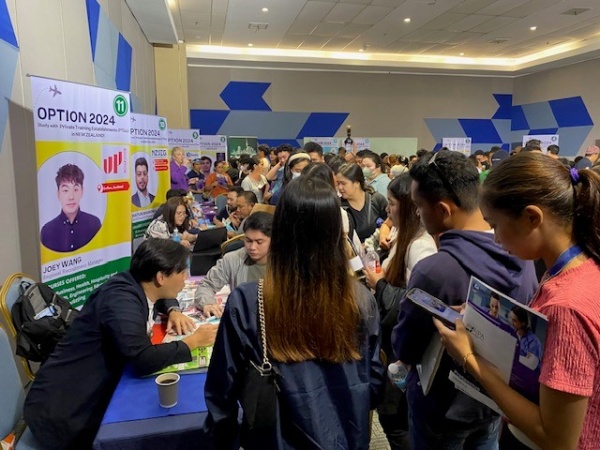
Standing room only at the agent-led fair in Bacalod.
ENZ’s Market Manager, Chor Pramoolpol, led the roadshow and commented that the agent seminar facilitated in-person interactions between PTEs and education agents interested in promoting New Zealand PTEs in the Philippines,
“The agent-led fairs provided prospective Filipino students and their families the opportunity to gather reliable information about studying at New Zealand PTEs by directly communicating with PTE representatives.
“In the recently released full year 2023 enrolment data, the Philippines comes in as the 8th largest partner country for New Zealand and saw a 131% increase in students enrolling with New Zealand education institutions from 2022 enrolments (1,933 vs 835 students). 51% of these total enrolments were for the PTE subsector which shows just how popular they are amongst Filipino students. Our roadshow was therefore very timely to capitalise on the interest from this market,” added Chortip.
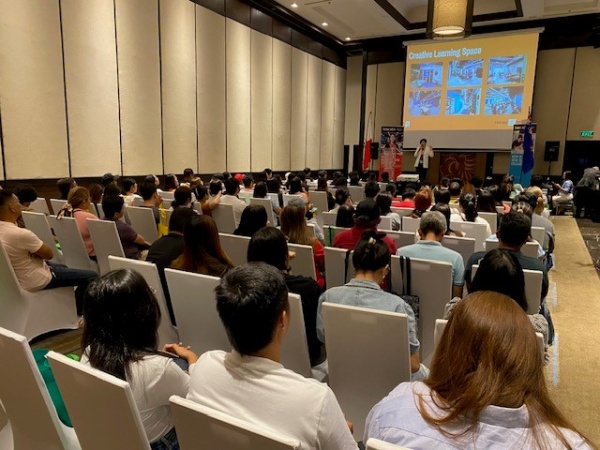
Filipino education agents in Cebu hearing about the creative learning spaces that PTEs in New Zealand provide their students.
Ann Gooco, Senior Marketing Manager at International College of Auckland (ICA) said that she thoroughly enjoyed presenting ICA’s programmes and offerings to education agents in Makati City and to the many students in Bacolod and Cebu.
“I found the experience incredibly rewarding. These gatherings allowed me to bond with the education agents and other PTE representatives, adding to the overall positive experience,” added Ann.
Anyone interested in receiving information about the student market in the Philippines can email our Market Manager for the Philippines, Chortip Pramoolpol – chortip.pramoolpol@enz.govt.nz.