Search
Showing 10 of 7355 results
-
Latest recipient of innovation funding will strengthen indigenous links
Te Whare Wānanga o Awanuiārangi (TWWOA) is the most recent recipient of support from the International Education Product Innovation Fund, administered by Education New Zealand Manapou ki te Ao (ENZ).
TWWOA’s pilot project ‘Iwi taketake: an Indigenous postgraduate curriculum’ will see the co-construction of an international Indigenous curriculum from post-graduate certificates through to doctoral studies.
The new curriculum will be developed and delivered with Indigenous college graduates based at Hawai’i, Washington State, Canada and Australia, and will strengthen relationships with and between Indigenous communities and education providers in the United States. The pilot project will demonstrate how applied Indigenous postgraduate education can deliver value for Indigenous communities who are more used to being the subjects of research, rather than the beneficiaries of it.
The first ‘co-badged’ qualifications, awarded jointly by TWWOA and partners offshore, will be offered to learners from 2024 onwards.
The International Education Product Innovation Fund is a New Zealand Government-funded initiative, managed by ENZ, to reimagine how an education from New Zealand can be delivered and create impact for global learners. Learnings from this stream of work will be shared for wider benefit to the sector in late 2023.
Visit the Product Innovation Fund page to learn more and discover all the pilot projects the Fund is supporting.
-
Study abroad promo in US
Study Abroad Month, led by our Washington DC-based team, targeted the study advisors at United States universities, who support students with their study abroad plans. A series of videos were published each week and sent to key contacts, including a closing video from Education Minister Chris Hipkins.
Lewis Gibson, Field Director North America at Education New Zealand Manapou ki te Ao, says study abroad students are our main source of international students from the US.
“Pre-Covid-19, around 350,000 tertiary students each year spent a semester overseas as part of their degree. We’re looking to increase our share of this group.
“In normal times, US institutions and study abroad advisors rely on the voices of New Zealand alumni, who can share their experiences with other people on campus and build interest in a New Zealand study experience,” he says.
“We needed to do something different this year, because our borders had been closed so there weren’t the alumni students available on campus. We also needed a good way to remind study advisors about New Zealand’s unique education offering.”
Lewis says feedback from institutions in the US has been very positive, and they are looking forward to seeing students travel again to New Zealand. Some of the comments received included the following:
- “Thank you so much for letting us know about this exciting project! I just shared the New Zealand Study Abroad Month YouTube channel with our spring 2023 applicants... We are thrilled to nominate over 15 students to our outstanding partner universities in New Zealand ...for the first time in over two years!”
- “Thank you for sharing this information. I watched Fiona’s video for VUW and I am sharing it with several students who are deciding which NZ institution to attend for Term 1 via TEAN. I’ll be certain to watch future videos and do the same with those.”
- “We are so grateful of the opportunities you provide our students, and our tight partnership together.”
“In case anyone is wondering, we initially intended to run the promotion for four weeks, hence the name, ‘Study Abroad Month’. But with the participation of so many universities, and the inclusion of additional videos reflecting the voices of students, it made more sense to expand the promotion to six weeks.”
Before our borders closed, the US was our sixth largest source of international students, with most students seeking to enrol in university-level study here. Study Abroad Month aimed to attract students to New Zealand from the US spring semester 2023 onwards.
- “Thank you so much for letting us know about this exciting project! I just shared the New Zealand Study Abroad Month YouTube channel with our spring 2023 applicants... We are thrilled to nominate over 15 students to our outstanding partner universities in New Zealand ...for the first time in over two years!”
- CA Summit G
- PR 2425 040 International Student Experience Survey Report 2024
- NAFSA 2018 Shipping Label
- PM and Alumni Showcase NZ event.MFAT picture
- PMSLA Programs UNIVERSIDAD ADOLFO IBANEZ
-
AUT international students connect with senior citizens
A uniquely engaging initiative supported by New Zealand Police and AUT recently brought together international students and local senior citizens to connect in Tāmaki Makaurau Auckland.
The initiative was an outcome of a meeting of the Auckland Agency Group, of which Education New Zealand Manapou ki te Ao is a member and enabled international students to understand and start to integrate into local culture guided by senior residents and members of the wider Auckland community.
As the last 12 months have seen the welcome return of international students to our campuses and communities, New Zealand Police Ethnic Services teams around the country, including in Tāmaki Makaurau Auckland, have been busy engaging with international students in a number of ways.
Around 18 students met with 10 senior citizens at the Northbridge Residential Village.
The event helped international students engage with their local community, establishing intergenerational bonds, helped them access support networks, engage in cultural exchange, and actively participating in community affairs.
The event included a panel discussion involving members of Northbridge Residential Village, AUT international students, and New Zealand Police. The panel discussion unfolded in two key segments: the initial part addressed the dynamics of culture shock, while the subsequent portion revolved around the overarching themes of diversity and inclusion.
AUT Students Association, International Affairs Officer, Yun Ke, said that the AUT international student interaction with local senior citizens event was a great success.
“We have received immensely positive feedback from students about the event, which is exciting.
“This interaction saw double the participation by international students, as compared to a previously held event in September,” Ke said.
San Winkyi, an international student from Myanmar, was grateful to New Zealand Police for the way they supported the event.
“The police’s presence and assistance contributed significantly to the event's success, and we deeply appreciate their commitment to international student safety and wellbeing,” San said.
For Huabiao Xiao, an international student from China, the interaction was a wonderful opportunity to appreciate cultural differences while enjoying communicating with an open and inclusive local community of senior citizens.
“Spending time with local seniors and police officers was an amazing experience, far beyond anything I could have imagined. These elders are simply the epitome of local cultures and society, and I deeply appreciate their differences and uniqueness. At the same time, I appreciated how New Zealand police officers are committed to promoting a community culture,” Huabiao said.
Education providers with international students who are interested in organising a similar event are welcome to contact Faymie Li, faymieli@enz.govt.nz or Ross Crosson, ross.crosson@enz.govt.nz.
-
New ECA signed with US institution
Increased opportunities for students and researchers from diverse backgrounds to study and carry out research in New Zealand, and more international opportunities for Māori will result from the new agreement between the Louis Stokes Alliance for Minority Participation-National Science Foundation International Center of Excellence (LSAMP-NICE) and Education New Zealand Manapou ki te Ao (ENZ).
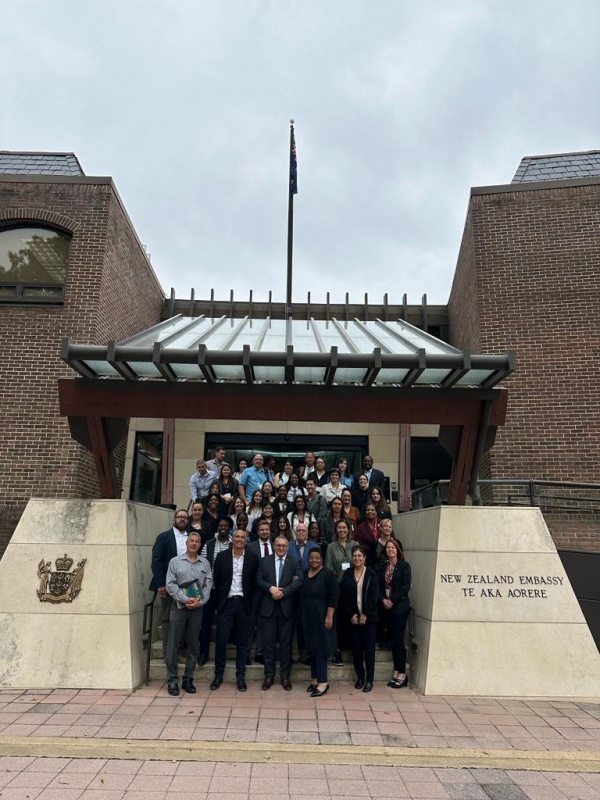
Attendees outside the Embassy of New Zealand in Washington DC, where the meeting was held
The Embassy of New Zealand in Washington DC was the venue for the annual general meeting and conference of LSAMP-NICE on 29-30 September 2022. Representatives of 60 LSAMP institutions across the US attended, as well as international partners including the University of Toulouse, the French Embassy, a Te Kāhui Amokura delegation, and ENZ. The role of Te Kāhui Amokura is to advance and promote the collective interests of New Zealand’s universities to improve outcomes for Māori, and the delegation comprised:
- Rawinia Higgins, Deputy Vice-Chancellor, Māori, at Victoria University of Wellington (VUW)
- Meegan Hall, Assistant Vice-Chancellor Mātauranga Māori, VUW
- Fiona Johnson-Bell, Senior Manager, Education and Māori, Universities New Zealand
- Tim Manukau, Mātauranga Co-Director, University of Waikato Environmental Research Institute
- Megan Ranapia, PhD student, University of Waikato
- Kirita-Rose Escott, PhD student, VUW.
ENZ Manukura Chief Advisor Māori, Ed Tuari, welcomed attendees with a mihi whakatau, and Lance Fisher (Northern Cheyenne) responded with a traditional Northern Cheyenne song. The meeting ended with the signing of the new agreement by Steve Dupuis, LSAMP-NICE Project Principal Investigator, Salish Kootenai College, and Ed Tuari on behalf of ENZ.
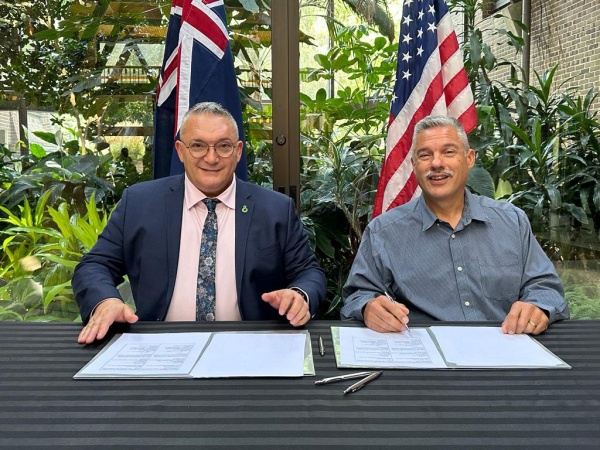
Ed Tuari and Steve Dupuis signed the education cooperation arrangement
“We are working to build people’s understanding of New Zealand as a country with a unique bicultural heritage and strong social justice values,” DuBois Jennings, ENZ’s Director of Engagement, North America said.
“The new agreement reflects that New Zealand is an ideal education destination for students from historically marginalised backgrounds, and it opens up exchange possibilities for Māori and Pasifika students from New Zealand to experience education on US campuses.
“We have been developing these relationships over several years, including at NAFSA earlier this year. Future possibilities include agreements between LSAMP-NICE and individual New Zealand providers.”
In late 2021 the National Science Foundation, Te Kāhui Amokura and ENZ worked together on a series of virtual information exchange sessions, which covered indigenous language research, indigenous data sovereignty, and the impacts of climate change on indigenous communities. More than 150 experts took part, including Native American, Alaskan Native, Native Hawaiian, and Māori scholars.
LSAMP-NICE is funded by the Louis Stokes Alliances for Minority Participation (LSAMP) programme, an alliance-based programme which aims to diversify the science, technology, engineering and maths (STEM) workforce in the US by increasing the number of STEM degrees awarded to historically underrepresented populations, specifically African Americans, Hispanic Americans, American Indians, Alaska Natives, Native Hawaiians, and Native Pacific Islanders. Salish Kootenai College, a Tribal College based in Montana serving the Confederated Salish and Kootenai Tribes, is LSAMP’s lead institution.
-
NZ’s education brand remains stable despite border closures
A recent presentation by Jason Cate of Kantar, who carried out the 2022 annual brand survey for ENZ, considers two broad questions:
- How is the demand for international education changing post-Covid 19?
- How is New Zealand’s brand as an education destination being impacted?
“This programme tracks perceptions of New Zealand as an education destination globally, but also specific association statements and overall sentiment, appeal and attractiveness,” Jason Cate says.
“It’s always interesting to see how this develops and changes over time, particularly over the last couple of years, given all the challenges.”
More than 4,800 potential students were surveyed online across 11 priority countries, as well as their parents in some markets. The 16-24 year olds surveyed were mostly current students, and all of them were considering further study in an offshore, English-speaking country.
Jason Cate says the survey shows the overall nature of demand for offshore education is stable in 2022, and only slightly lower than before Covid-19.
The core reasons why students are considering studying offshore haven’t changed:
- to live and travel overseas
- to meet new people
- to enhance their employability.
The survey shows there has been a significant reduction in the proportion of students delaying their studies because of Covid-19 (from close to half of students to around one third), but the proportions of students considering both study offshore and at home, or study offshore and online, have increased. In other words, there is a shift in their preferences for the mode of delivery.
Across most of our key partner countries, perceptions of New Zealand are relatively constant, with the only change being a small decline in awareness. New Zealand again tussles with Singapore for the fifth strongest brand in student mobility among English-speaking countries.
For more details about global demand and perceptions of New Zealand’s education brand in individual markets, you can listen to the full presentation on Intellilab here, by registering and logging in through MaiENZ.