
Search
Showing 10 of 7355 results
-
New Zealand highlights global education links at major Indian conference
As the International Academic Partner, ENZ helped showcase New Zealand as a trusted education partner and destination. The event brought together education leaders, policymakers, and experts to discuss the future of learning, skills, and global collaboration.
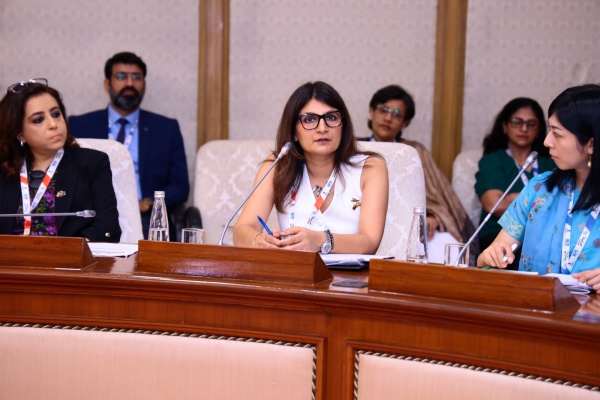
Jugnu Roy (pictured centre) representing ENZ at the SEPC roundtable on Global Academic Mobility.
ENZ’s Director of Engagement for India and East Asia, Jugnu Roy, joined panel discussions and roundtables on global academic mobility and faculty exchange. These sessions were a chance to share New Zealand’s approach to student-focused, future-ready education and explore new opportunities for partnerships with India.
Director of Engagement for India and East Asia, Jugnu Roy, said India is a key strategic partner for New Zealand’s international education sector, and that continued engagement is essential to strengthening that relationship.
“Participating in forums like this allows us to engage deeply on shared goals and support India’s ambitions through meaningful academic cooperation,” she said.
-
All Covid-19 requirements removed

Changes that take effect from Tuesday 15 August 2023
- Confirmed Covid-19 cases will no longer be legally required to self-isolate
- Masks will no longer be mandatory in any locations
This means that tertiary education providers can operate as normal, and set their own policies and procedures to ensure they meet their obligations to staff and learners, including under the Health and Safety at Work Act 2015, and the Education (Pastoral Care of Tertiary and International Learners) Code of Practice 2021.
Advice for tertiary providers and students
The Ministry of Education recommends that tertiary education providers follow COVID-19 health advice, and support staff and learners to do so.
Full COVID-19 health advice can be found at: Unite against COVID-19.
The Ministry of Education will also be updating advice for tertiary providers and students on the Te Mahau COVID-19 website following this announcement.
The latest health advice on COVID-19 includes:
- Stay at home if you are feeling unwell - if you, or someone in your household develops one or more of the following symptoms, you should take a Rapid Antigen Test (RAT) for COVID-19: a runny nose, sore throat, cough, fever, vomiting, diarrhoea, headache, loss of smell or taste, shortness of breath.
- If you have tested positive for COVID-19, it is recommended you isolate for 5 days, even if you only have mild symptoms, starting at Day 0, which is the day your symptoms started or when you tested positive, whichever came first.
- If you do need to leave your home during your 5-day isolation period, it is very important you take precautions to prevent spreading COVID-19 to others. You should wear a mask whenever you leave the house. You should not visit a healthcare facility (except to access medical care), an aged residential care facility, or have contact with anyone at risk of getting seriously unwell with COVID-19.
- If you are in isolation at the time of the setting change announcement, we recommend you continue isolating until you have completed 5 days. If you have already been isolating for 6 or 7 days, and are well, you can return to your normal activities.
- After completing 5 days isolation –
- If your symptoms have resolved and you feel well, you can return to your normal activities.
- If you still feel unwell, we recommend you stay home until you have recovered.
- We recommend you wear a mask if you need to visit a healthcare facility or an aged residential care facility, or you have contact with anyone at risk of getting seriously unwell with COVID-19 up until 10 days after your symptoms started or you tested positive. This is because some people are infectious for up to 10 days.
Mask wearing remains an important way we can prevent the spread of respiratory illnesses
Free masks are available for pick up with free rapid antigen tests (RATs) from participating collection sites.
RATs will remain free for everyone throughout 2023
You can find out participating pick-up points for RATs and masks at COVID-19 Testing • Healthpoint or by calling 0800 222 478 and choosing option 1.
The Government's media release can be found here.
-
Student Ambassadors build global citizenship skills
Since it was set up in 2021, the programme has involved around 85 secondary and 50 tertiary students in six participating regions – Northland, Auckland, Tauranga and Western Bay of Plenty, Hawkes Bay, Whanganui and Wellington. Northland acted as national coordinator.
“International students can sometimes find it difficult to connect with locals, make friends or venture outside their campus,” says Sahinde Pala, GM Sector Services at Education New Zealand Manapou ki te Ao (ENZ).
“Language and cultural barriers, hesitation to meet new people, lack of knowledge of opportunities off campus, or budget constraints – many factors can play a part. The emergence of Covid-19 and lockdowns made it even more important to address these challenges, and so we worked with a range of people, including regional partners and Welcoming Communities, to develop the student ambassador programme.”
The programme has developed differently in each region, but with the same shared goals. Another common factor has been the training provided for student ambassadors – the opportunity to complete a New Zealand Global Competence certificate, training in social media, and specially tailored training provided by ISANA NZ.
“Student ambassadors are bridgebuilders and leaders, who create opportunities for students from different cultures to form relationships and learn about each other,” Ms Pala says.
“The ambassadors themselves also gain from the programme, by developing their understanding of cultural differences and learning new skills and strategies that are valued by employers. And regional communities benefit when international students feel valued and connected – they are more likely to remain in the area or recommend it to others.”
The ISANA NZ Student Ambassador Training explores intercultural concepts in an interactive and engaging format that can be run online or in-person. Participants are then able to apply their learning to develop activities and events that help students to connect with the wider community. Debrief sessions towards the close of a programme cycle support students to reflect on what they have learned from being a student ambassador.
“I enjoyed learning about how communication works between different cultures, going over cultural values and how some are visible and invisible and learning top tips to help me improve as an ambassador” – student feedback.
“Our Northland student ambassadors joined the ISANA workshop as a group of excited students interested in global citizenship and finished as a tight knit group of inter-cultural leaders in the school community. They learnt to work together, giving everyone a chance to contribute and respecting each other’s perspectives. The communication and planning skills honed in the workshop, enabled them to run a large-scale ‘Matariki Kai Festival’ event, introducing a range of food from cultures across the school to the students.” – Jo Lees, National Ambassador Coordinator and Project Manager at Study Northland.
Other activities sparked by the programme in different parts of New Zealand have included a Kiwi Cooking Class, an Auckland Weekly video series, international languages week events and Matariki events organised and run by the ambassadors, diplomatic events attended by ambassadors from other countries and an International Students Issues Panel Discussion.
One of the student ambassadors was recently profiled by ENZ: Michael Ren – Award-winning app designer eyes a future in tech | Education New Zealand (enz.govt.nz)
Several regions have indicated they hope to continue their student ambassador programme beyond 2022: Northland, Tauranga and Hawke’s Bay.
“This student ambassador training is much needed, not only for the international education sector but also across wider communities in New Zealand. In fact, I think everyone could benefit from this training if they have not received similar training before in intercultural communications and leadership,” says Wenhua Yang, Regional Manager at Learning Hawkes Bay.
To learn more about the ISANA NZ Student Ambassador Training, please contact: caroline.stevenson@isana.nz
-
PMSA students flying the flag in Beijing
Students Jessica Clark and Samuel (Kiram) Choi are both currently on PMSA-funded exchanges to Renmin University in Beijing, China.
Recently, they organised a New Zealand stand at the university’s international cultural festival.
“It was such an incredible day – the weather was close to perfect with a slight breeze, beaming sun and minimal pollution,” says Jess.
“The day started at 7.00am when we set up the stall. Throughout the day there were many activities, food and photos. It was a great opportunity to hand out items from our New Zealand universities and teach people how to pass a rugby ball!”
Jess is completing a Bachelor of Management Studies at the University of Waikato and is currently studying at Renmin University’s world-renowned business school as well as undertaking an intensive Chinese language programme.
Samuel is at Renmin for 40 weeks studying Chinese law towards completing an LLB (hons) and Bachelor of Commerce conjoint at University of Auckland. He is the first student from the University of Auckland to be nominated to study at Renmin Law School as part of a newly developed exchange relationship between the two universities.
“Our scholarship students in Asia are ambassadors for New Zealand, helping raise the profile of our country and way of life in places where people may never have met another Kiwi,” says Peter Bull, Education New Zealand’s General Manager International.
“It’s great to see Jess and Samuel proudly representing New Zealand at Renmin University and perhaps planting a seed in the minds of a few Chinese students considering studying overseas.”
“Education relationships are two-way and having smart capable New Zealand students studying in China is very valuable in building capability for New Zealand's future.”
In true international student spirit, Jess and Samuel were joined on the stand by Hweiching Lim, a New Zealander studying towards a law degree at the University of Kent in England, who is also on exchange at Renmin University.
The Prime Minister’s Scholarships for Asia cover overseas study, research, or internships ranging from six weeks to two years at some of the best Asian institutions.
In three rounds of funding, just over 350 New Zealand students have been given the opportunity to further their studies in a different country and culture while building all important people-to-people networks with our trading partners.
Applications are now open for the March and September 2015 rounds of the PMSA. Visit the PMSA pages for further information and to find out about this year’s winners.

-
Engaging personally in Viet Nam
People generally seem tired of online meetings and webinars, preferring to meet and attend events in person. In recognition of this trend, Education New Zealand Manapou ki te Ao (ENZ) has actively engaged with different stakeholders in recent months, to maintain our in-market promotion and explore new opportunities for New Zealand providers.
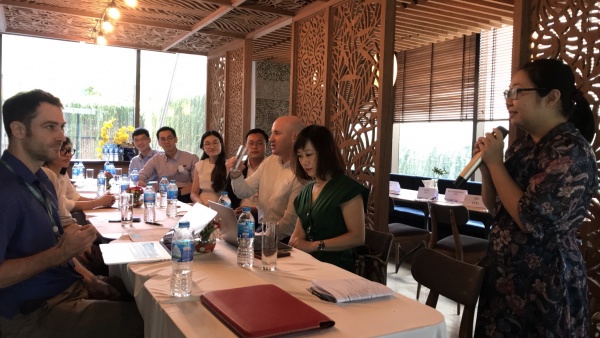
A workshop for counsellors from private and international schools to connect with recruitment representatives from NZ universities.
In late June, ENZ organised workshops to help connect recruitment representatives from New Zealand universities with selected counsellors from private and international schools in Ho Chi Minh City and Ha Noi. At the workshops, we asked about Vietnamese students’ current attitudes towards a New Zealand education, discussed the opportunities and challenges for each New Zealand provider, and identified any topics they wanted to explore further.
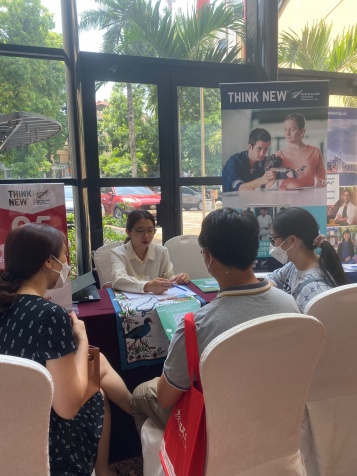 ENZ and in-market representatives of some New Zealand providers have also participated recently in commercial fairs, organised by key education agencies in Viet Nam. These fairs look and feel just like they did in the past, with multiple booths for institutions from various countries, and high numbers of students and parents coming to talk directly with recruitment staff.
 As New Zealand reopens the border for international students, it is critical we communicate directly with students and partners that we welcome students coming to study here. We are looking forward to the Hanoi and Ho Chi Minh City - Agent Seminar and New Zealand Fair in late October.
- Van Banh, ENZ’s market manager based in Ho Chi Minh City
-
IEGF recipient to enter Asian market
The product, called Bud-e Reading, was formally launched in Auckland on 14 April. It is the brainchild of education publisher Global Education Systems (GES), literacy expert Jill Eggleton and digital design studio Custard Square and introduces young children to read and write the most commonly used words, helping them develop confidence and positive attitudes to reading.
Education New Zealand’s grant has been used by Bud-e to sign up partner agreements in Asia, provide in-market training and pay for a social media and marketing strategy.
“The grant has been provided from the International Education Growth Fund (IEGF) as part of ENZ’s commitment to supporting businesses such as Bud-e Digital Limited, in developing new markets, products and services,” according to Business Development Manager Adele Bryant.
Bud-e features a free to download digital app and a series of picture books that introduce young readers to friendly little alien Bud-e who guides the reader through learning milestones using games and activities. That progress is captured and fed back to parents and teachers.
-
Campaigns go live
New marketing campaigns are launching in these key markets in April and May – the first major campaigns to use the ‘Think New’ brand.
Kathryn McCarrison, General Manager Marketing and Channel Development, says the campaigns aim to raise awareness about New Zealand and provide information to people interested in studying here to support their decision-making, and to capture contact details.
“Our research shows that New Zealand is close to halfway behind the awareness levels of key competitor countries: we’re just not top of mind when students overseas are considering their options.”
“So these campaigns have a dual focus: to continue to raise awareness of New Zealand as a place to study generally, and to build up a database of students actively considering New Zealand for introduction to institutions and/or agents.”
“The countries targeted are those identified by industry and in our market research as areas of significant potential growth in the near future.”
The China campaign launched on Friday 11 April, with India to follow after Easter and Japan in May.
“As well as being the first major campaigns to use ‘Think New’, they’re also the first trial of a partnership approach with key education agencies. These agencies will amplify the campaign messages through their own networks,” adds Kathryn McCarrison.
“While the campaign messaging will be sector-focused – universities in China, tertiary education in India, and English language schools in Japan – agencies will advise prospective students on New Zealand education as a whole.”
“Using such a targeted approach allows us to refine our campaign messaging tightly – to be sure we’re reaching people already considering studying in New Zealand with information relevant to their home country in order to generate high quality enquiries.”
“It’s a formula we’re trialling with a view to repeating it in other countries.”
For more information about the first campaign off the block, read this story about the ‘Think New’ China campaign.
You can see where it fits into New Zealand’s overall education marketing activities in China here.
-
SIEBA launches Schools Global Citizenship Pilot Programme
A network of 20 schools will take part, receiving professional advice and support to create, introduce and embed global citizenship strategies and initiatives across their schools.
SIEBA’s recent report on international business recovery for schools highlighted global citizenship education as one of three key areas expected to underpin business recovery and the future of international education, both within New Zealand and globally. The other two areas are sustainability/climate action, and growth in school-to-university pathways.
Global citizenship programmes contribute to a better international student experience, build understanding and support for international education, and enrich the value proposition that schools offer both domestic and international students.
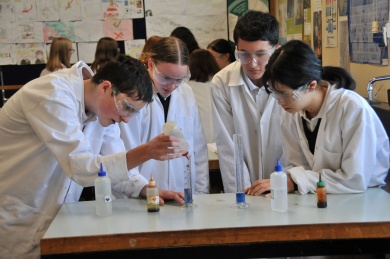
Image above: Japanese and Kiwi students discovering science together at Awatapu College in Palmerston North
“Global citizenship education (GCED) has the potential to bring local and international students together through a focus on global issues, and in development of global competencies. International students and parents are increasingly looking for schools that can demonstrably deliver GCED within the educational experience," the report says.
The pilot programme will be delivered in collaboration with the Centres of Asia-Pacific Excellence. The schools involved will draft Global Citizenship strategies linked to a range of programmes throughout the school, including learning content and teaching approaches, co-curricular programmes, professional learning and development, and student-led initiatives. They will examine how Te Tiriti o Waitangi and Te Ao Māori will underpin their global citizenship strategies. Schools will start local, this will be a multi-year journey, and the result will look different in every school.
Developing global citizens is also one of the overarching goals of the New Zealand International Education Strategy.
-
Insights for PTEs & ELS on how to better attract students from China
In June, participants from Private Training Establishments (PTEs) and English Language Schools (ELS) in New Zealand were invited by Education New Zealand Manapou ki te Ao (ENZ) and the North Asia Centre of Asia-Pacific Excellence (CAPE) to attend a workshop looking at opportunities in China. The workshop was called “"Navigating the new dynamics of Chinese overseas students seeking to study with PTEs and English Language Schools."
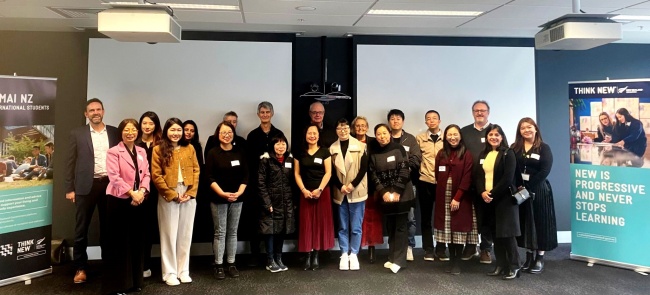
Participants from PTEs and ELS at the June workshop co-hosted by ENZ and North Asia CAPE.
Following the conclusion of the workshop, a report was commissioned by North Asia CAPE and facilitated by ENZ, with Shanghai-based market research company China Skinny conducting an in-depth exploration of key topics discussed during the event.
The report, ‘Insights for New Zealand’s English Language Schools and PTEs to better attract Chinese students’, was launched at an event at ENZ’s Auckland office in September with participants from PTEs and ELS. Mark Tanner, founder and managing director of China Skinny presented the report putting a focus on:
-
Building awareness of your institutions with your Chinese target audience.
-
Considerations for PTEs and English language schools.
-
Examples of how other institutions are marketing to their target audiences in China, with an accompanying checklist.
Richard Kensington, Principal of Academic Relations at UP Education, attended both the workshop and the report launch.
He said, “These initiatives by ENZ provided useful insights into Chinese students considering overseas vocational education, including some we were not previously aware of.
"It also reminded us of the significant potential in China’s vocational education market. We need to explore new, innovative ways to recruit students, rather than just relying on traditional methods,” continued Richard.
The report is based on insights drawn from a survey of 700 vocational and language school considerers and interviews with eight education agents in China. A copy of the full report can be found here - Insights for NZ's ELS & PTEs to better attract Chinese students.pdf
-
-
A taste of New Zealand
Kicking off on 20 May, proceedings got underway with an invitation-only event, hosted by New Zealand’s Ambassador to the Philippines, David Strachan.
ENZ engaged a number of successful New Zealand alumni for media interviews and delivered a keynote presentation to a highly engaged crowd at the Glorietta Mall, Makati City venue.

The ENZ booth was particularly busy over the three days. A number of prospective students came prepared with specific questions, with many focusing on postgraduate study options.
The Experience NZ event also coincided with the celebration of 50 years of diplomatic ties between New Zealand and the Philippines.
This event was the latest in a series of in-market ENZ activities in the Philippines. It followed a successful agent seminar in Manila earlier this year.
A second agent seminar is being held in Cebu on 14 July and is now open for registration.

