Search
Showing 10 of 7355 results
-
Education links with China
Lisa Futschek, General Manager, International, at Education New Zealand Manapou ki te Ao (ENZ) says the Joint Working Group has become an important mechanism for supporting educational cooperation and exchange with China.
“It’s a valuable opportunity for government agencies and education sector representatives from both countries to exchange ideas and information and build relationships.”.
This is the second time the Joint Working Group has been held virtually. Senior officials and subject matter experts from both New Zealand and China’s education and government sectors came together to discuss topics of mutual interest including higher education, early childhood education, vocational education and applied learning, and quality assurance.
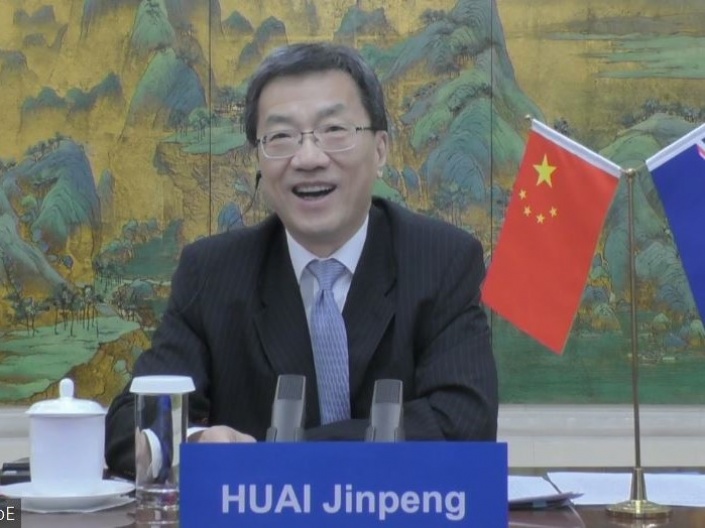
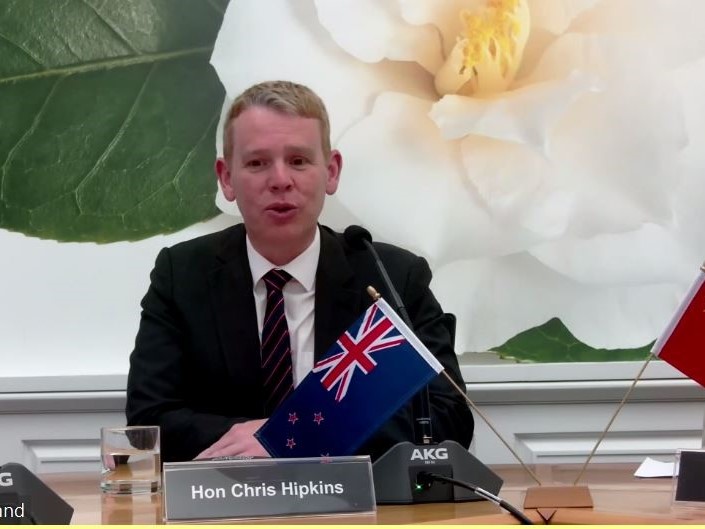
Jinpeng Huai, Minister of Education, People’s Republic of China and Hon Chris Hipkins, Minister of Education, New Zealand exchanged remarks at the Opening of the 10th Joint Working Group
The meeting saw the renewal of the Addendum to the New Zealand – China Arrangement on Cooperation in Education and Training, which covers a range of joint projects including the New Zealand-China Tripartite Partnership Programme. Note: the 2023 New Zealand-China Tripartite Fund is currently open for proposals from New Zealand university representatives.
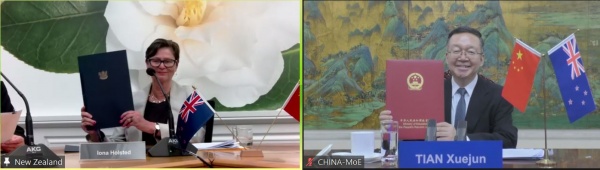
Secretary for Education and Chief Executive, Ministry of Education of New Zealand, Iona Holsted and Vice Minister, Ministry of Education of People’s Republic of China, Xuejun Tian, renewed the Addendum to the New Zealand – China Arrangement on Cooperation in Education and Training.
The meeting also provided an opportunity for New Zealand representatives to provide updates on collaboration with China in the areas of Vocational Education, Higher Education, and Quality Assurance.
David Christiansen, ITP Transition Lead, Te Pūkenga, shared the newly-launched International Strategy and the development of international collaboration and opportunities internationally and in particular with China.
“We wish to renew and strengthen our existing offshore collaborations and create new collaborations. New Zealand has many areas of strength, across a range of industries, where we believe we can offer value and strength to Chinese Industry,” Mr Christiansen said.
There are currently 41 degree or diploma joint programmes across more than 14 subjects from engineering and fashion to viticulture and winemaking, and agriculture. These partnerships cover 20-plus provinces and numerous cities throughout China.
The fifth New Zealand China Higher Education Forum, co-hosted by Universities New Zealand and China Education Association for International Exchange was held virtually on 10 November 2022 and was a discussion topic for the JWG during the Higher Education discussion. Chris Whelan, Chief Executive of Universities New Zealand, was present at the fourth New Zealand-China Higher Education Forum held in Beijing in 2015. He told participants that, back then, “the focus was on how to deepen collaboration between our institutions, how to grow mutual student mobility, and how to ensure high-quality education offerings.” It is evident the New Zealand-China education relationship in the higher education sector has developed over the years to envelop broader current topics such as “green and sustainable development of higher education,” building on the foundation established through years of cooperation.
The final discussion topic, Quality Assurance, saw Alex Bidois from New Zealand Qualifications Authority (NZQA) provide an update on the progress of the working group on the Recognition of Distance Learning Qualifications between NZQA and the China Service Centre for Scholarly Exchange. The working group was established at the ninth Joint Working Group and NZQA has been working with its partner agency to lay a foundation to build towards mutual recognition of distance learning qualifications.
-
PIF Recipient: Chasing Time English
Across the world, there is a vast market for English language learning. To put a number on it – around one billion learners. In many countries, though, English is taught through repetitive, mostly grammar-based content. The result is two-fold: students become disengaged and disinterested, and they advance in writing and reading skills at the expense of speaking skills.
Chasing Time English is a New Zealand company on a mission to make English language learning engaging, exciting, and effective for educators and students around the world. How? Through video. The team at Chasing Time English believe that English language classes should excite and inspire students to learn more, and decided video was the best medium to achieve this.

Chasing Time English uses engaging video story content to educate learners.
Through original, live-action-drama videos, Chasing Time English brings intrigue, humour, surprise and suspense into learning. Redrawing the line between education and entertainment, the short videos produced by Chasing Time English are designed to stand alone as quality entertainment, with strong learning outcomes embedded throughout.
To achieve this feat, the company brings together a team of English language educators, applied linguists and filmmaking professionals, who collaborate to create compelling, narrative-based drama content backed up by a cutting-edge pedagogy.
While other education publishers also produce English language learning video content, this is often lower quality video with limited learner appeal and retention. By creating professional quality drama content, Chasing Time English has become a market leader in English language video learning. Captivate learners, and the learning will follow.
Chasing Time English is one of the successful recipients of funding from the International Education Product Innovation Fund, a New Zealand Government-funded initiative to support pilot projects that reimagine and rethink what a New Zealand education experience can look like and mean for global learners. Education New Zealand Manapou ki te Ao (ENZ) is the government agency responsible for international education and is managing the Product Innovation Fund.
ENZ will work in a partnership approach with each successful recipient, sharing skills, expertise and resources to help each pilot succeed and develop into a self-sustaining education offering. The lessons learned through the pilot projects will be shared for the benefit of New Zealand’s entire international education sector, with a view to encouraging innovative, new offerings for international learners to experience a New Zealand education.
The Product Innovation Fund award will enable Chasing Time English to design, develop and deliver a new set of programmes for high beginner to elementary English language learners and educators. Target audiences include New Zealand education institutions with offshore partners, high schools in Japan and the Netherlands, and English language teachers at the post-beginner level.
Across two programmes of 10 weeks each, learners will be able to access up to 100 hours of engaging resources, including Chasing Time English’s distinctive video content, along with other audio and video resources and communication-based activities. The new set of programmes will incorporate a strong New Zealand theme, sharing New Zealand storytelling and themes of environmental sustainability and innovation. The original video content will also showcase New Zealand’s spectacular natural scenery, helping inspire learners and build a connection with New Zealand, wherever they are in the world.
With the support of ENZ through the Product Innovation Fund, Chasing Time English is set to continue growing its impressive offering for English language learners around the world. Already setting the bar for the quality of its learning resources and pedagogy, this Kiwi education provider is showing that online learning can be fun and effective, while also showcasing New Zealand’s landscapes, people and values to learners wherever they are.
More information:
-
Education New Zealand’s Brand Protect our most successful brand campaigns to date
Both campaigns exceeded previous ENZ results and were well above industry standards. These results, alongside the brand tracking research, have affirmed that global appetite for a New Zealand education remains high.
“We have learnt that our message resonates globally with people who are now seeing New Zealand in a whole new light,” ENZ Director Brand, Clayton Foster, says.
The second brand protect campaign – also known as Brand Protect 2.0 – ran from November to December 2020. It targeted the UK, Vietnam and Indonesia, and utilised the same video as the first campaign.
Brand Protect 2.0 reached 47 million people and achieved a high view through rate of 33.79 percent – or one in three viewers watched the video to a meaningful extent. The overall engagement rate was also high at 29.42 percent.
The first global brand campaign ran from July to August 2020. For a modest investment of $190,000 in Germany, Indonesia and Brazil, this campaign reached more than 30 million people across the three key markets and achieved an engagement rate of 22.35 percent. One in four people who came across this campaign watched the video to a meaningful extent.
The Brand Protect campaigns are a key part of the Recovery Plan’s third workstream, ‘Transforming to a more sustainable future state’. They leverage the positive global sentiment towards New Zealand to keep the dream of a New Zealand education alive in-market.
-
Connecting careers in Bay of Plenty and Waikato
This new online resource hub supports international secondary school students to pursue tertiary education and employment opportunities in the regions.
Secondary schools can use the tool to showcase the exciting range of opportunities in the students’ backyard. It encourages them to explore, plan, connect and succeed.
International students staying in the regions bring many benefits, including addressing skill shortages in key industries where skilled workers are in high demand, increased spending and promoting global citizenship and diversity.
Education Tauranga regional relationship manager Melissa Gillingham says providing a comprehensive international student journey plan is becoming increasingly important.
“This allows students and their parents to see the opportunities that exist in the regions, from the school sector, into the tertiary sector and through to employment,” she says.
“Excellent existing relationships across all education sectors within our region allowed us to hit the ground running, creating, delivering and promoting our international student journey plan. We would like to thank all our stakeholders for their support.”
Education Tauranga partnered with Education New Zealand Manapou ki te Ao, Te Waka and Rotorua NZ to help bring Career Connect to life.
-
SIEBA launches Schools Global Citizenship Pilot Programme
A network of 20 schools will take part, receiving professional advice and support to create, introduce and embed global citizenship strategies and initiatives across their schools.
SIEBA’s recent report on international business recovery for schools highlighted global citizenship education as one of three key areas expected to underpin business recovery and the future of international education, both within New Zealand and globally. The other two areas are sustainability/climate action, and growth in school-to-university pathways.
Global citizenship programmes contribute to a better international student experience, build understanding and support for international education, and enrich the value proposition that schools offer both domestic and international students.
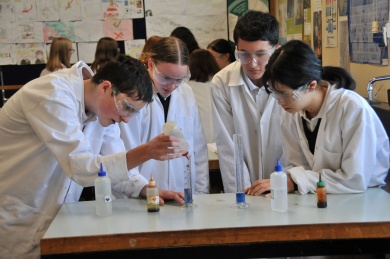
Image above: Japanese and Kiwi students discovering science together at Awatapu College in Palmerston North
“Global citizenship education (GCED) has the potential to bring local and international students together through a focus on global issues, and in development of global competencies. International students and parents are increasingly looking for schools that can demonstrably deliver GCED within the educational experience," the report says.
The pilot programme will be delivered in collaboration with the Centres of Asia-Pacific Excellence. The schools involved will draft Global Citizenship strategies linked to a range of programmes throughout the school, including learning content and teaching approaches, co-curricular programmes, professional learning and development, and student-led initiatives. They will examine how Te Tiriti o Waitangi and Te Ao Māori will underpin their global citizenship strategies. Schools will start local, this will be a multi-year journey, and the result will look different in every school.
Developing global citizens is also one of the overarching goals of the New Zealand International Education Strategy.
-
Funding available for science projects with leading Indian institution
A total of USD100,000 in seed funding is available for joint research projects with the Indian Institute of Technology Delhi (IIT Delhi), under a programme facilitated by Education New Zealand Manapou ki te Ao. Applications open on 1 February 2022 and close on 1 March 2022.
The funding is administered by the New Zealand Centre at IIT Delhi, which has been set up to help researchers to collaborate, host visiting scientists and act as a forum for diplomatic and trade dialogue.
A virtual summit in late 2021 organised by ENZ attracted more than 100 participants from IIT Delhi and all eight New Zealand universities to explore opportunities for collaboration.
The summit was led by the University of Auckland’s Director International, Brett Berquist and IIT Delhi’s Dean of Research and Development, Professor Naveen Garg. They were joined by the High Commissioners from both countries.
ENZ’s Country Manager for India, Jugnu Roy, says the New Zealand Centre at IIT Delhi is a major contribution to ENZ’s strategy for building New Zealand’s academic reputation internationally.
“Academic cooperation with a key market like India, helps to enhance New Zealand’s output of joint research projects with leading institutions.
“It is an opportunity to sustain and increase the visibility of New Zealand universities, as well as their connections and rankings.
“We are delighted at the way the virtual summit has kickstarted the research conversations,” she said.
The memorandum of understanding setting up the New Zealand Centre at IIT Delhi was signed between all eight New Zealand universities and IIT Delhi in February 2020. It is the second such research centre – the other is the New Zealand Centre at Peking University in Beijing, China.
Find out more about the New Zealand Centre @ IIT Delhi and seed funding applications. If you have questions, contact Sheree.Moanaroa@universitiesnz.ac.nz
-
Around the world in five
Australia
Scott Morrison prepares to let in over 200,000 students and skilled workers
Japan
Travel ban lifted but students could be a long time coming
United States
68% increase in new first-time international enrolments across the United States
Global
Agent views of Australia/New Zealand drop as United Kingdom, Canada and United States benefit
United Arab Emirates
-
Around the world in five
NEW ZEALAND
The global citizens helping connect New Zealand with the world
UNITED KINGDOM
Avoid transactional view of international HE, says guru
INDIAMore than half of Gen Z considering different career path in the wake of Covid-19
GLOBALConsolidation in English language travel: how Covid-19 has changed the market supply
GLOBAL
Global education has major role to play in climate change crisis
-
International students get behind Super Saturday vaccine drive
A group of students showed their concern and social responsibility by telling their stories to The New Zealand Herald ahead of the Super Saturday vaccination drive on 16 October 2021.
Education New Zealand Chief Executive Grant McPherson said it was great to see international students getting involved in the vaccination effort.
“New Zealand reaching its 90% vaccination target will aid in our recovery and bring us one step closer to welcoming more international students to Aotearoa,” he says.
“These are people who bring an array of benefits to community wellbeing, our global relationships, a productive workforce, a strong education system and enabling trade and diplomacy.”
-
Successful New Zealand – India Education Connect Initiative held in India
New Zealand – India Education Connect took place from 8 to 14 February, involving a high-level sector delegation made up of Vice Chancellors, Deputy Vice Chancellors, International Directors, academic heads, and regional recruitment staff from all eight New Zealand universities.
Led by Lisa Futschek, ENZ’s General Manager International, the delegation visited Bengaluru, Chennai, New Delhi, and Ahmedabad. During the visit, ENZ signed two Education Cooperation Arrangements (ECAs) and one Memorandum of Understanding (MoU), with the Higher Education Department, Government of Karnataka; Indian Institute of Management Ahmedabad (IIMA); and Gujarat International Finance Tech City (GIFT City) respectively. The ECAs and MoU provide a high-level umbrella arrangement for New Zealand universities to explore potential collaborations with each of the partners.
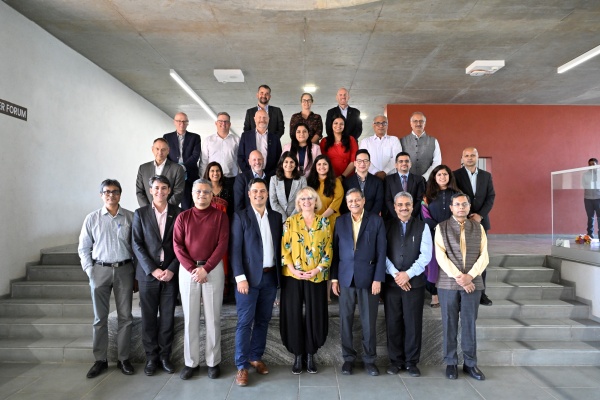
The New Zealand delegation with IIM Ahmedabad officials on 14 February.
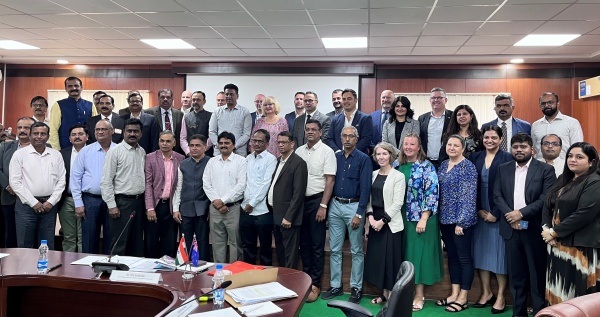
New Zealand universities delegation with Hon Dr. M C Sudhakar, Minister, Karnataka Higher Education Minister and officials of Karnataka Higher Education Council, Bengaluru on 8 February
Ms Futschek acknowledged the special relationship India and New Zealand have, noting that this year marks the 72nd anniversary of diplomatic relations between the two countries.
“India consistently holds the position of the second-largest international student market for New Zealand. The dynamic growth in the education partnerships between our two countries is attributed to strategic investments by universities, marked by heightened levels of internationalisation and strengthened commitments through the establishment of in-country representatives/offices by all eight.
“There is certainly much to be said for having power in numbers. Engaging as a group is a very good way to leverage connections with key government and private stakeholders that would otherwise be difficult on an individual institution basis,” said Ms Futschek.
The delegation visit to the New Zealand Centre at IIT Delhi (IITD) was one of the highlights of the programme as it facilitated discussions on resource mobilisation for long-term sustainability of the centre. The New Zealand Centre at IITD was established in February 2020 as a focal point for joint academic activity between New Zealand's eight universities and IITD. The centre is a research-focused hub that fosters collaborative, sustainable, self-supporting research programmes in areas of shared national interest such as climate change, disaster management, urban planning, and the environment. The first big engagement at the New Zealand Centre included 10 joint research projects between NZ universities and IITD academics in 2022. Subsequently, a fellowship programme with a joint funding of NZ$ 100,000 was announced in 2023, and as part of this programme four New Zealand Fellows will be spending time working with IITD in 2023/24 and two IITD Fellows with New Zealand universities.
Ms Futschek noted that the New Zealand Centre at IITD is a great example of how the cohesion between our eight universities and IITD has led to a flagship project growing in scale and sustainably.
“This success has all happened while building our reputation for quality education and a commitment to bilateral relations between our two countries,” added Ms Futschek.
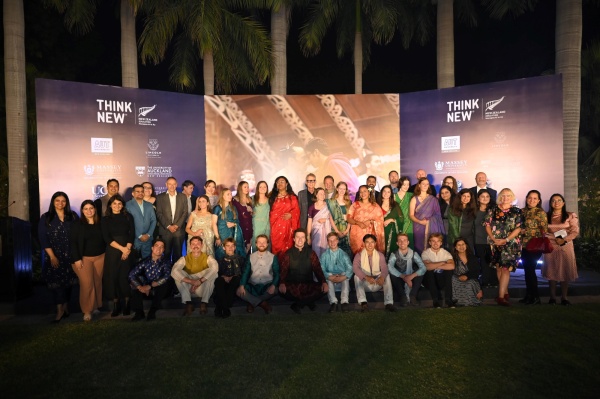
The networking reception organised by ENZ in Delhi during the ENZ Connect series, was attended by a group of 24 students from University of Auckland, University of Waikato, Massey University and Victoria University of Wellington, who were in India as part of the PMSA India immersion programme. They not only engaged with the ‘friends of NZ’ attendee, but also performed a Bollywood dance they had learnt during their six weeks in India, much to the delight of the audience.
Other activities conducted during the week included a media roundtable, led by H.E. Ambassador David Pine at the New Zealand High Commission in New Delhi. The roundtable reached over 984 million people with a PR value of over NZD 624,000, further increasing the brand awareness of New Zealand’s world class education across India.
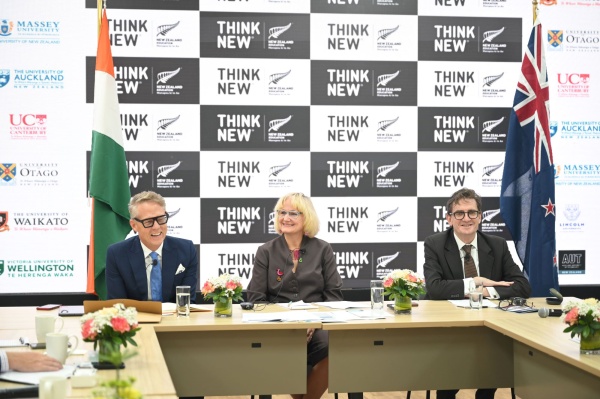
Media Roundtable at New Zealand High Commission in New Dehi, led by NZ High Commissioner to India, HE Mr David Pine, Lisa Futschek, GM International, ENZ and Brett Berquist, Assistant Vice-Chancellor Engagement University of Canterbury.
New Zealand universities also had a strong presence at QS India summit 2024, which coincided with the New Zealand – India Education Connect, helping delegates reflect their interest and achieve visibility in the Indian B2B space. ENZ was invited by QS to be a strategic partner at this summit.
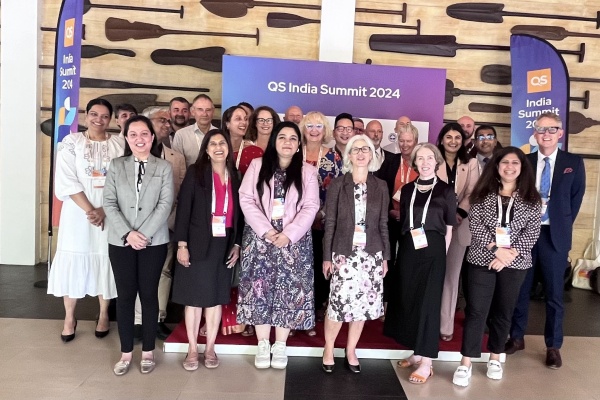
The delegation at the QS India Summit 2024.