Search
Showing 10 of 7355 results
-
Sister schools go from strength to strength
Tip
-
Sister-school relationships are a great way to connect on a personal level as well as a professional one
The sister-school agreement was officially signed back in 2015, and since then, the schools have alternated sending a cohort of students and staff to each campus.
Representatives from Chaotian Elementary School, including principal Kong Hong, visited New Zealand for the first time in 2016. During their visit to Owairoa Primary School, they discussed and compared educational philosophies, school management issues, teaching strategies, curriculum and cultural differences, as well as potential synergies and future co-operation between the schools.
Last month was Owairoa Primary School’s turn to travel to Guangzhou to share ideas with the principal and Board of Trustee members at Chaotian School. The Chaotian students were on hand to present musical numbers, martial arts, stories and art works for their guests – as well as drone acrobatics.
Principal of Owairoa Primary School, Alan McIntyre, said the Chaotian students were proud to perform for the Kiwi visitors, and were looking forward to having their turn to go abroad again.
“The Chaotian students couldn't contain themselves about the prospect of visiting us in New Zealand later this year – they were so excited.”
The visit also gave Alan an opportunity to try out principal Kong’s office chair for size, and the two talked about the possibility of a school principal exchange in future.
As part of the ongoing relationship, negotiations are currently underway to set up an Owairoa classroom at Chaotian school, and a Chaotian classroom at Owairoa school.

L-R: English Teacher/International Co-ordinator Sherry Xie, Principal Alan McIntyre, Principal Kong and Felix Ye, ENZ Education Manager Southern-Western China & Hong Kong.
However, Alan said the key to a strong sister-school dynamic is finding lighter moments in each visit to humanise their relationship.
“In New Zealand, we refer to a person by their first name and then surname, so in China where the names are reversed, we were addressing Principal Kong Hong as Principal Hong Kong!
“This cultural difference allowed us the cheeky opportunity to present her with a Miss Hong Kong sash and crown. The hilarity of the moment really helped cement our schools’ friendship and did so much for China–New Zealand relations,” said Alan.
-
- USA pic2
- NZregion Proposal
-
Smart waste management idea sees students take out top spot in KIWI Challenge Indonesia finals
The theme was “Reforming Indonesia’s mobility and smart cities using AI technology”. This year’s initiative hosted 59 teams from across 37 schools for a total of 269 student participants, the highest ever at the KIWI Challenge.
The groups were required to submit video entries to a judging panel made up of AUT academics and ENZ representatives, who reviewed the submissions and selected finalists. Participants received mentoring from a New Zealand university academic through the process and took part in workshops to refine their business plans. They were given a taste of New Zealand’s learning environment along the way and built an understanding of our tertiary education offering for future planning.
The participating academic was Dr Taghreed Hikmet from AUT, a Senior Lecturer in International Business, Strategy, and Entrepreneurship who has expertise in smart cities and is passionate about mentoring and inspiring young future leaders.
The finals were held on Saturday 25th November, where six shortlisted teams from across Indonesia presented their ideas to a panel of judges made up of Dr Hikmet (AUT), Ben Burrowes (ENZ’s Regional Director, Asia), and Indonesia Embassy staff (representing Ministry of Foreign Affairs and Trade), Hira Trisnoputri.
UniSadhuGuna International College took first place with their ‘Greenlight’ business idea, a smart waste management enterprise which aims to create a sustainable waste management system that actively involves households, businesses, and the government. UniSadhuGuna International College received a voucher worth 10,000,000 Indonesian Rupiah for winning the competition.
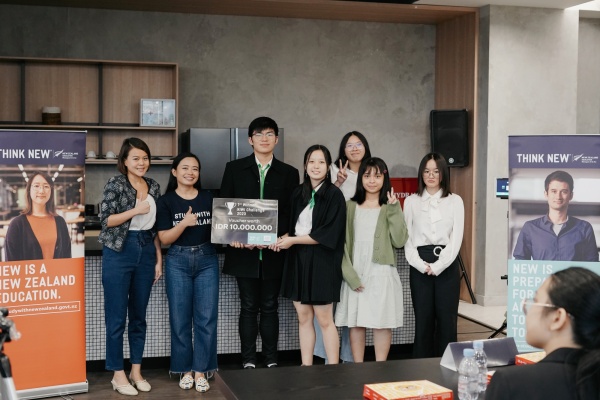
Winners! The team from UniSadhuGuna international College took out first place with their ‘Greenlight’ business idea.
Dr Hikmet reflected on the KIWI Challenge warmly. “It has been truly rewarding, observing the outstanding progress and growth in the finalists' projects, presentations, and overall confidence.
"It was a privilege to engage with high school students across Indonesia, contributing to the vibrant entrepreneurial spirit fostered by the competition. Excitement brews within me for the potential of future collaborations and initiatives,” Dr Hikmet concluded.
Following the finals, Ben Burrowes and Dr Taghreed Hikmet participated in an Instagram Live session with KOMPAS TV, the leading media network in Indonesia. This Instagram Live generated a total of 3.4k views and the highest number of people watching online was 348. You can watch the Instagram Live here: Part 1 and Part 2.
- eqsafety
- StuartRobinsonColombia
-
ENZ updates agents on future plans at ANZA
ANZA is held in New Zealand every three years with this year’s event held at SkyCity Auckland.
Almost 450 participants from 49 countries attended. Agents from China, India, Colombia, Brazil and Viet Nam were most heavily represented. A quarter of agents were taking part in their first ANZA workshop and many had not visited New Zealand before.

ENZ Manager Agents, Dan Smidt speaks at the workshop
“We talked about ENZ’s plans to increasingly engage with quality agents. We want to ensure that quality agents have available to them the most effective tools, resources and training they need to promote New Zealand as a high quality and welcoming international study destination.ENZ Manager Agents, Dan Smidt, said ENZ used the opportunity to give an update on ENZ’s plans for agent engagement.
“We discussed the upcoming re-launch of the Education New Zealand Recognised Agents (ENZRA) programme and the online agent training programme we are creating.
“We also talked about how the new MyStudy platform on the Study in New Zealand website can help agents to advise prospective students on study options in New Zealand.”
ENZ Business Development Manager, Jo Keane, said ENZ staff offered a range of other information, support and advice.
“One of our team ran a seminar on how agents and providers can grow their business profile on Facebook using the collateral and material on ENZ’s current social channels.
“We also ran a seminar focusing on the innovative ways that a number of New Zealand’s regions support agents and grow advocacy through the creation of outstanding student experiences.
Education New Zealand’s plenary presentation in the early evening was particularly well received.
“We talked about our current FutureProof campaign and showed our new FutureProof video, which people loved.
“We also gave an overview of the Student Wellbeing Strategy and the work being done to move from a good-to-great student experience.”
Following the conference, 11 familiarisation tours took place around New Zealand including to Taranaki and Christchurch.
ANZA will next be held in New Zealand in April 2021 at the new Christchurch Convention Centre.
-
Looking ahead to 2026 – What’s happening in our markets
We’ve highlighted ENZ-led in-market experiences that are underway for the first half of the year below, and we are also excited to provide you with provisional dates for in-market experiences that are planned for the second half of 2026, including New Zealand student fairs and agent seminars in Thailand, South Korea, China and Viet Nam (agent seminars only in Viet Nam and China).
Other targeted subsector in-market experiences will be developed around our flagship student fairs and agent seminars to maximise travel for visiting providers. These will be in ENZ's other focus markets in the region, including Japan, and will be delivered before or after the dates listed below. Further details will be shared in early 2026.
In the new year, we will invite providers to apply to participate in our in-market experiences. Please note that, given rising costs, we will likely need to review participation fees. Keep an eye on the ENZ website's events page at www.enz.govt.nz/events, and updates will be included in upcoming editions of E-News.
ENZ in-market experiences Subsector Dates Location Status ENZ Indonesia Roadshow Universities 30 Jan – 6 February 2026 Five cities, Indonesia Applications closed ENZ Philippines Roadshow ITP & PTE 18-25 February 2026 Manila, Pampanga & Davao,
PhilippinesApplications closed New Zealand Vocational Connect ITP & PTE 27 February 2026 New Delhi, India Applications now open ENZ Sri Lanka Roadshow ITP & PTE 5-8 March 2026 Colombo & Kandy, Sri Lanka Applications closed New Zealand Agent Seminars All sectors 23-27 March 2026 Shanghai, Guangzhou & Zhengzhou, China Applications now open (close 22 January 2026). More information contained in this edition of E-News ENZ USA Roadshow Universities 2 – 6 March 2026 Hawaii, USA Applications closed ENZ Malaysia Roadshow Universities 17-23 April Three cities, Malaysia Applications closed ENZ South America Roadshow English Language 14 – 27 May 2026 Chile, Brazil, Colombia Applications now open (close 30 January 2026) ENZ Philippines Roadshow PTE, ITP 18-22 June 2026 Cebu and Manila, Philippines Second round: applications open in March New Zealand Agent Seminar All sectors 24-26 August 2026 Ho Chi Minh & Hanoi, Viet Nam Applications to open late January New Zealand Agent Seminar All sectors 28 August 2026 – date tbc Bangkok, Thailand Applications to open late January New Zealand Student Fair All sectors 29 August 2026 – date tbc Bangkok, Thailand Applications to open late January New Zealand Student Fair All sectors 5 September 2026 – date tbc Seoul, South Korea Applications to open late January New Zealand Agent Seminar All sectors 4 September 2026 – date tbc Seoul, South Korea Applications to open late January New Zealand Agent Seminars All sectors November 2026 Locations TBC, China Applications to open in 2026 (timing to coincide with applications for CEE)
ENZ is also supporting New Zealand international education providers at third party events during 2026. These include:- APAIE 2026 in Hong Kong, 23-27 February
- The Forum of Education Abroad in Nashville, Tennessee, USA 11-13 March
- NAFSA 2026 in Orlando, USA, 26-29 May
- National Association for College Admission Counseling (NACAC) in Minneapolis, USA 8-10 October 2026
- China Education Exhibition (CEE) in Beijing, China 30-31 October
Applications are currently open for The Forum of Education Abroad, with applications for NACAC and CEE to open later in the year.
Finally, we are changing our events management process in 2026, including how we invite providers to participate in ENZ in-market experiences. Thank you for your patience while we make these changes.
If you need more information or would like to provide feedback, please email events@enz.govt.nz.
-
Student experience takes centre stage at NZIEC 2017
Delegates will gain insights from Study Auckland’s student experience transformation project, discover community support mechanisms to enhance your pastoral programmes and learn how to facilitate the successful education transitions of international students.
There are also sessions on how to foster collective leadership to encourage student wellbeing, how to challenge and motivate students, and how to equip yourself with teaching strategies to engage tertiary international students.
“We have the opportunity to deliver a unique and life-changing student experience in New Zealand,” says Hayley Shields, ENZ’s Student Experience Director.
“This year’s conference includes a broad range of sessions sharing best practice from around the country, and will be useful for institutions and regions seeking to enhance the experiences of international students throughout the student life cycle.”
This year’s conference also brings the voices of international students into the programme as never before. We will explore what current international students think about their New Zealand study experiences and learn from international student graduates about what worked and what didn’t as they transitioned to employment.
You’ll also find international students popping up throughout conference, including in Lian-Hong Brebner’s session ‘We just want to be included’.
Don’t forget to check out ISANA New Zealand’s breakout stream. ISANA have developed a comprehensive breakout programme with positive student experiences at the centre.
- NZIEC202445of47