Search
Showing 10 of 7355 results
- Japan School Award card
-
Replacement for China’s discontinued JSJ List announced
JSJ is the abbreviation in Chinese for ‘Website of Information on International Education Affairs Supervision and Management’ (Chinese Pinyin: Jiaoyu Shewai Jianguan Xinxiwang; Chinese Characters: 教育涉外监管信息网). Since 2003, this had been a key portal used by Chinese students and families to find information on overseas institutions. To be added to the JSJ list, providers had to apply to China’s MoE for approval but in late 2022, the JSJ List for all countries was removed from the JSJ Website. Education New Zealand Manapou ki te Ao (ENZ) has been informed that this list will not be returning.
A new list of international institutions was released in late 2023 on the Smart Education of China website (Chinese Pinyin: Guojia Zhihui Jiaoyu Gonggong Fuwu Pingtai; Chinese characters: 国家智慧教育公共服务平台). This is an official government website supplying standardised information and services on education to the public.
New Zealand institutions will appear on the new list if a student had a qualification from that institution successfully verified by the Chinese Service Centre for Scholarly Exchange (CSCSE), within the past five years. The CSCSE is the agency under China MoE mandated to provide verification of foreign qualifications. It should be noted that the CSCSE’s scope of services extends only to qualifications at the equivalent of Level 5 and above on the New Zealand Qualifications and Credentials Framework. This process is automatic, and institutions cannot apply to China MoE or CSCSE to be listed. A summary of the New Zealand Higher Education Institutions included on this CSCSE list (as of January 2024) can be found here.
Notably CSCSE has an existing list of overseas institutions which have issued qualifications that students have successfully verified through the agency. The information on the Smart Education of China website replicates this list. Any updates to the listed institutions will be made to both lists simultaneously. The CSCSE List is available (in Chinese) here - https://yxcx.cscse.edu.cn/rzyxmd?aisiteOutPageId=515a44d6f5774554a701ff1b20802c0b
If you have any questions in relation to the above that relate to qualification recognition, please contact the NZQA team at: internationalunit@nzqa.govt.nz
If you have any questions in relation to the above that relate to the China market, please contact ENZ’s China team – China@enz.govt.nz
-
International education delivers for New Zealand communities and visiting students
These are the key findings of two ENZ research projects to measure the student experience and the views New Zealanders hold towards international education.
Student experience in New Zealand
In the 2023 International Student Experience survey of 4,755 international students from more than 70 nationalities, 84 percent rated their overall experience positively, while another 83 percent said they would recommend New Zealand as a study destination.
Students were most positive about their personal development and outcomes, with 87 percent saying the experience helped encourage their curiosity and develop new ideas. Students were also very positive (88 percent) about the people and connections they made in New Zealand.
New Zealand was the first choice of study destination of 78 percent of respondents and 64 percent said their New Zealand experience had met or exceeded their expectations, which is consistent with previous research.
Commenting on the results, ENZ Student Experience Manager, Ross Crosson, said the results showed that New Zealand’s ability to deliver a quality education to international students had remained strong through the recent pandemic, and boded well for further recovery of the sector.
“The strong preference of students for New Zealand as a place where they can obtain a high-quality education while enjoying unique personal development really shone through in the student experience survey. It was heartening to hear about students growing their confidence because of their study experience in the country.
“We now want to make sure we’re using insights from the survey to inform our work – to ensure New Zealand continues to be the open, inclusive, and welcoming study destination it is known to be.”
ENZ’s Director Insights, Marie Clark, says the survey is a significant undertaking for ENZ and is an important resource for the international education sector.
"For one, it’s the only national survey of international students or indeed even students. We now have the beginnings of a valuable timeseries of data going back to 2019.
"It's important to be able to surface international student insights based on all sorts of variables, including country, sector or gender or a combination of these. We hope people working in the sector will find the sub-sector deep dives and Tableau dashboards particularly insightful resources,” she says.
The International Student Experience Survey 2023 Report is available here on IntelliLab.
Local benefits
In an ENZ survey of 1,100 New Zealanders conducted in December last year, 75 percent of respondents believe that international students benefit New Zealand.
The Ipsos Fast Facts survey, which drew responses from all regions of the country, saw 80 percent of respondents highlighting economic benefits, particularly in local communities, as a key reason for their positive view. Local and cultural contributions were also noted with 81 percent saying international students help local students learn about other cultures and ways of living, and contribute to New Zealand’s cultural diversity.
The results of the 2023 survey highlighted the continuing growth in support for international students and their positive impact on New Zealand since 2016 when only 57 percent believed international students helped the New Zealand economy and economic growth.
The proportion of New Zealanders who feel that international students make it harder for New Zealanders to get jobs also decreased from 34 percent in 2018 to 24 percent in 2023.
However, some respondents expressed concern that some international students use the New Zealand education system as a means to residency, while 32 percent felt New Zealand’s infrastructure in housing, transport and medical services is not well equipped to allow for international students.
Marie said the positive result from the domestic survey was also good news.
“International students have always been a significant contributor to regional economies. It is particularly pleasing that there is strong awareness and support of the cultural exchanges that happen when international students learn alongside New Zealand students and participate in our communities. While the research identified some challenges, the definite trend in awareness of the benefits international students bring to New Zealand is very positive for the future.”
- August 2018 student visa summary
- Around the world in 8
- 580 x 210
- AIS networking
-
From the CE: Successful start to packed promotions season
Kia ora koutou,
We are diving into the busiest and most energising time of year – promotions, recruitment, and global engagements are in full swing.
In late August, ENZ teamed up with around 65 New Zealand education providers to successfully deliver our flagship New Zealand education student fair and education agent seminar in Bangkok.
It was fantastic to see record attendance at the fair that offered prospective students and parents hands-on experience of New Zealand’s learner-centred teaching style through five simulated classrooms. Don’t miss the full story about the impact of our promotions in Thailand in this newsletter.
Earlier this month, I was pleased to represent New Zealand and support international education in Gothenburg, Sweden, at the EAIE: European Association for International Education Conference 2025, which is among the most important global gatherings for international educators, government agencies, and academic leaders.
The conference was a valuable opportunity for New Zealand education providers to connect with peers, promote our offerings, and build meaningful partnerships.
With all eight universities and UP Education exhibiting at the New Zealand pavilion, we packed the week with meetings, events, and brand-building — forging new partnerships and showcasing the strength of our education system.
In London, I joined a thought-provoking panel discussion on evolving student demand at the ICEF Monitor Global Summit. It was an insightful discussion that prompted some great questions from the audience about the opportunities and challenges in this area for New Zealand.
Preparations are now in full swing for our attendance at the China Annual Conference and Expo for International Education (CACIE), where New Zealand is proud to be Country of Honour for 2025.
The conference is a prime opportunity to highlight our education partnerships in China and reaffirm our commitment to future collaborations with China.
I look forward to sharing more about our planned conference engagements in my next update – stay tuned!
Ēhara tāku toa i te toa takatahi, engari he toa takitini
Our strength does not come from us alone but as a collective
Ngā mihi nui,
Amanda Malu
Chief Executive
- PUVC 2019 JAN FEB Programs
-
Indonesian events see strong interest from agents, students, NZ alumni, and scholarship applicants
In late January, Education New Zealand Manapou ki te Ao (ENZ) and all eight New Zealand universities joined forces to promote New Zealand's education offerings in Surabaya and Jakarta, Indonesia. The collaboration between ENZ and the universities aimed to strengthen ties with Indonesian education agencies, school counsellors, and alumni, fostering future partnerships and enhancing the visibility of New Zealand as a preferred destination for international education.
ENZ and the New Zealand universities organised a series of promotional activities in Surabaya on 24 January that saw participation from 11 agencies and school counsellors representing six schools. The promotional activities continued in Jakarta the next day, where representatives from 22 education agencies and 18 schools further demonstrated enthusiasm and interest in a New Zealand education. ENZ’s Regional Director for Asia (excluding China), Ben Burrowes and Market Manager (Indonesia and Malaysia), Naluri Bella, also had engagements with key agencies, such as Fortrust Education and SUN Education, across the two days.
Ben Burrowes said that the two events served to reconnect the universities with Indonesian agents and schools and proved an excellent opportunity for the institutions to showcase the diverse range of academic programmes available in New Zealand.
“The two events provided a platform for open discussion, idea exchanges and the exploration of potential partnerships that were focused not just on recruitment but also on building sustainable collaborations that would benefit both New Zealand institutions and Indonesian students seeking quality education abroad,” said Ben.
“A great example of such potential partnerships is how one school has already followed up saying they’d like to invite the universities back for a ‘New Zealand day’ event,
“These discussions come at an opportune time as ENZ continues to firm up its Indonesia strategy for the next financial year,” added Ben.
Following the university events, on 27 January, ENZ co-hosted a New Zealand Alumni Day with New Zealand Inc agencies. The event included information sessions on New Zealand scholarships, ranging from the New Zealand Manaaki scholarships and the Indonesian government scholarships such as LPDP (Indonesia’s Institute of Education Fund Management) and Indonesian International Student Mobility Awards (ISMA), attracting around 100 potential leads. This initiative aimed to guide and inspire prospective students in their pursuit of educational opportunities in New Zealand.
ENZ and NZ Inc also witnessed the launch of the New Zealand - Indonesia Alumni Association during the Alumni Day. The Association serves as a networking platform for connecting New Zealand alumni in Indonesia, fostering a supportive community and providing ongoing resources for professional and personal development. The event concluded with a networking dinner, providing a relaxed and informal setting for alumni to connect with each other and with representatives from New Zealand universities.

ENZ’s Naluri Bella moderating the alumni sharing session featuring alumni from different scholarship schemes at the New Zealand Alumni Day on 27 January 2024. From left to right: Nur Khaririyatun – Lincoln University, Master of Management of Agribusiness (Ministry of Agriculture scholarship), Alifia Sabila Putri – University of Canterbury (IISMA Scholarship), Moses Gregory Ginting – University of Auckland, Master of Energy (LPDP Scholarship).
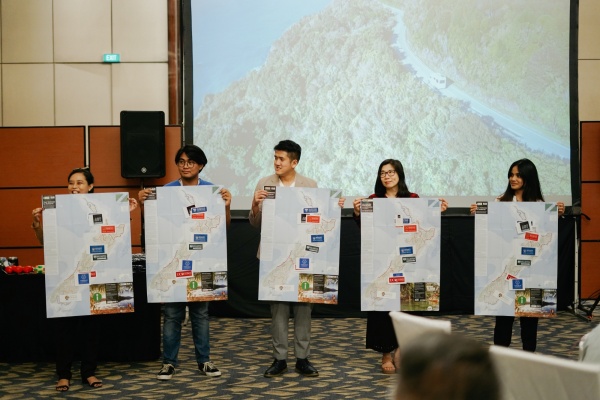
Agents in Jakarta engaged in interactive games to deepen their understanding of the beautiful and diverse landscapes and culture of Aotearoa New Zealand.

ENZ’s Ben Burrowes speaking at the New Zealand Alumni Day, highlighting the benefits of Study in New Zealand in front of the potential students.