Search
Showing 10 of 7355 results
- Delegation 2
-
Around the World in Five
INDIA
New Zealand sees 63 percent rise in first-time visas for Indian students
An industry-oriented curriculum and a focus on a supportive educational experience has triggered an increase in Indian students choosing to study in New Zealand.
NEW ZEALAND
Scholars to study traditional health system in India
A multi-disciplinary team of senior Rongoā Māori scholars, practitioners and members of the community will undertake a six-week indigenous health and entrepreneurship programme in India, supported by the Prime Minister’s Scholarships for Asia.
GLOBAL
The world’s changing language landscape
It’s never been more difficult - or more exciting - to choose which foreign language to study, as such a wide range are now important.
GLOBAL
International students want universities to be greener
Nearly all prospective international students looking to study in the United States, United Kingdom, Australia or Canada believe universities are not doing enough to be environmentally sustainable, according to new research.
ASIA
Asia outperforms continental Europe in top 500 universities for boosting student careers
In contrast to the QS World University Rankings, Asia’s top universities were shown to outperform continental Europe’s leading institutions.
-
Strengthening education partnerships in Japan
The visit was led by ENZ Group General Manager for International and Sector Engagement, Sahinde Pala, and Regional Director for Asia (excluding China), Ben Burrowes, who met with partners in Tokyo, Kyoto, and Sapporo to formalise agreements and discuss future initiatives.
Renewed commitment to education collaboration with Tokyo Metropolitan Board of Education
On 20 October, ENZ renewed its Education Cooperation Arrangement (ECA) with the Tokyo Metropolitan Board of Education. First signed in 2017, the arrangement underpins collaboration on inbound and outbound study programmes and initiatives that deepen understanding of New Zealand’s education system.
The renewal included a review of past activities and discussions on future areas of cooperation, ensuring the partnership continues to deliver meaningful outcomes for students and educators.
New arrangement with Ritsumeikan Academy
On 21 October, ENZ signed a new ECA with Ritsumeikan University and its affiliated schools. Ritsumeikan is recognised for its strong focus on global competence and has maintained a close relationship with New Zealand since 2000 through long-term and exchange programmes.
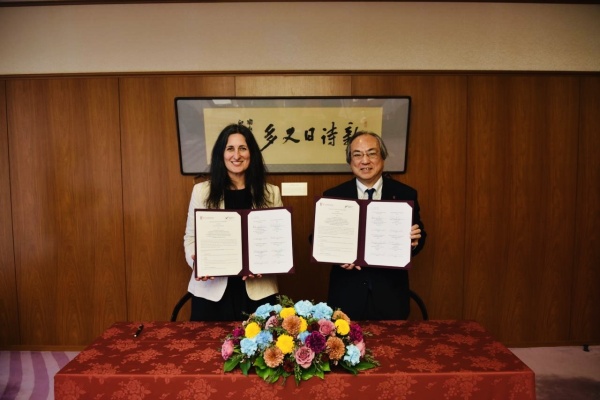
ENZ Group General Manager International & Sector Engagement, Sahinde Pala, alongside Chancellor, The Ritsumeikan Trust Presindent, Ritsumeikan University, Dr.Yoshio Nakatani.
The formalisation of this partnership builds on years of collaboration, including support for identifying partner schools and facilitating study tours. The new arrangement will strengthen opportunities for Japanese students to experience New Zealand education.
Reaffirming ties with Hokkaido Board of Education
On 22 October, ENZ met with the Hokkaido Board of Education to reaffirm a partnership that began in 2017 and was formalised through an ECA in 2020. Discussions focused on continuing reciprocal school exchanges, advancing digital learning in regional areas, and promoting cross-cultural understanding and global learning for students in both regions.
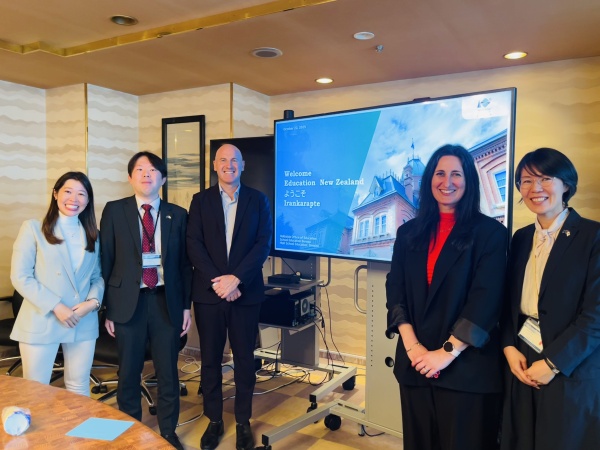
From L to R: ENZ Senior Market Development Manager Takako Tominaga, Chief Coordinator, Hokkaido Board of Education Yohei Kato, ENZ Regional Director Ben Burrowes, ENZ Group General Manager Sahinde Pala and International Exchange Section, High School Education Division, Bureau of school Education, Aoi Konagaya.
This engagement reflects ENZ’s commitment to sustaining and deepening educational exchange between Hokkaido and New Zealand.
Meeting with JAOS leadership
Also on 22 October, ENZ met with Mr. Sone, a Board Member of the Japan Association of Overseas Studies (JAOS), the peak body representing Japan’s study-abroad agencies. JAOS promotes ethical industry standards, provides counsellor training, and advocates for safe, high-quality study abroad options for Japanese students.
The discussion covered the strong reputation of New Zealand in the high school sector, emerging market dynamics, and evolving preferences among students and parents. Both sides explored opportunities for deeper collaboration with Japanese agents, including future initiatives to strengthen partnerships and enhance global learning experiences.
Looking ahead
The visit marked an important step in strengthening ENZ’s partnerships across Japan and reaffirming shared goals for international education.
Reflecting on the visit, Sahinde Pala said this visit shows ENZ’s commitment to building strong international partnerships.
“We are delighted to work with our Japanese partners to create more opportunities for students from both countries to gain global skills and for Japanese students to experience the quality of NZ's education system," she said.
-
Industry leaders gather for NZTech
The NZTech Advance Education Technology Summit, sponsored in part by ENZ, is an annual event designed to build New Zealand’s credentials as a hub of education technology. Last week at Massey University, it did just that.
Annabel Robertson, ENZ’s Business Development Manager, said common themes of creativity, collaboration, customer design and innovation emerged during the conference.
“The keynote speakers radiated optimism, and shared ideas on how to engage and prepare learners for the future,” said Annabel.
“The whole atmosphere was buoyant.”
Over two days, companies such as Banqer, Cognition Education, Code Avengers, DAQRI, Google, GlobalEd, Hapara, LearnCoach, Linewize and Wendy Pye Publishing shared their experiences, and explained how they are turning their ideas into viable global products and services.
Start-ups such as Accounting Pod, Savvy and ImmerseMe pitched to the diverse audience made up of e-learning facilitators, STEM leaders, policy makers, principals and teachers, exporters, investors and the interested public.
Annabel said Sue Suckling, Chair of NZQA, concluded the summit with a powerful challenge to New Zealanders to prepare now for the future education system.
“She encouraged educators and technologists to instigate change and not constrain their thinking to the existing regulatory framework,” said Annabel.
New Zealand's highly regarded education services and products offshore contributed $242 million to GDP in 2015 – with huge potential for growth in the education technology sector.
As part of the Leadership Statement for International Education, the Government set the goal of increasing its value to at least $500 million by 2025.
This was ENZ’s fifth year sponsoring the Ed Tech for Export stream of the conference.
-
Student wellbeing strategy launch
The new strategy aims to protect and enhance New Zealand’s reputation as a safe and welcoming study destination. It was officially launched at Ara on 13 June by Tertiary Education, Skills and Employment Minister Paul Goldsmith.
Hayley Shields, ENZ’s Director of Student Experience says the new strategy was the outcome of extensive consultation with the sector as well as with international students about what would make the most difference to them.
“Students that I spoke to at the launch were really pleased to see the new strategy, and to know that their wellbeing is considered so important for their student experience,” she said.
Ara Chief Executive Kay Giles together with Ara staff and international students, representatives of government agencies, Christchurch Educated, and the local community took part in the launch.
Development of the new strategy was led by the Ministry of Education.
Read the International Student Wellbeing Strategy.
Read Minister Goldsmith's announcement.
- Bid to host the Asia Pacific Association for International Education Conference and Exhibition 2021
- vietnam story pic
-
Ōtautahi Christchurch announced as host city for ICEF ANZA 2024

ICEF ANZA gives education providers from Aotearoa New Zealand and Australia the opportunity to meet with top international student recruitment agents from around the world who have a focus on these two study destinations.
Education New Zealand Manapou ki te Ao’s International Event Manager, Janine Huxford said that these conferences are such important events in our sector to bring everyone together and share industry insights, attend workshops and network with our international education peers from all over the world.
“We’re delighted that Ōtautahi Christchurch has been announced as the host city for the next ICEF ANZA conference in 2024. This is such a fantastic opportunity to shine a light on our new city and Aotearoa New Zealand as a study destination with world-class study options and unique travel and living abroad experiences", she added.
This in-person event will run from 22 – 24 April 2024 at the Te Pae Christchurch Convention Centre. You can register your interest for the event here: ICEF ANZA - education event focused on Australia and New Zealand
We look forward to seeing you there!
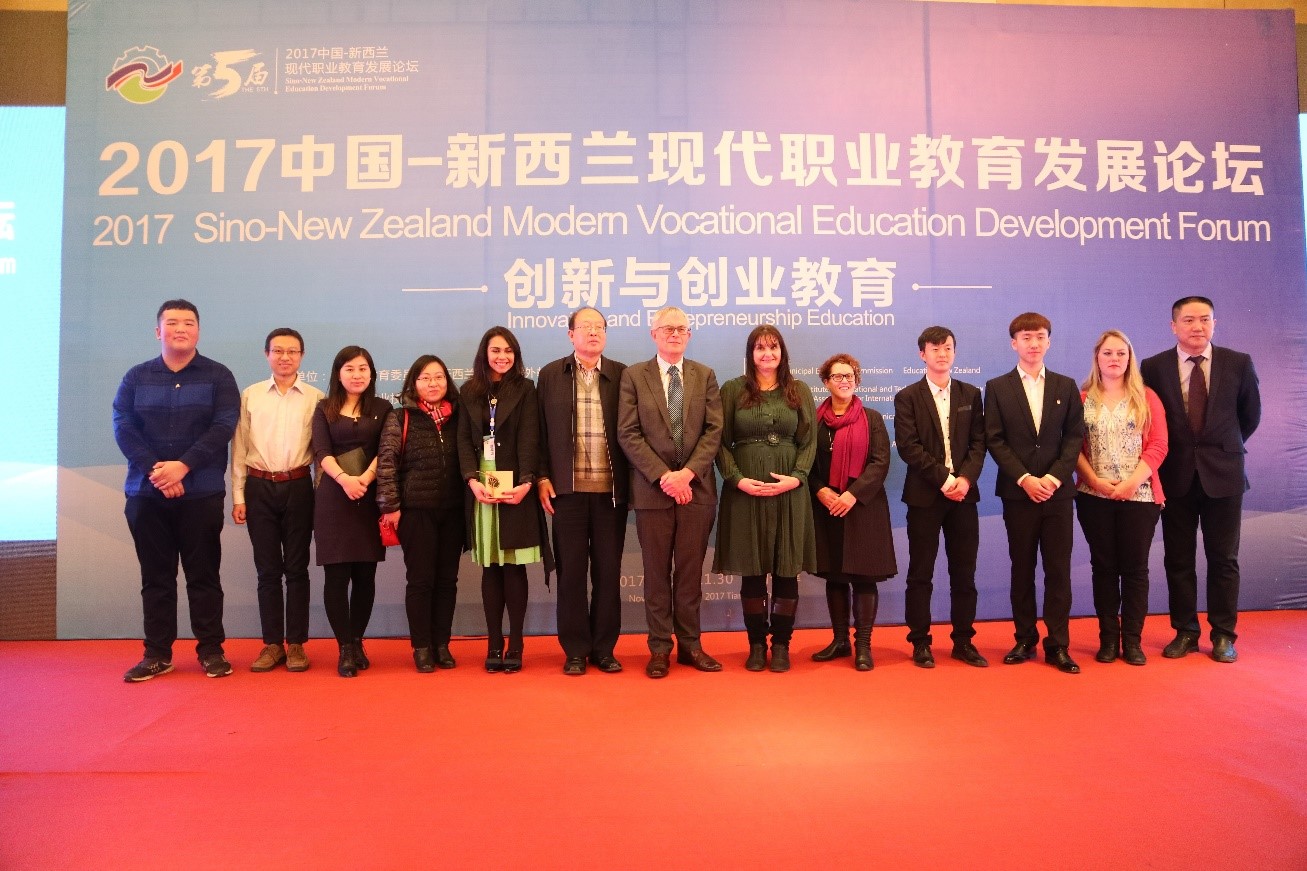
- China.vocational.forum
-
NZISA hits the road
Congratulations to NZISA for organising and delivering these four separate events to give international students a warm welcome to New Zealand. The events were also an opportunity for students to connect with each other in person, hear from inspiring speakers from international and migrant backgrounds, and network with a range of government and NGO organisations who work closely with international students.

The Roadshow also provided a moment to celebrate NZISA’s five-year anniversary and recognise five years of advocating on behalf of international students, raising issues and concerns with appropriate government agencies.
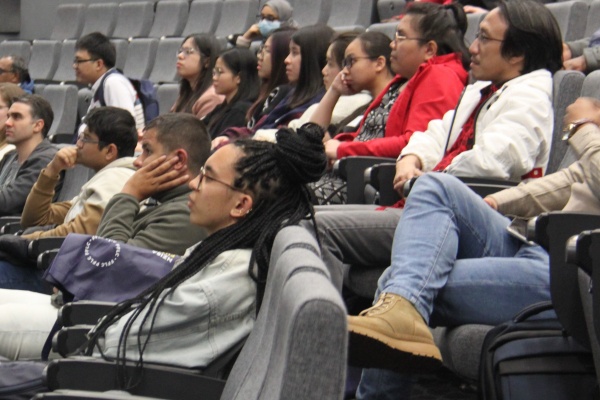
More than two hundred international students attended the events, which attracted very positive feedback. There was real appreciation for the kōrero of the guest speakers and the opportunity to connect with other students, especially from students who have just recently arrived in New Zealand.
“It was so inspiring to hear from the panellists how they were able to adapt and grow in new surroundings in a short time. I asked them about their motivation to work in New Zealand despite the cultural differences, and their answers really opened my eyes, as they mentioned that we can see challenges as a barrier, but instead look at them as opportunities to change and grow.” – Anis Aqeelah Afrina Mohd Raduan, who recently arrived in New Zealand to complete the final year of her Bachelor of Commerce at Te Victoria University of Wellington, majoring in Actuarial Science and Finance.
“It was so lovely to reconnect with past Presidents and executive members from NZISA and acknowledge just how far the association has come in five years,” says Sahinde Pala, General Manager Sector Services, Education New Zealand Manapou ki te Ao.
“Their hard work and commitment have given international students a voice with government agencies, ensuring the needs and concerns of international students studying with New Zealand are considered and addressed.”