Search
Showing 10 of 7355 results
-
Work with us
At Education New Zealand Manapou ki te Ao (ENZ), we’re a small, agile government agency with a big mission: to drive international student choice for New Zealand and support the international education sector to grow and thrive in a competitive global market.
We believe a New Zealand education transforms lives, builds lifelong connections, and equips learners with the skills to thrive in a connected world.
Supporting global learners
We connect with students from a wide range of countries, inviting them to study in New Zealand and bring new ideas, cultures, and perspectives that enrich our classrooms and communities.
We also proudly administer the Manaaki New Zealand Scholarships Programme – New Zealand’s largest investment in international scholarships, supporting scholars of eligible partner countries to access life-changing education experiences here in Aotearoa and the Pacific.
A truly global team
Our team spans 13 countries and 27 nationalities. We value diverse perspectives and know they make us stronger, more creative, and more impactful.
Work that matters
As a small agency, you’ll collaborate across all levels and teams. You’ll contribute to meaningful projects, shape ideas, and see the impact of your work.
A flexible, creative environment
We work in a dynamic, supportive setting where creativity is encouraged, personal growth is valued, and your voice matters.
If you're curious, passionate, and ready to help shape the future of international education, check out our current roles. We’d love to hear from you.
Our employee offerings
At ENZ, we believe that our people are the heart of everything we do. We know that to do great work, you need to feel supported in all areas of your life. That’s why we provide a variety of offerings to help you achieve balance, stay healthy and continue growing personally and professionally.
- gosocial2
-
Funding available for science projects with leading Indian institution
A total of USD100,000 in seed funding is available for joint research projects with the Indian Institute of Technology Delhi (IIT Delhi), under a programme facilitated by Education New Zealand Manapou ki te Ao. Applications open on 1 February 2022 and close on 1 March 2022.
The funding is administered by the New Zealand Centre at IIT Delhi, which has been set up to help researchers to collaborate, host visiting scientists and act as a forum for diplomatic and trade dialogue.
A virtual summit in late 2021 organised by ENZ attracted more than 100 participants from IIT Delhi and all eight New Zealand universities to explore opportunities for collaboration.
The summit was led by the University of Auckland’s Director International, Brett Berquist and IIT Delhi’s Dean of Research and Development, Professor Naveen Garg. They were joined by the High Commissioners from both countries.
ENZ’s Country Manager for India, Jugnu Roy, says the New Zealand Centre at IIT Delhi is a major contribution to ENZ’s strategy for building New Zealand’s academic reputation internationally.
“Academic cooperation with a key market like India, helps to enhance New Zealand’s output of joint research projects with leading institutions.
“It is an opportunity to sustain and increase the visibility of New Zealand universities, as well as their connections and rankings.
“We are delighted at the way the virtual summit has kickstarted the research conversations,” she said.
The memorandum of understanding setting up the New Zealand Centre at IIT Delhi was signed between all eight New Zealand universities and IIT Delhi in February 2020. It is the second such research centre – the other is the New Zealand Centre at Peking University in Beijing, China.
Find out more about the New Zealand Centre @ IIT Delhi and seed funding applications. If you have questions, contact Sheree.Moanaroa@universitiesnz.ac.nz
- Hugh Holland 1
- TRanslations
-
Prime Minister's Scholarship shakes up geology student's plans
Soltice Morrison was only 15 when that earthquake happened, but she is part of a new generation of students and researchers wanting to equip themselves with the latest knowledge and technology to better understand New Zealand’s vulnerability to quakes. The best way to achieve this is through international collaboration with other countries which face the same risks.
Having already completed a BSc in Geology and Oceanography from Otago University, Rotorua-born Soltice secured a Prime Minister’s Scholarship for Asia during her Honours year in 2018, which allowed her to enrol in a post-graduate short course in geology at Hokkaido University in Japan and stay on to complete most of her Honours research.
Prime Minister’s Scholarship allowed joint research
Under the guidance of her supervisor, Dr Virginia Toy, she was involved in a project which studied the characteristics and behaviours of New Zealand’s Alpine Fault and Japan’s Median Tectonic Line to better understand what causes earthquakes in both countries.
"We’re both very seismically active countries but Japan is much more advanced in its use of technology. We were able to bring some of that knowledge back to New Zealand."
Soltice says that without the funding she received through the Prime Minister’s Scholarship (PMS), she would not have been able to study abroad.
The scholarship programme to Asia was established in 2013 and extended to Latin America in 2016. To date, 2400 students have been given financial support to study abroad. While currently on hold due to Covid travel restrictions, the programme is poised to restart once borders reopen.
Importance of New Zealanders studying abroad
Funded by the government and administered by Education New Zealand, the programme recognizes the importance of giving New Zealanders the opportunity to have an international education experience in countries where we have key trade and business relationships.
There are few restrictions on study options, with the programme having broad goals to enhance understanding of other cultures and business practices; establish new friendships and networks; and upskill the New Zealand workforce through overseas experience.
“It’s very important to connect with students and colleagues internationally in order to get ahead,” says Soltice. “We can get caught up thinking that the New Zealand way is the only way. Studying overseas helps you broaden your horizons, your knowledge, your understanding of different cultures, and the way things can be done.”
In geophysics, Soltice says international collaboration is essential.
“We’re able to learn a lot from Japan and the advances they have made in technology and monitoring.”
The time Soltice spent in Japan ended up taking her career in a new direction. “While I was there, I was able to understand the effects of seismic activity on buildings and how we can strengthen our cities to ensure they’re resilient, so I’ve ended up in the engineering space working for Aurecon.”
But her work also has an environmental focus and she is currently part of the multi-disciplinary team working on the Lakes 380 project, which seeks to combine best scientific thinking with mātauranga Māori (traditional wisdom and knowledge) to better understand the social, cultural, and environmental history of Aotearoa’s lakes. “It’s rewarding work and I love it.”
Reawakening of cultural identity
Soltice says her time in Japan prompted a reawakening of her own cultural identity. “I had always tried to blend in at home, but the questions I was asked about my background while I was away made me realise I was proud of my Māori ethnicity and also taught me the value of indigenous knowledge.”
Building on this confidence, she has set up a Māori strategy group with colleagues at Aurecon “looking at ways we can weave cultural understanding with scientific knowledge into the work we do.”
Soltice says she made life-long friends during her time in Japan and built a valuable network of contacts. “I work closely with the geophysicists here at Aurecon and sometimes when we have questions, I will reach out to my contacts offshore.”
Three years on, she remains a passionate advocate for Prime Minister’s Scholarship programme. “The overall experience – the research, the culture, the living situation, I would 100 percent say it was one of the best times of my life.”
Students value flexibility, networks, and personal growth
The positivity of Soltice’s experience was echoed by other scholarship recipients in a recent survey conducted by Education New Zealand. Close to 300 students participated, with 98 percent saying they would recommend PMS to others. Benefits they identified included the unique flexibility of the programme, the networks they built, the opportunity for personal and professional growth, and the chance to better understand New Zealand’s place in the world.
As for life after the programme, 57 percent said they would become involved in global causes, 50 percent would become involved in political or policy issues, and 44 percent would become involved in their local community or iwi.
- A3 infographic 2015 V2
-
New Zealand tops English-speaking countries in Educating for the Future ranking
 There were just 1.6 points between top-ranked Finland (80.9), second place-getter Switzerland (80.3) and New Zealand on 79.3 points.
The overall ranking was a small drop for New Zealand, which ranked first out of 35 economies in the first EIU report which came out in September 2017. However, the 2018 ranking involves 50 economies and additional indicators on which countries were evaluated.
"This is a very good result for New Zealand," said ENZ Chief Executive Grant McPherson.
"New Zealand retains its position as the number one English-speaking country in the ranking as well as its top ranking in the Asia-Pacific region.
"Along with Finland, New Zealand is the only country that has been in the top 3 two years in a row."
The index evaluates the way that countries approach future-focused education to encompass problem-based learning, innovative teaching methods and broader themes of global citizenship.
It has a focus on young people aged 15 to 24 in 50 economies, and measures three pillars of education systems – policy approaches, teaching conditions and broader gauges of societal freedom and openness – as a means of preparing young people to meet the challenges of work and society in future.
You can read the full report here.
The top 10 country rankings were:
Rank
Economy
Score
1
Finland
80.9
2
Switzerland
80.3
3
New Zealand
79.3
4
Sweden
78.1
5
Canada
77.9
6
Netherlands
76
7 =
Germany
74.8
7 =
Singapore
74.8
9
France
74.2
10
UK
74.1
-
Minister congratulates education community on 2015 results
 Mr Joyce made the comments in his media release issued this week about the 2015 International Education Snapshot Report.
 New Zealand’s international education industry grew to 125,011 international student enrolments in 2015.This is an overall increase of 14,748 enrolments and every region experienced growth.
“New Zealand is increasingly being recognised for the excellent education and study experiences it delivers to both local and international students,” Mr Joyce said.
“The benefits of international education extend well beyond the economic contribution to the economy. Young New Zealanders live and learn alongside people from other countries, increasing their understanding of other cultures and boosting our links with the world. These links are vital for us to prosper in an increasingly Asia-Pacific world,” says Mr Joyce.
Tuition fee income received from international education reached $1 billion for the first time in 2015. Fee income reached $1.029 billion, a 17 per cent increase ($146 million) on 2014. Statistics New Zealand recorded the value of education exports as $3.1 Billion for the year to March 2016.
The fastest growing markets for New Zealand education in 2015 were India with a 45 per cent increase in international student enrolments (9,013), China up 13 per cent (3,881), and the Philippines up 83 per cent (1,648).
“While most of this growth has been good for New Zealand, it is important to ensure that all student recruitment in fast-growing markets like India is done within the rules and regulations that New Zealand sets. The new Code of Practice for Pastoral Care of International Students that came into force last Friday makes it clear that all New Zealand tertiary providers are responsible for the activities of their agents,” says Mr Joyce
Auckland continues to be the largest region for international student enrolments with 63 per cent of enrolments, similar to 2014. Canterbury has 8.4 per cent of enrolments (an increase in enrolments of 13 per cent to 10,547), and Wellington has 5.9 per cent (an increase of 9 per cent to 7,456) of international student enrolments.
Education providers also welcomed more students in Nelson/Tasman (21 per cent growth), Bay of Plenty (22 per cent), Southland (18 per cent), Waikato (7 per cent), Northland (6 per cent) and Hawke’s Bay (4 per cent).
“It is important that regional New Zealand shares fully in the growth of our international education sector and it’s great to see strong growth in many regions. Education New Zealand will continue to develop their new Regional Partnership Programme to promote the benefits of studying in each regions,” says Mr Joyce.
The International Education Snapshot: 2015 full year report is available here.
The Student Visa Dashboard to May figures are available here.
-
Introducing Monika Chaudhary, ENZ’s new Market Manager – Sri Lanka
Tell us about your professional background
I am based at the New Zealand High Commission in New Delhi, India, and work closely with education providers, key education sector and government stakeholders to grow New Zealand’s education presence in Sri Lanka.
I completed my Master of Arts in Social Work from the Tata Institute of Social Sciences (TISS), Mumbai, and worked in Project Manager roles across various community and not-for-profit organisations before transitioning into the international education space.
I joined New Zealand Trade and Enterprise (NZTE) in 2003 as an Education Marketing Executive based in New Delhi, a role that began what is now over 22 years of close and enduring involvement with New Zealand’s higher education sector. These two decades have shaped me deeply as both a professional and a person, and I’ve had the privilege of witnessing the sector evolve significantly.
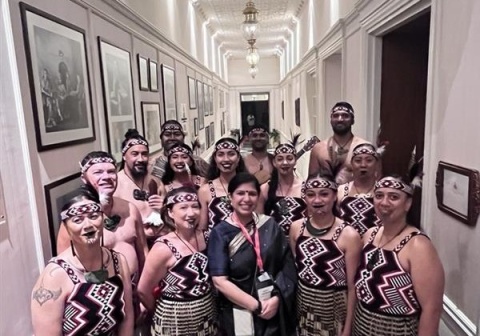
Monika (centre) with the kapa haka group that supported the Prime Minister’s trade mission to India in 2025I joined ENZ in 2015 as Market Development Manager for India, playing a key role in growing the New Zealand university sub sector through targeted strategic initiatives. Over a decade working across India, I have also supported education agents and contributed to the development of other education sub sectors.
How has the new role been so far?
I’m really enjoying the opportunity to help grow a new market for New Zealand in Sri Lanka. The recent Study with New Zealand Roadshow was a fantastic way to kick start our work in market. Across four days and seven events, we brought together 19 New Zealand education providers and connected with Sri Lankan universities, education agents, schools, and students.
It was a huge effort, but a very rewarding start to our market-building journey.
What opportunities and challenges do you see in Sri Lanka?
Beyond student mobility, there is strong potential for Transnational Education (TNE) partnerships. Sri Lankan education institutions are increasingly interested in offering New Zealand programmes locally while creating pathways for students to continue their studies in New Zealand.
While Australia and the UK already have a strong presence in this space, New Zealand has a great opportunity to build visibility, showcase the quality of its education, and develop accessible pathway models for Sri Lankan students. Upskilling education agents will also be key to supporting sustainable growth in the market.
What will the new Project Advisor – Sri Lanka role focus on?
I am delighted that Madonna Phillip has joined us as Project Advisor on a fixed-term basis. She hit the ground running, starting in the same week as the Sri Lanka Roadshow. She will support the expansion of ENZ’s promotional activities in Sri Lanka and work closely with New Zealand government agency partners on cross-agency initiatives, including the development of an alumni network and broader collaborative programmes.
Outside of work, what do you like to do?
I enjoy challenging myself beyond my comfort zone. While I like to travel within and outside India, the pandemic had me discover new interests, including baking, painting and photography. More recently, I have also taken up gardening. But above all, dancing is something that comes naturally to me – and it’s what I enjoy the most!