Search
Showing 10 of 7355 results
- KNZFTA20MOA20signing20photo
- Vietnam 4
- Freyberg High 3
-
Brazilian students look to New Zealand tertiary studies
Organised by Brazil agent FPP Edu-Media, ENZ attended the high school tour to introduce Brazilian students to the tertiary possibilities in New Zealand, particularly undergraduate qualifications.
The last BELTA SEAL Survey from March 2018 shows that 30% of the Brazilians who studied overseas in 2017 were in the 18 to 21 age group, and that their main motivation for international education is to stand out professionally.
Daniela Ronchetti, Director of Operations at FPP Edu-Media, says while short-term programmes have typically been the most popular overseas study for Brazilian students, there's a growing interest in undertaking full degrees overseas.
“Many of these students, fluent in English and with experience of overseas study via summer courses at a young age, are comfortable enrolling in international universities.
“With interest in the US and UK declining, Brazilian students are looking closer at New Zealand, Australia and Canada when considering a full degree abroad.”
Ana Azevedo, ENZ’s Senior Market Development Manager for Brazil, visited eight international secondary schools, from small boutique schools with 15 students per class to large education groups with thousands of students, which are all investing in pathways to international tertiary education.

ENZ’s Ana Azevedo with Marilda Bardal, International Relations Coordinator at International School Alphaville.
“These schools typically offer bilingual education, IB (International Baccalaureate) or the American diploma and academic counselling, so that by the time students complete high school, they are prepared for an international experience,” said Ana.
Also in attendance were government education organisations and universities from the US, Canada, Australia, France, Germany, the Netherlands and the UK – but Ana said New Zealand had an edge.
“It was a great experience to stand among our competitors at the opening of each event and present New Zealand as the country that best prepares students for the future – not an easy ranking to beat!”
“There is still work to be done on raising awareness of all that New Zealand has to offer to Brazilian students, particularly in tertiary education. It is a significant investment for a family so we need to be clear about the return of this investment.
“Showing students the variety of programmes they can find in New Zealand, the cultural diversity and welcoming environment – very few countries offer this combination. It is a full package!”
-
Brazil’s untapped potential
Brazil is New Zealand’s largest source of international students in Latin America. Last year, almost 3,600 Brazilians studied in New Zealand and Ana Azevedo, ENZ’s Senior Market Development Manager for Brazil, says there is more room for growth.
“For institutions seeking quality students and diversity, Brazil may be the answer. According to the Brazilian Educational and Language Travel Association, more than 300,000 Brazilians studied abroad in 2017, so there is huge untapped potential in this market to be explored,” said Ana.
As country of honour, Brazil featured in two NZIEC breakout sessions.
In From Zero to Hero: How to lead a successful education strategy in Latin America Professor Kerry Taylor from Massey University shared his experience in developing links with Brazilian universities, jumping from zero to 10 agreements in only three years. Taylor emphasised that “nothing substantial will come from one single visit” and highlighted the importance of a proposition that meets your partner institution’s needs, saying “the best relations are mutually beneficial.”
The second session, Spotlight on Brazil: Finding your place in the sun, featured a panel of representatives from New Zealand secondary and tertiary institutions about their own success in the Brazilian market. Key recommendations included maintaining a consistent presence with the market, building and maintaining a personal relationship with local education agents and institutions and investing in digital marketing so Brazilian students can find you – Brazilians spend an average of three hours a day on social media platforms, mainly YouTube, Facebook and WhatsApp.
Delegates also enjoyed delicious Brazilian appetizers, drinks and live Brazilian music at an energetic conference dinner. The Brazilian Ambassador to New Zealand, HE Mr Paulo Cesar de Camargo, also attended and spoke about bilateral relations between our countries in the education space.
"Education is a very important aspect of the relationship between Brazil and New Zealand. As some 3,600 Brazilians choose New Zealand to study, we have also seen a growing interest in Kiwi students travelling to Brazil. This exchange builds foundations and pushes Brazil-New Zealand partnerships closer, and in future will create ties in various other fields.”
If you want to know more about the Brazilian market, check out the BELTA SEAL Market Survey 2018 here.


- Webinar card
- Womens20weekly
-
Aotearoa sharpens Sherpa’s ambitions on conservation in Nepal
The Everest region of Nepal is his home, and he has seen first-hand the impact of climbers and climate change on the world’s most famous mountain environment.
The former international student to New Zealand is a columnist in the Kathmandu Post, readily highlighting successes and calling out failures on a range of environmental issues impacting Nepal. He is part of a generation determined to find solutions.
Tsewang recently completed his Master’s in Environmental Management at Lincoln University, an international education experience made possible by the Mingma Norbu Sherpa Memorial Scholarship. Mingma was an early graduate of Sir Edmund Hillary’s Khumjung School, an alumnus of Lincoln University, and one of the leading voices on conservation in Nepal and Bhutan through his work with World Wildlife Fund (WWF) before his untimely death in 2006.
His legacy is a scholarship jointly funded by WWF, Lincoln University, and the Greater Himalayas Foundation which supports students from remote regions of Nepal committed to careers in conservation to study at Lincoln.
Tsewang says the links with New Zealand which date back to the work of Sir Edmund Hillary, and his belief in the importance of education for future generations, are a driver for many Nepalese students seeking to improve their opportunities in life.
“The connection is very strong,” he says. “Sir Ed Hillary is such an icon and I feel that the students who come to New Zealand to study are continuing to strengthen the relationship established by Sir Ed and Mingma”.
Fulfilling the dream of a New Zealand education
“The scholarship allows you to fulfil a vision of having a higher education in New Zealand, but more than that, it connects many people already working in the conservation sector in New Zealand, Nepal, and other parts of the world.”
Tsewang spent two years in New Zealand, arriving just before the border closed in 2020 and is grateful that his studies were largely unaffected by the pandemic. He says he has learned much about New Zealand’s approach to conservation and gained a better understanding of te ao Māori and the concept of kaitiakitanga (guardianship and protection).

“I am a Sherpa. We are renowned as mountaineers, but we are also an ethnic tribe with a strong connection and respect for nature and a strong desire for environmental stewardship.
“Seeing Māori taking ownership of preserving and retaining their culture was an important learning for me. These are taonga (treasures) which we should be taking from one generation to another.
“Through my education I want to promote empowerment of local people on conservation issues,” Tsewang says. “Studying in New Zealand made me realise that this is already happening in Nepal, but we just need to find ways to make it more effective.”
Tsewang’s Master’s research was into the effectiveness of the Garbage Deposit Scheme (GDS) initiated by the Sherpa people, in which Everest climbers pay a US$4000 deposit that’s returned only if they bring back at least 8kg of rubbish produced during their expeditions. “Working in conjunction with the aims, aspirations, and opportunities of local communities is incredibly empowering.”
Making a positive impact in Nepal
The students who have come to Aotearoa have made a positive impact in Nepal, Tsewang says. “It’s all about learning from best practice and sharing knowledge.
As one person it’s hard to make change, but by sharing information and knowledge we can make incremental change.”
“We are seeing that governments globally are starting to overhaul their environmental protection policies. New Zealand has played a key role in the context of Nepal because people before me came to study and returned home to build crucial environmental education and awareness.”
Tsewang loved his time in Aotearoa, both inside and outside the classroom, having spent most of his free time hiking iconic tracks. “There’s so much learning that happens out in the field where you hear first-hand of the experiences of those working in conservation.
“This was an essential part of my education experience. You have unplanned conversations which are inspiring and hugely valuable,” he says.
“The last two years have been monumental in so many ways. It’s not just the academic learning, but also the personal growth. I have gained so much confidence to voice my opinion and share my knowledge.
“I will stay in touch with many of the people I have met and hopefully we will have the opportunity to collaborate in the future. Learning never stops.
“The international education opportunities with New Zealand only serve to strengthen the long-standing bond with Nepal. There’s a real legacy involved for both countries.”
- conference afs
-
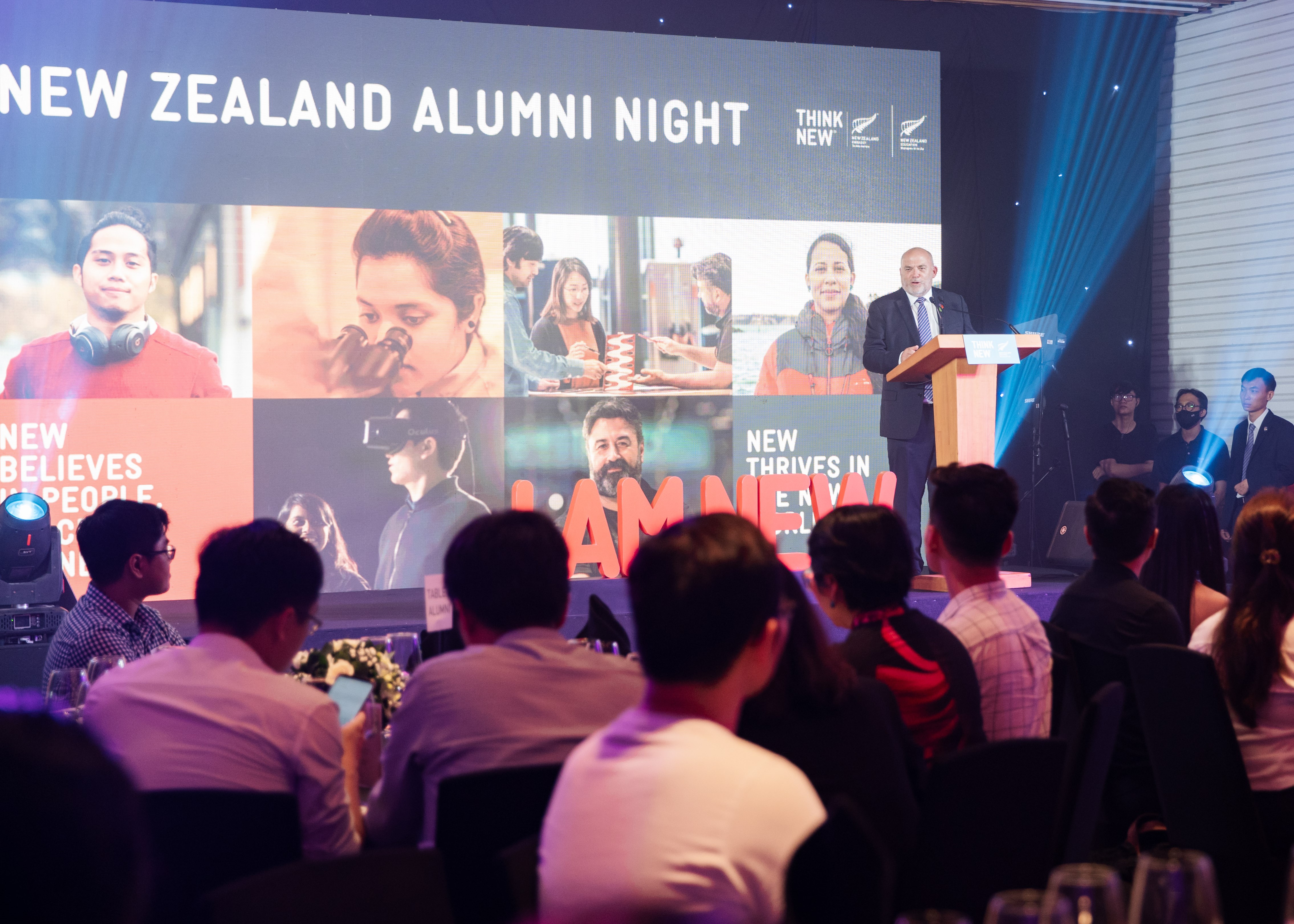
Viet Nam kickstarts 2021 with series of offline student events
This January, ENZ’s team in Viet Nam sought out a number of opportunities for New Zealand providers to appear at in-person or hybrid events.
ENZ has also participated in a series of multi-destination education fairs organised by SiPM and ATS at three top high schools in Ha Noi, university admission day in the northern Vĩnh Phúc province, and a New Zealand University Fair co-hosted by ENZ at Nguyen Sieu school (a long-standing partner for several New Zealand institutions).
As travel restrictions are still in place around the world, these fairs are not necessarily aimed towards immediate student attraction. ENZ is attending these events as part of the marketing and brand protection work that comes under the third workstream of the Recovery Plan for International Education.
Many attendees expressed a wish to study in New Zealand, especially after learning about our successful COVID-19 response.
“Students and parents are still concerned about safety and political stability, so New Zealand is currently being viewed as an ideal destination for study when border restrictions are lifted,” ENZ Market Manager – Viet Nam, Van Banh, says.
Viet Nam’s economy was heavily impacted by COVID, but data still shows that Vietnam recorded net positive GDP growth in 2020, which is considered an impressive achievement in the present global context. As a result, other study destinations have also kept their promotional activities warm in this market.