Search
Showing 10 of 7355 results
-
Join ENZ’s virtual Latin America regional update
The session – set to take place on Wednesday 5 April at 9 am NZT – is an opportunity for those who are both new to the sector, or wanting to re-establish links in the region, to hear updates from our LatAm team.
As the New Zealand international education sector rebuilds, Latin America provides New Zealand institutions with an opportunity for diversification. New Zealand has well-established links in the region, with many strong connections in the fields of education, academic research, government, business, and agriculture.
Following the re-opening of borders in 2022, New Zealand has recently welcomed high school student groups on exchange from Brazil and Colombia. In turn, New Zealand students have travelled to Latin America as part of the Prime Minister’s Scholarships for Latin America, participating in study tours and exchanges in Chile, Brazil, Colombia, and Mexico.
To learn more about the Latin America region, be sure to register for the session on this link
For more information about international education in the LatAm region, contact latinamerica@enz.govt.nz.
-
First marae-led Prime Minister’s Scholarships for Asia recipients build indigenous connections in Japan
The first marae-led Prime Minister’s Scholarships for Asia recipients (members of Te Piruru Papakainga, Ngāti Maniapoto) visited Japan for a six-week visit that included a customised internship that connected them with indigenous Ainu organisations and villages in Hokkaido.
ENZ’s Manukura Chief Advisor Māori, Ed Tuari and Director of Education – Japan, Misa Kitaoka, welcomed the scholarship recipients in Tokyo in early January.
This is a great outcome for the Prime Minister’s Scholarship Programme, which has seen an increase in Māori participation. The latest round of applications for the scholarships saw an increase in Māori participation to 22 percent in 2022 from 5 percent from 2016 to 2019.
ENZ is eager to continue partnering with iwi, marae and whānau groups to raise Māori participation in the Prime Minister’s Scholarship programme, particularly in the current group round that opened for applications in March.
ENZ’s Manukura Chief Advisor Māori, Ed Tuari said it was a privilege to participate in what is an important milestone for building indigenous connections between Māori and the Ainu people of Japan.
“This is a significant achievement for ENZ Manapou ki te Ao. I want to acknowledge this collective achievement as we break new ground with this marae-led group of PMSA recipients.
“It’s hugely encouraging to see the increase of Māori participation in the latest round of the scholarships. This is a demonstration of ENZ ‘walking the talk’ to ensure Māori are better represented in opportunities to share and learn on the global stage, as well as promote indigenous to indigenous exchanges.”
ENZ’s Director Scholarships Carla Rey Vasquez said she was excited to see the growth and learnings that these programmes would bring to the wider whānau and iwi.
“Our scholarship recipients cherished the opportunity to connect with indigenous communities in Japan, and they particularly appreciated the value of reciprocity as well as the importance of generational knowledge being shared along.
“We look forward to continuing to raise Māori participation in the Prime Minister’s Scholarship programme.”
The latest visit by scholarship recipients has also been a good opportunity to enrich the existing education connections between New Zealand and Japan under a Memorandum of Understanding between New Zealand and the Hokkaido Government, which was renewed in 2022.
The customised internship that saw scholarship recipients visit Ainu villages and organisations, was organised by the Hokkaido Government and the Hokkaido Board of Education.
ENZ’s Director of Education – Japan, Misa Kitaoka, said the visit by scholarship recipients was timely as Japan starts to promote Ainu history, language and culture.
“The Ainu people received official recognition as ‘indigenous people of northern Japan’ from the Japanese government in 2019. As the government begins to promote Ainu history, language, and culture in Japan, Ngāti Maniapoto’s visit to Hokkaido was timely and appreciated by the Ainu community to learn about how New Zealand society has embraced Māori language and culture.”
Applications are open for the 2023 group round of the Prime Minister’s Scholarships for Asia and Latin America until 23 April 2023. More information on applications is available on ENZ's dedicated scholarship website here.
[updated 18 April 2023]
- people nziec
- Ed publishing picedit edit
- 17
- SocailPostImage1
-
New Zealand to be Country of Honour at China Annual Conference for International Education and China Education Expo 2025
CACIE is the largest international education conference in China connecting professionals, researchers and international education stakeholders. The 2023 Expo hosted 18 national pavilions, attracting 364 institutions from 34 countries and regions with a total of 28,980 visitors, including prospective students. New Zealand has participated in CACIE for 19 consecutive years.
The Expo is scheduled for late October 2025 in Beijing, China.
Michael Zhang, Regional Director Greater China, ENZ said, “Being Country of Honour is not only a privilege, it is a significant opportunity to raise awareness of New Zealand’s education offerings to China and a wide audience, including government leaders and officials, education providers, agents and students.”
The invitation builds on the momentum from high-level education engagements with China in the past two years since the borders reopened, including Premier Li’s visit to New Zealand in June 2024, and two visits to New Zealand by Education Minister Huai Jinpeng in 2023 and 2024.
China is New Zealand’s largest source country of international students accounting for 35 per cent of enrolments in 2023, and a top destination for New Zealanders on the Prime Minister’s Scholarship for Asia.
Zhang said, “Education links are an important part of New Zealand’s relationship with China. Being Country of Honour is an opportunity to support our international education sector to strengthen their links with Chinese counterparts and build new connections. This will help enhance student mobility, academic and research collaboration, and people-to-people links.”
Education New Zealand leads New Zealand’s education engagement with China and supports our providers in-market. This includes managing bilateral education cooperation initiatives such as high-level dialogues, sectoral forums, student mobility channels, national-level education events and research programmes such as the long-standing Tripartite Partnership Programme.
- Ed publishing pic
-
Report concludes international education can recover and grow
In 2019, international education’s direct financial contribution to New Zealand’s GDP was $3.7 billion using the Computable General Equilibrium (CGE) methodology. This contribution was reduced to an estimated $0.8 billion in 2020 by the pandemic. The CGE methodology applied by EY to determine the contribution was supported by MBIE and MoE and is more rigorous than previous analyses.
Having established the direct financial contribution, EY explored the extent of the indirect longer-term contribution to New Zealand’s GDP from the small proportion international students that remain in New Zealand after completion of their studies.
EY found that international students living and working in New Zealand in 2019 and 2022 contributed economic, social, cultural, and international benefits. Using NZ Statistics Department IDI data and CGE modelling, EY found that these students contributed in the order of $6 billion in the form of labour supply and productivity to New Zealand’s GDP in both 2019 and 2022.
Determining this contribution involved estimating the GDP output and wage impacts associated with New Zealand educated international students who remained in New Zealand and transitioned into the domestic workforce in the 10 years leading up to each year.
ENZ Chief Executive, Grant McPherson said, “This report confirms the tough time the sector has had over the past two years, highlights the contribution it made in the past, the contribution it makes beyond economic value, and tells us that it is possible to become a vibrant, sustainable and resilient sector in the future.”
The majority of international students, 62%, return to their country of origin after they have completed their studies. A further 13% leave New Zealand after their post-study work experience meaning that in total 75% have returned home after three years, according to the research.
More broadly, EY concluded there is evidence that international education can enable New Zealand students to develop global competence within a structured teaching environment, and contributes to soft power in diplomacy, trade and perceptions of New Zealand through a range of mechanisms. Broader impacts for Māori are potentially also present across each area of impact from international education. These impacts were not directly quantifiable.
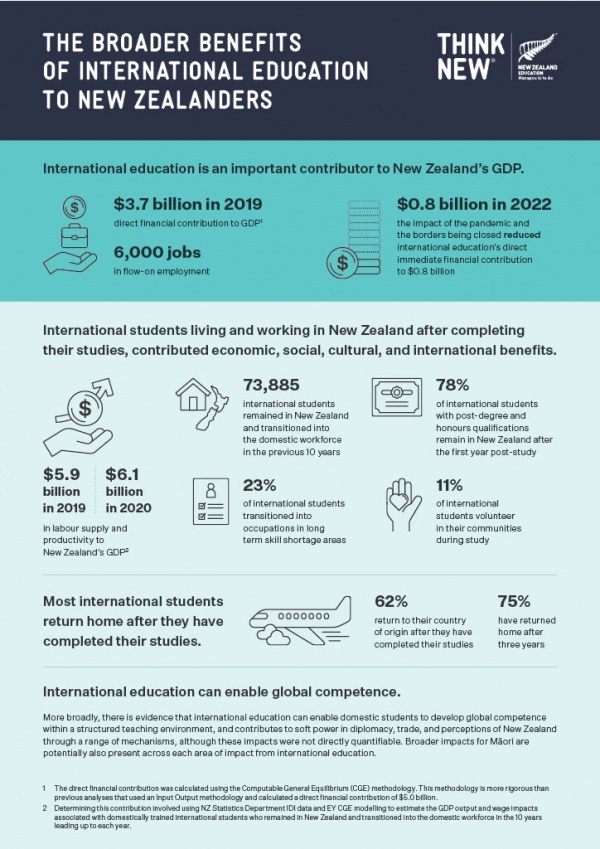
For a full-size image of the infographic, click here. For a full copy of the report, click here.
-
From the CE: India-New Zealand Education Week and release of the Broader Impact Valuation report
As you read this I will be about to get on to a plane to India. I’m leading a high-level University delegation to participate in the India-New Zealand Education Week from 16 - 22 April 2023. This is an important initiative which will further support the sector’s re-engagement with India, a market which remains critical to the recovery of international education.
The week features engagements with institution and Government partners, education agents, media and others involved in both student recruitment and internationalisation. We will also be re-launching the New Zealand Excellence Awards (NZEA), our flagship scholarships programme for India co-funded by Education New Zealand Manapou ki te Ao (ENZ) and all eight universities. The week will be bookended by two ENZ Recognised Agent Fairs in Delhi and Mumbai respectively. I expect it to be successful and enormously valuable.
This is a nice segue to the release of the Broader Impact Valuation report made public for the first time in this edition of E-News. Commissioned by ENZ from EY the valuation found that international education is a significant contributor to the New Zealand economy.
In 2019, international education’s direct financial contribution to New Zealand’s GDP was $3.7 billion using the Computable General Equilibrium (CGE) methodology. The CGE methodology applied by EY to determine the contribution was supported by the Ministry of Business, Innovation and Employment and Ministry of Education and is more rigorous than previous analyses.
Having established the direct financial contribution, EY explored the extent of the indirect longer-term contribution to New Zealand’s GDP from the small proportion of international students that remain in New Zealand after completion of their studies.
EY found that international students living and working in New Zealand in 2019 and 2022 contributed economic, social, cultural, and international benefits. Using Stats NZ Integrated Data Infrastructure (IDI) and CGE modelling, EY found that these students contributed in the order of $6 billion in the form of labour supply and productivity to New Zealand’s GDP in both 2019 and 2022.
Determining this contribution involved estimating the GDP output and wage impacts associated with New Zealand educated international students who remained in New Zealand and transitioned into the domestic workforce in the 10 years leading up to each year.
They also found that the pandemic significantly, and unsurprisingly, reduced the direct financial contribution to an estimated $0.8 billion in 2020. Truly tough times.
From my perspective the report is an important and long-awaited development. Using the most up to date valuation methodology it confirms the contribution the sector has made in the past, the contribution it makes beyond economic value, and tells us that it is possible to become a vibrant, sustainable and resilient sector in the future.
I urge you to download the full report, read it thoroughly and make use of its conclusions within your community.
सहनांशक्तिको वहुशक्ति्तिः
The power of many is greater than the power of one who stands alone.
Ngā mihi nui,
Grant McPherson