Search
Showing 10 of 7355 results
- resize pic v3
- FP2 card 2
-
Industry leaders gather for NZTech
The NZTech Advance Education Technology Summit, sponsored in part by ENZ, is an annual event designed to build New Zealand’s credentials as a hub of education technology. Last week at Massey University, it did just that.
Annabel Robertson, ENZ’s Business Development Manager, said common themes of creativity, collaboration, customer design and innovation emerged during the conference.
“The keynote speakers radiated optimism, and shared ideas on how to engage and prepare learners for the future,” said Annabel.
“The whole atmosphere was buoyant.”
Over two days, companies such as Banqer, Cognition Education, Code Avengers, DAQRI, Google, GlobalEd, Hapara, LearnCoach, Linewize and Wendy Pye Publishing shared their experiences, and explained how they are turning their ideas into viable global products and services.
Start-ups such as Accounting Pod, Savvy and ImmerseMe pitched to the diverse audience made up of e-learning facilitators, STEM leaders, policy makers, principals and teachers, exporters, investors and the interested public.
Annabel said Sue Suckling, Chair of NZQA, concluded the summit with a powerful challenge to New Zealanders to prepare now for the future education system.
“She encouraged educators and technologists to instigate change and not constrain their thinking to the existing regulatory framework,” said Annabel.
New Zealand's highly regarded education services and products offshore contributed $242 million to GDP in 2015 – with huge potential for growth in the education technology sector.
As part of the Leadership Statement for International Education, the Government set the goal of increasing its value to at least $500 million by 2025.
This was ENZ’s fifth year sponsoring the Ed Tech for Export stream of the conference.
- Henderson High School 10
- Monika 2
-
Manaaki Scholarships operations transferred to ENZ
Operational responsibility for the Manaaki New Zealand Scholarships programme was formally transferred to Education New Zealand Manapou ki te Ao (ENZ) on 1 November 2022, the result of almost two years of sustained effort from both sides.
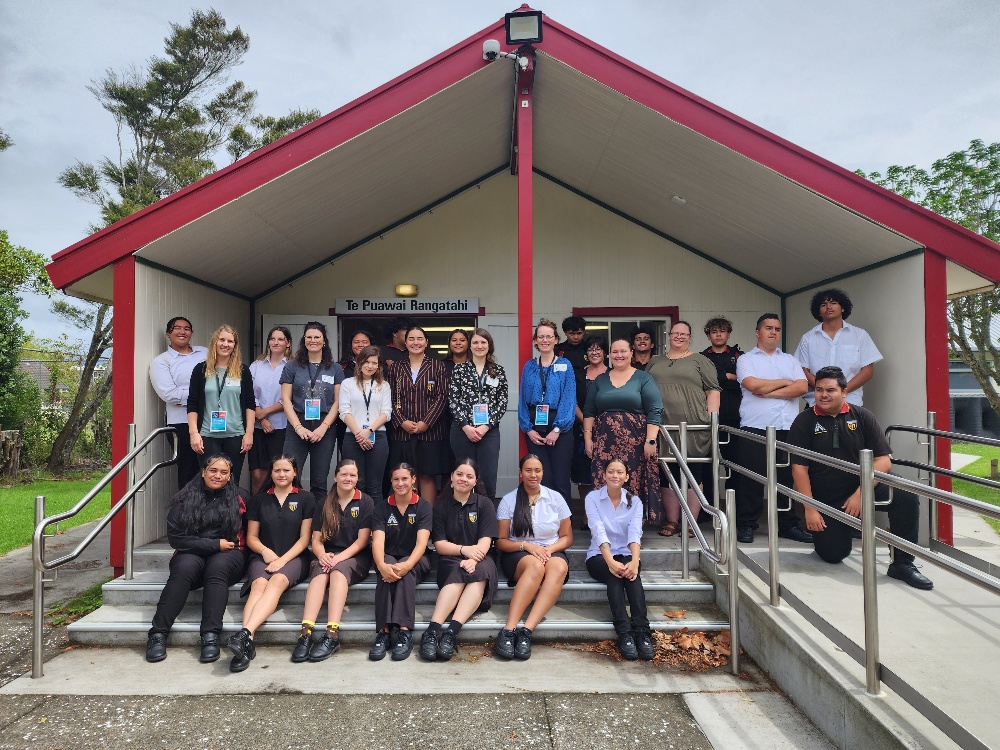
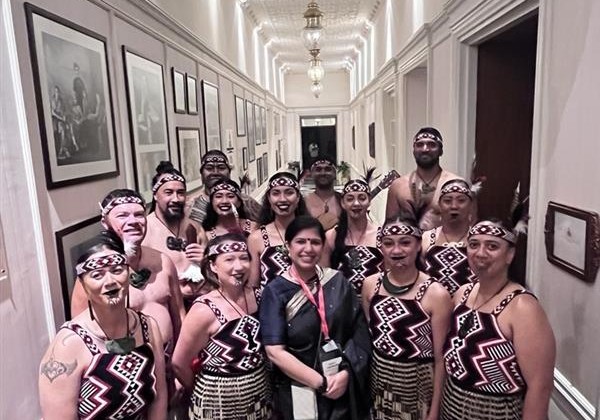
The team transferring from the Ministry of Foreign Affairs and Trade (MFAT), along with other new staff working on the scholarships programme, were welcomed to ENZ with a mihi whakatau by a group that included ENZ Board Chair Steve Maharey and Chief Executive Grant McPherson.
Manaaki Scholarships represent the government’s single largest investment in international scholarships and have been awarded for more than 70 years. ENZ is taking over operational management from MFAT, which will remain responsible for setting the strategic direction, alumni relationships and funding the programme.

On the symbolic handing over of MFAT's ‘living taonga’ to ENZ, Divisional Manager Joanna Kempkers noted, “if our Policy Team are the head, giving strategic direction, and the Alumni Team is the arms, reaching out to embrace scholars on completion, then the Operations Team is the beating heart of the Manaaki Scholarships Programme. We are confident that ENZ will take good care of our team, of the Manaaki Scholarships Programme, and deliver enhanced ‘mana through manaaki’ to our individual scholars.”
ENZ and MFAT have worked together on an improvement programme that will get underway early in 2023. This will include a technology upgrade as well as operational policy shifts to strengthen student experience.
“This partnership is one of those rare events where logic and virtue combine to provide a stronger and better outcome,” said ENZ Chief Executive Grant McPherson. “It is not just a good idea for our two agencies, but it’s a great idea for NZ Inc and will bring broader benefits beyond our immediate goals.”
“We know our own in-country teams already work closely with MFAT on matters concerning the Manaaki Scholars,” says GM Sector Services Sahinde Pala.
“This is an exciting opportunity for us to become more closely involved in the scholarships programme and the work on continuous improvements. Our aim is to ensure scholars have an excellent experience and become lifelong ambassadors for Aotearoa New Zealand.”
Manaaki Scholarships are a key pillar of Aotearoa New Zealand’s International Development Co-operation, offering more than 1,100 scholarships annually to students from 112 eligible countries to study in Aotearoa New Zealand, in the Pacific, or online.
For information on opening dates to apply for Manaaki Scholarships, go to: Application opening and closing dates for your country | MANAAKI | Education New Zealand (nzscholarships.govt.nz)
Programmes of study can be found here: Types of Manaaki Scholarships | MANAAKI | Education New Zealand (nzscholarships.govt.nz)
Eligible countries can be found here: 1.Check eligible countries | MANAAKI | Education New Zealand (nzscholarships.govt.nz)
To contact ENZ’s Manaaki Scholarship team, please email manaaki@enz.govt.nz
- Crusaders head
- Xavier1
-
ELS changes for Korean students
The Korean government has announced a ban on after-school English education to first and second graders in elementary school (Years 3 and 4 of New Zealand primary school) as well as English classes at kindergarten (Years 1 and 2 of New Zealand primary school).
The ban for first and second graders will come into effect in March 2018 while the kindergarten ban will take place from 2019.
Kay Kyungah Lee, ENZ’s Senior Market Development Manager – South Korea, explains that the ban is to prevent students from studying English before the third grade, where it becomes part of the curriculum in Korea.
“To get a headstart, many schools offer after-school English courses for first- and second-graders.
“To equalise the competitive education culture, a law banning advanced learning was adopted in 2014. However, after-school English courses remained intact due to strong demand from parents.”
Kay said Korean parents have relied on English being taught during early education for many years. However, with the new ban limiting this option in-country, there could be opportunities for New Zealand providers to benefit.
“This ban is likely to result in an increase in private English education. But when only expensive options are available in Korea, overseas education can be more appealing and have better value for money.
“English language is still regarded as one of the most important skills in the competitive job market in Korea. The level of interest for an effective English education would be high amongst Korean parents.”
- Japanese Teachers Maori class 1