Search
Showing 10 of 7355 results
-
Language and culture exchange strengthens ties with South Korea
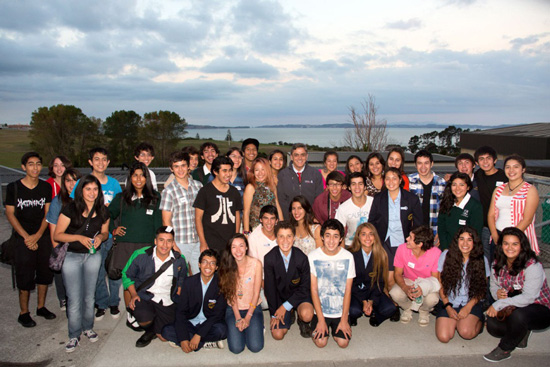
The students, from 64 schools across South Korea, were welcomed by Waiuku College and St Peter’s School in Cambridge, where they connected with local students, explored school facilities, and experienced Kiwi culture first-hand. From powhiri to classroom visits, the exchange sparked meaningful cross-cultural connections.
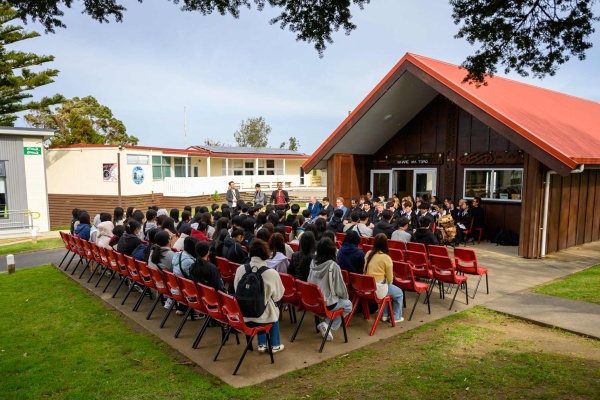
Powhiri at Waiuku College.
Waiuku College Director of Community and Global Relations, Antionette Walters, said the students were amazing, and willing to make the most of their experience.
“They were so happy to give anything a go – they even loved trying a New Zealand mince pie!” she said.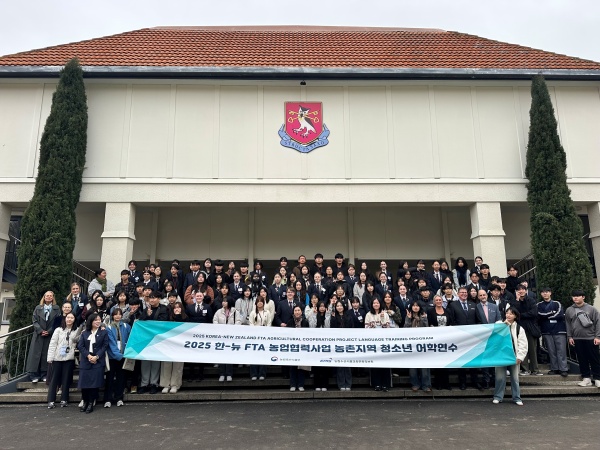
At St Peter’s, students toured the Equestrian Centre and Golf Academy, with Head of School Jason Speedy welcoming the group and sharing insights into the school’s campus and learning environment.
The visit followed a two-week English training programme in rural South Korea, where six experienced New Zealand teachers taught students aged Year 8–11. Selected from over 35 applicants, the teachers represented schools from Hamilton, Hawke’s Bay, Auckland, Cambridge, Wellington, and Tauranga.
ENZ representatives joined the programme’s opening event in Yangpyeong on 25 July, meeting the teachers and witnessing the enthusiasm of Korean students engaging with New Zealand’s distinctive teaching style.
Bernadette Moffat, ESOL Teacher at Silverdale Normal School and Huntly Primary School, said: “It was a privilege to represent New Zealand and see how eager the students were to learn.”
Bernadette was one of six New Zealand teachers who travelled to Korea to teach English and attended the closing ceremony where students were recognised for excellence in English.
Looking ahead, EPIS is exploring the possibility of expanding the current short visit into a four-week study experience in New Zealand from 2026, offering even deeper immersion for future scholarship recipients.
-
High level of interest in PM's Scholarships
“We’re particularly pleased in the level of interest, given outbound mobility has been paused since March 2020,” says ENZ’s Global Citizenship Manager Carla Rey Vasquez.
“Since the Prime Minister’s Scholarships reopened earlier this year, we’ve also tried hard to reach a wider range of people than previously.
“In this latest round, 17 percent of applicants are Māori while the age range is from 18 to 66 years old. We want to continue achieving greater diversity and inclusion, so that a wider range of people can have an international education experience, and the opportunity to develop their global citizenship skills and learn more about the language and culture of partner countries.”
The majority of applications (110) were for Prime Minister’s Scholarships to Asia, with South Korea the most popular destination country. Prime Minister’s Scholarships to Latin America received 55 applications, and the top destination country is Colombia.
An extra step in selecting the final recipients has been introduced this year. If they are shortlisted, applicants will be given 10 days to respond to four additional questions seeking more detailed information about their proposed programme.
Completed applications will then be considered by the selection panel, which is due to meet in late October.
The current Prime Minister’s Scholarships round is for individual applicants, following the first round that awarded scholarships to 30 groups in July.
For more information about the Prime Minister’s Scholarships, please visit the scholarships website.
- untitled8
- E News Visiting Drivers image
-
Around the world in five
CHINA
Luring back talent is top priority to fuel innovation
Attracting Chinese students back from abroad has become policy at the highest level of the Chinese government in a bid to fuel innovation as the country moves away from reliance on manufacturing.
MALAYSIA
You can now get a visa to study in Malaysia within a week
Under new regulations, international students can obtain their student visa in just seven days – part of the government’s aim to double Malaysia’s international student population to 200,000 by 2020.
FRANCE
Emmanuel Macron ‘to double the number of Indian students coming to France’
Indian Prime Minister Narendra Modi held talks with French President Emmanuel Macron to explore ways to deepen bilateral cooperation. The French President interacted with students in New Delhi, where he invited students to pursue education in France.
EUROPE
Germany ranked as most attractive study destination in Europe
An annual ranking of European study destinations places Germany as the most attractive option for international students, thanks to a growing number of courses offered in English and with the lowest unemployment rate for university graduates in Europe.
UK and AUSTRALIA
UK and Australia seek to 'turbocharge' higher education links
Universities UK and Universities Australia will work together to boost joint research, student and academic exchanges, and mutual recognition of each other’s qualifications.
- sister cities pic edited
-
Summerland Primary joins SIEBA
The programme, supported by ENZ, helps to grow international programmes at smaller schools that don’t have the resources and capabilities to do it on their own.
By centralising administration of international programmes, schools can focus on the educational and pastoral aspects.
Barb Dysart, a Co-Principal of Summerland Primary, said as a school new to the sector, creating networks, administering programmes and managing all the paperwork on their own was a challenge.
“We had no time to market our school and we were reliant on ‘word of mouth’ or agents to bring international students.”
Barb says working with SIEBA made it easy to enrol prospective students, and provided clarity and good practice around the policies and procedures.
“With SIEBA’s involvement, we’ve seen a large increase in international students attending our school – in part because of our confidence and ease in the process.
“If we are unsure of any situation, SIEBA is an email away. With their advice and support, we are able to focus on what we do best – teaching.”
Richard Kyle, ENZ Business Development Manager, said for many schools the work load of managing an international programme often fell on already busy principals or senior staff. This was a barrier to get more actively involved.
“SIEBA already has the insight and expertise so reaching out to them saves schools from having to reinvent the wheel,” said Richard.
“Welcoming international students to your school is a big commitment, and to make it sustainable and as stress-free as possible, peak bodies such as SIEBA can be a big help.”
To find out more about SIEBA’s primary schools programme, please contact Robbie Pickford, Project Manager: robbie@sieba.nz
- 2016 PTE ISB ENZ PowerPoint report 02120617
- newpenguins
-
New Zealand well represented at the 2024 World Digital Education Conference
The 2024 World Digital Education Conference, attended by representatives from over 70 countries and regions as well as international organisations, aims to work with governments, the education sector, and stakeholders to jointly implement the outcomes of the United Nations Transforming Education Summit, promote education recovery post-pandemic, equitable quality education through digital education transformation, and advance the realisation of the Sustainable Development Goals (SDGs).
Chinese Education Minister Huai Jinpeng provided the keynote speech at the opening ceremony. He noted the impact of technology on education and the need to prioritise education reform to keep pace with changes and harness the benefits of digital education. Minister Huai concluded by saying they look forward to the new impetus into promoting international cooperation in digital education through this conference.
New Zealand was represented by Minister of Education, Hon Erica Stanford (through a pre-recorded session); H.E. Grahame Morton, New Zealand Ambassador to People’s Republic of China; Ardi Barnard, New Zealand Consul-General to Shanghai; Dr Grant Klinkum, Chief Executive New Zealand Qualifications Authority and Education New Zealand’s China-based representatives. The strong presence at the conference contributes to New Zealand’s reputation as an education partner with an innovative approach to digital learning. New Zealand Education Minister Hon Erica Stanford gave a video address and shared New Zealand’s efforts to harness digitalisation to improve our education system and support lifelong learning.
“As an education minister with a relentless focus on the progress and achievement of all students, I see that digital tools and the well-designed use of data have enormous potential to help us drive progress and achievement,” said Minister Stanford.

Hon Erica Stanford, New Zealand’s Minister of Education delivered a pre-recorded session, sharing New Zealand’s efforts to harness digitalisation and data in education.
In his address at the Opening Ceremony, Ambassador Morton highlighted the important role of education in the New Zealand-China relationship and gave insights into New Zealand’s innovative EdTech sector.
“Digital education is at the centre of New Zealand’s EdTech sector and its developments. Three-quarters of New Zealand EdTech companies are actively looking to take their offerings to the world,” said Ambassador Morton.
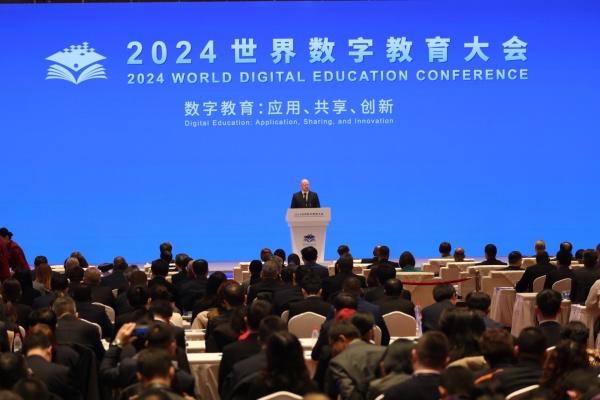
Ambassador Morton addresses the audience during the Opening Ceremony of the conference.
During the Parallel Session on Governance and Digital Transformation, Dr Klinkum shared New Zealand’s experience in quality assurance, qualification recognition and assessment delivery in the digital era.
“We would like to continue working with our international colleagues to ensure that we provide credible education for learners and that life-long learning and global mobility is supported by digital education and reflects the needs of increasingly digital societies,” said Dr Klinkum.
During the conference, organisers held the inaugural launch ceremony of the World Digital Education Alliance (WDEA). Universities New Zealand, on behalf of the University sector, joined the Alliance. The first batch of members is by invitation and as of 30 January 2024, 104 agencies from 41 countries joined the alliance ranging from schools to Technical and Vocational Education and Training (TVET) institutions, training centres, colleges and universities as well as research institutions and enterprises. The initiative aims to fulfil the UN SDG 4, build a mechanism for international cooperation and exchange in digital education, form synergy to promote global educational development, and create a new environment for smart education.