Search
Showing 10 of 7355 results
-
Opportunities to participate in two major education events in Middle East
Global Higher Education Exhibition Oman (GHEDEX Oman) will take place in Muscat from 27 to 29 March 2022, supported by the Omani Ministry of Higher Education, Research and Innovation. Secondary and tertiary students, parents, young professionals and education professionals from across the Gulf Cooperation Council region will attend.
Recent GHEDEX events have been held virtually due to the Covid-19 pandemic, but this year the event will have both face-to-face and virtual options. Alongside universities, GHEDEX 2022 is open to vocational training providers and EdTech companies.
The International Conference & Exhibition for Education (ICEE) is scheduled to take place in Riyadh from 8 to11 May 2022, organised by the Saudi Ministry of Education. Five New Zealand universities participated alongside ENZ at the 2019 event, which was previously known as IECHE. This year, organisers have opened up participation to include English language schools, aviation training providers, vocational education institutions, and EdTech companies.
“This is the first time these events have taken place in person since the beginning of the Covid-19 pandemic, and we know building relationships face-to-face is important in the Gulf region,” says Amy Rutherford, ENZ’s Regional Director, Americas, Middle East and Europe.
“This is also the first time these events have invited other education sectors to participate as well as universities. There are significant opportunities for English language schools, aviation training providers, and vocational education institutions to attract students from Saudi Arabia, Oman and other GCC countries, as well as opportunities for EdTech companies in the region,” Amy said.
ENZ will host a New Zealand pavilion and have on-the-ground representation at both events. If your organisation is interested in exploring opportunities in the region and would like to find out more about participation in these events – in-person, virtually, or represented by ENZ – please contact Bronwyn Shanks, ENZ’s Senior Advisor – Special Projects, Middle East and Europe, bronwyn.shanks@enz.govt.nz.
NOTE: Recent changes to our border settings mean that New Zealanders attending these events will not need to book a space in Managed Isolation and Quarantine on their return to NZ.
-
Inviting expressions of interest for the Tokyo Global Friendship programme
For the fourth year in a row, Education New Zealand Manapou ki te Ao (ENZ) is pleased to invite expressions of interest (EOI) for the opportunity for eight students (ages 14-18) and one teacher to join the Tokyo Global Friendship programme hosted by Tokyo Metropolitan Board of Education from 4-11 July 2026.
Tokyo Global Friendship Programme | 4 – 11 July 2026
Teachers are invited to submit a group EOI (one application per school) by Friday 6 March.
Note:
Schools must be signatory to Code of Pastoral Care.
The accompanying teacher must be from the same school as the students and will need at least conversational Japanese.
Students and the accompanying teacher must be New Zealand Citizens and have a valid passport, with a minimum of six months available from the date of travel, before expiry.When will teachers be notified on the status of their school’s EOI
Teachers who submit a completed EOI for their school by Friday 6 March will be notified by Wednesday 11 March if successful. They will have until Thursday 2 April to submit their full application form which will be sent on to the Tokyo Metropolitan Board of Education.
Visit this link to read FAQs before submitting an EOI
Visit this link for an overview of the programme and to submit your EOI
- India NZ connect 1
-
Promotional opportunity in Japan
The advertising rates range from around $800 NZD for a quarter page (available to schools only) to $5800 NZD for a two page colour spread, with five other options in between.
The 2015 magazine can be viewed here.
The Guidebook is distributed free of charge to 30,000 schools, universities and education organisations and is a highly-respected Japanese-language source of information on studying in New Zealand. For details on the guidebook, including content and distribution, download the Keibunsha’s proposal. [link to proposal once uploaded]
For those interested in advertising in the guidebook, please fill out the form included in the proposal and email it to minori@kbunsha.com by 29 February.
ENZ will also update existing information with new images and content to give the guidebook a fresh new look that best showcases New Zealand’s education offering.
- Air NZ
-
Hundreds of Brazilian high school students arrive at New Zealand schools
Over January and February, 200 students from Paraná and 100 from São Paulo arrived in New Zealand on a Brazilian state-funded scholarship that will have them spending a semester and term in New Zealand schools while staying with host families.
Chosen for their academic performance, attendance, and completion of an English course, these top students get a chance to immerse themselves in New Zealand's education system and culture.
New Zealand is considered a strategic partner by Paraná state and São Paulo. This programme highlights the success of increased educational cooperation between Brazil and New Zealand. In addition to improving English proficiency, the initiative also aims to develop intercultural skills.
Paraná's programme, launched in 2019, has sent 1,240 students to various countries, with more than 600 going to New Zealand.
Coordinator of the São Paulo programme, Simone Telles, said New Zealand was chosen for this programme due to our innovative education system, use of technology, the freedom given to students and the welcoming nature of New Zealanders.
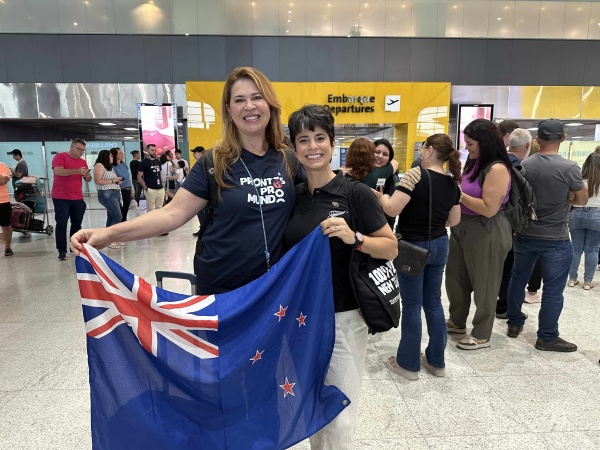
Simone Telles and ENZ’s Market Development Manager, Bruna de Natale: Education partnership between São Paulo and New Zealand.
In São Paulo, ENZ Market Development Manager, Bruna de Natale, attended one of the departure days for the group traveling to New Zealand. Bruna spoke to Luciangela Fonseca, mother of one of the selected students, Juan Fonseca. Luciangela said she felt “pride mixed with fear and emotion” and that the family felt privileged to get this opportunity.
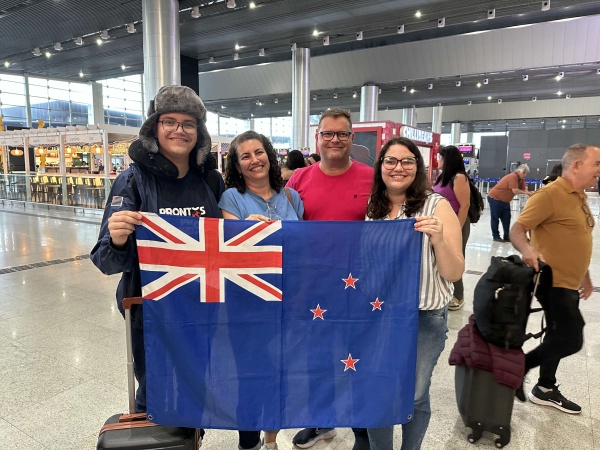
Juan Fonseca, his parents, and sister. Emotions at the departure for Auckland.
All programme costs are funded by Brazilian states, including transportation, education, food, accommodation, and leisure activities.
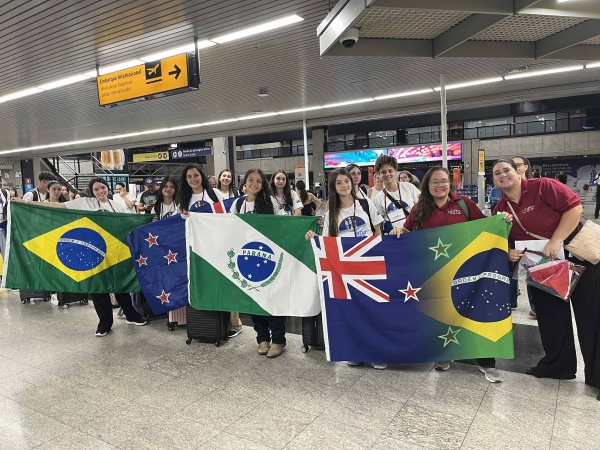
Paraná students departing in São Paulo.
-
Prime Minister meets Kiwi students in Singapore
Last week the Prime Minister announced the 249 young New Zealanders who have been awarded prestigious Prime Minister’s Scholarships for Asia (PMSA) and Latin America (PMSLA) as part of the August 2018/19 round.
She congratulated the new round of awardees in Singapore, where she met a group of 11 current PMSA recipients and reflected on the value of young Kiwis having international education experiences.
The Singapore-based awardees at the event included Louis Martin (25) who is carrying out a four-month internship with Asia Internship Program (AIP), Nicolas Steyn (20) who is on a one semester exchange at the National University of Singapore, and Lucy Kenner (22) who is undertaking a 12-week legal internship at Providence Law Asia.
“Ongoing academic relationships and new business opportunities are two things we are seeing result from the scholarship programme,” Jacinda Arden said in the announcement release.
“Our awardees are welcomed and supported by diplomatic communities in New Zealand and offshore, which we also value.”
John Laxon, Regional Director – South and South East Asia, Middle East, said that Friday’s event during which the Prime Minister chatted and mingled with the group of Kiwi students showed how international education can be life changing.
“Our scholars gave great insights into how they have created lifelong connections through their PMSA experiences, which will enrich their lives and strengthen their careers,” said John.
“The Prime Minister enjoyed the discussions, which brought back memories of her own exchange student experience at Arizona State University.”
Applications for the next round of PMSA and PMSLA opens mid-January and must be submitted online by 30 March 2019. More information on the application process can be found here. Institutions are encouraged to contact ENZ to discuss potential group applications.
The PMSA recipients’ names from the August 2018/19 round can be found here. The PMSLA recipients’ names from the August 2018/19 round can be found here.


- yuki sugito2
- hbcu
-
Students around the globe join New Zealand summit
Kicking off this week with seminars on the space economy and mechanisms for social change, and the human cost of climate change, the online global workshop connects a diverse group of potential international students to help them connect, collaborate and shape their future.
ENZ’s Deanna Anderson, Business Development Manager says the project offers ENZ a great opportunity to learn more about the motivations of learners from new markets while offering the students involved a unique digital engagement with New Zealand.
“It’s a two-way learning experience that explores the futures of our next generation of learners while offering them a window into New Zealand’s unique way of problem solving.
“The aim is to create an inspiring initiative that engages hundreds of students and allows us to use their insights to better understand the future of our next generation of learners.
“Each student has the ability to offer insight that could help shape a more personalised, meaningful, relevant and uniquely New Zealand education experience.”
The summit involves 12 expert speakers who are presenting six online seminars on topics ranging from sustainable design to social entrepreneurship to climate change.
“After the seminar series, the students will be involved in a co-creation weekend where they will work as part of 65 online challenge groups to discuss solutions to some of the planet’s most pressing issues such as energy production, waste as a resource and the future of human survival.”
Deanna says this pilot research project will provide invaluable insights for New Zealand’s international education sector that will inform the direction of future industry innovation.
For more information or to join the webinars, visit https://www.emergingfutures.co.nz/